Hardy moved to Nashville with one goal — write songs for the artists he admired. Turns out, Blake Shelton was at the top of that list. Continue reading…Country Music News – Taste of Country









Hardy moved to Nashville with one goal — write songs for the artists he admired. Turns out, Blake Shelton was at the top of that list. Continue reading…Country Music News – Taste of Country
Hardy moved to Nashville with one goal — write songs for the artists he admired. Turns out, Blake Shelton was at the top of that list. Continue reading…The Boot – Country Music News, Music Videos and Songs

Reading Time: 2 minutes
For Khloe’s birthday, all of the Kardashians came out of the woodwork.
As a result, family photos included smiling kid, momager Kris Jenner, and even Rob.
Rob is often a no-show at even semi-public gatherings, avoiding reality TV spots and red carpet walks whenever possible.
Showing up in snaps with his sisters meant that he totally stole the show, to the delight of fans.
Khloe Kardashian was born on June 27, 1984.
With that in mind, her birthday was this past weekend. She is now 42!
Several days later, she shared a series of snaps from the birthday bash in an Instagram post.
“How blessed am I?” Khloe captioned.
She added: “Missing a few but they’re always with me.”
However, the very first of the snaps that Khloe posted was a family portrait.
We can see Khloe in her red-orange gown next to Kim, who is standing next to Kourtney (whose bangs are a choice), Kris, and finally Rob, who appears to be holding a bottle of Pellegrino.
9-year-old Dream Kardashian looks beautiful as she smiles, standing next to Kourt.
Almost all eyes were on Rob, however, Kris’ 39-year-old (and only) son.
He doesn’t appear on camera so much these days. But fans love when he does!

“We are so Blessed to have you!” Rob gushed in the comments.
He continued: “We love you so much!!!”
For her part, Momager Kris wrote: “My heart.”
“We love you so much,” Kim raved.
Obviously, thousands upon thousands of other commenters swarmed the comments. Many of them chose to praise Rob.

Rob has had what one might generously characterize as “ups and downs” in terms of public perception.
Less than a decade ago (it was almost exactly 9 years, wasn’t it?), he and Blac Chyna went to war on social media.
Among other things, Rob posted revenge porn of her. He received a hefty Instagram ban as a result.
It is unclear why Meta decided to reinstate him, except of course that Zuckerberg stopped pretending to care about right and wrong years ago.
Regardless, a lot of people see him so seldom that they shower him with encouragement whenever he pops up in a family photo.
Rob Kardashian Upstages Sisters in Rare Photo at Khloe’s Birthday was originally published on The Hollywood Gossip.
The Hollywood Gossip
Book a nonstop to Italy this summer, and the surprise is where the newest flights actually go; not Rome, not Venice. The routes U.S. airlines … Read moreThe post New US flights to Italy are betting on food country, not…

 Lil Wayne isn’t trying to be a crook and steal his fans’ hearts.
After the “How to Love” rapper abruptly missed opening night of his 20 Years of Carter Classics tour at Maine Savings Amphitheater…
E! Online (US) – Top Stories

Florence Corcoran, an employee of South Central Bell Telephone Company, was eight months into a high-risk pregnancy when her obstetrician recommended she spend the final month on bed rest in the hospital, for close monitoring. Despite the recommendation, her health insurer determined that it would only cover partial-day at-home nursing care.
While a nurse was off duty, her fetus went into distress and died.
Corcoran sued her insurer, UnitedHealthcare. Because of a little-known law called the Employee Retirement and Income Security Act of 1974, or ERISA, she was unable to recover any money from her insurer due to their wrongful denial. She would see no legal justice following this avoidable tragedy.
Facing health insurance hurdles is an all-too-common American experience. But while courtroom dramas would have many Americans believe that patients can sue to recover money damages when they face wrongful denials, for most people who have employer-sponsored insurance, that is far from the truth. Corcoran’s case was decided in 1992 – and the situation is only worse today.
I’m a political scientist studying health insurance barriers and the politics of efforts to reform America’s health care system. In my book, “Coverage Denied: How Insurers Drive Inequality in the United States,” I traced how health insurance obstacles can upend patients’ health and economic lives.
ERISA magnifies those barriers by limiting patients’ legal ability to hold health insurers accountable – instead giving them a free pass to keep denying coverage without facing real consequences.
Health insurance hurdles, such as prior authorization and claim denials, are widespread in U.S. healthcare, and the problem is growing.
Americans who have health insurance say prior authorization is the healthcare system’s biggest burden, causing administrative headaches while care is kept out of reach. Claim denials hit hard too.
Between 2016 and 2023, claim denials increased from 9% to 12%. In a nationwide survey I conducted in 2024, I found that 36% of Americans experience at least one coverage denial – though usually, it’s several.
The denial rate is even higher among people on employer-sponsored insurance, the type of insurance to which ERISA applies.
Denials can be appealed, but doing so demands a level of health insurance literacy and bureaucratic know-how that most people lack. My research shows that less affluent people are less likely to appeal denials in the first place, and sicker patients and those from historically marginalized groups are less likely to prevail even if they do appeal.
Such hurdles effectively create a dynamic that I call “rationing by inconvenience,” with red tape impeding meaningful access to care. This drives both health and economic inequities.
When healthcare is kept out of reach, less affluent and Black and Hispanic patients are more likely to postpone care they need, often to the detriment of their health. And they may delay non-medical spending, too, due to unexpected healthcare costs.
The sweeping impact of coverage barriers makes it especially important for patients to be able to take effective legal action against insurers. But ERISA strictly limits legal leverage for most people who get health insurance through their employer.
ERISA was crafted in response to widespread public concern about the mismanagement of private pensions, such as with the infamous sudden closure of Studebaker’s factory in South Bend, Indiana in 1963, which left thousands of autoworkers without their pension benefits. By establishing minimum federal standards and regulations for private benefit plans, the law aimed to protect workers’ pensions from fraud and mismanagement.
But shortly before Congress voted on the legislation, it added text related to “employee welfare benefit plans,” which include health benefits. It seems that lawmakers failed to appreciate that pensions and health benefits might demand different approaches to enforcement.
Unlike with other insurance plans, patients with ERISA-governed plans can’t sue an insurer for money damages – to reflect pain and suffering or lost income – when an insurer wrongly denies their care. They can only sue to get the specific treatment covered.
The law mainly affects one type of employer health insurance, called self-insured plans, in which the employer pays employees’ medical claims itself rather than buying coverage through an insurer. When ERISA was enacted in 1974, no more than 6% of workers who got health insurance through an employer were covered by a self-funded plan.
Today, 67% of people insured through an employer – roughly 100 million Americans – are in these plans, making the law’s defects especially salient.
ERISA’s constraints on patient protections have far-reaching effects. For one thing, lawyers prefer not to take on cases that don’t involve money, making it hard for patients to sue even for the limited benefits to which they would be entitled.
What’s more, even if patients are able to sue an insurer, the harms they experienced from wrongful coverage denials still wouldn’t be fully addressed – or in some cases, addressed at all.
For a worker suing an employer over a wrongly withheld pension, which ERISA was originally enacted to address, receiving that retained money would restore their loss. But that’s not the case for a worker who sues an insurer that denies coverage for their health condition.

Imagine a patient denied coverage for cancer treatment, for example. Even if a court reverses the decision, the patient’s condition may have worsened to the point where the treatment is no longer clinically indicated or as effective.
Florence Corcoran experienced this in the extreme: When she lost her fetus at eight months, the only relief to which she was entitled under ERISA was the inpatient monitoring that she no longer required after her pregnancy’s tragic conclusion.
ERISA’s poor design thus creates a destructive feedback loop that limits Americans’ access to healthcare and promotes health and economic disparities. By disincentivizing lawsuits, ERISA makes it virtually costless for insurers to deny coverage for patients’ prescribed healthcare.
In many cases, individual states can pass their own laws to get around congressional gridlock relating to health policy. But ERISA explicitly overrides state laws that relate to self-insured health plans – including consumer protection laws that could potentially protect patients. In doing so, ERISA blocks states from enacting comprehensive health insurance reforms, including those promoting health insurance equity.
Lawmakers have raised this issue over the years, but Congress has not made serious attempts to reform these provisions since the late 1990s’ unsuccessful efforts toward a patients’ bill of rights. Later healthcare measures, including the Affordable Care Act, have focused on increasing the number of people who have health insurance and largely steered clear of efforts to reduce barriers for the tens of millions enrolled in these plans.
In my view, that is especially unfortunate because at the state level, there is bipartisan appetite to address ongoing health insurance barriers, such as by reforming prior authorization.
For example, California’s prior authorization reform bill, SB 1120, passed in 2024 unanimously. The problem is that ERISA prevents laws like SB 1120 from addressing health insurance barriers within the majority of employer-sponsored insurance plans.
Congress could move toward overhauling this outdated law – for example, by allowing states to seek waivers from ERISA’s constraints. Without such action, insurers will continue to face relatively little legal risk when they wrongly deny coverage, and patients will continue to bear most of the consequences.

Miranda Yaver does not work for, consult, own shares in or receive funding from any company or organization that would benefit from this article, and has disclosed no relevant affiliations beyond their academic appointment.
Politics + Society – The Conversation

In Watson v. RNC, decided June 29, 2026, liberal and conservative Supreme Court justices joined a noteworthy cross-ideological majority to uphold state grace periods for mail-in ballots. The decision, which went against President Donald Trump’s policy preferences, preserved the status quo, allowing states to accept and count mail-in ballots postmarked by Election Day but received after.
The case revolved around the meaning of “election day,” which federal law states is the Tuesday after the first Monday in November. The statute does not say anything about casting or counting ballots on or by Election Day.
The Constitution says the time, manner and place of elections will be managed by states. Thus, Mississippi’s Legislature passed a law in 2020 to count mail-in ballots if they are postmarked by and received within five days of Election Day. Thirteen other states and Washington also allow this grace period, which ranges from one day in Texas to 20 days in Washington. The Republican National Committee, the Mississippi Republican Party, the Libertarian Party of Mississippi and several individuals challenged the Mississippi law, saying it violates federal law because it allows the state to count votes received after Election Day.
Advocates argue that these grace periods are important, in part because irregularities in the postal service can make it difficult for people who use mail-in voting to get their ballots to an election official by Election Day. These challenges are more acute for people with disabilities and people living in remote areas or abroad.
As a legal scholar with expertise in veterans affairs, I’ve paid close attention to how the Watson v. RNC case could impact active-duty military and veterans, given the latter’s higher rates of disability and rurality.
This Supreme Court ruling stems from a pandemic-era law to make mail-in voting easier. Before 2020, Mississippi required mail ballots to be received by 5 p.m. on the day prior to the election.
The pandemic changed voting behavior, with mail-in voting rates higher than they were pre-pandemic. Since Donald Trump lost the 2020 presidential election, after these laws were passed, the president’s critique of mail-in voting has often hinged on false election fraud claims. This helped make mail-in voting a partisan issue.
In the oral arguments, conservative Supreme Court justices asked about the possibility of grace periods making an election’s outcome uncertain for weeks or months. They also expressed concern that a person could potentially cast a ballot and then recall it after Election Day, which goes against the federal law’s purpose.
Liberal justices were concerned that reading the statute as requiring votes to be received on or by Election Day could undermine states’ efforts to expand voting access through early voting.
Interestingly, the decision did not turn on the issue of early voting; rather, the history and impact of active-duty military voting was central.
The conservative justices split on how to interpret the statute – how to interpret historical voting practices and previous court decisions. Justice Amy Coney Barrett and Chief Justice John Roberts joined the liberals. Barrett penned the opinion, saying that “election day” means the day by which someone chooses a candidate, not the day the ballots are received.
Importantly, the majority was concerned about preserving the Uniformed and Overseas Citizens Absentee Voting Act. This 1986 law, passed under Ronald Reagan, is the culmination of numerous efforts to ensure that active-duty military would be able to vote in federal elections.
The Uniformed and Overseas Citizens Absentee Voting Act clarifies that states can establish their own procedures for counting ballots. The majority in Watson v. RNC explained that this provision of the 1986 law would make no sense if states could not count ballots received after Election Day.
As a practical matter, if states were not allowed to count ballots received after Election Day, many active-duty military and their dependents would be disenfranchised. That’s because the main reason active-duty military votes are not counted is late-arriving mail.
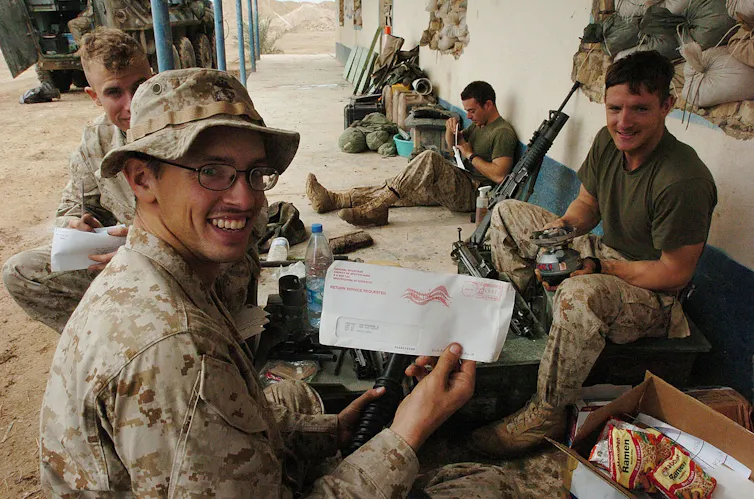
Mail-in voting was first implemented to extend voting rights to active-duty soldiers during the Civil War. Soldiers submitted ballots to be counted and recorded by commanding officers, and their votes played an important role in the reelection of Abraham Lincoln.
The conservative justices split on how to interpret this history, since Civil War soldiers’ votes had to be received by Election Day. But Barrett’s opinion says that this practice tells us little about whether federal law required it.
Today, active-duty military and their families frequently go to great lengths to ensure they cast a ballot. In federal elections, they are voting for their commander in chief and members of Congress who control their budget. Many see it as a civic duty much like their military service. This sense of duty to vote remains even after active-duty military transition to veteran status.
For military stationed outside their home states or outside the country, mail-in voting is a necessity. Since 1942, Congress has passed laws to ensure that overseas military and their dependents are able to vote in federal elections. Current law protecting overseas voters requires that citizens abroad, including military, be sent their absentee ballots at least 45 days prior to the election.
The Justice Department’s Civil Rights Division has filed more than 30 lawsuits since 2000 against states and territories – including Vermont, Alabama and Guam – to ensure states properly mail and count absentee ballots of active-duty military and other Americans overseas.
In 2014, for example, a case against West Virginia ended in a judicial order that the state would count any ballots “executed” by Election Day but received up to 13 days later. Watson v. RNC reinforces these decisions designed to protect the voting rights of overseas military personnel.
Veterans vote in higher proportion than the civilian population. Despite long-standing bipartisan support for veterans benefits, such as healthcare, their voting access has been controversial.
At the turn of the 20th century, Democrats tried to restrict voting rights for veterans because of their tendency to elect Republicans.
Historically, poor and disabled veterans have faced the biggest hurdles. For example, in the 1860s, Ohio state legislators passed a law so veterans in an Ohio residential facility would not count as Ohio citizens and, thus, would not be able to vote for congressional candidates.
Veterans often come from and return to rural areas, and many have disabilities, meaning they greatly benefit from mail-in voting policies because it is more difficult for them to show up in person to a polling location. Policies that make it harder for them to vote illustrate the negative impacts on Americans who also live in rural areas or are disabled, transient or otherwise unable to get to polling booths.
For these reasons, bipartisan veterans groups are actively engaged in protecting voting rights, and many have already spoken out in favor of the majority’s decision, which will help active-duty military and veterans be confident that their votes will be counted.

Jamie Rowen receives funding from National Science Foundation.
Politics + Society – The Conversation
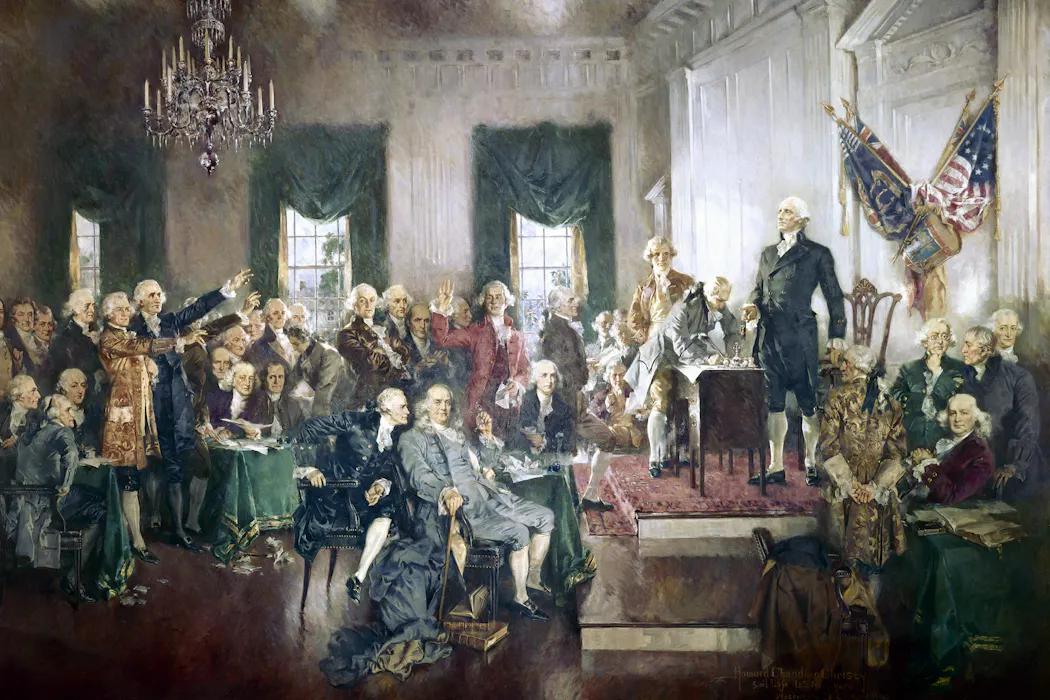
As the 250th anniversary of American independence approaches, many people in the U.S. are deeply concerned about the country’s future.
A recent poll by Elon University found that 69% of respondents “believe the signers of the Declaration of Independence would feel more disappointment than pride about modern American democracy.” Confidence in public institutions is historically low, and the most recent Harvard Youth Poll indicates that just a quarter of 18- to 29-year-olds “feel hopeful about the future of America.”
Many are also afraid. For the 10th consecutive year, Americans reported corrupt government officials to be their single greatest fear, according to the Chapman University Survey of American Fears, ranking above financial collapse or a loved one becoming seriously ill.
“Americans have come to see threats as not just the possibility of attack by a foreign adversary. The potential for political violence at home is part of it, along with polarization, corruption and a sense of cultural dysfunction,” pollster Kristen Soltis Anderson wrote in The New York Times. “Americans increasingly view the survival of the country as being at stake.”
How are people in the U.S. to make sense of these trends? As Americans celebrate the country’s 250th anniversary, how faithful is the U.S. today to its founding principles? I’m a political philosophy scholar who studies constitutional government. In my view, an especially helpful approach to answering such questions is to revisit the towering but neglected influence of the French philosopher Montesquieu on the founding of this country.
Charles Louis de Secondat, baron de Montesquieu, was an 18th-century philosopher and aristocrat whose book “The Spirit of the Laws” caused a sensation when published in 1748. His ideas shaped the American founders. At the Constitutional Convention, only the Bible was quoted more often.
On the separation of powers, Montesquieu was, in James Madison’s words, “the oracle who is always consulted and cited.” Of all authors cited in political writings published by Americans between 1760 and 1805, none was more frequently mentioned. He loomed so large that “American republican ideologues could recite the central points of Montesquieu’s doctrine as if it had been a catechism,” according to historian Forrest McDonald.
Montesquieu was especially celebrated for his account of how and why political power needs to be separated into branches. But behind this now familiar idea was another that is less remembered: Montesquieu’s theory of liberty inspired the founders’ own understandings of this core concept of American politics.
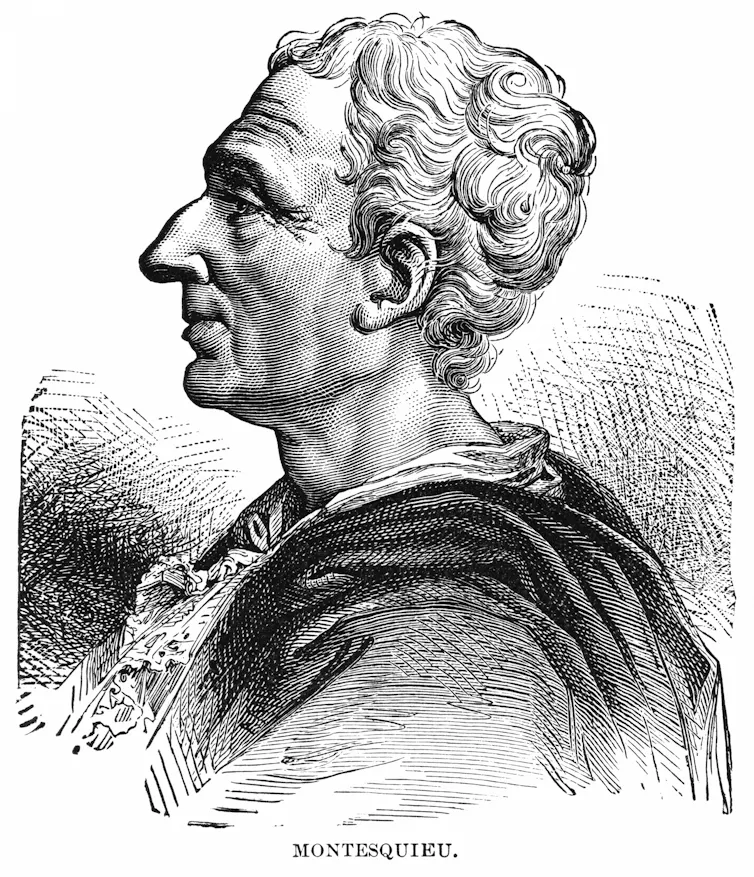
In “The Spirit of the Laws,” Montesquieu describes political liberty as a “tranquility of mind arising from the opinion each person has of his safety.” To be free is to believe that one is secure. But to believe as much, “it is requisite the government be so constituted as one man need not be afraid of another.”
Liberty cannot be a matter of “doing what one wants,” Montesquieu warns. What if what one person wants threatens others? Then one person’s freedom to act limits everyone else’s. No one can feel secure unless everyone lives under laws that regulate what each may do. Montesquieu understood liberty in terms of this confidence or “tranquility” because it amounts to being free from the arbitrary will of others.
When Montesquieu stresses freedom from fear of other citizens, he doesn’t just mean private individuals. He especially means those acting in a public capacity, like “magistrates” or “rulers.” If public officials’ behavior doesn’t conform to predictable norms set by law, if agents of the government can summarily arrest people, seize their property or revoke their citizenship – say, by denaturalizing and deporting them without due process – it becomes impossible to feel secure.
Even if such actions aren’t directed against me or those like me, such lawlessness is still threatening because it’s unpredictable. I might support the government’s moves against other groups in the moment, but what’s to stop the government from suddenly turning on me when the political winds change?
To prevent public officials from simply doing what they want, Montesquieu famously called for the separation of political power into branches headed by different citizens.
But, he explains, it is not enough that people live under free institutions. They must also believe those institutions to be in the service of their freedom. Liberty, then, is as much a matter of opinion as of fact.
Montesquieu shows in “The Spirit of the Laws” how the fundamental laws of a country can permit a free way of life even as the country’s cultural norms prevent it. A country might have a free constitution while its citizens believe they hold moral obligations inconsistent with it.
For example, today, Americans might believe that the demands of racial equity or of evangelical Christianity are so pressing that executive power would be justified in ignoring the legislature or the judiciary to serve them.
“In these instances,” Montesquieu writes, “the Constitution will be free by right and not in fact.” The people – or some of them – will experience the law as a hindrance to what they believe they ought or ought not to do.
In such cases, there arises what Montesquieu calls a tyranny “of opinion.” The laws that would otherwise free people from fear of one another and of the government instead inspire a fear all their own. The laws might prevent what some people believe is morally right, or command – in the name of protecting others’ rights or the common good – what others regard as unjust or unholy.
That misalignment between constitutional law and cultural norms makes people feel insecure. It makes the Constitution seem opposed to their will and sense of duty. It can then seem appealing for a leader to promise, in the name of freedom, to ignore the law.
In recent years, figures across the political spectrum have called for radical constitutional change – or for ignoring the Constitution outright. There are calls not only to pack the Supreme Court or to ignore its decisions, but also to abolish the Senate and the Electoral College.
From Montesquieu’s perspective, polarization worsens this appetite for disregarding constitutional norms. Each party champions a cultural agenda from which supporters of the other party recoil. Whenever either party is in office, even when it respects constitutional law, its rule can feel to the other side much like the tyranny of opinion Montesquieu describes. The other side’s policies can seem to violate deeply held values, whether it’s banning transgender girls from competing in girls sports or declining to deport immigrants residing in the U.S. illegally.
According to Montesquieu, liberty depends on the kind of civic culture the U.S. seems at risk of losing. No institutions, however well designed, can preserve liberty if citizens believe their preferred cultural norms are so obligatory that political power is needed to enforce them, opposition be damned.
A culture more tolerant of moral disagreements and less quick to reach for political power to force others to accept what they find morally wrong would help ease the distrust many Americans feel toward the government and one another. Until then, Americans will continue drifting away from the liberty that the U.S. was founded to secure.

Robert A. Ballingall does not work for, consult, own shares in or receive funding from any company or organization that would benefit from this article, and has disclosed no relevant affiliations beyond their academic appointment.
Politics + Society – The Conversation
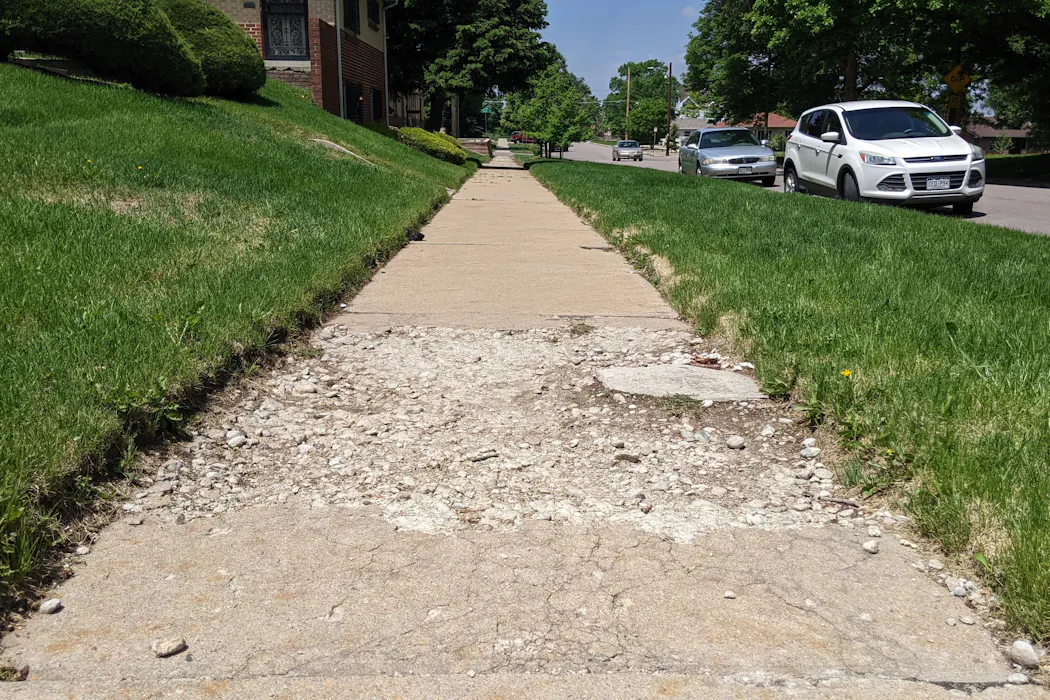
Let’s say you drive over a pothole in front of your house in Denver and call the city. They come fix it within a few days. Problem solved.
Now let’s say the problem is the sidewalk in front of your house. You call the city again.
Until recently, city staff would have pointed you to their “Homeowner’s Do-It Yourself Guide for Hazardous Sidewalks,” where it clearly states that “sidewalk maintenance is the responsibility of the adjacent property owner.” This online document then suggests that if you need to remove a tripping hazard from your sidewalk, you could rent a “Masonry Rotary Grinder” from your local rental center.
Be sure to also get yourself some eye protection.
In most U.S. cities, a pothole is treated as a public problem, but a broken sidewalk – even one that blocks access – is treated as the homeowner’s problem.

It is not this way everywhere. In some older U.S. cities such as Boston and Washington, sidewalks have long been a public responsibility – the same as streets, water lines and sewers. But cities that grew up in a different era – or cities eager to offload maintenance and legal responsibility – treated sidewalks not as fundamental infrastructure but as an amenity tied to adjacent property.
More than three-quarters of the 30 most-populous U.S. cities take that same approach.
But not Denver – at least, not anymore. In 2022, the city changed its rules, not because city leaders suddenly changed course, but because advocates such as Jill Locantore and the Denver Streets Partnership got tired of waiting, organized and took the issue to the ballot. Denver allows citizens to initiate legislation, and the measure won handily, making sidewalks a public responsibility.

Denver ended up with a citywide sidewalk program funded through a fee on property owners, typically $150 per household per year, and managed by the city. Instead of trying to get individual homeowners to fix bad sidewalks one segment at a time, Denver now has a system – and funding it can bond against – to repair, build and maintain sidewalks as a connected public network.
Los Angeles underscores the contradiction. The law there still says adjacent property owners are responsible for sidewalk maintenance; yet, the city also runs a public repair program for larger sidewalk projects after years of ADA litigation made clear that this is not just a private matter.
But most cities don’t even know which sidewalks need fixing.
When I first took my job at the University of Colorado Denver in 2009, I taught an Introduction to GIS course, where students learned how to use digital maps to understand real-world problems. In prepping for that class, I dug into the city’s data and came away impressed by the fact that they had a sidewalk layer, basically a digital map of the city’s sidewalks. However, unlike nearly every other GIS dataset the city provided, the sidewalk one hadn’t been updated since 2004. The logic seemed to be that not seeing the problem protects you from liability. But sticking your head in the sand is not much of a long-term strategy.
There is no such hesitancy with cities collecting roadway data. In one study, my colleagues and I interviewed staff from 16 U.S. cities about the information they track on their roads. One city told us that they had “no gaps in data and don’t need anything else.” Most others likely would’ve agreed with that sentiment.
We then asked the same questions about their sidewalk data. The tone of the responses shifted quickly. Audible frustration and an early disclaimer of “it’s complicated” were common. They told us that sidewalks just weren’t given the same priority as roads.
Why would they be? Or better yet, why should they be?
One reason is road safety.
Hoboken, New Jersey, has become the U.S. poster child for safe streets. Experts point to the success of interventions like curb extensions, high-visibility crosswalks, protected bike lanes and lowering the citywide speed limit.
But before all of that, Hoboken undertook a systematic effort to catalog its sidewalks and their condition. The city runs an annual sidewalk inspection program where trained volunteers walk the sidewalks and record problems. Hoboken also developed a smartphone app so the inventory could be digitized instantly, including not just sidewalk defects but also things like burned-out pedestrian lights and damaged pedestrian signals.
Hoboken remains one of the many cities that put the onus to fix sidewalks onto adjacent property owners. But you can probably get away with that when your nickname is the “Mile Square City” and your median income is more than twice the national average.
But nine consecutive years without a traffic fatality? In a city of nearly 60,000 residents and a daytime population of over 90,000? Hoboken must be doing something right, and focusing on sidewalks first may be part of it.

Springfield, Ohio, also has nearly 60,000 residents. Yet the city suffered more than 50 road fatalities over the past nine years. The list of contributing factors is long, but sidewalks matter.
In fact, in Springfield’s 2024 community survey, residents cited the condition of sidewalks and streets as the city’s worst problem. Over 90% of residents said they were dissatisfied with them.
To its credit, Springfield is looking to fix its sidewalks. And to be fair, doing so is much harder when your city is spread across 26 square miles (67 square kilometers) of land instead of one.
But giving property owners just 30 days to fix their own sidewalks? And adding the repair costs to their property tax bill if they don’t? There has to be a better way. I’m guessing that the residents along the 22 streets that recently received such notices would agree.
I live in Denver. The sidewalk in front of my house had some lips and dips that could’ve compelled me to rent heavy equipment and get to work. But the city came out and replaced it. Without my even asking.
So if you want to take a lesson from Denver, making sidewalks a public responsibility is possible. It can even be popular. And if you want to take a lesson from Hoboken and make your city safer, start with the humble sidewalk. Figure out where they are, and where they are not. Where they need to be repaired, and where they need to be replaced.
In other words, sidewalks come first.
Read more of our stories about Colorado.

Wes Marshall, PhD, PE, receives funding from entities such as the Colorado Department of Transportation and the University Transportation Center program.
Politics + Society – The Conversation

 Kourtney Kardashian’s sweet keepsake will strike a chord.
Over three years after the Lemme founder shared she was pregnant with her and Travis Barker’s first child together with a sign at one of…
E! Online (US) – Top Stories