This two-ingredient whisky shot may have a scary(-ish) name, but we promise it doesn’t bite. Much. In reality, it’s sweet and deceptively smooth.

Food Republic – Restaurants, Reviews, Recipes, Cooking Tips









This two-ingredient whisky shot may have a scary(-ish) name, but we promise it doesn’t bite. Much. In reality, it’s sweet and deceptively smooth.
Food Republic – Restaurants, Reviews, Recipes, Cooking Tips
HOLLYWOOD, Florida — Colombia and Portugal’s World Cup match in Miami Gardens won’t be the only major draw pulling crowds to South Florida this weekend: Florida’s Republican grassroots are heading to Hollywood for their “Sunshine State Showdown.”
The GOP’s event at the Seminole Hard Rock Hotel & Casino is one of the state party’s biggest of the year. The GOP sold more than 800 tickets, with the party’s most devoted volunteers and many donors coming in from all over the state to get revved up for the midterms, gameplan their messaging and hear directly from top candidates.
The shindig will feature speeches from Sens. Rick Scott and Ashley Moody, as well as gubernatorial candidates Rep. Byron Donalds, former Florida House Speaker Paul Renner and Lt. Gov. Jay Collins. It will also include two congressional debates.
Several “Showdown” attendees said they were thrilled about the convergence of their party’s bash with a World Cup match. South Florida has already seen a huge economic boom in recent years, and the Magic City is poised to become even more prominent given Miami is set to be home to Donald Trump’s future presidential library and will host the G20 in December. “Miami is again at the center of the universe,” observed Miami-Dade County GOP Chair Kevin Cooper.
Several prominent Republicans said they see the international event as an opportunity to showcase the state. State Rep. Dean Black of Jacksonville, who also chairs the Republican Party of Florida’s fundraising committee, said he’d enjoyed seeing fans from abroad show appreciation over social media for American culture. “They have fallen in love with the greatness of America,” Black said. “By being exposed to the Republican Party event, they will learn just how that greatness came to be.”
Collins’ team said that while the lieutenant governor wasn’t attending the game, he was “happy the state of Florida is hosting so many fans from across the world experiencing the beauty of our state.”
Former Fox 35 Orlando anchor Ryan Elijah, a GOP candidate for Congress who’s attending the showdown, said he would be checking his phone regularly for World Cup updates.
“What a night for Florida to see the biggest names in Florida politics and World Cup soccer be just miles apart!” he said in a text. “It’s a dream night for tourism numbers and local businesses!”
But the packed weekend also risks turning into a logistical headache. The Hard Rock Hotel is one of the pickup points offering shuttle services to Miami Stadium. It’s less than 9 miles away from the big game.
Angie Wong, Republican executive committeewoman in Miami-Dade, attended Wednesday’s match between Scotland and Brazil. She said her family paid $200 for parking near the stadium and that it took more than an hour just to get out of the parking lot.
“We were lucky — we actually left before the game ended,” she said.
Yet this year’s “Showdown” is a more scaled-back affair than in the recent past. It won’t, for example, feature a dinner like in previous years. But that’s probably good news for any attendees who don’t want to miss the soccer match — or who are just trying to get back home without getting stuck in traffic. And it doesn’t have any major Trump administration officials attending, in comparison to last year, when the event prominently featured White House chief of staff Susie Wiles and now-former deputy chief of staff James Blair, who is currently running Trump’s political operation for the midterms.
Florida’s GOP Gov. Ron DeSantis — who remains highly popular with the state’s grassroots — won’t be speaking at the “Showdown” this weekend and his office didn’t reply to an inquiry about whether he’d attend Saturday night’s game. The governor was in the Miami area during the last couple of days, including hitting the Brazil-Scotland game on Wednesday night and holding a press conference at the former Alligator Alcatraz immigration detention center on Thursday.
Evan Power, chair of the state party, had already arrived at the Hard Rock Hotel on Wednesday night and said he got to watch a Brazilian victory parade happening right outside the restaurant where he was having dinner. He added he hadn’t had any issues getting in and out of the events center and that Republicans sold out their room block, “so I think we were able to get in before the craziness.”
“In our room block, people are happy because they’re not paying the market rate that is out there,” Power said. “Seeing some of the prices — they’re crazy now.”
Politics
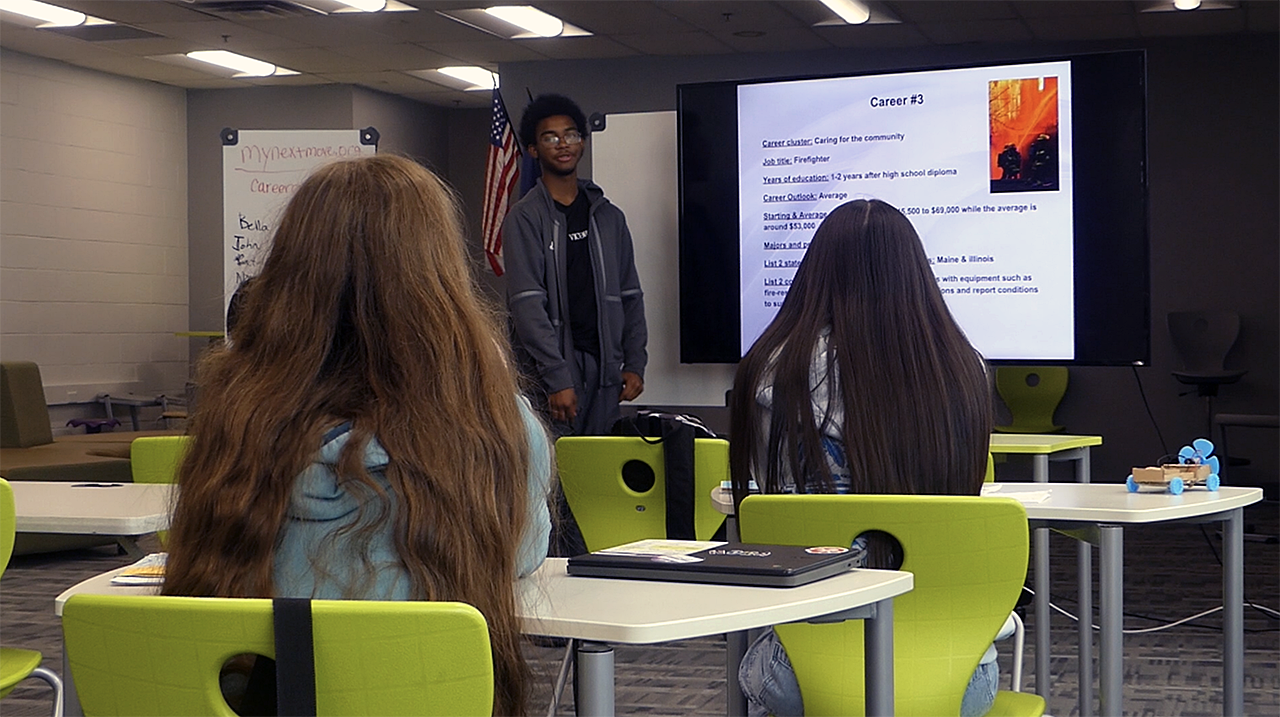
Incoming Anchorage freshmen are exploring careers through a summer CTE program offering hands-on learning, planning tools, and credit before high school begins.
Incoming Anchorage freshmen are exploring careers through a summer CTE program offering hands-on learning, planning tools, and credit before high school begins.

Alaska State Troopers arrested 18-year-old Gary Reddig in the fatal shooting of 19-year-old Jaxon Williams, whose body was found in Hatcher Pass in June.

 Think Amazon Prime Day is over just because it’s the last day of deals? Think again. Amazon is quietly hiding one of its best designer sales of the season, with major discounts on coveted brands…
E! Online (US) – Top Stories
Iditarod CEO Rob Urbach will step down after seven years, remaining through a leadership transition as the board searches for the organization’s next chief executive.

A young polar bear climbs atop some ice Sept. 13, 2016 in the Chukchi Sea. The bear was spotted by crew members and scientists aboard the U.S. Coast Guard Cutter Healy during a scientific cruise in the Arctic. (Photo by Petty Officer 2nd Class Christopher M. Yaw/U.S. Coast Guard)
Lately, much of the news about the Arctic has been bleak. The far north is warming three to four times faster than the rest of the planet. Arctic climate change – manifesting in sea ice loss, permafrost thaw and coastal erosion, among other phenomena – is already causing serious problems for Arctic residents, ecosystems and the rest of the planet.
At the diplomatic level, Russia’s invasion of Ukraine in 2022 has had spillover effects in the Arctic, raising tensions and causing a breakdown in cooperation among the Arctic countries. The Trump administration’s interest in Greenland, along with its combative approach to NATO, has roiled relations among Arctic allies. The Arctic Council, established in 1996 to promote cooperation among the Arctic states, significantly scaled back its operations after the Russian invasion.
But there is a bright spot. Five years ago, the United States, Russia and China joined six other nations and the European Union to bring into force a new treaty – the Central Arctic Ocean Fisheries Agreement – to keep commercial fishing out of the region, at least for now.

The agreement’s moratorium on fishing remains in place today, and the parties to the treaty, including Russia, continue to work together to advance scientific understanding of the Arctic Ocean under the treaty, despite other tensions in the region.
While serving in the U.S. State Department, I chaired the negotiations that produced this treaty. It’s useful to look at why this unusual pact came together, why it still works, and whether it could serve as a model for future diplomacy in the Arctic.
At the heart of this treaty, and part of what can make it a good role model, is a tenet of modern international law known as the precautionary principle, or precautionary approach. In fact, it may be the best example of it that I’ve ever seen in international law.
In the context of managing international fisheries, this tenet calls upon governments to “be more cautious when information is uncertain, unreliable, or inadequate.” Unlike many treaties, including past fishing treaty failures, the countries agreed to take action in advance, before commercial fishing could become a problem.
Commercial fishing has never taken place in the Central Arctic Ocean. That’s because the area was completely covered by ice as far back as records exist, until recently. Today, as temperatures quickly rise in the Arctic and sea ice declines, a significant portion of the Central Arctic Ocean – the ocean’s international waters – is open water for part of each year.
Nobody can say what effect commercial fishing might have on the ecosystem in this region, given the dearth of scientific knowledge about the Arctic Ocean.
In the face of such uncertainty, this treaty – applying the precautionary approach – delays the start of commercial fishing until governments have adequate information to manage fishing sustainably. The treaty also sets up a research program to study and monitor the Central Arctic Ocean.
The origins of the agreement trace back to a bipartisan effort in the United States that may be difficult to imagine now. In 2008 Congress passed a joint resolution, signed by President George W. Bush, calling for a Central Arctic Ocean fisheries treaty.
Under President Barack Obama the United States convened two sets of international negotiations. The first round aligned the views of the United States and the four other countries that have coastlines on the Central Arctic Ocean: Canada, the Kingdom of Denmark, Norway and Russia. Next, the negotiations expanded to include Iceland and others with large, distant-water fishing fleets: China, Japan, South Korea and the European Union.
The treaty is also one of the best examples of a binding international agreement that requires incorporating Indigenous knowledge and the involvement of Arctic Indigenous peoples in its implementation. I believe the negotiations would not have succeeded without the involvement of Indigenous and other nongovernmental experts and groups, including scientists, industry leaders and environmental organizations.
The resulting treaty entered into force in 2021. The United States signed and ratified the agreement during President Donald Trump’s first term.
Each country has something to gain from cooperation. For the United States, the agreement extends the successful model of fisheries management off Alaska to the high seas and helps limit foreign vessel activity in the region. For countries that don’t border the Arctic Ocean, such as China, Japan and South Korea, the treaty gives them international recognition as Arctic players. At the same time, the treaty doesn’t preclude future commercial fishing in the Central Arctic Ocean, but instead allows time to ensure any fishing there can be sustainable.
The 10 parties to the treaty have met each year since 2022 to implement the agreement. They have advanced scientific research in this little-known part of our planet and are developing rules for very limited “exploratory fisheries” to study the migration of fish into the Central Arctic Ocean.
The fact that these meetings are taking place at all is an anomaly. In contrast to the Arctic Council, the conferences of the parties to this treaty have involved Russian experts each time, including during a meeting taking place June 16-17, 2026, in Brussels.
Despite the geopolitical turmoil in the world, those working to implement the treaty have put aside their differences to pursue their common interests concerning the Central Arctic Ocean.
That willingness to set aside differences in pursuit of common interests can have many benefits.
Even during the Cold War, the United States and the Soviet Union worked together on a wide range of issues, including a joint effort to spearhead the Antarctic Treaty, which has kept Antarctica demilitarized and facilitated scientific advancements at the Earth’s other pole.
After the Cold War ended, the Arctic also became a region of exceptional East-West collaboration. Nations cooperated to protect the Arctic environment, to promote economic development, to bolster search-and-rescue capacity and to improve scientific understanding.
The current breakdown in cooperation with Russia is, on one level, entirely understandable, given the desire to maintain pressure on Russia to end the war in Ukraine. However, the Arctic Ocean is facing new challenges, with commercial shipping increasing as the ice melts and the rising potential for seabed mining, each of which poses unknown risks to its environment.
I believe the Central Arctic Ocean Fisheries Agreement could serve as an inspiration, maybe even as a road map, for the path back to a cooperative, well-managed Arctic region, if countries follow its example.
This article is republished from The Conversation under a Creative Commons license. Read the original article.
SUBSCRIBE: GET THE MORNING HEADLINES DELIVERED TO YOUR INBOX.
Post Content

The Sealaska Corporation is speaking out after incidents in Alaska involving tourists interacting with sacred totem poles, calling for greater respect and education about their cultural significance.