If there was ever an occasion for setting aside differences, this was it:
The New York Knicks came back from a 29-point deficit to defeat the San Antonio Spurs in Game 4 of the NBA Finals last night.
And some of the biggest celebrities on the planet took to the court to celebrate the historic win — including ones who might normally give each other the cold shoulder.
Taylor Swift performs onstage during “Taylor Swift | The Eras Tour” at Johan Cruijff Arena on July 05, 2024 in Amsterdam, Netherlands. (Photo by Aldara Zarraoa/Getty Images for TAS Rights Management)
As usual, Kylie Jenner was there, alongside boyfriend Timothee Chalamet, a hardcore Knicks fan.
And in a development that few saw coming, Taylor and Kylie briefly embraced one another during the post-game celebration.
Social media users were quick to make note of the somewhat surprising interaction.
After all, Kylie happens to be the younger sister of Kim Kardashian, and Kim’s feud with Taylor has been simmering for what feels like several geological eras.
Yet here were Kylie and Taylor, hugging, smiling, and chatting like two people who weren’t connected to one of pop culture’s longest-running beefs.
Of course this was no time for nursing old grudges.
The moment occurred after the Knicks beat the Spurs 107-106 to take a commanding 3-1 lead in the NBA Finals.
The Knicks haven’t won a championship since 1973, and the post-game scene looked like the world’s most chaotic awards show.
Kylie turned around, spotted Taylor standing behind her, and immediately broke into a smile. The two exchanged a quick hug and a brief conversation before heading off in different directions.
Naturally, Swifties and Kardashian-watchers immediately began dissecting every frame.
Does this mean the feud is over? Not exactly.
Taylor has never suggested she’s ready to become best friends with Kim Kardashian, and nothing about one courtside hug indicates a sudden reconciliation.
But it does seem to suggest that Kylie has no interest in carrying on family drama that began nearly a decade ago.
And while Taylor’s interaction with Kylie generated plenty of buzz, she was already one of the night’s biggest attractions.
Fans packed Madison Square Garden hoping to witness a Knicks win, but no doubt many were also eager to catch a glimpse of Taylor, who arrived wearing a custom “Stevie Knicks” shirt in a nod to both the team and her longtime friend Stevie Nicks.
The appearance comes during an especially busy stretch for the singer, who has been making headlines thanks to speculation surrounding her upcoming wedding to Travis Kelce.
For now, though, the biggest takeaway from Game 4 might be this:
The Knicks are one win away from a championship.
And Taylor Swift and Kylie Jenner are apparently on hugging terms.
Both developments seemed unlikely just a few weeks ago.
As Kyle Busch was dying, his wife vowed to do everything to support their kids’ dreams. Continue reading…The Boot – Country Music News, Music Videos and Songs
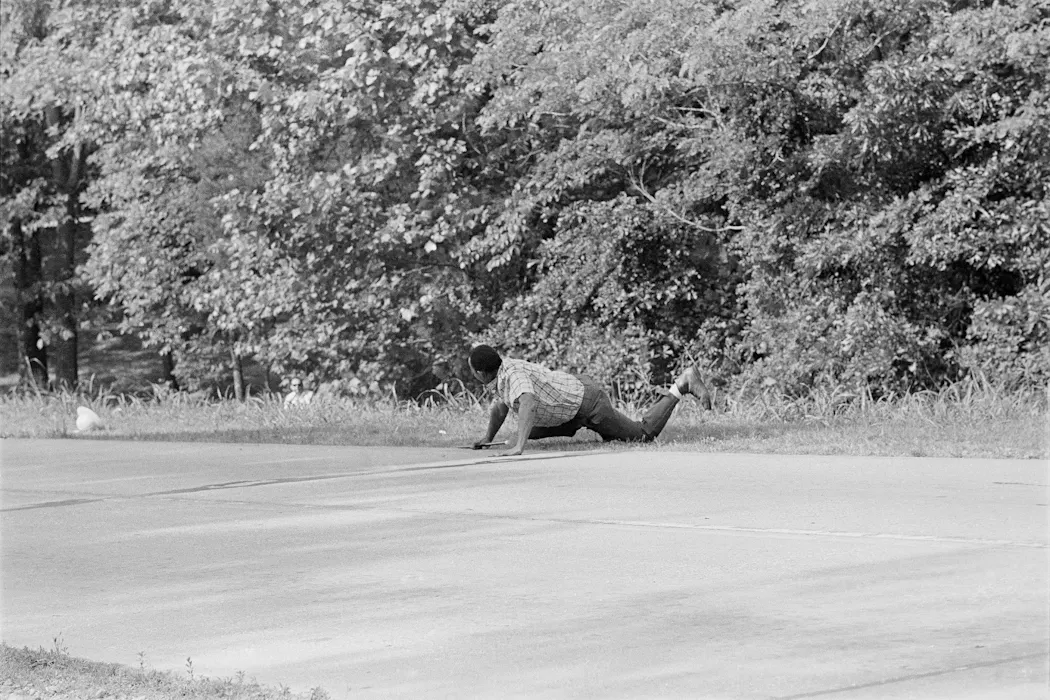
James Meredith looks at Aubrey Norvell, partially hidden behind foliage, after Norvell shot him in Hernando, Miss., on June 6, 1966.AP Photo/Jack Thornell
On June 6, 1966, on a stretch of Highway 51 just south of Hernando, Mississippi, a portly, middle-aged white man named Aubrey Norvell stepped out of a gully, lifted his shotgun and fired three shots at James Meredith, a Black civil rights activist and Air Force veteran.
Bloodied by bird shot, Meredith again returned to the national spotlight. The shooting transformed his walk into a civil rights spectacle.
Activists descended upon Mississippi for a three-week mass march. It featured titans of the movement, including Martin Luther King Jr., while inspiring Mississippians to march down country roads, volunteer their homes and food, and register at their local courthouses. During these protests, the civil rights activist Stokely Carmichael introduced “Black Power,” a slogan of self-determination that marked the next stage in the Black freedom struggle.
It is a rich, intricate and evocative story – one that I tried to chronicle in my book, “Down to the Crossroads: Civil Rights, Black Power, and the Meredith March Against Fear.”
Sixty years later, however, a mystery lingers. Clouded in the haze of a political extravaganza, Norvell never revealed his motivations for shooting Meredith.
His silence allowed for the flourishing of conspiracy theories – most notably, from those most resistant to racial equality. In a political and rhetorical strategy that echoes into the present day, many white conservative Southerners painted themselves as Norvell’s real victims.
‘A quiet, Christian man’
At first, it was civil rights activists who suspected a conspiracy. Meredith’s companions testified that law enforcement had reacted slowly to Norvell’s threat. They assumed that Norvell was a virulent white supremacist, in cahoots with a racist police force.
But as reporters investigated Norvell, they found no evidence of a hate-spewing Klansman. He lived in a middle-class Memphis suburb. He had no criminal record. Neighbors described him as a “quiet, Christian man” who never mentioned civil rights, one way or another.
Upon posting bond, Norvell disappeared from the public eye until his trial that November.
A University of Mississippi student points a finger at James Meredith as he is taken to class, in Oxford, Miss., on Oct. 4, 1962. AP Photo
The significance of bird shot
By presenting a blank slate, Norvell allowed white Southern conservatives to launch a counternarrative. The previous decade of Black activism, from the Montgomery bus boycott through the Selma-to-Montgomery march, had taught them that open violence ignited public outrage and prompted civil rights legislation. So they distanced themselves from Norvell.
Mississippi Gov. Paul Johnson noted that Meredith was attacked “by birdshot by an out-of-state resident.” It foreshadowed the language employed by a host of Southern politicians and newspaper editorialists.
“The whole affair smells badly of a plot instigated by the Communist-controlled rights groups and capitalized on by the press, the government, and all the other liberal screamers,” wrote one woman to Sen. James Eastland, as I discovered during my research. Like many others, she imagined that civil rights organizations paid Norvell to wound Meredith, which would stoke a media hubbub and invite the federal government to persecute white Southerners.
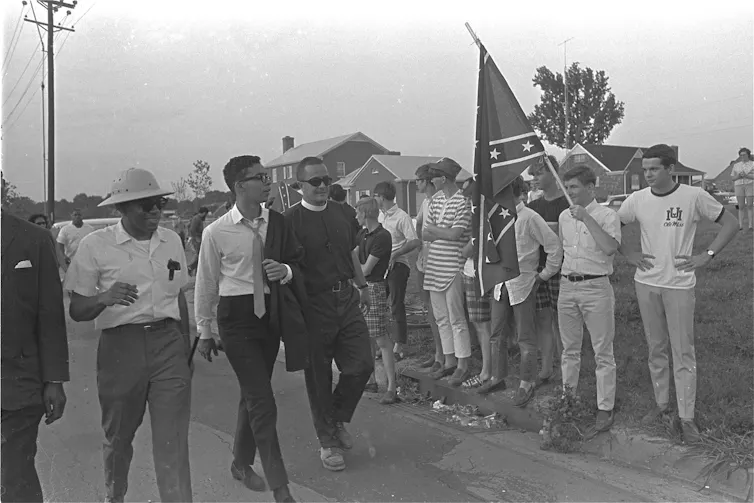
James Meredith, left, passes white spectators after he began a 225-mile walk from Memphis, Tenn., to Jackson, Miss., on June 6, 1966. AP Photo
According to commission files, an FBI agent from Mississippi, high-ranking officials of the Memphis Police Department and a Mississippi district attorney all agreed that Norvell’s shooting was “a hired job for the advancement of various civil rights groups.”
Segregationists kept grasping at this far-fetched scenario, exaggerating and manipulating it to serve the purpose of discrediting the Meredith March Against Fear. A Mississippi sheriff named Jack Cauthen went even further, suggesting Meredith hadn’t even been shot in the first place. He claimed to have put his arm around Meredith, who had rejoined the march for its final days.
“His back was just smooth as silk. There hadn’t been no pellets or shots in James’s back,” asserted Cauthen, as I found while conducting research for my book. “I don’t think he was shot, no sir.”
Echoes from the past
Norvell pleaded guilty and spent 18 months in Parchman Prison in Sunflower County, Mississippi. Despite being approached by many journalists and historians – including me – he never revealed his motive. He died in 2016.
In the 1960s, white southerners perceived that their way of life was under assault by big institutions, including the federal government and the media. They blamed the Civil Rights Movement on nefarious “outside agitators” determined to smash their status. Their political motivations led them down bizarre and fantastical paths, with some even fashioning themselves as the true victims of Norvell’s attack.
Even if these notions emerge from a modern sense of dislocation and anxiety, I think they have roots in the same crass bigotry that defined the conspiratorial segregationists of the civil rights era.
Aram Goudsouzian does not work for, consult, own shares in or receive funding from any company or organization that would benefit from this article, and has disclosed no relevant affiliations beyond their academic appointment.
Costco is the go-to retail store for many shoppers looking for budget-friendly deals. Women over 40 may also find interesting wellness products on the shelves.
Health Digest – Health News, Wellness, Expert Insights
More than any other U.S. president in decades, Donald Trump has aggressively pursued military interventions in Latin America.
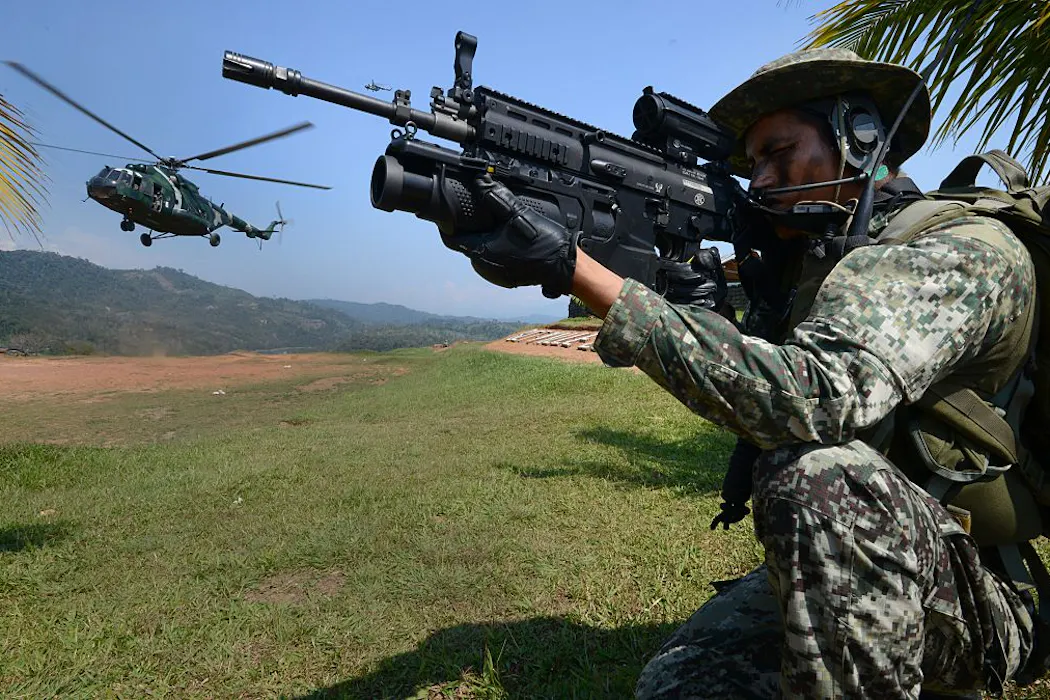
On Jan. 3, 2026, U.S. special forces captured Venezuelan President Nicolás Maduro on charges of narco-terrorism. In the months before the operation, U.S. Southern Command began targeting small, fast-moving boats in the Caribbean and eastern Pacific. The death toll from the continuing war on these alleged narco-terrorists has risen to over 200 people.
At the heart of these events is the Trump administration’s stated goal of combating drug trafficking organizations. The White House and State Department have designated a plethora of guerrilla groups, drug cartels, gangs and criminal enterprises as “foreign terrorist organizations.”
Washington has also expanded security ties with Ecuador and El Salvador, which are led by right-wing Trump allies. At the same time, the administration has pressured left-wing governments in Colombia, Guatemala, Brazil and Mexico to join the U.S. war on drugs or else risk Trump’s wrath.
When it comes to opening legal avenues for the application of armed force, the narco-terrorism label is useful. Indeed, it is how the Trump administration justified Operation Absolute Resolve to capture and indict Maduro. Yet Trump’s decision to pardon a right-wing ally – former Honduran President Juan Orlando Hernández – who was convicted and sentenced to 45 years in prison for drug trafficking and related weapons offenses, appeared to some observers to be “at odds with Trump’s war on drugs.”
The history of that war on drugs, however, especially during the presidency of Ronald Reagan, shows that the narco-terrorism label has always been politicized. My research on Reagan and the drug war suggests that the nebulousness of the concept aided U.S. policymakers in achieving fundamentally anti-communist and anti-leftist political objectives.
Shining Path and the roots of narco-terrorism
Peruvian President Fernando Belaúnde Terry first coined the term narco-terrorism in 1982 to describe the infiltration of Sendero Luminoso – or Shining Path – guerrillas into the drug trade.
An ultraradical offshoot of the Peruvian Communist Party, Shining Path was one of the most vicious insurgencies in Latin America. A truth and reconciliation commission later attributed at least half of the 70,000 conflict-related deaths and disappearances to the Maoist guerrillas in their campaign to overthrow the “bourgeois” democratic government. After the Peruvian army chased the guerrillas out of their home base in Ayacucho in the southern Andes, they moved north to the upper Huallaga Valley, the source of over half the world’s cocaine supply at the time.
The Peruvian police, together with the U.S. Drug Enforcement Administration, created special counternarcotics units focused on crop eradication in the upper Huallaga. This strategy sought to reduce the supply of cocaine by eliminating its source, the coca plant. Peasant growers’ resistance to these operations fueled the Shining Path insurgency by providing recruits and creating an opening for the guerrillas to interpose themselves between the farmers and the police.
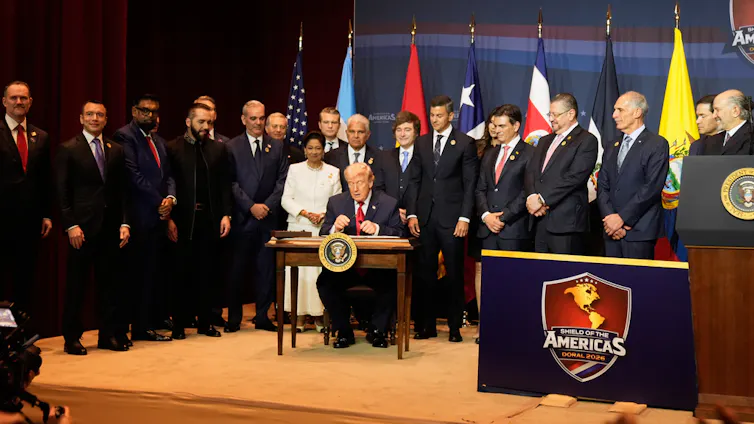
President Donald Trump signs a proclamation committing the U.S. to countering cartel criminal activity on March 7, 2026, in Doral, Fla. AP Photo / Mark Schiefelbein
With the Cold War drawing to a close, a militarized drug war expanded under the administration of George H.W. Bush. As the federal counternarcotics budget nearly doubled, U.S. officials pressured the Peruvians to militarize their counternarcotics efforts, too. But it wasn’t until the Peruvian armed forces pursued a tacit truce with the traffickers that they were able to locate and capture Shining Path leader Abimael Guzmán in September 1992 and dismantle the insurgency.
The Peruvian counterinsurgency succeeded due to a strategy that deliberately cut ties between the guerrillas and the drug traffickers. Essentially, the armed forces of Peru took control of the drug trade from the leftist guerrillas. U.S. anti-narcotics officials, together with their Peruvian police colleagues, were less than thrilled with this strategy – as were the tens of thousands of people who were caught in the crossfire. But for myriad U.S. defense officials more interested in defeating Shining Path than stemming the tide of drugs, the narco-terrorism label had facilitated a clear success – and drafted a valuable blueprint.
Colombia and the ‘narco-guerrilla connection’
The incident that indelibly linked the drug cartels and the communist guerrillas in the U.S. concept of narco-terrorism was the November 1985 M-19 siege of the Colombian Palace of Justice, the country’s supreme court. The M-19, or 19th of April movement, so named for a disputed election, had as a main objective to establish socialism in Colombia. The guerrillas took the high court hostage and intended to subject the then-president to a trial. The resulting clash with the military left nearly 100 people dead, including soldiers, guerrillas and 11 of the justices.
Allegations surfaced that Pablo Escobar, head of the notorious Medellín cartel, had paid M-19 for the raid. The guerrillas had apparently stolen hundreds of documents, including U.S. extradition requests for Escobar. Though this motive is still disputed – and even the U.S. ambassador in Bogotá emphasized that the “narco-guerrilla connection” had not been proven – the shocking event hardened U.S. public opinion against the new threat of narco-terrorism.
In April 1986 the Reagan administration issued National Security Decision Directive 221, officially linking counternarcotics and counterinsurgency in U.S. foreign policy. The declaration of drugs as a national security threat widened the scope of U.S. involvement in the Colombian counterinsurgency against entrenched communist guerrilla groups such as the Revolutionary Armed Forces of Colombia and the National Liberation Army.
That cooperation continues to the present day, though it is currently jeopardized by hostility between Trump and Colombian President Gustavo Petro, himself a former member of M-19.
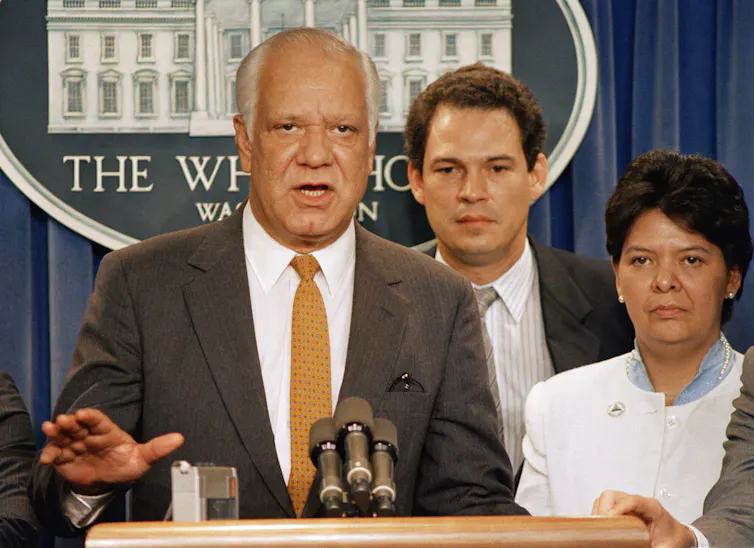
Contra leaders Adolfo Calero, left, with Pedro Joaquin Chamorro and Mario Azucena Ferrey, talk with reporters in 1987 in the White House briefing room after a meeting with President Ronald Reagan. AP Photo / Scott Stewart
The selective application of trafficking claims
The narco-terrorism label was selectively applied not only to left-wing guerrillas but to the two communist governments in Latin America. The Reagan administration seized upon allegations of Nicaraguan and Cuban drug trafficking to influence U.S. public opinion at a time when the American people worried about becoming bogged down in another Vietnam-style quagmire.
Vietnam had shattered the foreign policy consensus around the containment of Soviet communism, but the 1980s crack cocaine epidemic created a powerful new rationale for U.S. intervention. After Congress, citing human rights concerns, restricted aid to the anti-communist Contra forces fighting Nicaragua’s left-wing Sandinista government, Reagan publicly accused the Sandinistas of drug trafficking.
The only evidence produced to support the charge was likely obtained as the result of a joint DEA-CIA sting operation involving Barry Seal, an American drug smuggler turned DEA informant later played by Tom Cruise in the Hollywood cinematic version of the sordid tale, “American Made.” Questions arose as to whether the Nicaraguan trafficker identified by the sting was even linked to anyone in the Sandinista government.
At the same time, the Reagan administration ignored allegations that the Contras themselves were smuggling cocaine into the U.S. Indeed, a Senate investigation spearheaded by U.S. Sen. John Kerry revealed that administration officials had repeatedly ignored or obstructed evidence of Contra drug trafficking. The CIA’s inspector general found that the agency had received but neglected to verify similar allegations.
These activities were tolerated because they raised money for a cause that Reagan and his supporters viewed as righteous. The Contras were seen as “freedom fighters” struggling to liberate Nicaragua from communism.
Coming full circle
Then, as now, Washington policymakers pursued a regional approach designed to strengthen security cooperation and bolster the military capabilities of allied nations.
In March 2026 the Trump administration created the Americas Counter Cartel Coalition, or Shield of the Americas, a security alliance to stop illegal immigration, Russian and Chinese interference, and “narco-terrorist gangs and cartels.” In his remarks at the March 7 opening summit, Trump insisted that “the only way to defeat these enemies is by unleashing the power (of) our militaries.”
Then, as now, this collaboration appears to be aimed at the leftist and communist governments in the Western Hemisphere.
In many cases, the drug framing is an explicit rationale for action. That was most recently on display with the U.S. designation of the two largest criminal gangs in Brazil as foreign terrorist organizations, leading Brazilian officials of the leftist Lula government to warn that any pretext for intervention would be “unacceptable.”
In other cases the administration’s argument is broader. The ratcheting up of military maneuvers, rhetoric and sanctions against Cuba – including declaring the island nation an “unusual and extraordinary threat” to U.S. security – has led many to speculate that Cuba is the next target of regime change.
While the narco-terrorism label may be applied selectively depending on the case, the result remains the fulfillment of anti-communist political objectives dating back to the Cold War.
The opinions expressed are the author’s alone and do not reflect the views of the U.S. Naval War College, the Department of the Navy, or any other part of the federal government.
Michelle D. Paranzino does not work for, consult, own shares in or receive funding from any company or organization that would benefit from this article, and has disclosed no relevant affiliations beyond their academic appointment.
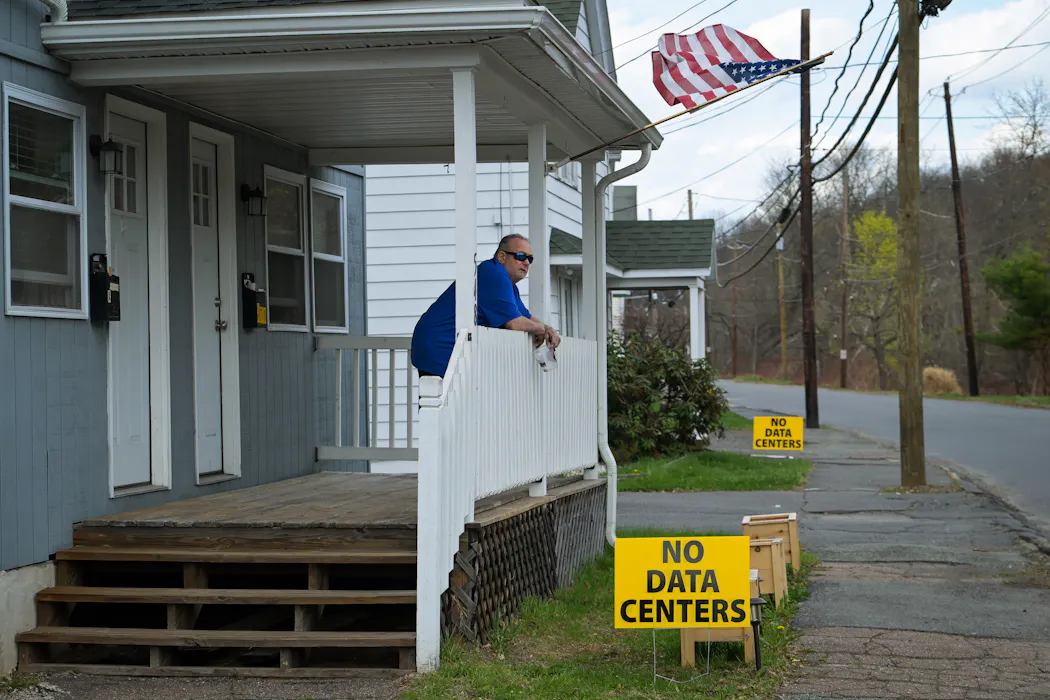
Pennsylvania has become a hot spot for data center proposals and public backlash about where to build them.
I’m a law professor and executive director of Penn State’s Center for Energy Law and Policy. I’m also a native of Archbald, a borough of 7,500 residents in the Lackawanna Valley in northeastern Pennsylvania. My hometown has drawn national attention because of proposals for multiple data centers that would cover 14% of its area.
Because of my professional and personal interest in data centers, I have been researching local responses to data center proposals across Pennsylvania. I’ve learned there are a host of considerations that local officials and citizens are taking into account when they evaluate data center proposals.
However, these job are mostly limited to the construction phase. One estimate suggests a moderately large data center would create about 15-30 long-term jobs.
Data centers have also been shown to create heat island effects, raising the local air temperature by an average of 3.6 degrees Fahrenheit (2 degrees Celsius).
They can also be loud due to the noise from cooling systems and diesel generators. And some residents object to what they consider eyesores in rural or suburban communities.
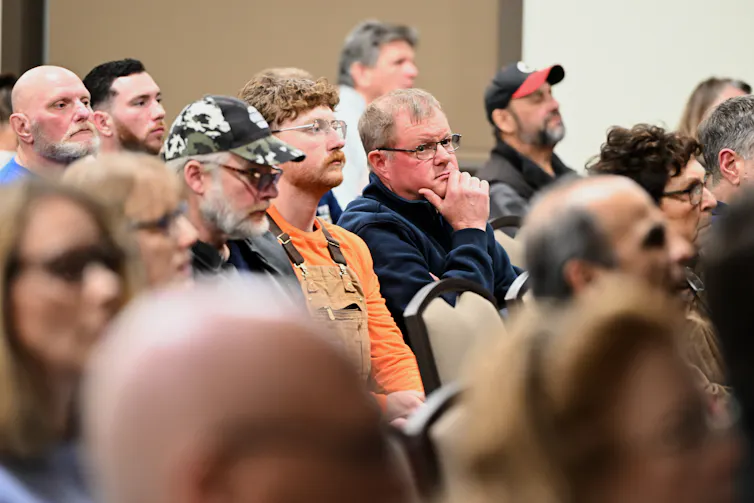
Residents of East Vincent Township in Pennsylvania listen during a supervisors meeting in December 2025 where an agenda item involved a data center proposal for the former Pennhurst state hospital grounds. AP Photo/Marc Levy
Communities can plan ahead
Because of the significant impact that a data center can have on its surroundings, communities benefit from planning ahead before any proposal has even been made in their area.
Under this law, a municipality generally cannot completely exclude from its zoning ordinance a legal use of a property unless it is inherently objectionable. An example of an inherently objectionable use might be a heliport in a heavily residential municipality.
But it can regulate where within the municipality buildings or other structures can be constructed and how they can operate.
Many Pennsylvania municipalities, including East Vincent Township and Jessup Borough, have amended their zoning ordinances to account for data centers.
Municipalities can also determine what level of municipal approval is required for a data center development. In Pennsylvania, uses can be allowed “by right,” “special exception” or “conditional use.”
“By right” means that no approval is required as long as ordinance provisions are followed.
By “special exception” requires approval from a municipal zoning hearing board.
By “conditional use” requires approval from the municipality’s governing body. This might be a board of supervisors or borough council.
Most Pennsylvania municipalities that have addressed this issue have designated data centers as a conditional use. Some, such as Butler Township/Arendtsville Borough, have allowed them as a special exception. When a municipal body evaluates an application for a conditional use or special exception, it must determine whether the proposed data center complies with the zoning ordinance and that it would not otherwise injure the public interest.
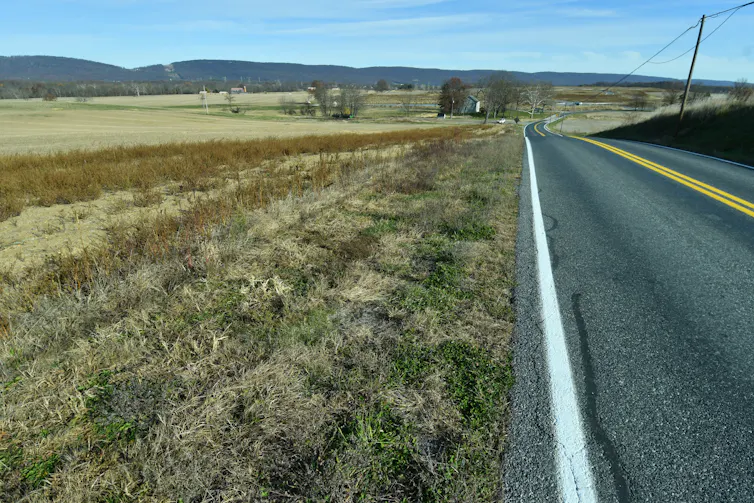
A stretch of land between the Conodoguinet Creek and Country Club Road near Carlisle, Pa., is set to become the site of a hyperscale data center. AP Photo/Marc Levy
Setback distances and impact studies
Another significant tool that municipalities have used is setback distances. A setback distance defines how far a data center structure must be from an adjacent property.
In Pennsylvania, ordinances have established setbacks for data centers from 50 feet (15 meters) to 400 feet (122 meters). Many ordinances establish longer setbacks from residential properties, hospitals or schools than from industrial sites.
Many ordinances also require plans or studies to be submitted as part of a zoning application. Noise or sound studies are common ones. These studies are intended to establish background noise levels for the area of the proposed data center and to identify ways to mitigate noise impacts.
Learning about the specifics of a particular data center proposal can help a community to understand the potential impacts – both positive and negative – and prepare a response.
Local residents and officials should be poised to ask probing questions about:
power and water demand, and the source of those resources
infrastructure needs
utility rate impacts
cooling system design and noise and resource consumption impacts
It may be possible in some circumstances for municipalities to negotiate community benefits agreements with data center developers. These agreements can ensure that the host community obtains certain specified benefits, such as local workforce guarantees or infrastructure development, as a result of the data center project.
The drive to build data centers and related infrastructure is moving quickly. By updating ordinances in advance, and diligently collecting information about any data center proposals that are made, local officials and citizens can protect the best interests of their communities.
Michael Helbing’s work for the Penn State Center for Energy Law and Policy has received funding from the Sloan Foundation, Arnold Ventures, the Center for Rural Pennsylvania, the U.S. Department of Energy, the Commonwealth of Pennsylvania, and the National Science Foundation. He is a member of Citizens for a Healthy Jessup and has volunteered for the Democratic Party. He owns shares in PPL Corporation.
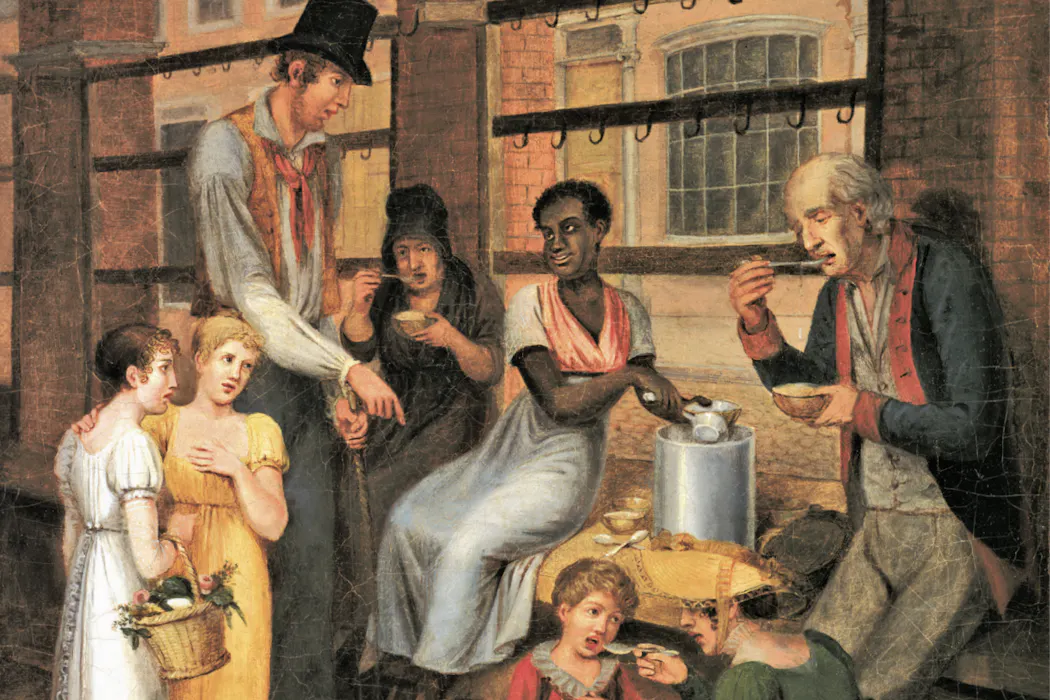
In the 18th and 19th centuries, pepper pot stew was a popular street food. A dish of Afro-Caribbean origin, it was typically made with tripe and other cheap cuts of meat mixed with vegetables, hot peppers and other spices.
One such woman I’ve researched represents both the possibilities and sharp limitations of freedom in that era. She was a pepper pot seller in Philadelphia known to us only as Dina.
Hiding in plain sight
Pennsylvania, like many northern states, responded to the Declaration of Independence’s rhetorical commitment to liberty by enacting a gradual emancipation law.
Children born to enslaved mothers before March 1, 1780, would remain enslaved for the rest of their lives. Children born after that date remained in bondage until they were 28 years old. So-called “slaves for life,” the status Dina held, would have had no hope of gaining legal freedom.
In the face of this grim reality, some, like Dina, seized freedom for themselves.
She slipped away from her enslaver, Rev. James Anderson, in Middletown, Chester County, sometime in 1785 or 1786 and made her way to nearby Philadelphia.
Almost all of the information we have about Dina comes from a notice Anderson placed in a local newspaper offering a reward for her return. Each detail is stained with his opinions about the woman he held as property. Anderson described Dina as “lusty,” a word that can be interpreted in a number of ways.
White people generally held insidious ideasabout Black women’s sexuality in this period. In the 18th century, lusty also meant insolent, which might have conveyed Anderson’s frustrations with Dina’s unwillingness to accept his authority over her. The word also could refer to health and vigor, so it’s possible Anderson was describing Dina’s physique and general affect.
Enslaver James Anderson offered $4 to anyone who would return Dina, whom he wrote ‘passes for a free woman, and is often seen in the market selling Pepperpot.’ Freeman’s Journal, No. CCCXII, April 11, 1787/Library Company of Philadelphia
It is impossible to know how familiar Dina was with Philadelphia, or if she had friends or family there when she arrived. She might have simply decided that her best chance of avoiding recapture was in an urban area where she could blend in with the free Black community that was growing rapidly due to migration from neighboring states and people manumitted by their enslavers. Dina might have imagined she could tuck herself into the hustle and bustle of this incredibly dense city more easily than in a thinly populated rural area.
After Dina got to Philadelphia, she made an interesting decision. Instead of finding more discrete employment, such as working as a domestic, she supported herself by selling pepper pot stew in one of the city’s markets. According to Anderson, she had been seen “numerous times” over the past 18 months.
One of many Black women selling the dish, Dina could essentially hide in plain sight from Anderson and anyone who hoped to collect the US$4 reward he offered.
It is unclear how long she was able to evade Anderson, but the fact that she maintained her freedom for at least a year and a half is remarkable. Philadelphia’s vagrancy docket is full of examples of freedom seekers who were apprehended almost immediately.
Dina’s ultimate fate is unknown. After Anderson’s three newspaper notices, she disappears from the archive. She may have been captured and returned to Anderson. Or it’s possible that working as a pepper pot seller allowed her to gain her freedom permanently.
Opportunity in Philly’s informal economy
Spiraling war debt and inflation during the 1780s fell heavily on the neediest Americans. In Philadelphia, impoverished people often subsisted on bread. Affordable, hearty street food like pepper pot stew would have offered important nutrients and perhaps pleasure from a good meal. By providing cheap, nourishing food for working Philadelphians, pepper pot sellers could be seen as participating in a kind of informal mutual aid.
However, city officials characterized some market activities during this period as “riotous and disorderly” and imposed stricter regulations around when and where pepper pot sellers could operate. Boisterous gatherings of Black and white working-class people might have seemed potentially threatening or disruptive to city leaders.
As the United States celebrates its semiquincentennial this year, many Americans will be reminded of the stories of popular Revolution-era figures such as Paul Revere or George Washington.
But I’ll be thinking of Dina and the countless other Black women who sold pepper pot stew on the streets of Philadelphia, the nation’s first capital. To me, they symbolize the fragile hope, terrible failures and tireless quest for true freedom that defined the founding era.
Why did she skip Cannes this year, when she was due to receive an award?
The official story is that doctors asked her to stay home for the time being.
But a new report says that the aging superstar’s days in the spotlight may be over.
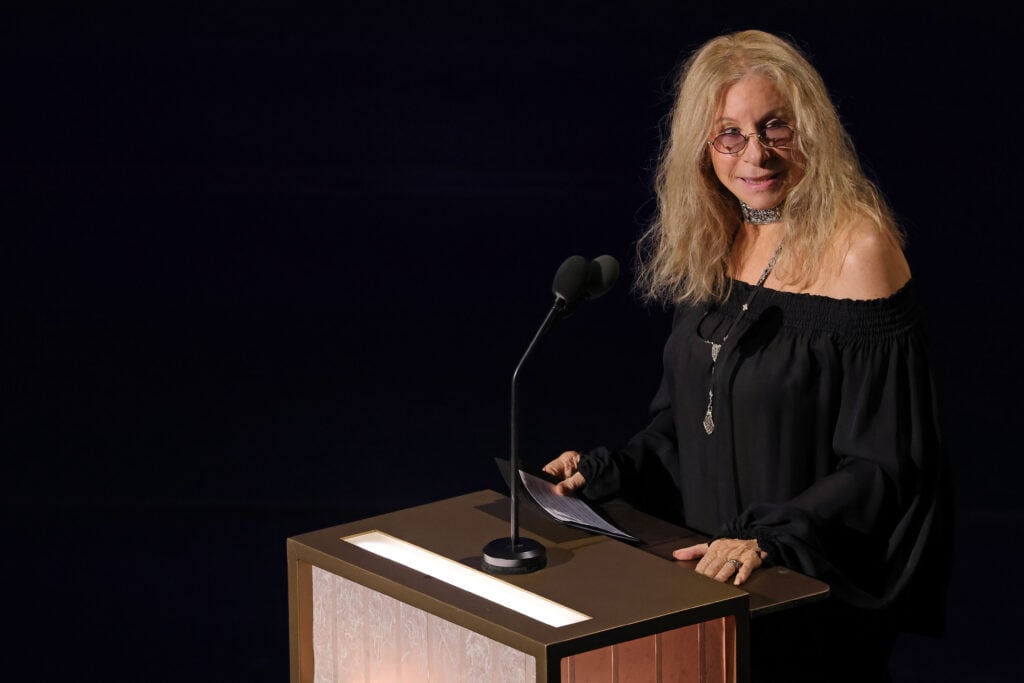
Barbra Streisand speaks onstage during the 98th Oscars at Dolby Theatre on March 15, 2026. (Photo Credit: Kevin Winter/Getty Images)
‘I am sadly unable to attend’
When Streisand skipped the Cannes Film Festival, was it just a sign of things to come?
“On the advice of my doctors, as I continue recovering from a knee injury,” she announced as explanation.
Therefore, Streisand shared in her statement: “I am sadly unable to attend the Festival de Cannes this year.”
“But I am deeply honored to receive the honorary Palme d’Or,” she affirmed, “and had so been looking forward to celebrating the remarkable films of the 79th edition.”
Streisand continued: “I was also very much looking forward to spending time with colleagues whom I so admire — and, of course, returning to France, a place I have always loved.”
RadarOnline reports that there is allegedly more than her knee recovery at work.
“With Barbra’s resources, a bad knee alone would never stop this trip to France,” a source claimed.
“She flies private. She would have had medical staff, assistants, whatever she needed,” the insider listed.
According to the source: “This is much bigger than mobility issues.”
What is the real cause? It may be her big public appearance in March.
‘Right now the focus is Barbra’s health’
During the Academy Awards, an emotional Streisand honored the late Robert Redford.
Her tribute included singing several lines from the theme song of The Way We Were, a 1973 drama in which both starred.
The audience broke into thunderous applause.
However, online, people were less than kind about her Oscars performance. Some were even cruel.
As a result, it seems that her confidence in public appearances may have been shaken.
“The reaction shook her confidence badly,” a source described.
The insider added: “Barbra has always been incredibly sensitive and when she feels exposed or vulnerable, she disappears.”
That much is no secret. After all, The Streisand Effect is arguably better known than the Yentl star herself.
“Don’t expect another concert,” warned a second insider. “Right now the focus is Barbra’s health, her comfort, and protecting her from unnecessary stress that could kill her.”
She is 84 years old. But her age could also explain why doctors would prefer that she not cross any oceans or accept any awards while her knee recovers.
Imagine spending six hours on just one verse—Keith Urban’s dedication to his craft is something to admire. Continue reading…The Boot – Country Music News, Music Videos and Songs