Ahead of the United States’ World Cup opening match against Paraguay on Friday, former U.S. men’s national team assistant coach and current Canada head coach Jesse Marsch shared his experience leading the USA in the 2010 World Cup. Marsch threw a dig at the U.S. team, and former players did not hesitate to respond. But let’s back up. Marsch opened up about his time leading USA under former head coach Bob Bradley, and commented about his perspective around the players — specifically what he thought was lacking. “In the U.S., we had to beg players to sing the national anthem,” Marsch said. Marsch’s comments did not faze FOX Sports’ Clint Dempsey — who played for Marsch and the American national team in the 2010 World Cup. “I can’t take that guy too seriously,” Dempsey said ahead of Canada’s opening match against Bosnia and Herzegovina on Friday. “It was an honor for me, growing up and representing my country. I wasn’t someone who would normally sing. I put my hand over my heart and pray to the good man upstairs.” Dempsey remains one of the USA’s most talented players across his three World Cup appearances — he was the only player to score in all three — and recorded 54 goals in 141 appearances with the United States. When it comes to playing for the U.S., Dempsey emphasized his experience representing his country. “I bled for this country. I broke my nose playing for this country. I came back from two heart procedures and played for this country,” Dempsey added. “I’m not going to take advice from someone who switched to the other side and is singing for another country’s national anthem.” Marsch assisted Bradley from 2010-2011 and was a part of the Americans’ 2010 World Cup staff when the squad posted a first-place finish in Group C before being eliminated by Ghana in the round of 16. Marsch was strongly considered taking over as the United States head coach in 2023, but he was ultimately sidelined when former coach Gregg Berhalter was rehired. Additionally, FOX Sports’ Thierry Henry offered his advice to Marsch ahead of his World Cup debut. “You got to walk the walk and talk the talk. You can’t hide behind the fact that you are a decent team,” Henry said ahead of Canada’s opener. “You took a job, by the way, that someone started… That team was already there when he arrived. Yes, he elevated them. Let’s see what he can do today against Bosnia [and Herzegovina].” Since Marsch arrived to Team Canada in 2024, he has accumulated a 12-12-5 record.Latest Sports News from FOX Sports
The world’s most famous singer was flanked by friends Mariska Hargitay and the Haim sisters, all of them wearing t-shirts featuring puns on the team’s name (Taylor’s read “Stevie Knicks).
When the Knicks won, Taylor seemed as happy as a million Chalamets — but like everything she does, her attendance quickly became a source of controversy.
Taylor Swift attends the Songwriters Hall of Fame 55th Annual Induction and Awards Gala at Marriott Marquis Hotel on June 11, 2026 in New York City. (Photo by Jamie McCarthy/Getty Images)
Now, Taylor spent years living in Manhattan, and she considers New York her adopted hometown.
But lots of folks are questioning her legitimacy as a Knicks fan. In short, she’s being accused of an egregious act of bandwagon jumping.
Normally, that’s a pretty innocuous crime, and most sports fans are a little bit guilty of it at one point or another (hey, you have to do something when your team is eliminated from the playoffs).
But as Mariska knows, some violations are considered especially heinous, and in the eyes of New Yorkers, a casual fan claiming four courtside seats is a capital offense.
Some believe that even Selena Gomez shaded Taylor’s Knicks fandom, a rumor that arose when Selena commented “lol” on a post about Swift sitting courtside.
Selena’s Instagram Story. (Instagram)
But as TMZ points out, Selena has since clarified the matter, insisting that she did not intend to insult her bestit.
“Woke up and was sent so many texts. I would never insult my friends nor was it an insult,” she posted.
The same cannot be said of New York sports journalist Monica McNutt, who was caught remarking on Taylor’s presence in an unfortunate hot mic moment.
“She’s not a Knicks fan. Get out of here, girl,” McNutt said ahead of the game.
In remarks to TMZ, McNutt later clarified that she stands corrected and has since learned that Taylor is actually a diehard Knicks fan who owns such coveted merch as a game-worn Amar’e Stoudamire jersey.
McNutt stated that her original comment was merely a reflection of the fact that she had been covering Celebrity Row all season and had not seen Taylor attend a game.
So there you have it. Taylor has the express written, authorized approval of the Knicks media team.
Will she be in the crowd on Tuesday if the Spurs manage to send the series back to New York? Maybe.
But Taylor is probably hoping Jalen Brunson and company will get the job done tomorrow night.
Dr. Mehmet Oz, administrator of the federal Centers for Medicare & Medicaid Services, speaks at the Department of Health and Human Services in Washington, D.C., in December. CMS this week released guidance on how states should implement new Medicaid work requirements. (Photo by Alex Wong/Getty Images)
The Trump administration has issued final rules on how states should ensure that millions of Medicaid enrollees prove they’re working or completing other activities, such as job training, volunteering, or being enrolled in an educational program.
The Centers for Medicare & Medicaid Services released the rules on June 1. That deadline was set last year in the GOP tax-and-spending law known as the One Big Beautiful Bill Act, which established a work requirement for certain people enrolled in Medicaid, the state-federal health insurance program for people with low incomes or disabilities.
Medicaid agencies are scrambling to rework IT systems and make sure they have staff to effectively enforce the rules, while also keeping enrollees from losing coverage for administrative reasons, such as difficulty navigating state eligibility portals.
The newly announced regulations offer a clearer picture of what roughly 18.5 million Medicaid enrollees will have to do to prove they qualify for benefits.
Jim Torres, who helps people enroll in health coverage at the Samuel U. Rodgers Health Center in Kansas City, Missouri, said a “very small percentage” of his clients have heard of the changes coming to Medicaid.
“These folks have very busy lives. They’re doing the best they can to get by,” he said. “It’s just not a top-of-mind thing for most of them.”
Health policy researchers and consumer advocates said enrollees should keep a few things in mind as the Jan. 1, 2027, rollout approaches in most states.
1. The work rules won’t apply to everyone.
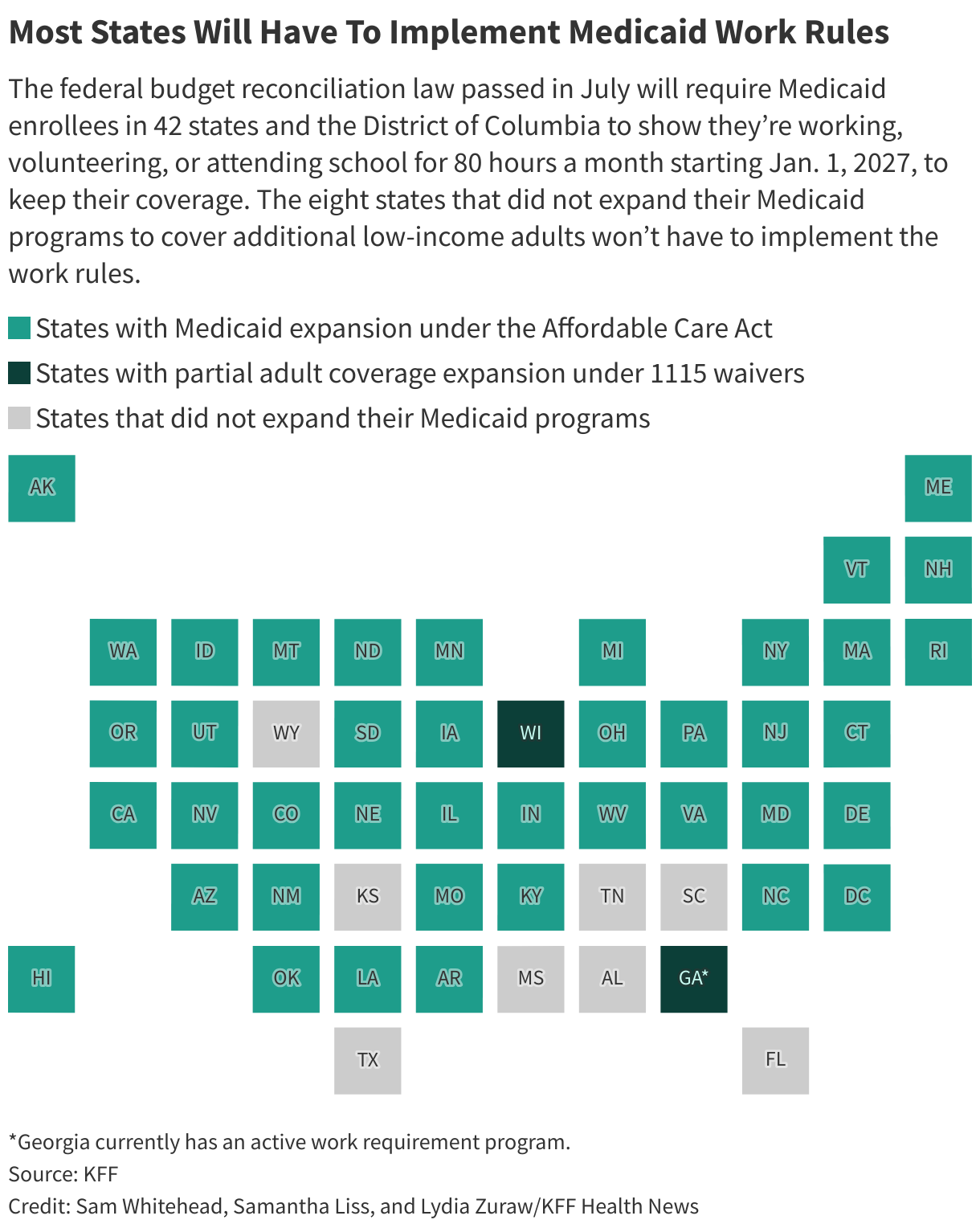
The new rules will apply to people covered through what’s known as Medicaid expansion. Since 2014, more than 40 states and the District of Columbia have decided to allow more people into their Medicaid programs, generally low-income adults without dependents. Georgia and Wisconsin offer coverage to some people in this group, so they’ll be subject to the rules.
Children and pregnant people, as well as individuals with disabilities who receive Social Security payments — all groups that already qualify for Medicaid — won’t be subject to the rules. Nor will people determined to be “medically frail,” or too sick to work.
People subject to the work rules are “crowding out” people in the Medicaid program who are “truly in need,” CMS Director Mehmet Oz claimed during a June 1 press call. “Work requirements are going to turn this around, we hope.”
2. States will take your word that you’re too sick to work. For now.
Federal officials have stressed that states should make the process of reporting hours and requesting exemptions as simple as possible for Medicaid enrollees by creating automated systems and using existing data sources, such as unemployment and education records.
If states cannot determine you’re performing 80 hours of qualifying activities a month using those data sources, you may be allowed to “self-attest” to that in 2027, health policy researchers said.
People will also be allowed to “self-attest” that they are too sick to work in 2027, and do so one time in 2028. Then states will start asking for proof, if they can’t find it through available data.
But after the initial rollout, the burden of proof is likely to still fall on many enrollees, said researchers and consumer advocates.
People may need to dig up pay stubs, medical records, and doctors’ notes and submit them for state review, said Morgan Henderson, who has studied Medicaid work programs in Georgia and Arkansas at The Hilltop Institute, a research center at the University of Maryland-Baltimore County.
“The higher this manual reporting burden, the less people are going to do it,” he said. “That means that we’re going to see coverage drop-offs.”
3. The rules are tougher than expected for people too sick to work.
One of CMS’ primary goals has been to “protect vulnerable populations” through “strong exemptions to make sure people who can’t reasonably be expected to work are not subject to the requirements,” Dan Brillman, a deputy administrator at the agency, said during the June 1 press call.
Consumer and patient advocates, however, said the final rules’ exemptions are more restrictive than expected. Enrollees will eventually have to provide documentation, such as a statement from a medical professional, to prove that a health condition keeps them from working. And each individual state will have to determine the severity of beneficiaries’ medical conditions.
“Someone could be medically frail in Nebraska but not medically frail in Delaware,” said Carolyn Sheridan, associate director of state policy for the National Organization for Rare Disorders, which lobbies for patients with rare diseases. She said her group had hoped the rules would offer a standardized definition of who counted as medically frail and not leave the decision up to states.
Trump administration officials have publicly crusaded against fraud in government health programs, such as Medicaid, and states could face financial penalties for incorrectly granting people exemptions from the work rules, said Jennifer Tolbert, who researches Medicaid at KFF, a health information nonprofit that includes KFF Health News.
“States may be more cautious,” she said. “That will likely lead to people losing coverage who may still be eligible.”
4. Only certain qualifying activities count.
Enrollees can satisfy the rules by working 80 hours a month. They can also be enrolled in college courses, volunteer through a community organization, or do “in-kind” work that doesn’t result in pay.
The rules set out, in detail, how many academic credit hours translate to 80 hours a month — students need to be enrolled in six credit hours per semester to meet the “half-time” requirement. An unpaid internship can count toward the 80 hours.
People can also prove they’re volunteering with “a document from a community service organization.”
Consumer advocates say it might be hard for people to obtain proof they’re performing these kinds of informal activities. But supporters of the rules say volunteerism can already be tracked.
“If you run into trouble with the law and the judge says, ‘Hey, you need some volunteering and community service to serve your time,’ there are already ways that we verify that,” said Niklas Kleinworth, who works on state health policy for the conservative Paragon Institute.
5. You have time to prepare.
Make sure your state Medicaid agency has your current mailing address and keep your eye on your mailbox, said researchers and consumer advocates. State Medicaid agencies must inform you in two ways if you’ll be subject to the rules — by either regular mail or email, and by one other form of communication, such as a text or phone call or by posting a notice online.
“The important stuff comes by mail,” Henderson said.
And check in with your state Medicaid agency, said researchers and advocates. Some states, including Arkansas, California, and Wisconsin, have already posted information about the work rules on their websites. If you can’t find what you’re looking for there, visit or call a local office. A caseworker should be able to tell you whether you’ll be subject to the rules.
“Get ahead of this,” said Joan Alker, executive director of the Georgetown University Center for Children and Families and studies Medicaid. “So that you don’t end up going to the pharmacy one day and they say, ‘Oh, you’re not insured anymore’ when you’re trying to get your prescriptions refilled.”
KFF Health News correspondent Samantha Liss and senior correspondent Rachana Pradhan contributed to this report.
Have you tried to prove your eligibility for Medicaid under new rules that require people to show they are working, going to school, or participating in another qualifying activity? Click here to contact KFF Health News.
KFF Health News is a national newsroom that produces in-depth journalism about health issues and is one of the core operating programs at KFF—an independent source of health policy research, polling, and journalism. Learn more about KFF.
Koe Wetzel has spent the past year putting together his brand-new record, The Night Champion. Today, June 12, his sixth studio album finally arrives via Columbia Records, giving fans a taste of everything that has led up to him becoming best version of himself.
A few days before the highly anticipated release, Wetzel made the trip to Chicago to give a select group of fans an early listen. He performed a few of the songs that reflect spirit of the project produced by Gabe Simon, and its underlying theme of resilience as he celebrates surviving the “night side” of himself and coming out a champion.
“We’ve been listening to it damn near every day through the mixing process and the master process. But I think we got something really special with this record,” he admitted to the crowd at Carol’s Pub.
Photo Courtesy of Koe Wetzel
While the Texas native taps into his deep thoughts and vulnerable emotions throughout the 11 tracks, he doesn’t lose sight of his signature gritty, hard-edged sound. Listeners will even get a dose of lust, romance and heartbreak come to play with songs like “Magnet,” “I’ll Lock Up,” “Dollar and a Bottle” and more.
“It’s kind of where I am now: an edgy roughness to all of the songs that doesn’t give a f*ck, but there’s a tenderness to it, too. Whatever happens, I’m man enough to deal, but the focus and headspace have shifted; I’ve grown up and become okay with looking back,” he admitted.
Koe Wetzel; The Night Champion
Wetzel only included one outside cut on the entire project, “Circus.” While introducing the track to fans in Chicago, he explained it was the only song he didn’t write on the record and said there was a “damn good reason” it made the final tracklist.
The song, penned solely by Sam Harris, taps into the gap between how life was imagined versus how it actually turned out. In this case, Wetzel reflects on the dreams he once had and contrasts them with the reality, which feels much heavier and less glamorous.
Then there’s the “really sad cowboy sh**” on the record, as Wetzel describes, that comes through in songs like “When I Was,” featuring harmonies from Maggie Antone.
“We had her come on and throw some harmonies on it and it really made the song what it is,” he said of Antone’s vocals. “I’ve been telling everybody that this is probably one of the slower, sadder songs that I’ve put out in a very, very long time. I’m really excited about this tune.”
Whether you’re a fan who’s been here since day one or who jumped on the train during Wetzel’s most prominent radio hit is “High Road,” The Night Champion serves as the perfect place for all listeners to meet in one place and experience where the singer/songwriter is at in his life now.
“In a lot of ways, it’s closing a chapter, and opening another one for what’s to come for the next 10, 12 years,” Wetzel admitted.
Following “High Road,” Wetzel returned to country radio with “Hurts Like You,” the lead single from his new project. Now he is gearing up to take the new music on the road during his 50+ date The Night Champion World Tour. The trek launches July 8 in Edmonton, Alb. and will continue with several dates across Canada before returning to the U.S. on July 23 with a show in Nampa, Idaho and running through the fall.
Fans will soon get the chance to relive the magic of CMA Fest as country music’s biggest stars take over the small screen for CMA Fest presented by SoFi, returning to ABC and Hulu later this month.
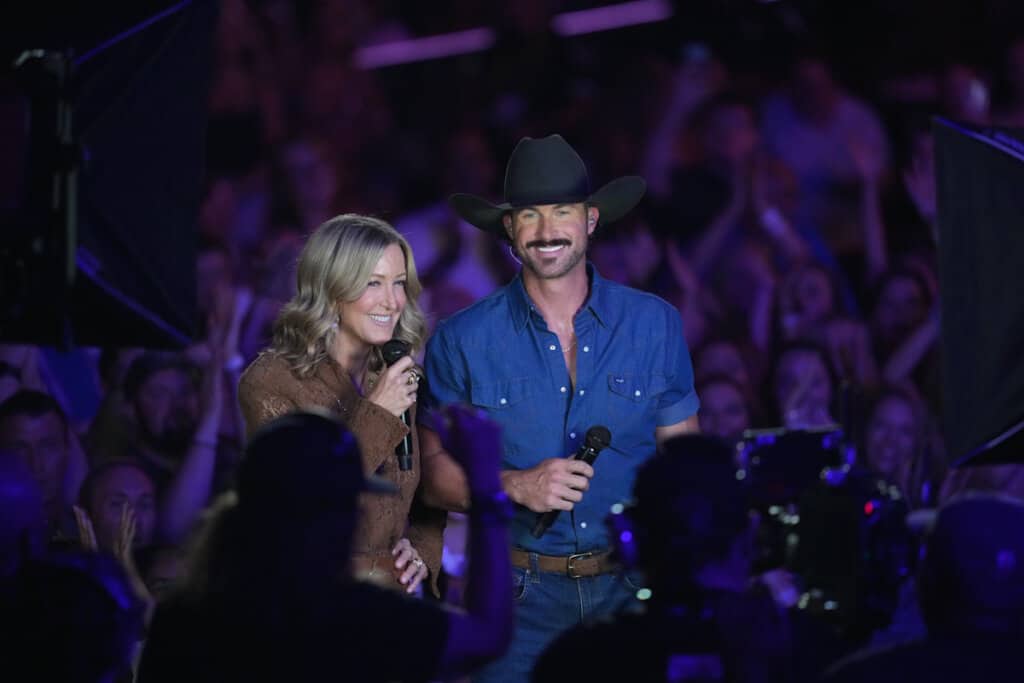
As anticipation builds, the Country Music Association and ABC have revealed the star-studded lineup for the three-hour concert special, which will be hosted by country superstar Riley Green alongside Good Morning America co-host Lara Spencer.
Riley Green and Lara Spencer host the 2026 CMA Fest presented by SoFi at Nissan Stadium on Friday June 5, 2026 in Downtown Nashville; Photo Courtesy CMA
The special will feature performances from Bailey Zimmerman, Blake Shelton, The Band Perry, Brothers Osborne, Carly Pearce, Cody Johnson, Deana Carter, Ella Langley, Fetty Wap, Florida Georgia Line, Gretchen Wilson, HARDY, Jason Aldean, Jelly Roll, Jordan Davis, Keith Urban, Lainey Wilson, Luke Bryan, Michael McDonald, Molly Tuttle, The Red Clay Strays, Ricky Skaggs, Riley Green, Russell Dickerson, Shaboozey, Shay Morgan, Stephen Wilson Jr., Tim McGraw, Tucker Wetmore, and Zach Top.
Airing Thursday, June 25 at 8/7c on ABC and streaming the next day on Hulu, the special will give fans a front-row seat to one of country music’s biggest weekends, all set in the heart of Music City.
CMA Fest 2026
SoFi has been named the first-ever broadcast presenting sponsor and Official Bank of CMA Fest, joining the festival in a partnership centered on helping people pursue financial independence through music. As part of the collaboration, SoFi will highlight standout performances, including country icon Deana Carter and the live debut of Shaboozey’s new single, “Cowgirl.”
This year, CMA Fest — the longest-running country music festival in the world — welcomed an estimated 100,000 fans per day to Nashville. Coming from all 50 states and 39 countries around the globe, fans flooded Music City for four days and nights packed with nonstop music and no shortage of surprises.
Country Music fans can already start marking their calendars for next year’s celebration. The 54th CMA Fest will return to Nashville June 10–13, 2027, continuing its run as the longest-running country music festival in the world. Over four days and nights, fans can expect nonstop performances, surprise collaborations, and one-of-a-kind moments only CMA Fest can deliver.