Categories
Sports Fox

What Makes Mo Salah So Special? Former Egypt Coach Bob Bradley Explains

Bob Bradley woke up Monday morning and sent a text to Egypt national team superstar Mohamed Salah. He had two wishes for the player he once coached: Good luck in Egypt’s 2026 World Cup opener — and Happy Birthday. Salah — Egypt’s captain and arguably its best player ever — turned 34 years old the same day as his team’s match against Belgium in Seattle, kicking off what could be his last World Cup. And Bradley is rooting for him. “I haven’t gotten to see him in a while, and we always talk about how we’ve got to figure out a way to get together, but in the meantime, we stay in touch,” said Bradley, who previously coached the U.S. men’s national team, along with the Pharaohs, and is now a FOX Sports World Cup analyst. Expectations are high for Salah and Egypt, which aims to not only win its first World Cup match but also to advance to the knockout round of the tournament for the first time. With 67 goals and 116 appearances for Egypt ahead of the Belgium opener, the Liverpool legend also has the second-most men’s national team goals and is two away from tying current coach Hossam Hassan’s record of 69. On Salah’s birthday and ahead of the Pharaohs’ first 2026 World Cup match, we spoke with Bradley about his time coaching the Egyptian star and what makes him the beloved icon he is. This interview has been condensed and edited for clarity. Mo Salah made his Egypt national team debut as a teenager about a month before you took over as manager in 2011. When you look back, what characteristics did you see that indicated what type of player he would grow into? Two things. First, from the very beginning in training, you could see how quick and powerful he was, really dynamic. And I was fortunate that I had coached a great player named Hristo Stoichkov [on the Chicago Fire], and Hristo was also strong and powerful and is left-footed. Hristo is a player that would start in wide positions — but not stay wide and play like a winger, but find ways to make really hard runs into the box to be a goal-scoring threat. And when I got to see Salah up close, the bells in my head went off. There are so many similarities with Hristo. The second thing is how much he wanted to be coached and challenged and how you could tell he was so motivated to get better. I think that’s been something that has been evident throughout his career. He’s just constantly looking for ways to improve. You once said you “immediately” knew Salah was special. What else pointed to that for you? It was the power and the speed that he had. You could tell that he was young, but he was still strong and could get away from defenders and get into good positions. Those things just stood out immediately. When you look back, is there a favorite on-field moment that comes to mind first when you think of him? Yes. At that time in Egypt, on February 1, 2012, there was a [riot] in the stadium in Port Said, where 72 young fans were killed in the stadium after a game. When that happened, the [Egyptian Premier] League shut down, and we could only have friendly matches. We had to work very hard because our first [2014] World Cup qualifier was in June, and friendly matches had to be outside the country. So it was a really tough time, but the players were incredible. It was a time when none of them knew what was going on in their careers. They probably weren’t being paid, but they still were so committed to the national team. And it was during that period that, in these camps and with these friendly matches outside Egypt, the team started to take shape. The player who had been a big part of the team for years — African player of the year — was [Mohamed] Aboutrika. And you could see on the field the way Aboutrika and Salah developed a very good understanding. So we played the first World Cup qualifier in Alexandria against Mozambique in an empty stadium, which was obviously quite strange, and we won, 2-0. For the second World Cup qualifier, we had to travel and play in Guinea. We were down, 1-0, and then [Aboutrika] scored two goals to make it 2-1. Near the end, Guinea scored, so it looked like a 2-2 game. [Salah] played mostly on the right, and we had worked really hard on his movement — I always use this expression — from outside, meaning you’re wider on the field, to inside. After the game was 2-2, we moved forward with the ball, and he made a very strong move without the ball from outside to inside [and] received a great pass. He’s left-footed, so when he’s coming in from the right, he worked very hard on his ability to curl a ball into the far corner. So he scored the winning goal in that fashion, and I think from that moment on, he was a star, with Aboutrika, on the national team. Off the field, is there a memory that encapsulates him as a leader or as just who he is as a person, rather than a player? His teammates love him. He’s humble, and he’s just a guy with a fantastic personality. Just to see how much his teammates love him. We stay in touch, in part, because he’s always appreciated everything, and in all ways, he’s, for me, a great guy. Why do you think he’s so beloved by his teammates? How does he endear himself to them? He’s funny, he’s down to earth. He’s just good to be around and makes everybody better in a real way. Salah is obviously a huge international star, but is there something you think the masses don’t know about him but should? Probably two things. The first one is out there a little bit because people have written about it, but as a young player, he played at a team called Al Mokawloon. In English, they would call it Arab Contractors. He lived in a village outside Cairo, so it took him three to four hours to get into training and to get home. And when you travel in Egypt, there’s something called microbusses. It’s a little van [for] public transportation, but people pack inside microbusses, and he had to take a number of different microbusses and get off and get on. So his commitment just to get from where he lived in and out to training every day was incredible. And then the second thing is — and he does it very quietly — he finds many, many ways to give back to causes in Egypt. Egyptians are very proud people, and they love their country. That shows in the way he conducts himself and also in the way that he quietly supports many, many, many good causes. From a global perspective, what do you think Salah’s legacy is for the game? His legacy is that when he got to Liverpool, he exploded. And there were steps along the way, but it all came together. Everyone got to see him playing on one of the best teams in the world and become a global star that people mention with the best names in football. For that to happen for a player from Egypt, that was new, and to do it with style and class and grace and a smile, I think made it even better. In what could be Salah’s last World Cup, what are your expectations for him and for Egypt as a team? For sure hope that they can play well, that they can get out of the group [stage] and have a chance to go far in the tournament. I know that that would be his dream and his goal for himself and for the team. Do you think they can do it? I hope so. We’ll see. What three words would you use to describe Mo Salah? Humble, proud, positive.​Latest Sports News from FOX Sports

Categories
Music

The Top 20 Waylon Jennings Songs

The 20 best Waylon Jennings songs prove that without Jennings, country music simply wouldn’t be what it is today. Continue reading…​The Boot – Country Music News, Music Videos and Songs

Categories
Entertainment

Add A Splash Of This For A Better Bourbon And Coke

A bourbon and Coke is already a classic cocktail and easy to make. Adding this one ingredient, though, can give it a small boost without overpowering it.

​Mashed – Fast Food, Celebrity Chefs, Grocery, Reviews

Categories
Entertainment

Kourtney Kardashian & Travis Barker Reveal Devastating Miscarriage: ‘We Cried …

Reading Time: 2 minutes

These days, we all know Kourtney Kardashian and Travis Barker as the parents of their precious baby, Rocky.

(He’s no longer a baby, really.)

But though the public knows a great deal (perhaps too much) about Kourt and Travis’ marriage, there’s one very new piece of information.

The two suffered a devastating miscarriage. They kept it secret until now.

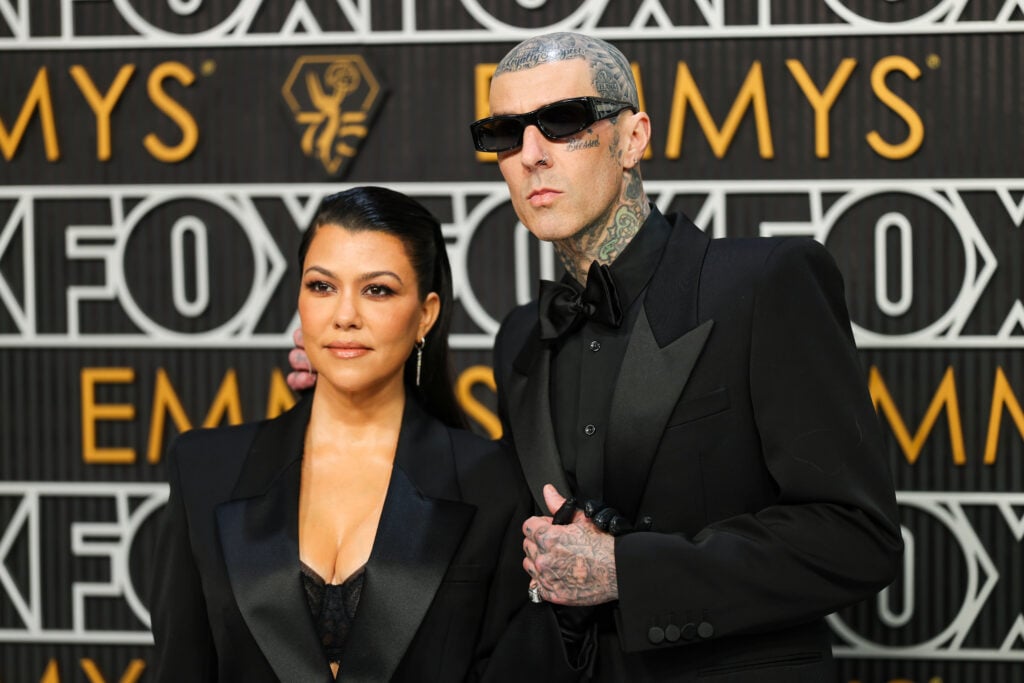
Kourtney Kardashian and Travis Barker in 2024.
Kourtney Kardashian and Travis Barker attend the 75th Primetime Emmy Awards at Peacock Theater on January 15, 2024. (Photo Credit: Neilson Barnard/Getty Images)

‘We were devastated’

The Travis Barker: Louder Than Fear documentary premiered over the weekend, at the Tribeca Film Festival.

During the documentary, it is revealed that, mere months into his romance with Kourtney, she suffered a miscarriage.

This was a dark emotional moment for them both.

“When we lost the baby, we were devastated,” Kourtney told the camera, per Us Weekly‘s reporting.

She detailed: “We cried for days.”

According to the couple, Kourt became pregnant about 6 months into their relationship.

(As fans will no doubt remember, the two first became entangled in 2021, and went on to marry in May of 2022.)

This was not a brief thing — not, for example, a chemical pregnancy.

Travis and Kourt went so far as to learn that they were expecting a girl.

Their intention was to name their potential future daughter Tulip.

Ultimately, their perseverance paid off

According to the documentary, they were at the three-month mark and attending a doctor’s appointment when they got the news.

Kourt and Travis learned that the fetus no longer had a heartbeat.

Miscarriages are devastating on multiple levels, from hormonal fluctuations to personal pain to shared grief as a couple. In some cases, people can even go their separate ways, unable to go on as before.

This was, of course, not the end of their relationship — or their attempts to have a child together.

Kourt shared in the documentary that their fertility journey included five in vitro fertilization attempts across an eight month span.

In May of 2023, Kourtney and Travis decided that they were “officially done” with IVF and resolved to conceive naturally — letting the chips fall where they may.

Just one month later, Kourt and Travis announced the pregnancy news on social media.

Kourtney very memorably showed up in the audience of Travis’ Blink-182 concert, holding a poster that read: “Travis I’m pregnant.”

Though Rocky Thirteen, their son, needed “urgent fetal surgery” before he was born, they welcomed him into the world in November of 2023. He will be 3 years old this autumn.

Kourt and Travis have received an outpouring of support from fans for what they have endured together.

Kourtney Kardashian & Travis Barker Reveal Devastating Miscarriage: ‘We Cried … was originally published on The Hollywood Gossip.

​The Hollywood Gossip

Categories
Alaska News

Final rules for Medicaid work requirements are out. Here’s what you need to know.

The Trump administration has issued final rules on how states should ensure that millions of Medicaid enrollees prove they’re working or completing other activities, such as job training, volunteering, or being enrolled in an educational program.

The Centers for Medicare & Medicaid Services released the rules on June 1. That deadline was set last year in the GOP tax-and-spending law known as the One Big Beautiful Bill Act, which established a work requirement for certain people enrolled in Medicaid, the state-federal health insurance program for people with low incomes or disabilities.

Medicaid agencies are scrambling to rework IT systems and make sure they have staff to effectively enforce the rules, while also keeping enrollees from losing coverage for administrative reasons, such as difficulty navigating state eligibility portals.

The newly announced regulations offer a clearer picture of what roughly 18.5 million Medicaid enrollees will have to do to prove they qualify for benefits.

Jim Torres, who helps people enroll in health coverage at the Samuel U. Rodgers Health Center in Kansas City, Missouri, said a “very small percentage” of his clients have heard of the changes coming to Medicaid.

“These folks have very busy lives. They’re doing the best they can to get by,” he said. “It’s just not a top-of-mind thing for most of them.”

Health policy researchers and consumer advocates said enrollees should keep a few things in mind as the Jan. 1, 2027, rollout approaches in most states.

1. The work rules won’t apply to everyone.

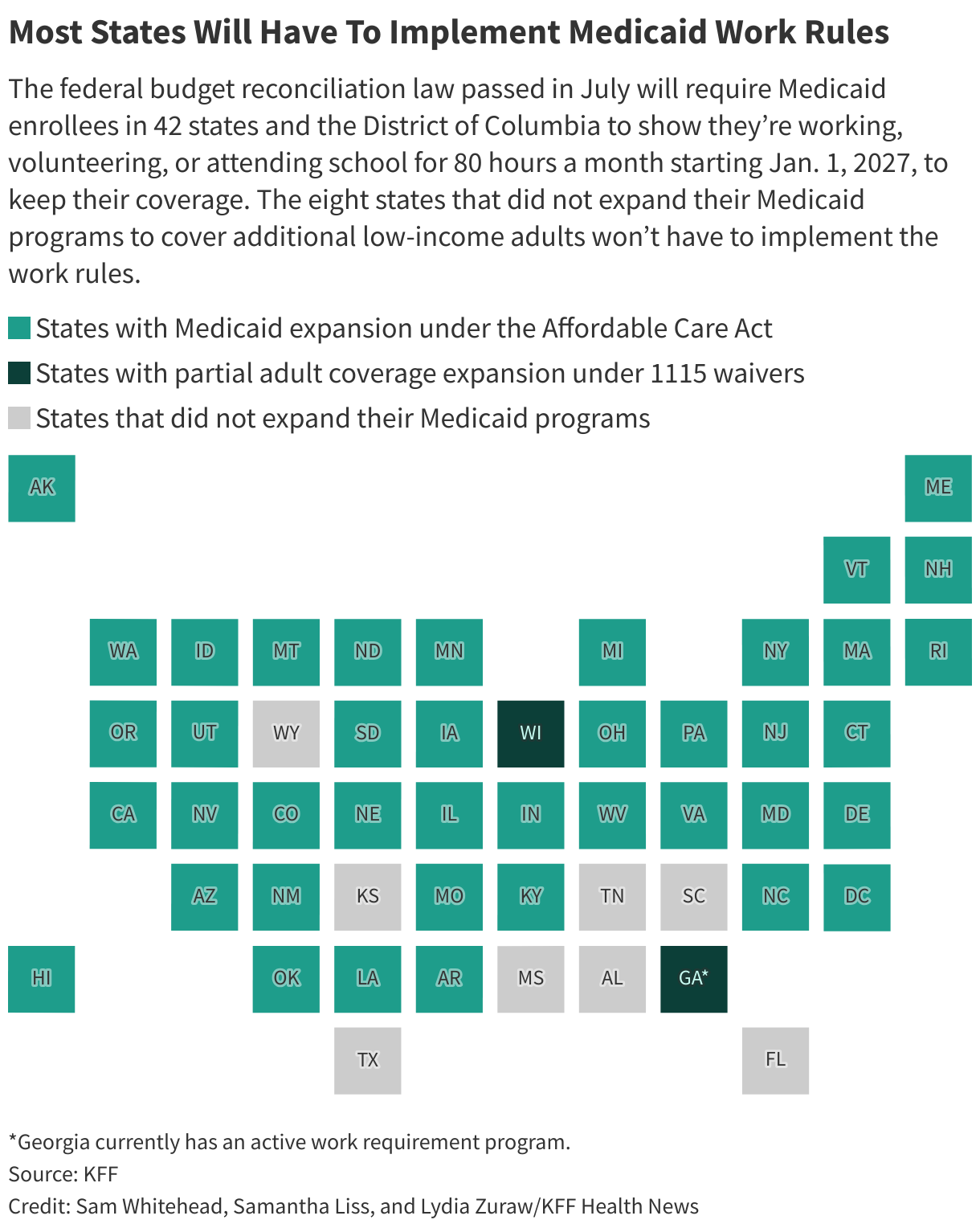
The new rules will apply to people covered through what’s known as Medicaid expansion. Since 2014, more than 40 states and the District of Columbia have decided to allow more people into their Medicaid programs, generally low-income adults without dependents. Georgia and Wisconsin offer coverage to some people in this group, so they’ll be subject to the rules.

Most States Will Have To Implement Medicaid Work Rules (Choropleth map)

Children and pregnant people, as well as individuals with disabilities who receive Social Security payments — all groups that already qualify for Medicaid — won’t be subject to the rules. Nor will people determined to be “medically frail,” or too sick to work.

People subject to the work rules are “crowding out” people in the Medicaid program who are “truly in need,” CMS Director Mehmet Oz claimed during a June 1 press call. “Work requirements are going to turn this around, we hope.”

The rules are set to take effect in most places in January. Nebraska started enforcing them in May. Montana plans to start in July but won’t kick people off until October. Arkansas will do a “soft” launch in July — it will start enforcing the rules but with no penalties until next year.

2. States will take your word that you’re too sick to work. For now.

Federal officials have stressed that states should make the process of reporting hours and requesting exemptions as simple as possible for Medicaid enrollees by creating automated systems and using existing data sources, such as unemployment and education records.

If states cannot determine you’re performing 80 hours of qualifying activities a month using those data sources, you may be allowed to “self-attest” to that in 2027, health policy researchers said.

People will also be allowed to “self-attest” that they are too sick to work in 2027, and do so one time in 2028. Then states will start asking for proof, if they can’t find it through available data.

But after the initial rollout, the burden of proof is likely to still fall on many enrollees, said researchers and consumer advocates.

People may need to dig up pay stubs, medical records, and doctors’ notes and submit them for state review, said Morgan Henderson, who has studied Medicaid work programs in Georgia and Arkansas at The Hilltop Institute, a research center at the University of Maryland-Baltimore County.

“The higher this manual reporting burden, the less people are going to do it,” he said. “That means that we’re going to see coverage drop-offs.”

3. The rules are tougher than expected for people too sick to work.

One of CMS’ primary goals has been to “protect vulnerable populations” through “strong exemptions to make sure people who can’t reasonably be expected to work are not subject to the requirements,” Dan Brillman, a deputy administrator at the agency, said during the June 1 press call.

Consumer and patient advocates, however, said the final rules’ exemptions are more restrictive than expected. Enrollees will eventually have to provide documentation, such as a statement from a medical professional, to prove that a health condition keeps them from working. And each individual state will have to determine the severity of beneficiaries’ medical conditions.

“Someone could be medically frail in Nebraska but not medically frail in Delaware,” said Carolyn Sheridan, associate director of state policy for the National Organization for Rare Disorders, which lobbies for patients with rare diseases. She said her group had hoped the rules would offer a standardized definition of who counted as medically frail and not leave the decision up to states.

Trump administration officials have publicly crusaded against fraud in government health programs, such as Medicaid, and states could face financial penalties for incorrectly granting people exemptions from the work rules, said Jennifer Tolbert, who researches Medicaid at KFF, a health information nonprofit that includes KFF Health News.

“States may be more cautious,” she said. “That will likely lead to people losing coverage who may still be eligible.”

4. Only certain qualifying activities count.

Enrollees can satisfy the rules by working 80 hours a month. They can also be enrolled in college courses, volunteer through a community organization, or do “in-kind” work that doesn’t result in pay.

The rules set out, in detail, how many academic credit hours translate to 80 hours a month — students need to be enrolled in six credit hours per semester to meet the “half-time” requirement. An unpaid internship can count toward the 80 hours.

People can also prove they’re volunteering with “a document from a community service organization.”

Consumer advocates say it might be hard for people to obtain proof they’re performing these kinds of informal activities. But supporters of the rules say volunteerism can already be tracked.

“If you run into trouble with the law and the judge says, ‘Hey, you need some volunteering and community service to serve your time,’ there are already ways that we verify that,” said Niklas Kleinworth, who works on state health policy for the conservative Paragon Institute.

5. You have time to prepare.

Make sure your state Medicaid agency has your current mailing address and keep your eye on your mailbox, said researchers and consumer advocates. State Medicaid agencies must inform you in two ways if you’ll be subject to the rules — by either regular mail or email, and by one other form of communication, such as a text or phone call or by posting a notice online.

“The important stuff comes by mail,” Henderson said.

And check in with your state Medicaid agency, said researchers and advocates. Some states, including ArkansasCalifornia, and Wisconsin, have already posted information about the work rules on their websites. If you can’t find what you’re looking for there, visit or call a local office. A caseworker should be able to tell you whether you’ll be subject to the rules.

“Get ahead of this,” said Joan Alker, executive director of the Georgetown University Center for Children and Families and studies Medicaid. “So that you don’t end up going to the pharmacy one day and they say, ‘Oh, you’re not insured anymore’ when you’re trying to get your prescriptions refilled.”

KFF Health News correspondent Samantha Liss and senior correspondent Rachana Pradhan contributed to this report.

Have you tried to prove your eligibility for Medicaid under new rules that require people to show they are working, going to school, or participating in another qualifying activity? Click here to contact KFF Health News.

KFF Health News is a national newsroom that produces in-depth journalism about health issues and is one of the core operating programs at KFF—an independent source of health policy research, polling, and journalism. Learn more about KFF.

This article first appeared on KFF Health News and is republished here under a Creative Commons Attribution-NonCommercial-NoDerivatives 4.0 International License.

The post Final rules for Medicaid work requirements are out. Here’s what you need to know. appeared first on Chilkat Valley News.

Categories
Alaska News

Alaska attorney general among those urging EPA to classify mifepristone as water contaminant

Republican attorneys general from 14 states and 19 GOP members of Congress are asking U.S. Environmental Protection Agency Administrator Lee Zeldin to classify and regulate the abortion medication mifepristone as a water contaminant.

Mifepristone is prescribed as part of a two-drug medication regimen to terminate a pregnancy. Studies have shown medication abortion to be safe and effective.

In a letter last Friday, the state officials argued that mifepristone is “a growing threat to the country’s waterways.” The letter was signed by the attorneys general of Alabama, Alaska, Arkansas, Florida, Idaho, Indiana, Kansas, Kentucky, Missouri, Nebraska, Louisiana, Oklahoma, South Carolina and Texas.

A concurrent letter, led by Republican Rep. Chris Smith of New Jersey, made similar claims and was signed by 18 other GOP members of Congress.

Environmental health science experts say there is no evidence that mifepristone in wastewater causes harm to the environment or to humans.

“There’s no evidence that medication abortion is affecting U.S. water systems, including drinking water and aquatic wildlife,” the Center for Biological Diversity, which advocates for stronger environmental protections, says on its website.

The GOP letters cite a 1996 FDA Center for Drug Evaluation and Research statement that said harmful environmental effects from mifepristone were “not anticipated,” while acknowledging that the drug may enter the environment via excretion or disposal of pharmaceutical waste. But drug trace amounts in water are a common occurrence, experts say, and state environmental agencies and scientists check for harmful contaminants in water as part of protocols and research.

In 2025, state lawmakers in seven states introduced nine bills that included claims about medication abortion and its effects on the environment and water. State lawmakers also introduced legislation calling for testing for mifepristone in water systems.

Last year, Republican members of Congress brought up similar concerns in a letter to the EPA.

The U.S. Supreme Court decided last month to preserve telehealth access to mifepristone until after the U.S. 5th Circuit Court of Appeals has ruled on the merits of the high-stakes federal lawsuit Louisiana v. Food and Drug Administration.

Medication abortion accounted for nearly two-thirds of all clinician-provided abortions in states without abortion bans in 2023, according to the most recent data available from the Guttmacher Institute, a research and policy organization focused on advancing reproductive rights.

Stateline reporter Nada Hassanein can be reached at nhassanein@stateline.org.

This story was originally produced by Stateline, which is part of States Newsroom, a nonprofit news network which includes Alaska Beacon, and is supported by grants and a coalition of donors as a 501c(3) public charity.

The post Alaska attorney general among those urging EPA to classify mifepristone as water contaminant appeared first on Chilkat Valley News.

Categories
Music

Top 10 Tim McGraw Songs – Most Important Modern Country Artists

He’s built a one-of-a-kind career. Continue reading…​The Boot – Country Music News, Music Videos and Songs

Categories
Music

Top 10 Tim McGraw Songs – Most Important Modern Country Artists

He’s built a one-of-a-kind career. Continue reading…​Country Music News – Taste of Country

Categories
Music

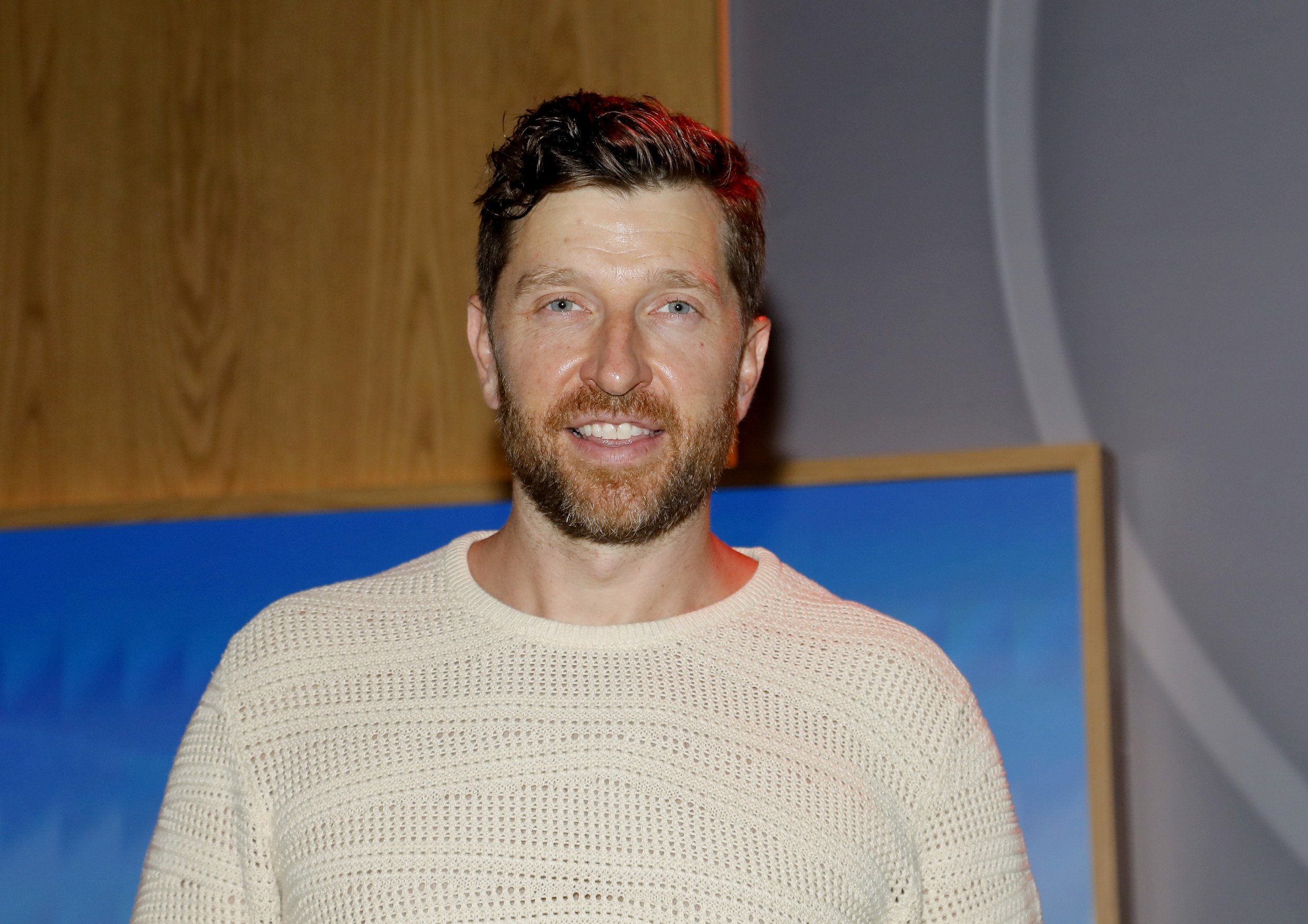
Surprise! Brett Eldredge Reveals He’s a Married Man

It sounds like Brett has found the love of his life. Continue reading…​The Boot – Country Music News, Music Videos and Songs

Categories
Music

Surprise! Brett Eldredge Reveals He’s a Married Man

It sounds like Brett has found the love of his life. Continue reading…​Country Music News – Taste of Country