Screwworm is back in the US for the first time since the 1960s. A racist mob in Belfast attacked families of color in a pogrom.
His biggest accomplishment may be that SpaceX, his rocket company, is going public — inflating its estimated valuation to thirteen digits.
The world’s richest man is set to become the world’s first trillionaire. And some of that money might be yours.
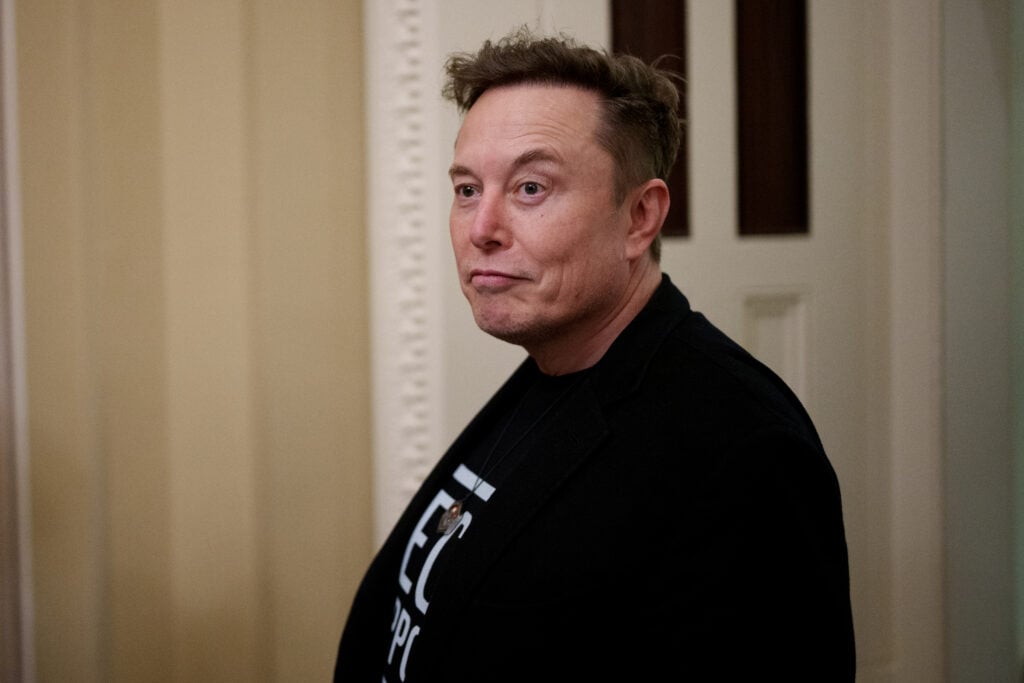
Tesla and SpaceX CEO Elon Musk departs the U.S. Capitol Building on March 5, 2025. (Photo Credit: Andrew Harnik/Getty Images)
This could make a lot of money for a few people
Friday, June 12, is the day that SpaceX went public, selling 555 million shares at $135 each.
The plan is to raise around $75 billion, elevating the company’s total estimated value to $1.77 trillion.
This is both the largest I.P.O. in history and a huge risk for investors.
The New York Times warns that analysts have argued that SpaceX is “significantly overvalued.”
SpaceX is not a profitable company. It is reliant upon government contracts and lost billions last year.
Still, many investors operate on FOMO.
For other examples, look no further than investments in LLM (“AI”) companies over the past couple of years.
These are slop projects that don’t generate profit and a bubble that is doomed to burst (sooner rather than later, please), but investors hope to squeeze as much profit out as possible — and are gambling that they’ll cut and run sooner than others when the only tech scam more annoying than NFTs finally collapses.
Say what you will about SpaceX, but while it doesn’t generate a profit, it does at least offer a product or service: rockets.
Should governments be contracting space flight to private companies instead of funding our own rockets and shuttles? Of course not. But rockets are a real product that do a measurable amount of good despite their environmental impact. That counts for something, right?
SpaceX goes public tomorrow. A wonderful moment for cynical shills and Patagonia gargoyles to roll in the filth of the dodgiest company to list since Enron. This is the last exit route for capital for a minute. A big win for horrible people, but a brief one before a dark era for Silicon Valley
Experts warn that a lot of everyday investors are unprotected and could lose a lost
Investors are one thing. What about everyday people who neither like nor trust Musk or his products?
Well, if you have certain investment portfolios, like a 401(k), you might be out of luck.
See, normally, a company that’s just gone public doesn’t get included in the nation’s top stock indexes.
However, SpaceX got fast-tracked, by their own request. That’s a little odd, especially for a company that loses billions annually.
People with investments in index fund behemoths like Fidelity and Vanguard may end up accidentally enriching Musk without their knowledge or approval. And carrying significant risk in the process.
The pogrom in Belfast in which a white nationalist mob attacked people for the color of their skin came only after Musk repeatedly boosted
Musk’s DOGE cuts as part of the Trump regime’s early months are already responsible for hundreds of thousands of deaths. One of the many victims was funding for screwworm monitoring, which works to avoid exactly the problem that has now cropped up in two US states (and counting).
That, on top of so much else, has many people clamoring for Musk to be tried at the Hague.
It’s a lovely sentiment, but a little dramatic. The United States (not to mention N. Ireland and elsewhere) has plenty of courts that will do just as well.
The good news is that Musk becoming a trillionaire is mostly a matter of valuation. People estimate that his products have some sort of value, inflated how much they guess that he’s worth, in theory. These numbers can plummet.
The even better news is that no amount of wealth actually makes someone immune to prosecution and other legal actions.
Burger King has some of the best onion rings around, but it’s not because the chain carefully selects each vegetable or uses some secret frying technique.
A German fan just turned a gas station into a global sensation—24 million views on his Bucees video! Who knew convenience stores could be this captivating? Continue reading…The Boot – Country Music News, Music Videos and Songs
A German fan just turned a gas station into a global sensation—24 million views on his Bucees video! Who knew convenience stores could be this captivating? Continue reading…Country Music News – Taste of Country
From left to right, Reps. Neal Foster, D-Nome; Calvin Schrage, I-Anchorage; and Jamie Allard, R-Eagle River; talk with Rep. Frank Tomaszewski, R-Fairbanks (facing away from camera) on Tuesday, June 9, 2026, after the conclusion of that day’s House Finance Committee meeting in Juneau. (James Brooks photo/Alaska Beacon)
The Alaska House of Representatives is planning to vote as soon as Friday morning on a proposal to cut state taxes in order to encourage construction of the proposed trans-Alaska natural gas pipeline.
On Wednesday, the House Finance Committee voted unanimously to advance a bill that would effectively cut taxes on the project by about 85% for 30 years.
Project developers have said the tax break is necessary to keep the project economically competitive in global markets, and the reduction would reduce the cost of natural gas for Alaskans across the Railbelt.
The finance committee — four Democrats, two independents and five Republicans — voted unanimously to advance the bill, indicating a broad level of support for the proposal.
Rep. Will Stapp, R-Fairbanks and a member of the committee, said on Thursday morning that he expects the bill to pass by a “wide, bipartisan margin” on Friday.
Rep. Andy Josephson, D-Anchorage, said he expects the bill to pass the 40-person House by a 3:1 margin.
“The fight in at least one chamber is over,” he said.
The bill’s fate is less certain in the Senate, where leading lawmakers have repeatedly expressed concerns about possible risks to the state and Alaska natural gas consumers.
“The bill still has a long way to go. I think we can do better,” said Sen. Bill Wielechowski, D-Anchorage, on Facebook.
The legislature is currently in a 30-day special session that ends June 19, which puts a strict timeline on action.
Under a draft schedule discussed by House lawmakers on Thursday, the House would pass the bill on Friday or Saturday, allowing the Senate to formally receive it on Monday.
The Senate Finance Committee would have a few days to examine the bill and amend it before sending it to the full Senate for a vote. There would be no time for the House and Senate version to be negotiated further: The Senate is expected to present the House with a straight up or down vote on Friday to determine whether legislators in the House agree with the Senate’s changes.
“The way this is going to play out … is that the Senate is going to have the last touch,” said Rep. Calvin Schrage, I-Anchorage.
The version of the bill that passed out of the House Finance Committee on Wednesday does have the support of Dunleavy and Glenfarne.
In a written statement, the governor thanked the committee for its work.
“Alaska has a tremendous opportunity before us, and this bill is a critical step toward making the Alaska LNG Project a reality,” he said on social media.
“The hard work by committee members produced a thoughtful bill that, if passed by the legislature, will enable Alaska LNG to go forward and unlock the long-awaited benefits of Alaska’s North Slope natural gas resources while protecting the state’s interests,” said Glenfarne Alaska President Adam Prestidge.
Rep. Neal Foster, D-Nome and co-chair of the House Finance Committee, asks a question to Alaska Gasline Development Authority officials at a May 27, 2026, hearing in Anchorage. Shown with him are other members of the committee: Rep. Alyse Galvin, I-Anchorage, Rep. Andy Josephson, D-Anchorage,a nd Rep. Calvin Schrage, I-Anchorage. (Photo by Yereth Rosen/Alaska Beacon)
A $54 billion project from North Slope to Cook Inlet
As currently proposed, the Alaska LNG project would involve constructing an 807-mile pipeline from the North Slope to a port on the Kenai Peninsula.
At the northern end would be a multibillion-dollar industrial plant needed to strip carbon dioxide from natural gas produced on the Slope. That carbon dioxide would be injected deep underground to keep it from being released into the atmosphere and contributing to climate change.
If the gas were left untreated, the carbon dioxide would create carbolic acid within the pipeline, destroying it.
At the southern end of the pipeline would be another multibillion-dollar industrial facility that takes the gas and prepares it for shipping via specialized tankers to customers in Asia and elsewhere around the world.
Prestidge has said that tax incentives are “critical” in order for Glenfarne to obtain loans and attract investors for the project.
Under new cost estimates published June 3, Glenfarne expects the project to cost between $44.5 billion and $54.5 billion altogether. The high end of the developer’s cost estimate has gone up by almost $10 billion.
Alaska currently levies a 2% tax on oil and gas property. The pipeline and associated facilities would be exempt from taxation during construction, but Glenfarne is proposing to build the project in two phases: First, the pipeline, which could transmit gas to Southcentral Alaska as soon as 2029, and second, the associated processing plants, which are expected to be online by 2033.
That schedule, coupled with the setup of the property tax, means Glenfarne would be required to start paying taxes before it begins selling profitable amounts of gas.
In March, Dunleavy introduced a bill that proposed a 90% tax cut for the project by replacing the property tax with a tax on gas shipped through the pipeline.
Legislators held dozens of hearings on the proposal and House legislators even considered a consequential pipeline-for-pensions trade, but no bill passed during the regular session, which ended May 20.
Rep. Frank Tomaszewski, R-Fairbanks (standing at left) and Rep. Will Stapp, R-Fairbanks (facing away from camera) talk with Glenfarne officials and lobbyists on Tuesday, June 9, 2026, during a break in the work of the House Finance Committee. The group was discussing an amendment proposed by Tomaszewski to a bill that would cut taxes on the proposed trans-Alaska natural gas pipeline project being developed by Glenfarne. (James Brooks photo/Alaska Beacon)
Special session advanced progress on the issue
Dunleavy immediately called a 30-day special session on the issue, and the finance committees in the House and Senate continued holding hearings.
Those continued discussions helped move the needle, Schrage said.
“I think more time to talk, time to move it through the committee process, really has been very helpful, and will help to produce a different outcome than last time,” he said, referring to the failed pipeline-for-pension arrangement.
John Sims, president of Southcentral Alaska’s largest natural gas utility, told lawmakers that the utility is already in negotiations with Glenfarne on a 30-year contract for gas at no more than $16 per mmBtu.
That’s above current prices but below the expected cost of imported gas.
Glenfarne’s Adam Prestidge said the company would be open to a cost cap on similar terms for Alaskans in general.
Members of the House Finance Committee adopted that proposal and others in close consultation with Glenfarne. During frequent breaks, legislators would duck into a hallway connected to the committee room to talk with company officials and lobbyists.
Under the draft of the bill finished Wednesday, Glenfarne would pay no taxes for five years after the first gas begins flowing down the pipeline.
For the following 30 years, Glenfarne would pay 6 cents per thousand cubic feet of gas that flows through the pipeline, 13 cents per thousand cubic feet through the North Slope plant, and another 13 cents per thousand cubic feet through the gas liquefaction plant on the Kenai Peninsula.
Ken Alper, an aide to Josephson and adviser to the Finance Committee during its deliberations, said that roughly amounts to an 85% tax cut when compared to the current property tax rate.
Of the collected taxes, 93% would go to boroughs along the route of the pipeline. The remaining 7% would stay with the state.
The new tax rate is conditional. Glenfarne would have to sign labor agreements with local unions, agree to construct a pipeline spur to Fairbanks, and pay $80 million into an impact fund.
That fund would be used to compensate borough governments for costs they incur to deal with as many as 12,000 temporary workers who would be employed building the pipeline.
Only six communities are eligible for the money in the fund: the North Slope Borough, Fairbanks Borough, Denali Borough, Matanuska-Susitna Borough, Anchorage and the Kenai Peninsula Borough.
Rep. Will Stapp, R-Fairbanks, leads a tour group through the Alaska State Capitol on Thursday, June 11, 2026, while awaiting the final draft of a bill cutting taxes for the proposed trans-Alaska natural gas pipeline project. (James Brooks photo/Alaska Beacon)
Pipeline construction isn’t guaranteed
Even if the current bill passes the Legislature and is signed into law, it doesn’t guarantee a pipeline.
In presentations to the finance committees, various consultants and experts from the Alaska Department of Revenue have said that the forecast cost of natural gas exported by Alaska LNG is very close to the cost of gas available from other sources internationally.
If the project costs more than anticipated, if natural gas from the North Slope costs more than expected, or if buyers aren’t willing to pay as much as forecast, the pipeline is uneconomical and doesn’t get built.
“I think there is a broad belief that it’s going to be a difficult project to pull off, but we want to give them a chance, and we wish them the best in doing so, because I think most Alaskans do want to see our natural gas brought to be able to benefit Alaskans,” Schrage said.
Stapp, sitting in the halls of the Capitol on Thursday and awaiting the final draft of the bill, said he believes that without the bill, there is a “zero percent chance of a pipeline.” With the bill, “there’s a 10% chance.”
Tomaszewski is more optimistic.
“I’m looking forward to the groundbreaking ceremony,” he said.
On Tuesday, 19-year-old Karmelo Anthony was found guilty of murdering 17-year-old Austin Metcalf during a 2025 altercation at a high school track meet.
The news sparked tense debate across social media, as Anthony, who is Black, was sentenced to 35 years after being convicted by a jury with no Black jurors.
Now, Congressman Randy Fine is stoking the flames of controversy by insisting that Anthony deserved an even harsher sentence.
Karmelo Anthony posed for a new mugshot before beginning his lengthy sentence. (Collin County)
“Karmelo Anthony deserves the death penalty,” the Florida congressman tweeted this week, adding:
“Anything less is unacceptable.”
Now, Anthony is a teen who committed a non-premeditated murder during a heated confrontation, all of which would make him a highly unlikely candidate for the death penalty.
But Fine doubled down on his remarks when TMZ caught up with him earlier this week.
“What he did to that kid was horrible, and I think it’s important to tell our country that we’re not going to allow that kind of behavior,” Fine told the outlet.
“Part of the reason to send a message that strong is because of all the people who didn’t think he should be punished at all.
When the TMZ journalist pointed out that Anthony could have received a lesser manslaughter conviction (and we don’t typically execute teens to make a political point in this country), Fine stood his ground.
“I think we need to send a message about behaviors we’ll put up with and behaviors that we won’t,” he said.
The Texas jury rejected Anthony’s self-defense claim, and he was eventually sentenced to 35 years in prison.
Fine was quick to express support for a harsher punishment after the verdict was revealed, maintaining that Anthony deserved the death penalty despite the fact that Texas law prohibited such a sentence because of Anthony’s age at the time of the crime.
His remarks immediately generated backlash from critics who accused him of politicizing a tragedy and inflaming tensions surrounding an already divisive case.
Others, however, applauded Fine for taking a hardline stance in support of the Metcalf family.
Prosecutors argued that Anthony escalated a dispute and fatally stabbed Metcalf, while defense attorneys maintained that Anthony feared for his safety and acted in self-defense. Jurors ultimately sided with the prosecution and returned a guilty verdict.
The mug shot of accused murderer Karmelo Anthony. (Collin County)
Even after the conviction, the case has remained a lightning rod for political commentary, with public figures, activists, and elected officials continuing to debate everything from the sentence itself to the broader issues of race, justice, and accountability raised during the trial.
Fine’s latest comments ensured that those debates aren’t ending anytime soon.
Supporters argued that the severity of the crime warranted the harshest punishment available, while opponents pointed out that Anthony was legally ineligible for the death penalty because he was a juvenile when the stabbing occurred.
The congressman’s refusal to soften his position only fueled another round of heated exchanges online, where opinions about the case remain deeply divided.
Regardless of Fine’s intentions, the fact remains that more than one year after Austin Metcalf lost his life, the tragedy continues to generate strong emotions — and politicians like Randy Fine appear determined to keep themselves at the center of the conversation.
But Brandi has also revealed that she has ringworm in her throat.
She says that she contracted the infection sexually — from dating a porn star.
The ‘Brandi Glanville Unfiltered’ wished that she had better news for listeners. (Image Credit: YouTube)
‘I feel like I have it … in my throat’
During her most recent Unfiltered podcast episode, Brandi abruptly shared some troubling news.
“I have a quick question,” she said. “Have you heard about sexually transmitted ringworm?”
What?
Brandi confessed: “I feel like I have it … in my throat.”
Though she did not name the man she suspects of giving her this infection, she did delve into some details.
According to Brandi, she was dating an adult film star — one who was, perhaps, a little naive.
“He would only, you know, my face because he didn’t want to get me pregnant,” Brandi explained.
Notably, pulling out is not a reliable form of birth control, even if perfectly executed every time. Thankfully, with Brandi, it’s moot.
“He didn’t know that ship had sailed,” Brandi revealed.
She joked: “I’m like, ‘Okay, whatever, I’m not going to correct you.’”
The eponymous host of ‘Brandi Glanville Unfiltered’ speaks on her podcast. (Image Credit: YouTube)
Okay so back to the ringworm …
According to Brandi, ringworm can go undetected among STIs because “It’s one of these things that most people don’t know what to look for.”
Unlike things like Texas’ new screwworm infestation (the first in over half a century after DOGE cut funding to the program that helped keep it at bay), ringworm is not actually a worm.
Rather, ringworm is a fungal infection of the hair, skin, or nails.
And, yes, ringworm can spread via skin-to-skin contact, including during sex.
“If it’s in your throat, they can burrow deep into your ears and all that,” Brandi characterized dramatically.
On her ‘Unfiltered’ podcast, Brandi Glanville gave a sad update on her face. (Image Credit: YouTube)
According to Brandi, ringworm can be “severe and difficult to treat.”
It’s not entirely clear if she received a diagnosis. If she did, we hope that she tells the sex worker whom she was dating. He and his professional and private partners have a right to know.
Meanwhile, Brandi has also been battling a resurgence of her “melting” face.
It’s also only been two months since she went to urgent care to get a clove of garlic — a home cure that she believed would help combat a cold — removed from her ear.
Brandi’s not having the best luck with health stuff right now. We hope that she chooses caution from here on out.
Alan draws from the gospel classic ‘He’s Got the Whole World in His Hands,’ and it fits the father-daughter theme perfectly. Continue reading…The Boot – Country Music News, Music Videos and Songs
Alan draws from the gospel classic ‘He’s Got the Whole World in His Hands,’ and it fits the father-daughter theme perfectly. Continue reading…Country Music News – Taste of Country
The generational divide between millennials and boomers is apparent in many aspects of life, including hygiene-related behaviors and consumption habits.
Health Digest – Health News, Wellness, Expert Insights