Anglers crowded Ship Creek for the Slam’n Salmon Derby, with one participant landing a 13-pound king salmon as the popular Anchorage fishing event continues.
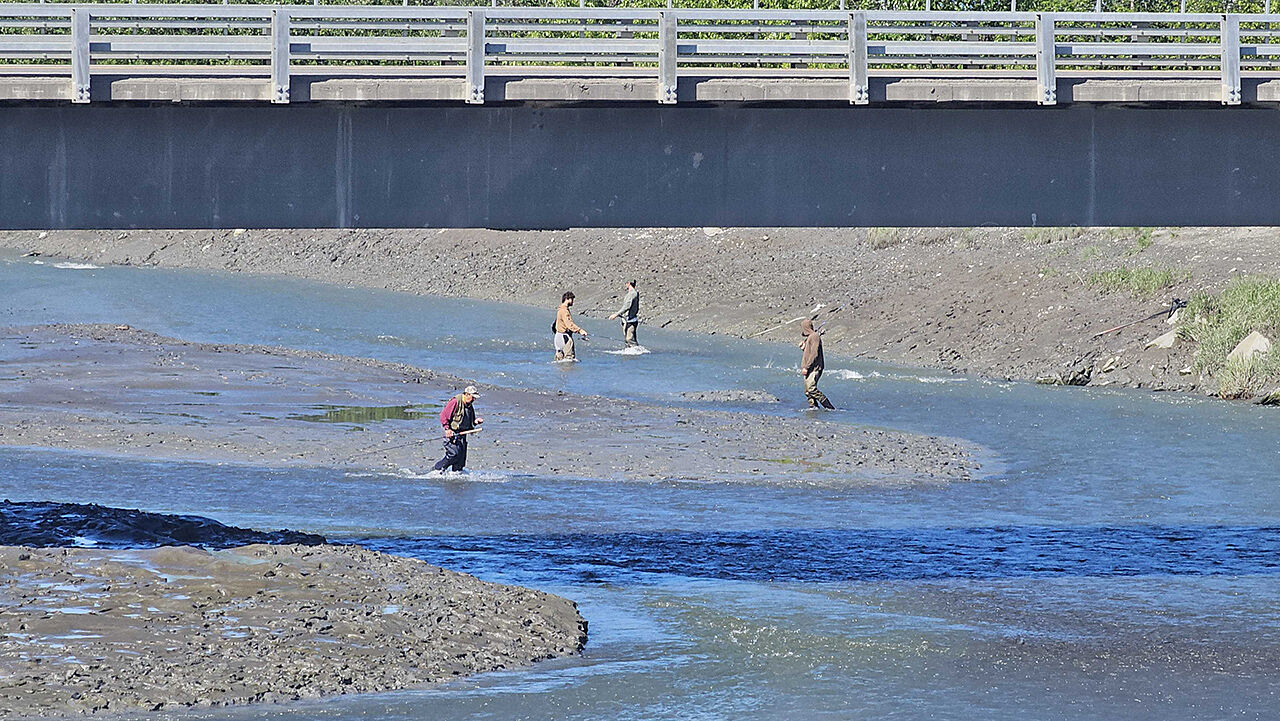








Anglers crowded Ship Creek for the Slam’n Salmon Derby, with one participant landing a 13-pound king salmon as the popular Anchorage fishing event continues.

Democrats aren’t done debating Graham Platner.
Platner’s decisive victory in Maine’s Democratic Senate primary quelled for now any serious discussion that he could be replaced as the party’s nominee in the wake of a recent bout of scandals. The party’s campaign arms were quick to indicate support for him after the race was called Tuesday night. Progressives took a victory lap while arguing their colleagues need to coalesce around the Maine nominee.
But a small yet notable faction of Capitol Hill Democrats still has qualms about the oysterman’s tumultuous past that has rattled some Maine voters — and what it could mean for their chances of defeating Sen. Susan Collins and taking back the upper chamber in November.
On Wednesday, several senators stopped short of outright endorsing Platner when asked by POLITICO.
Sen. Mark Kelly (D-Ariz.), a potential 2028 contender who has kept his distance from Platner so far, said he thought Platner can defeat Collins and that “the path for us winning back control of the Senate runs through Maine.” But he still declined to endorse Platner, saying that he’d yet to meet or speak with the nominee. Asked whether Platner had done enough to address his scandals, Kelly said the oysterman has “got things to explain.”
Sen. Catherine Cortez Masto (D-Nev.), who had previously endorsed Gov. Janet Mills in the Maine Senate race, and Sen. Tammy Duckworth (D-Ill.) also declined to endorse Platner on Wednesday. Cortez Masto rattled off other top Democratic targets in Iowa, North Carolina and Alaska, while Duckworth said she’s “focused on the Midwest.”
And Sen. John Fetterman (D-Pa.), a frequent critic of his own party who has repeatedly raised concerns about Platner, said Maine Democrats have made their choice but “I would never [endorse Platner]. I’ll be a Democrat to refuse to carry water for that.”
Even Sen. Peter Welch (D-Vt.), who said Wednesday he would support all Democratic Senate nominees, suggested the oysterman still has “work to do” to address his scandals.
“The challenge that Platner has is the challenge that any candidate has, and it’s to address in a direct way both personal and political issues that are legitimate questions for the voters. He’s got to do that,” said Welch, who had also met with Platner last week to privately urge him to address voters’ questions head on. “Until the election is over, he’s got work to do, every day in every way.”

Not every senator traditionally endorses in every race. But Democrats’ chances of taking back the Senate hinge squarely on being able to defeat Collins, the only Republican senator seeking reelection this year in a state former Vice President Kamala Harris won in 2024. The party has hoped to knock off Collins many times before only to come up short — and it’s now putting its hopes on Platner, whose campaign has electrified Maine and generated unprecedented grassroots support, but also faced a litany of controversies.
Continued Democratic division could be a boon for Republicans who are already launching into general-election attacks on Platner. Collins has repeatedly won reelection with a coalition that includes a substantial share of independents and Democratic voters, especially moderate women.
Platner’s rise came without the backing of the Democratic establishment: Senate Minority Leader Chuck Schumer (D-N.Y.) recruited Mills, who suspended her campaign in April after poor polling and fundraising numbers.
The political newcomer’s ability to challenge the establishment was part of his appeal to Maine voters, as he argued the Democratic Party had lost its way and needed to return to its working-class roots.
Some well-timed endorsements helped Platner in key moments in his primary campaign. Sen. Bernie Sanders’ (I-Vt.) early backing helped put him on the map. Sen. Ruben Gallego (D-Ariz.) gave his campaign a boost earlier this year as he faced renewed questions about a tattoo resembling a Nazi symbol. And Sen. Brian Schatz (D-Hawaii) even helped him fundraise in the aftermath of the most recent allegations.
The New York Times last week reported that several of Platner’s ex-girlfriends alleged toxic patterns of behavior, including one who said he grabbed her in ways that left marks. Before that, his campaign acknowledged he had exchanged sexual messages with other women while married. Last fall, his uncovered Reddit history included numerous offensive comments. And Platner owned up to having a tattoo resembling a Nazi symbol, although he said he was unaware of its meaning.
Platner has denied being violent with women and has argued that his past poor behavior reflects a difficult time in his life, as he struggled with post-traumatic stress disorder after leaving the military.
“I’ve made mistakes in my life, mistakes that I regret, that I lived with, that I continue to learn from,” he said in a Tuesday night victory speech. “I’m still far from perfect, but every day I wake up and I try to be a little bit better and a little bit kinder than I was the day before.”
Following his Tuesday primary victory, Platner’s Senate supporters urged their colleagues to rally behind him.
“They need to coalesce, they need to coalesce around Platner,” Sen. Elizabeth Warren (D-Mass.) told reporters on Wednesday, arguing Platner has “taken responsibility” for his past actions.
Sanders told reporters on Capitol Hill he was confident that Democrats would come around.
“Platner won a landslide victory last night, and I am quite confident that Democrats who want to regain the Senate will be supporting him as the Democratic nominee,” he said.
At least one lawmaker who had not previously endorsed Platner was ready to support him.
“Here’s a man who said ‘I made mistakes, I apologize for them, I am going to earn the trust of my constituents,’” said Sen. Mazie Hirono (D-Hawaii). “That says a lot in contrast to the president, who never admits doing anything that is untoward, and who just blames everybody else, and who prosecutes people. I think Maine voters have expressed themselves and they’re willing to give him a chance.”
Other Democrats who had been skeptical of Platner’s viability in the general election — and had considered pressuring him to drop out — now appear resigned to him staying in the race.
“It was obviously a strong result for him which I think should quiet some of the immediate anxiety, but that will return if more revelations come out,” said one senior Democratic Senate aide, granted anonymity to discuss the race candidly. “Seems like even his supporters are not really defending the conduct, so [it’s] kind of incumbent on him to try to address more fully and move on.”
Another Senate Democratic aide, also granted anonymity to speak candidly about the race, agreed: “He weathered the storm, but is he out of it? Primary night didn’t answer that question. The next several weeks will determine whether this campaign is a referendum on his personal conduct or Susan Collins aligning with an unpopular GOP agenda that is hurting Mainers.”

Republicans have indicated they will try to make Platner’s controversies central to the race, with the National Republican Senatorial Committee and a pro-Collins super PAC launching ads that highlight some of the Democrat’s past Reddit comments. Platner, meanwhile, in his first general election ad on Wednesday, went after the “Epstein class” but did not mention Collins.
Sen. Elissa Slotkin (D-Mich.) said her thinking on the race had not changed from a few weeks ago, saying she plans to “work with whoever the Mainers elect, period.”
“The way that this president has completely railroaded my Republican colleagues in this body, they don’t deserve to run a separate branch of government,” she said. “And if we want any chance of putting a check and balance on him that involves electing Platner.”
Asked whether Platner needs to do more to address his past scandals, Slotkin simply replied: “I just hope I’m not caught again live on TV answering the same questions about bad behavior.”
Jordain Carney contributed to this report.
Politics

You might think that practically everything that McDonald’s makes comes with a fresh seasoning of salt after it’s cooked, but this isn’t the case.

Food Republic – Restaurants, Reviews, Recipes, Cooking Tips

Benjamin Kugtsun, right, gathered melting ice and snow in May from a pond near Kipnuk. His friend and cousin Burt Paul sits at left with his dog Koda. Paul and Kugtsun never left Kipnuk after ex-Typhoon Halong wreaked havoc on the community last fall, and instead decided to stay and rebuild. (Katie Baldwin Basile for Northern Journal)
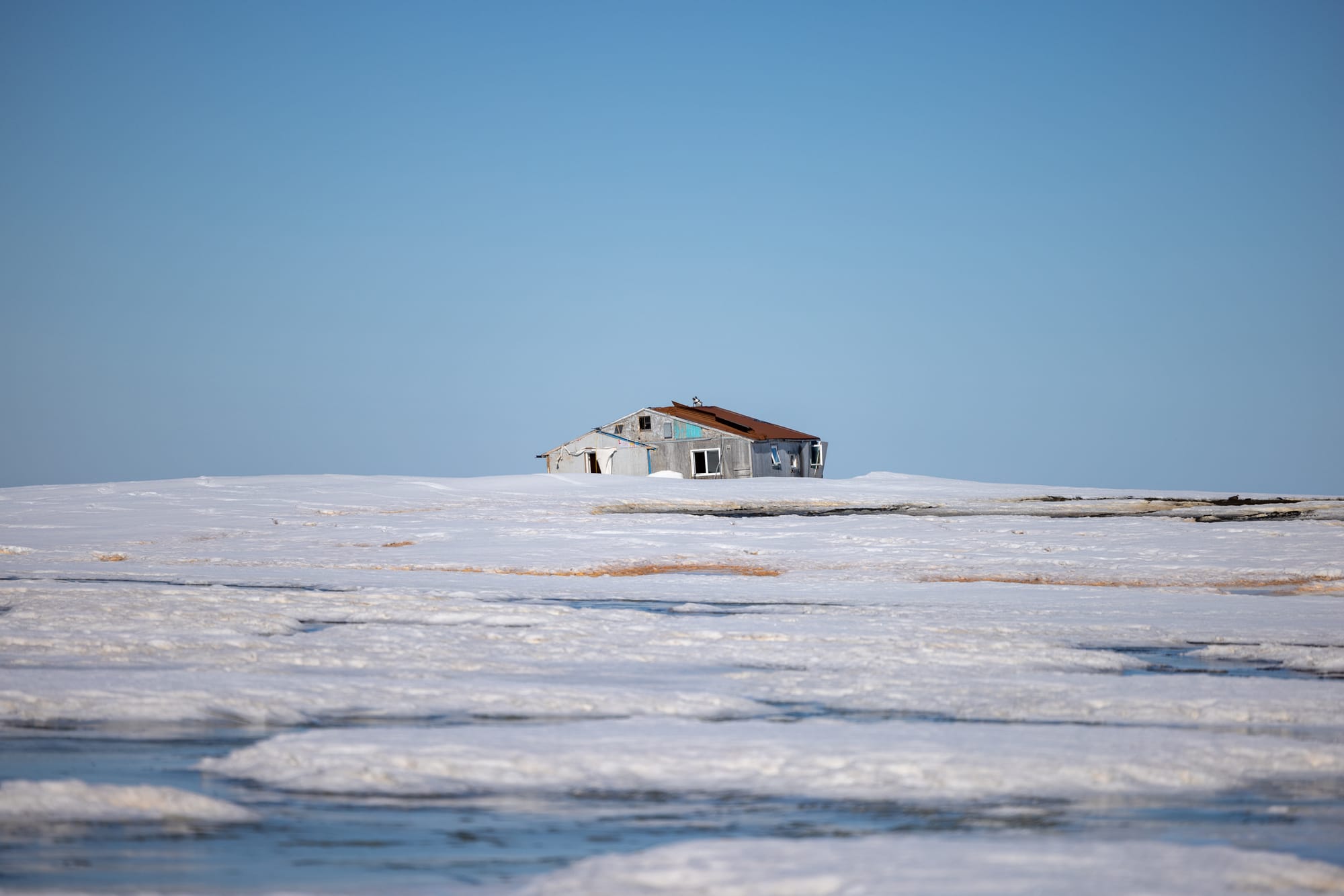
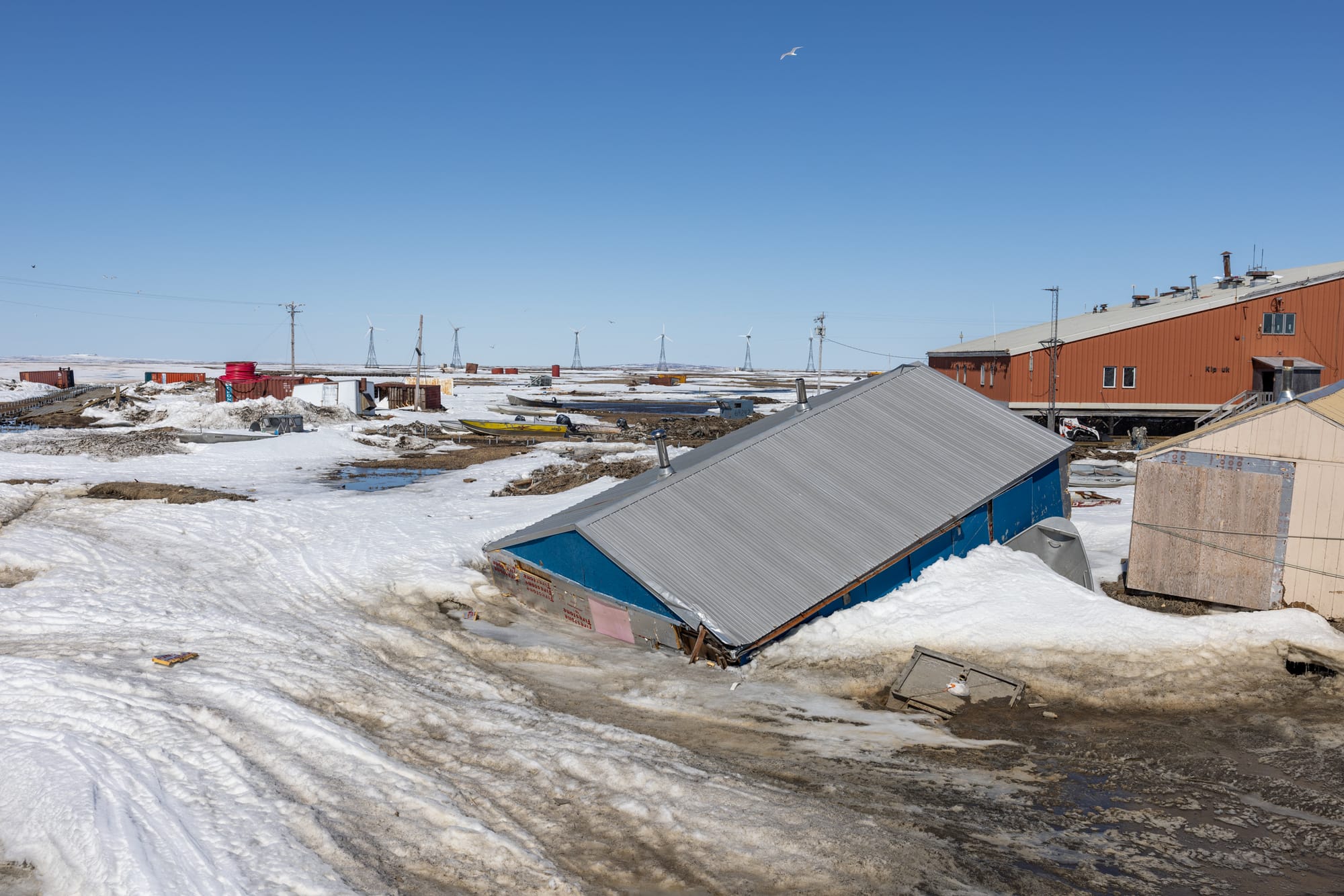
When ex-Typhoon Halong flooded the Western Alaska village of Kipnuk last fall, a mass evacuation followed.
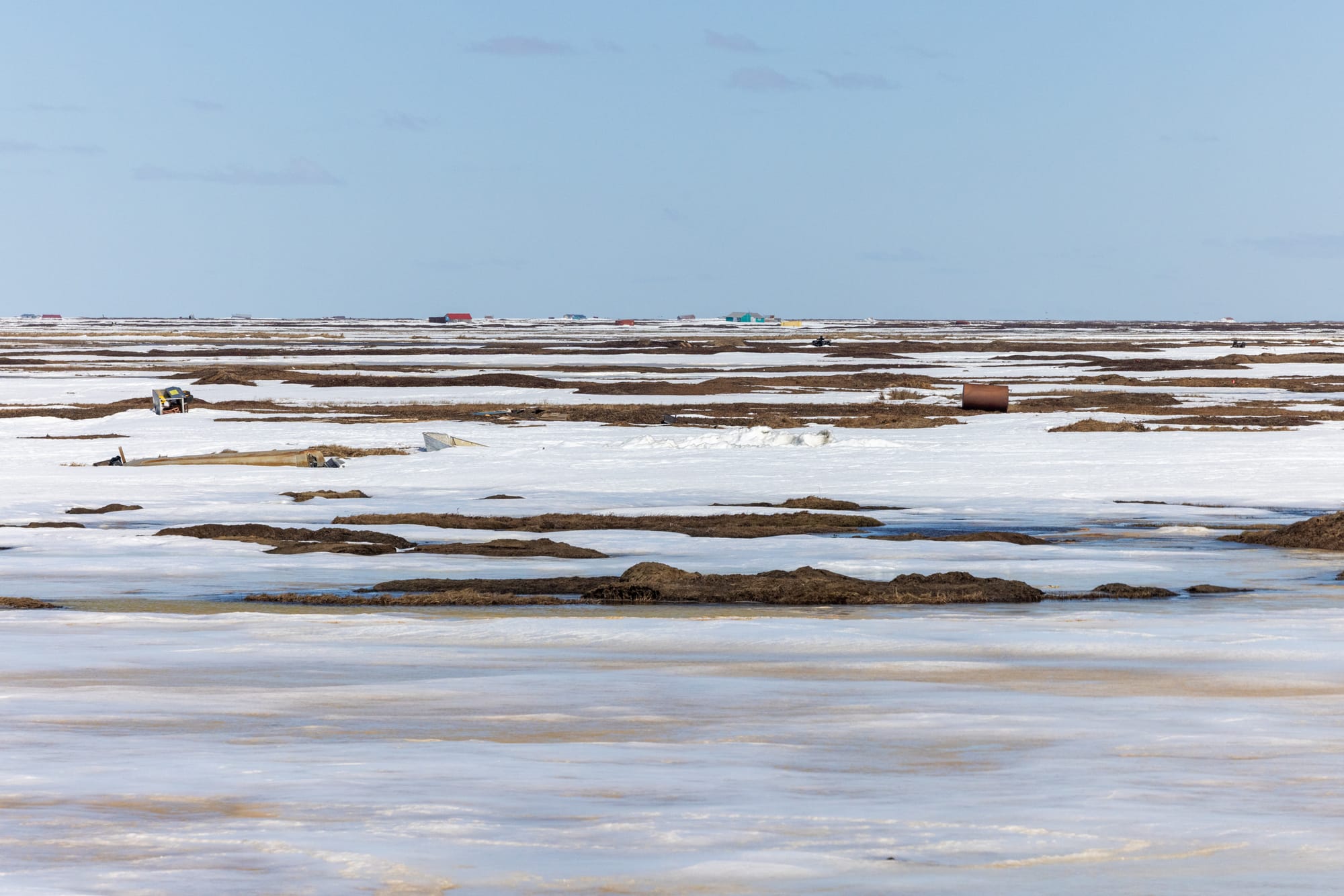
Homes were displaced, with some 90% of the village’s structures destroyed, according to Gov. Mike Dunleavy. Most people made the difficult decision to leave the village.
In the end, 19 people stayed behind, determined to see Kipnuk rebuilt — a tiny fraction of the nearly 1,000 people that tribal leaders say lived in the village before the flooding.
Kipnuk was the hardest hit during the storm, but Halong also caused widespread damage in other communities across Western Alaska, including the village of Kwigillingok.
Burt Paul and Benjamin Kugtsun are two of those who remained in Kipnuk.
Cousins and best friends, the two believe that despite the damage, the village can still serve as an interim home for community members while they wait to relocate to higher ground — a long-term goal that tribal leaders announced in March after a formal vote.
Before Halong hit, Burt was a Yup’ik culture and language teacher at the Chief Paul Memorial School. I visited his classroom May 8 and spoke with him and Benjamin.
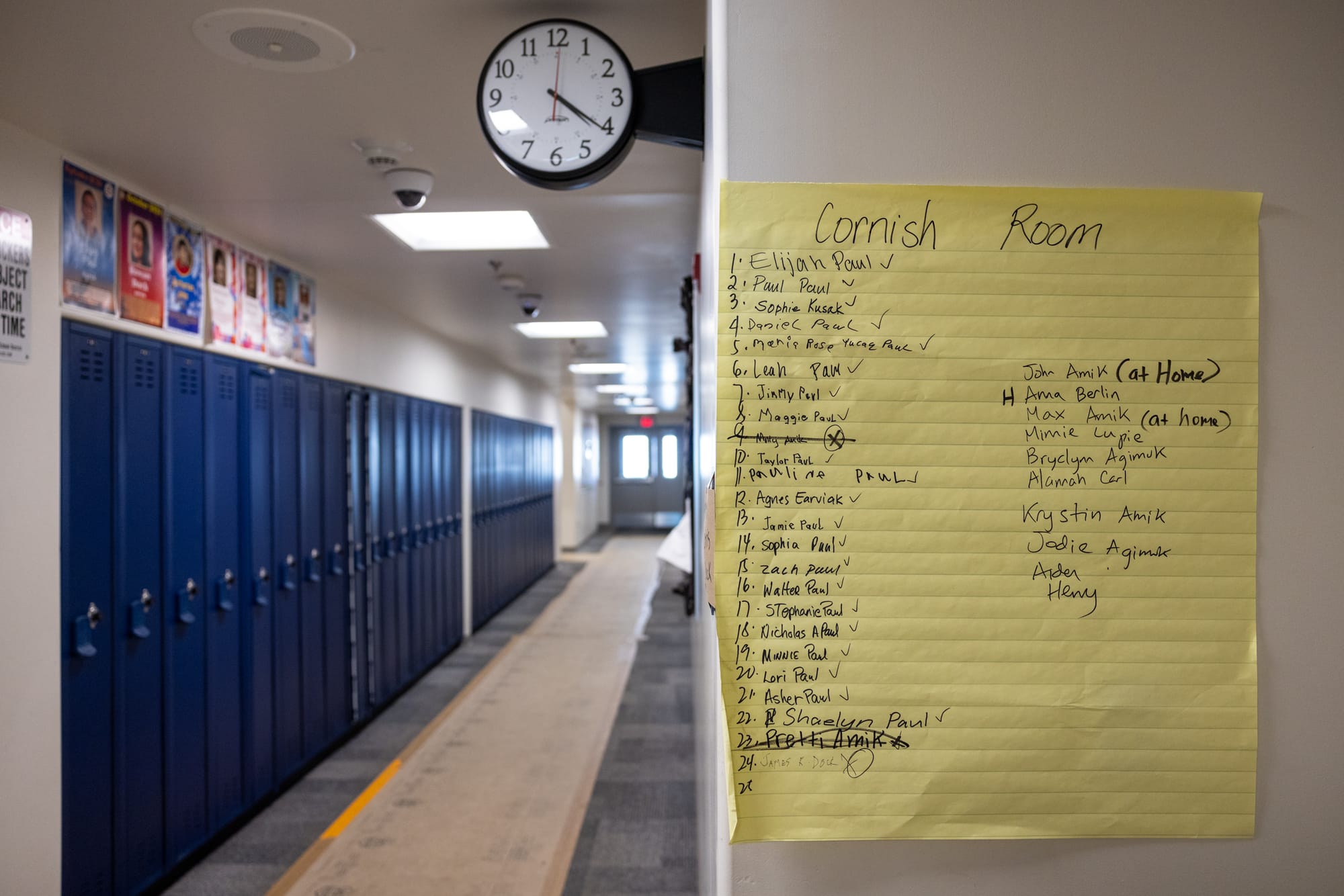
Posters highlighting traditional Yup’ik values and books by regional authors like Elsie Mather and Paul John filled the space, along with a coffee maker, pillows, mattresses and blankets. For the past seven months, the classroom was a dorm room for both men while they worked with contractors to repair homes and village infrastructure.
In this conversation — the first in a series of dispatches on Halong’s survivors — Benjamin and Burt reflect on the difficult night that the storm arrived in October, their lifelong friendship and the reasons they stayed behind.
The discussion has been edited for clarity, and condensed.
Katie Baldwin Basile: Did you ever leave Kipnuk after the typhoon?
Benjamin Kugtsun: No. We stayed here after everybody evacuated, we stayed behind.
Katie: What made you decide to stay?
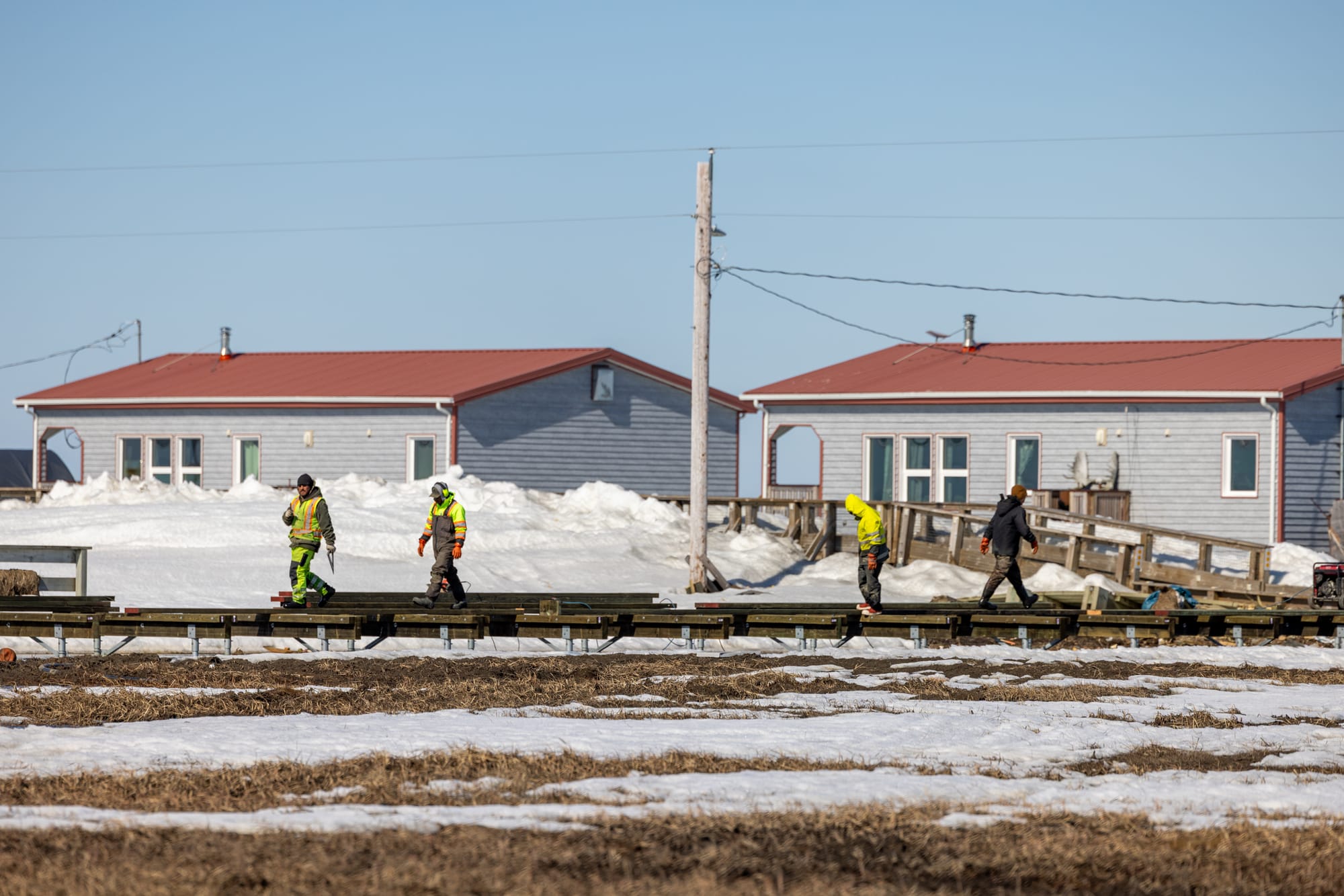
Benjamin: We hoped that it could be a village again. To this day, everything’s going good. Power. Houses are back. There is (some) electricity in houses. It’s livable, it’s getting there.
We worked on foundations. They’re replacing the insulation that got soaked. They’re working at our house that I’m staying in right now. I just need steps, so that’ll be it.

Katie: What made you decide to stay, Burt?
Burt Paul: It’s my hometown, and there’s many reasons that I wanted to stay. One of the reasons: The village was destroyed. I felt that we needed to take care of the village. For example: caskets (that floated away from the cemetery), cleanup. I could name so many things.
With these guys, the 19 men that were staying behind, I had a spark in the hope of rebuilding. And then help (from the state and contractors) started to arrive.
It’s a very hard start. It felt like a new beginning. That very strong hope, and I didn’t want to leave home. Like everyone else, there’s no place like home.
Katie: You guys are cousins and good friends. When it came time to stay or go, did you decide together?
Benjamin: Yeah, we planned. We planned every day: What’s next? What’s got to be worked on? And it worked. And now we can be smiling every day.
People that evacuated are coming back for work, to make money for their family. Pretty soon, Kipnuk people will come back, and the school will be open for the kids — that’s our goal.
Katie: How did you feel when you heard that the village had voted to permanently relocate?
Benjamin: I voted that I’m not going to relocate. Because relocation is — you’ve got to have meeting after meeting to get funding. It’s hard to get there right now. So I said, I’ll stay home, where there’s an airport, school, post office — while they’re standing.
Burt: I also voted to stay, but that vote is weak. Maybe a quarter of the village wanted to stay. But the relocation time estimate is 10 years. [1]
Before that happens, we need this village to operate, to use it for waiting at home, for the new location.
Because not all the people have steady jobs and driver’s licenses. Living in a city is a lot of change for many people. The evacuees are depending on a lot of help — but that help will not always be there. Pretty soon, one is going to be standing alone. Some may be successful with finding a new job, a new home, but not all. [2]
That’s one of the reasons I keep the village running, so (eventually) they can come home and settle-in.
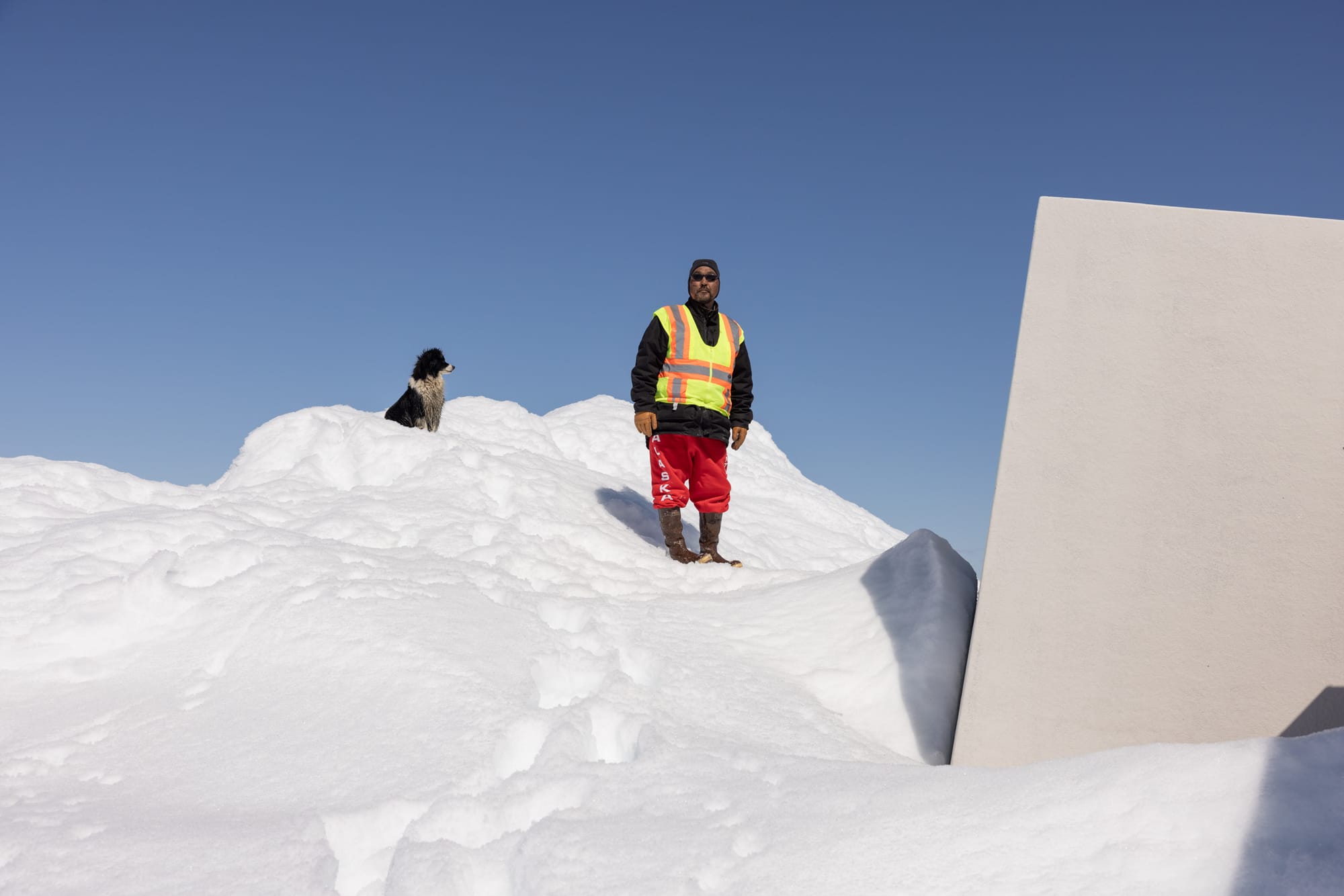
Katie: What was that night the typhoon hit like for you? What do you remember?
Burt: We knew the wind was strong. And then it shifted to the direction of southwest; it pushed the water towards the land. I know it’s flat in Kipnuk, but the elevation is (normally) just high enough. The regular flood that occurs during the fall time usually does not reach my area.
When I started seeing that (Halong) flood coming in, and how strong the current was, I knew it was going to be high.
We started hearing that houses were floating and drifting away, and some people were texting their whereabouts. Seeing and watching a house float by in the dark. Watching my neighbors float away.
All the debris that hit my house made me worried. A couple of conexes hit, but somehow my house stood up, survived.
When I saw water, I prayed to God to hold and keep my house safe. It was a great disaster that changed people’s feelings about coming back to Kipnuk. Who knows if they will change their minds and come back? Some say, after this year’s fall flood (season), they’ll see, because we cannot tell the future. But standing strong and praying for strength is helping a lot, and people’s prayers all over the world. I believe in that.
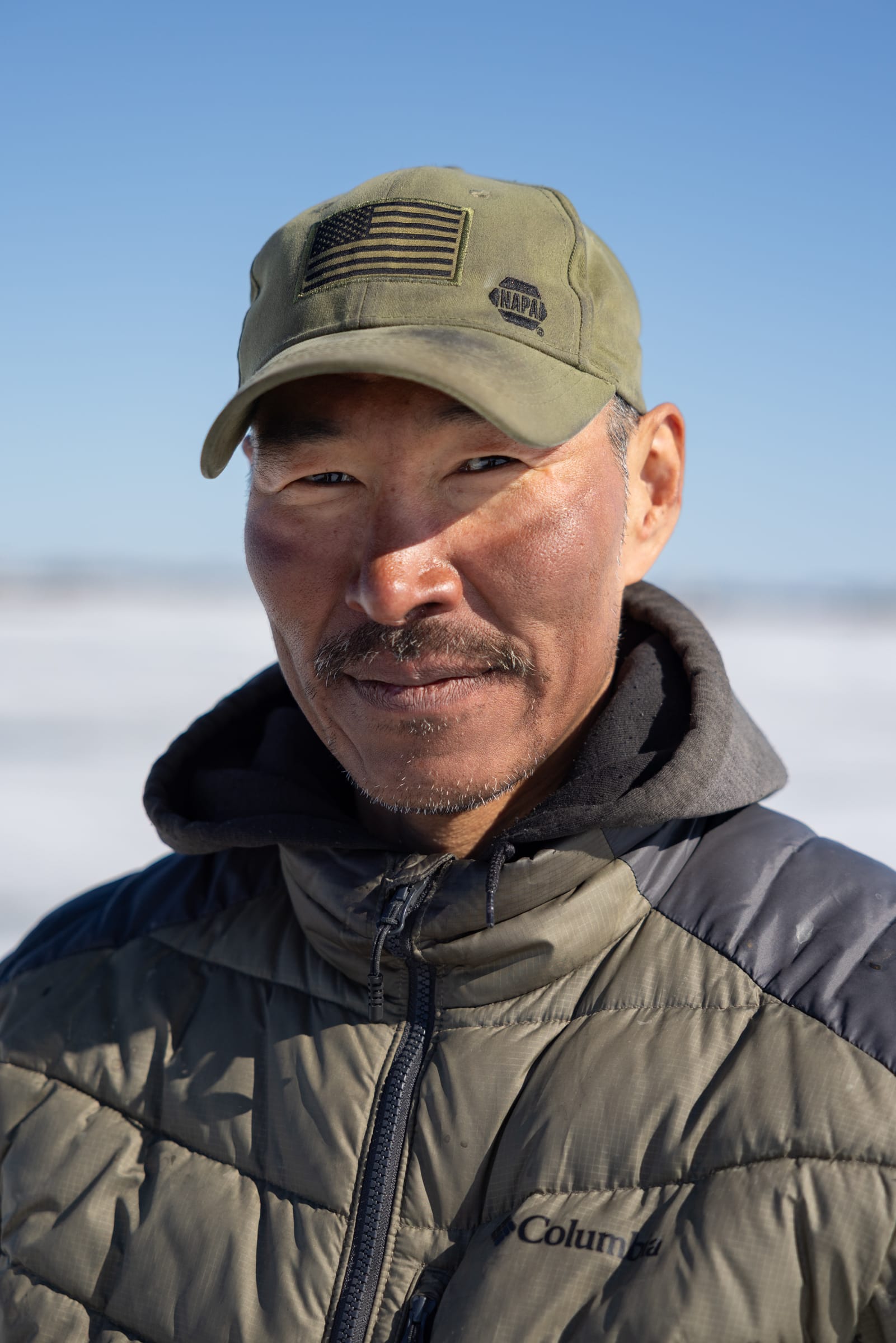
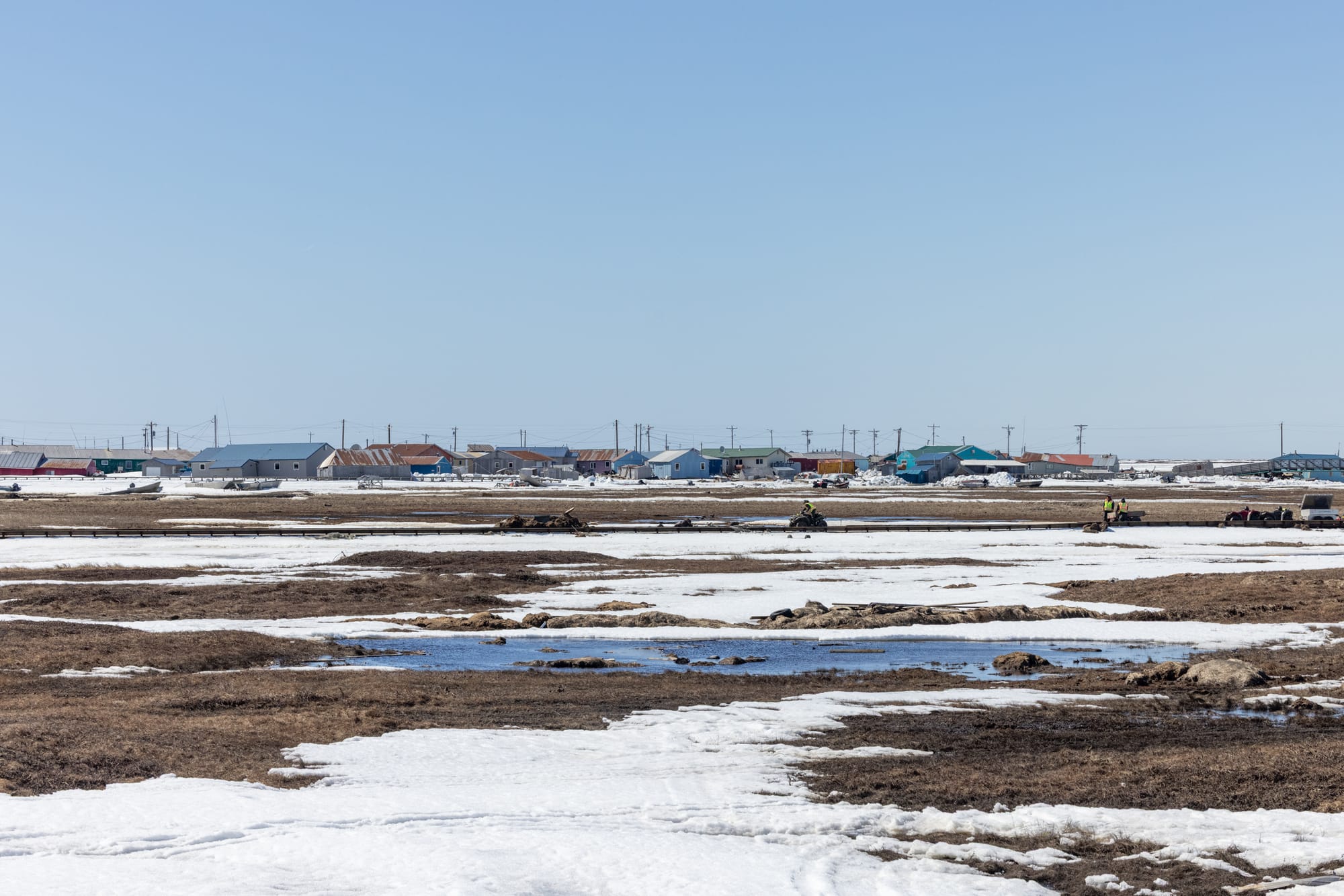
Benjamin: I put three twelve-foot-long boards on my house just in case, so when the water got there, the boards would keep it steady, and not float away. It worked.
When it started floating, those three boards were holding the house in place. But once another house drifted and hit our house from behind, we started floating. If I anchored the house, probably it could have stayed where it was. But I wasn’t ready for that.
We started floating away. Next thing, I looked out the kitchen window with a spotlight, I saw a house coming towards us at about three miles an hour. Man, I yelled at my family, hold on to something.
It hit us and it rocked the house. But good thing, it never broke any windows. It was that close to breaking the window — about two to three inches off. So, we are here.
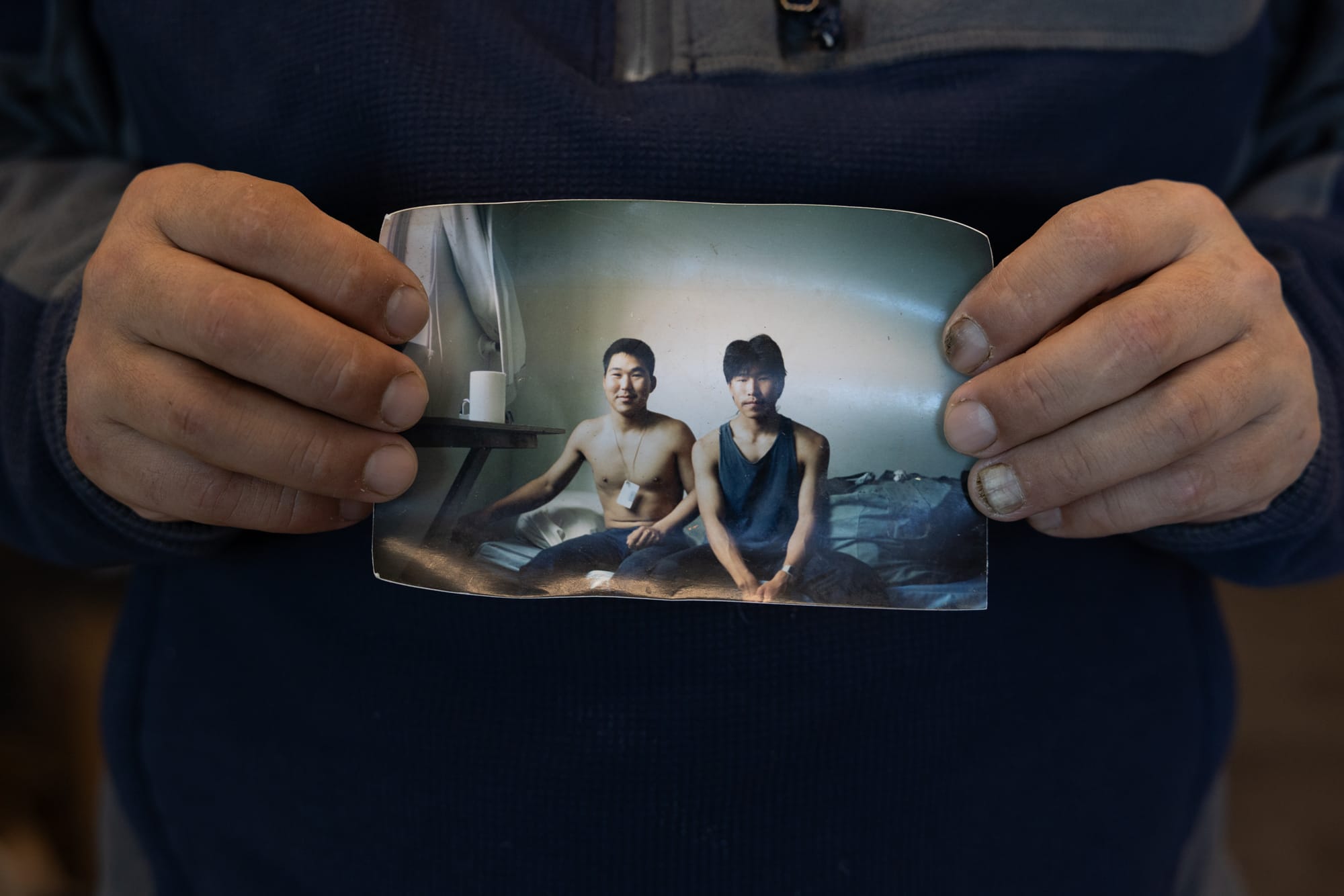
Katie: I’m looking at this photograph of the two of you from when you were much younger, still best friends. Where was the picture that night? And where did you find it?
Benjamin: Oh, the picture of us when we were teens, 18 years old or so.
I had lots of photos that I took out to our old house, because there was no more room and I had to store my stuff. But that old house floated away behind the school where we used to live, and I lost all of the photos.
After the storm, one of the teachers found that picture of us when we were young, on the ground. And when I walked into the school lobby and saw it, I had to take it. And to this day, that picture of us is — we’re still best friends.
Katie: Wow, so this was the only photo of yours that made it through the storm. That’s symbolic, I think, of your friendship.
Benjamin: Now we’re in our 50s or so, still young. We feel like we’re 21.
Katie: Burt, what did you think when you saw that photo?
Burt: It told me that time flies by.
In those younger days, we used to hear from our elders, to expect the unexpected. Because in history, they went through famine, sickness. They went through so much trauma and disaster. I guess this history is ours too.
And they did proceed in success. They would say, you never know what’s coming, but be ready. Be strong. Don’t get comfortable with life’s comforts. Don’t take things for granted.

I always remember those things. Wake up early, all those things that elders used to speak of. And be humble. Sometimes thinking too far ahead eats your mind. Like already thinking of relocating. Maybe that day will come. Maybe not, with the world changing.
Yeah, relocating, starting a new life in a good spot, high spot. We have to adjust with the new location. It’s not far. It’s in the same area, 15 miles away. But infrastructure, I don’t know, it will take 10 to 15 years. A new school, airport, laundromat, maybe a road. We’ve got to think of those things before we relocate. We cannot just build a home and expect to live happily ever after. We’ve got to build the infrastructure first.
Katie: Thank you both. Do you want to add anything else?
Benjamin: I’m going to start making Noah’s Ark… (laughter) That’s a joke.
1. Community relocations take decades and there is no specific federally funded program to support them. For example, the community of Newtok recognized the need to relocate their village due to erosion in the 1980s. The Newtok Native Corp. proposed a land exchange agreement with the U.S. Fish and Wildlife Service in 1996. The land exchange was formally signed in 2003. After sixteen years of fundraising and construction, the first families moved to the new village of Mertarvik in 2019. The final families moved there in 2024, nearly 30 years after the initial land exchange proposal.
2. Roughly 680 community members from Western Alaska were living in temporary housing within Anchorage and surrounding areas as of earlier this spring, according to the Alaska Division of Homeland Security and Emergency Management.
This article was originally published in Northern Journal, a newsletter from Nathaniel Herz. Subscribe at this link.

Long before he became the voice of college football Saturdays on FOX, Joel Klatt made a decision that only makes sense to anyone who grew up playing EA Sports College Football. During his freshman season at Colorado, Klatt was given No. 14 as a walk-on quarterback. He eventually had the opportunity to change it before becoming the Buffaloes’ starter the following year. He never did. The reason? He knew the video game would have Colorado’s starting quarterback wearing No. 14. Now, 23 years later, Klatt is the new color commentator in EA Sports College Football 27. We caught up with Klatt to get a behind-the-scenes look at how he became the voice of the game. What’s the story behind you becoming the voice of the new EA Sports college football game, and what was the process like from that first conversation to officially landing the role? The process was actually painless. EA contacted my agency, and they did a great job of fostering that relationship. It was pretty well set before I even knew about it. I was incredibly excited. We had a Zoom with some of the executives at EA, and from that point, we signed the deal and started scheduling recording sessions. You’ve spent years calling college football games. How different is it recording commentary for a video game versus calling a game in real-time on a college football Saturday? It’s so different calling games for the video game. I would spend all day in one recording session just calling touchdowns. You’re not actually calling a game in sequence. You’re just trying to just take each situation for its own and give a line for that situation. Typically, each situation will have variables. You can talk about the defensive perspective, the offensive perspective, or the player perspective. It was very different and very compartmentalized, but it was certainly a cool experience. What was your familiarity with this game and was there a “this is actually happening” moment for you? I’m very familiar with the game. I’ve got three boys — 14, 12 and nine. They play the game. I played the game when it had its previous version. In fact, when I was playing at Colorado, they just gave me the number 14 when I walked on, and I had the option to switch my jersey number before my sophomore year, which was going to be my first year as the starting quarterback. But I didn’t change my number because I knew the game would have my No. 14 as the starting quarterback at Colorado. I’ve loved the game for a long time, and there was certainly part of me that, as I was recording, was thinking to myself, ‘I can’t believe I’m actually doing this.’ What actually went into becoming the voice of the game — from the recording sessions, to the scripting, to trying to make reactions sound natural for so many different in-game moments? We did a lot of hard work. My first question to the folks at EA was if there was going to be AI support. They made it very clear that this was all going to be essentially manual. I would have recording sessions two hours at a time, and since they were based in Orlando, they came out and set up a little sound booth in my house. I would get on Zoom two to three times per week, typically at 6 a.m., and we would go through our sessions. I wanted to get in as many sessions as I could possibly get in before the game went to market. This was a lot of hard work. I think we ended up doing close to 90 hours of recording and thousands of lines, but it was certainly fun. They would send me a script, and the script was basically just situations. I didn’t think I would do well just reading lines, so I started just getting situations. I would talk about the offensive line, the running backs fighting for extra yards and being able to move the chains. And that’s how it went. With everything you learned working on the game, if you had to pick one team right now to win a national title in EA Sports College Football 27, who are you taking and why? From what I know about the game and some of the player ratings after the transfer portal, I know that Ohio State is going to be very good in the game. I think Indiana is going to be very good. I know Oregon is going to be very good, and Texas. Basically, they kind of nailed what a preseason top 10 would look like. So, any of those teams, I think, will have a great chance to win a national championship. Where does becoming the voice of this game rank among the coolest experiences you’ve had in your career covering college football — and did it hit you at any point just how big of a deal this is for fans? I’ve been so fortunate in this career, and done a lot of incredible things, even outside of college football. I got to call the U.S. Open and interview the players after they finished 18 at Pebble Beach. That was incredible. I’ve done studio shows at the Super Bowl when I was a host. I’ve called Big Ten championship games and Michigan vs. Ohio State. I will tell you that this absolutely ranks up there as one of the highlights of my career. It’s such an iconic brand and game. They do such an incredible job honoring college football. They love college football, and to be a part of that team and to further something that is really special in our space is a real highlight. It’s certainly one of the best things that I’ve ever done in my career. This is very cool.Latest Sports News from FOX Sports

Tim Ream gets wrapped up in a bear hug. Mark McKenzie is dapped up. Tim Weah has a special handshake. Every time U.S. men’s national team players get off the bus — whether it’s arriving at a training or for a game — they’re greeted by their biggest hype man, Harris Patel. “He’s barking, he’s hugging you, he’s dapping you up, he’s picking you up,” McKenzie told me before a recent pre-World Cup training session. “That shock to the nervous system is sometimes necessary. It shows how much he cares about this team.” “And it’s times 10 on game day,” Christian Roldan added. Patel is on staff for his second consecutive World Cup as one of the U.S. squad’s athletic trainers. The USA starts its campaign vs. Paraguay on Friday at Los Angeles Stadium (9 p.m. ET on FOX/FOX One and streaming for free on Tubi). But it would be doing Patel and the team a disservice if he was simply described as one of their physios. “He’s an energy guy,” said Weston McKennie, who sometimes likes to joke with Harris and pretend he doesn’t see him while getting off the bus. “It’s like taking a shot of espresso getting off the bus. Whenever you may feel like you don’t have the energy or the jet lag is kicking in, he’s someone that sparks energy and wakes people up. “I always think that I’m the energy guy of the group. But then he always tops me.” Patel, who U.S. Soccer did not make available for this story, has been with the team since before the 2022 World Cup. He’s also served at five Olympic Games and 10 World Championships with USA Track and Field, and he was one of a select few trainers inside the NBA Bubble during the COVID pandemic. His resume includes stints with the New York Jets and the Indianapolis Colts, as well as the Alabama and Georgia football programs. Most importantly, to his athletes, he’s their guy. “That man is an energizer bunny,” said Ream, who joked that Patel’s hugs are so strong that they give him a good back crack. “He brings such an infectious positive energy. He comes in the morning ready to go, pumping guys up, getting guys really ready to put their best foot forward and put them in a place where they feel comfortable and welcome. And he transfers that energy to each of us every single day.” Added Weah: “He’s like a dad to all of us. We call him Unc. Just the energy that he brings, the vibes daily, keeping us on track. He’s our physio, so he keeps our bodies right. He has blessed hands, and he’s the guy to go to, and we love him so much.” ‘He’s The OG’ Patel grew up about 30 miles northeast of Atlanta in Suwanee and attended the University of Georgia in the late ’90s. As a college freshman, he was part of the first athletic training and sports medicine programs there, which is where he met his mentor, Ron Courson. Courson, now Georgia’s Executive Associate Athletic Director for Health and Performance, spent decades leading the school’s sports medicine efforts after becoming Director of Sports Medicine in 1995. He has also worked at multiple Olympic Games and helped shape health and safety policies throughout the NCAA, SEC and NFL. He knew right away that Patel was special. “One thing about Harris is, he’s all in,” Courson told me by phone. “He really buys a team concept. He’s got a tremendous work ethic, and he’s going to do whatever it takes to help athletes get well. “He has an engaging personality and is really dedicated to learning more and trying to grow in the profession.” Patel was a student trainer at Georgia before getting his masters at Alabama, where he specifically helped out the softball team as a graduate assistant. After two years in Tuscaloosa, he returned to Courson’s staff in Athens. He later went to physician assistant school at Emory University and has crafted a unique business in concierge sports medicine that’s allowed him to work with a variety of prestigious organizations and famous athletes. What makes Patel so endearing, though, is the way he connects with people. He’s the type of guy who says hello in a hotel lobby and then immediately introduces you to the two colleagues he’s meeting for breakfast. He’s the one roaming the U.S. training field with water bottles in hand, shouting encouragement — “Let’s go!” — with a huge smile on his face. He also makes a point of paying it forward. Courson said Patel will return to Georgia this fall to speak with student athletic trainers about careers in Olympic sports medicine. And those relationships don’t end when athletes leave camp. Patel stays in touch with players no matter where they are in the world. When Weah and McKenzie are back with their clubs in France — at Marseille and Toulouse, respectively — Patel regularly checks in, sending texts to see how they’re doing physically and mentally. “HP, he’s the OG,” McKenzie said. “He’s someone special. When you have somebody who truly cares about you, not just from an athletic perspective but also on a personal level, it’s huge. That shows the kind of staff that we have.” ‘Always On The Cutting Edge’ So much of the focus ahead of this summer’s World Cup is about the 26 players on the USA roster. But manager Mauricio Pochettino has expressed his gratitude for staffers behind the scenes like Patel. “You can never find words or money to reward their effort,” Pochettino said during a press conference earlier this month. “I think we have a staff that for sure can compete to win the World Cup. Now we need to translate that energy and everything they provide the players to help the players win.” Aside from his warm demeanor and outgoing personality, Courson says another thing that sets Patel apart is his commitment to learning more about his own profession. For example: A couple weeks ago, he introduced Courson to a pair of innovative “core shorts” he discovered during a trip overseas. The compression style shorts help manage groin and core muscle issues, which is particularly helpful for soccer and football players who are prone to soft tissue injuries. This model had new technology that Patel was eager to try out. “I think Harris is one of those people who is always on the cutting edge,” said Courson, who visited Patel at U.S. Soccer’s new National Training Center before the team left for the World Cup. “Sometimes you get accustomed to doing things one way, and one of the unique things working with the Olympics or the World Cup and having the ability to do international travel is you get exposed to different concepts, you meet different people, and that’s how you get new ideas. “Harris is always finding new ideas and not only using them himself, but sharing them with other people. And that’s how we all get better.” While players love being around Patel, seeing him often means something has gone wrong, whether it’s a minor knock or a more serious injury. It helps that he’s one of the friendliest faces around the team. “I don’t know anybody who ever met Harris and didn’t love him,” Courson said. “Sports medicine is tough because most everybody who comes into the training room comes there because they have a problem. You have a responsibility to take care of them and help them with what they’re dealing with. “And to have somebody who is always positive, who cares about you not just as an athlete but as a person, I think that’s one of the most engaging qualities.”Latest Sports News from FOX Sports

A new album, a new single and a deeply personal message reveal where Wynonna Judd finds herself after years of reflection. Continue reading…The Boot – Country Music News, Music Videos and Songs
A new album, a new single and a deeply personal message reveal where Wynonna Judd finds herself after years of reflection. Continue reading…Country Music News – Taste of Country

Smoke rises from Augustine volcano during its last eruption in 2006. Experts have been studying the volcano to better understand the hazards it poses to Alaskans. (Photo courtesy of U.S. Geological Survey)
In my office hangs an old black-and-white USGS geothermal map of Alaska from the 1980s. Most of the map is nearly blank — white space with just a few major rivers and roads transecting the landscape. The only color delineates Alaska’s known geothermal systems and their relative importance for future development: green for low to moderate importance, orange for high importance.
None of the geothermal sites are labeled, but the patterns are familiar. Small green circles are sprinkled like freckles across a wide swath of the Interior, all of them moderate temperature hot springs located near ancient granite intrusions. These systems are powered by heat slowly released from radioactive elements within the rock over geologic time. One represents Chena Hot Springs, where I helped develop Alaska’s only operating geothermal power plant two decades ago.
More green dots mark known hot springs in Southeast Alaska, each emerging along major fault systems that act like natural plumbing networks, allowing water to circulate deep underground, absorb heat, and rise back toward the surface.
A chain of irregular orange patches follow along the Aleutian Islands from the volcanoes of Cook Inlet, along the Alaska Peninsula, and all the way out to Attu, delineating the tectonic boundary where the Pacific Plate slowly descends beneath the North American Plate. As the slab sinks deeper into the mantle, water released from the subducting crust triggers melting in the overlying rock. Some of that molten rock rises back toward the surface in columns of magma, feeding the iconic stratovolcanoes that delineate the northern boundary of the Pacific Rim of Fire.
But when my eyes drift across the map, none of those features hold my attention for very long. Instead, I find myself drawn to an enormous orange blob just east of Glennallen, its edge lying only a couple dozen miles from the Richardson Highway. I once took out a ruler and measured it. It covers an area roughly the size of Massachusetts and easily dwarfs every other geothermal feature in Alaska.
At that scale, it is not a geothermal prospect. It is more like an entire geothermal province hidden in plain sight. Clearly, the authors of the map believed this place mattered. So why does no one ever talk about it?
Much of my early professional career revolved around geothermal energy, and back then it was not considered very cool. The excitement was around wind and solar, while geothermal was viewed as a mature technology. Most people assumed we already knew where the major resources were located, and many of the best prospects had already been developed. The field felt a little like it was on cruise control.
That has changed dramatically.
Advances in drilling and stimulation technologies pioneered by the oil and gas industry have generated excitement about their potential application to geothermal energy, while improvements in high-temperature materials and subsurface imaging are opening resource frontiers that would have seemed impractical just a decade ago.
As a result, venture capital is pouring into geothermal startups. Former oilfield service companies are reinventing themselves as geothermal developers. Research in the field is booming, with efforts ranging from Enhanced Geothermal Systems, or EGS, to superhot geothermal and a host of other approaches aimed at expanding where and how geothermal energy can be developed. The old assumption that geothermal only works in a handful of special places is being challenged from multiple directions at once.
And plenty of people are catching the geothermal bug. It consistently scores well in public opinion surveys, and readers frequently bring it up in the comments on my energy articles — often as the preferred alternative to whatever technology I happen to be discussing. The appeal is easy to understand. It promises reliable, around-the-clock energy with a small physical footprint and very low emissions.
I get that. I really do. I also love geothermal energy. But one thing I have learned over the years is that not all heat is created equal. More often than not, when people point to a spot on a map and ask, “Why don’t we develop geothermal there?” the answer has very little to do with temperature and everything to do with geology.
Everyone knows that the deeper you go into the Earth’s crust, the hotter it gets. But heat alone does not make a usable geothermal system. To put that energy to work, you have to bring it to the surface, and that requires fluid flow.
Essentially, the challenge is finding — or creating — an underground heat exchanger capable of moving large volumes of fluid through hot rock and back to the surface, where that energy can be used to generate electricity or heat homes and businesses.
Heat deep underground is not very useful if you cannot get it to the surface. It is a bit like having a boiler in your house but no plumbing or ductwork to move the warmth where you want it. Sure, the boiler room might be warm, but without circulation the rest of the house stays cold. Geothermal systems need plumbing too.
In the oil and gas industry, the development of fracking technology has been a game changer, dramatically increasing production by creating artificial fracture networks that allow trapped oil and gas to move more easily through the subsurface. That success has generated a lot of interest in applying similar techniques to geothermal through EGS. If engineers can create permeability in oil and gas reservoirs, why not do the same thing in hot rock and harvest the heat instead?
There are three major challenges with this concept.
First, geothermal systems need to move far more fluid to produce meaningful amounts of energy. The amount of energy that can be extracted from a gallon of hot water is much smaller than the chemical energy stored in a gallon of oil. To compensate, geothermal systems require extensive fracture networks and very large volumes of fluid circulating through the subsurface.
Second, those fractures need to stay open. That is where you run into a challenge that oil and gas developers know well: gravity. The deeper you go, the more overlying rock there is pressing down on the formation. That pressure is constantly trying to squeeze those fractures shut. At some point, drilling deeper can begin to produce diminishing returns.
Third, much of the deep crust consists of dense metamorphic and crystalline rocks with very little natural porosity or fluid storage capacity. That is an important distinction from oil and gas reservoirs. Hydrocarbons accumulate and are trapped in porous rocks, so fracking largely works by enhancing pathways that allow those trapped fluids to migrate more efficiently toward a well.
In other words, the heat might be there at depth. The plumbing often is not.
That does not mean EGS will not work. The early results are encouraging, and the potential is huge. But if you were looking for a place to start, you would probably begin where nature has already stacked the deck in your favor — places where high temperatures sit unusually close to the surface.

Iceland is one of those places. The island sits on top of a spreading zone in the Earth’s crust, where North America and Europe are slowly pulling apart. New crust is continually being created, the crust itself is relatively thin, and magma can lurk very close to the surface.
Near the Krafla geothermal power plant in northern Iceland, drillers working on the Iceland Deep Drilling Project unexpectedly struck magma in 2009 at a depth of only about 2 kilometers. While they were looking for high temperatures, they were not expecting to drill directly into molten rock. Despite the challenges, they were able to complete the well and briefly produce steam at temperatures exceeding 450°C.
At very high temperatures and pressures, approaching so-called supercritical conditions, geothermal fluids begin to behave differently and can carry far more energy than ordinary hot water. Under the right conditions, a single well could potentially produce several times the power of a conventional geothermal well. The Krafla experience provided a glimpse of that potential and helped accelerate interest in what is now known as superhot geothermal.
The challenge is that these conditions are brutal on drilling equipment and well materials. Temperatures can exceed the limits of cements, steel alloys, and downhole sensors, while corrosive fluids can attack everything from well casing to valves and surface equipment. Only recently have advances in drilling technology and high-temperature materials made it realistic to pursue geothermal development in such extreme environments.
For geothermal engineers, these ultra-high-temperature systems are something akin to Formula One race cars — technically challenging, expensive, and potentially capable of extraordinary performance.
Iceland has been pioneering this work for decades, but Alaska has one of the field’s most respected experts in John Eichelberger, who has worked alongside Icelandic researchers studying these magma-adjacent systems. When I asked John a few years ago where he would pursue superhot geothermal in Alaska, he answered instantly: Mount Augustine, a volcanic island in lower Cook Inlet.
Recently, at the Alaska Sustainable Energy Conference, I got a better sense of why.
Paul Craig, co-founder of GeoAlaska, and his partner Antony Penino hold the geothermal lease rights to the site. During a break, Paul pulled me aside and showed me an image from a magnetotelluric survey estimating the location and size of the magma body beneath the volcano. The way he carried it around reminded me of a proud first-time parent showing off ultrasound photos.
The image showed the fuzzy but distinct black and white outline of an interpreted magma body beneath the volcano. Based on the survey, it appears to lie less than a mile beneath the surface — potentially even shallower than the magma encountered by the Icelanders at Krafla. It was easy to see why he would be excited.
But a shallow magma body does not automatically make a geothermal project viable. Like the other volcanoes in Cook Inlet, Augustine sits within a compressional tectonic environment where rocks are being squeezed together rather than pulled apart. That is one reason there are surprisingly few hot springs, fumaroles, or other obvious signs of active hydrothermal circulation associated with these systems.
There is also the significant detail that Augustine is an active volcano and a very remote one at that. It would take a very expensive extension cord to get power from the island to the Railbelt grid. In other words, developing a geothermal project at Augustine is not a slam dunk. Still, it’s an enticing prospect.
If Augustine represents a place where very high temperatures may lie close to the surface, that big orange blob in the Copper Basin on my map may represent something equally important: natural permeability.
And in geothermal, the plumbing problem is often the harder one to solve.
That enormous orange shape east of Glennallen corresponds to one of the stranger and lesser-known geologic systems in Alaska: the Klawasi mud volcanoes and deep crustal fluid systems of the Copper Basin and Wrangell region.
I have started thinking of it as the “Copper Basin geothermal province” because this is clearly not a single geothermal site like Mount Augustine. It is an enormous region that appears to contain many of the hallmarks of a large hydrothermal system. In terms of unexplored geothermal potential, it may be one of the most significant underappreciated geothermal regions in all of North America.
What makes the area especially interesting is its tectonic setting.
While much of southern Alaska, including Augustine, exists within a compressional environment, the Copper Basin and Wrangell region sit within a complicated network of major strike-slip faults where sections of crust are sliding sideways past one another. In certain places, bends and offsets along those faults create localized zones where the crust is also being pulled apart slightly — what geologists call transtensional faulting.
That distinction matters because these kinds of fault systems can create exactly the sort of permeability geothermal systems need. They act as giant crustal plumbing networks, allowing water to move downward through fractures, encounter heat at depth, and then circulate back upward toward the surface.
Historically, many of the world’s most productive geothermal systems formed in precisely these kinds of tectonic environments where heat and permeability intersect.
The geology is only part of what makes the Copper Basin intriguing. The other part is the old real-estate adage: location, location, location. The western edge of the province is adjacent to the corridor proposed for the long-discussed “Roadbelt” transmission concept — a line that could someday provide redundancy to the Railbelt grid by linking the Mat-Su region, Glennallen, Tok, Delta Junction and Fairbanks while also connecting the Copper Valley Electric Association system.
This is a big part of why the area attracted serious attention during the energy crises of the 1970s and early 1980s, around the same time my map was produced. The geologists evaluating Alaska’s geothermal potential were not simply looking for heat. They were looking for resources that could realistically be developed and connected to the people who might use them.
And initial studies on the ground were promising — geologists documented large carbon dioxide emissions, warm mud temperatures, unusual gas chemistry and helium signatures suggesting at least some contribution from deep crustal or magmatic sources. In other words, they found good reason to believe there could be a dynamic and actively circulating deep crustal plumbing system.
Yet despite those intriguing findings, no serious exploration program ever followed. Why?
Part of the answer is that geothermal exploration is both expensive and inherently risky. Before a drill bit ever touches the ground, much of what lies beneath the surface remains an inference — geophysics, fluid chemistry, structural interpretation and educated guesswork. Exploration wells are expensive, and many fail to find an economically viable resource.
As a result, even projects with compelling targets — like Mount Augustine — face major challenges attracting the capital needed for a multimillion-dollar exploration or resource-confirmation drilling program.
But the challenge in the Copper Basin also extends to land ownership, jurisdiction and leadership. Unlike Augustine, where a defined geothermal prospect on state lands has been leased to a private developer, the Copper Basin geothermal area spans a complicated patchwork of federal, state and Native-owned lands. Portions lie within or adjacent to federally protected lands, while others fall within state lands or lands owned by Ahtna, a Glenallen-based Alaska Native Regional Corporation. Any serious effort to evaluate the resource would almost certainly require cooperation among multiple landowners, agencies, researchers, utilities and local stakeholders.
That complexity may help explain why the prospect has never developed a project champion. Large energy projects rarely move forward simply because a resource exists. More often, they move forward because someone believes in the opportunity and is willing to do the hard work of assembling partnerships, pursuing funding, navigating permitting and keeping the idea alive long enough to determine whether it is worth developing.
In other words, the Copper Basin may have the right geology. What it is lacking is an organization or coalition willing to take ownership of the next step.
And yet, the timing may never have been better. Alaska is actively searching for long-term energy options as uncertainty grows around the future of Railbelt gas supply. At the same time, the Department of Energy is investing hundreds of millions of dollars in geothermal exploration and demonstration projects. If there was ever a time to bring together Ahtna, state agencies, utilities, researchers and federal partners to take a fresh look at the Copper Basin using modern tools and techniques, this may be it.
Whether the Copper Basin ultimately proves to be a major geothermal resource or not, the potential upside is significant enough that we owe it to ourselves to find out.
Forty years ago, the geologists who assembled the map hanging in my office looked at the available evidence and colored an enormous swath of the Copper Basin bright orange.
That was a provocative choice. In the years since, relatively little has been done to either confirm or refute that interpretation.
Perhaps it is finally time to find out whether they were right.

MAJOR SHIFT: Last week’s conclusion of Albany’s legislative session left Democratic state lawmakers poised for the biggest shakeup in their ranks since they assumed one-party control in 2019.
Assembly Majority Leader Crystal Peoples-Stokes is retiring at the end of the year, opening up the No. 2 job for only the second time since Carl Heastie became speaker 11 years ago.
State Sen. Mike Gianaris is on his way out too. His departure will leave open the role of Democratic Senate Campaign Committee chair, which he’s held since he was a senator-elect in 2010. It will also pave the way for a new floor leader and Majority Leader Andrea Stewart-Cousins’ deputy.
On top of that, Senate Democrats are about to become the first conference in state history to bump up against term limits.
Rules enacted in 2009 imposed eight-year caps on the majority leader and committee chairs. No party has remained in power long enough to be impacted since then, but the rules will soon apply to Stewart-Cousins and up to a dozen of her members.
“I’d probably have to,” state Sen. Liz Krueger said when asked if she’d vote to scrap the term limits. “Because it would mean Andrea couldn’t remain leader. And I do not actually accept the concept where Andrea doesn’t remain leader.”
Krueger is one of seven impacted chairs surveyed in recent months who unanimously said they want Stewart-Cousins to remain. But Democrats haven’t yet settled on what should happen to other top jobs.
“It’s really a question of ‘do you change all the term limits for everybody while you’re changing them for leadership, or do you allow for some new opportunities at the committee level?’” Investigations and Government Operations Committee Chair James Skoufis said. “I don’t know where I land on that.”
“The level of expertise I’ve developed, it’s not because I’m better or smarter than anyone else, I’ve just been in it longer,” state Sen. Gustavo Rivera said of the “deep and dark and mysterious” realm of policy he oversees as Health Committee Chair. “I would be hard pressed to find somebody in the Senate who would be able to do the job on day one.”
Gianaris’ departure might lead to widespread shuffling, regardless. And while Krueger is running again, she missed the conclusion of this year’s session after an April stroke. It remains to be seen whether she’ll return to the grueling job of being the top Democrat on the Finance Committee as she’s been since 2011 — possibly leading to more musical chairs at the top.
Stewart-Cousins said she’s looking for a deputy “who can bring the same types of talents and skills that Sen. Gianaris has brought.” Names that came up in surveys of legislators and lobbyists include state Sens. Jamaal Bailey, Andrew Gounardes and Shelley Mayer. Still, there isn’t a widespread consensus.
There’s more agreement over who might replace Peoples-Stokes. Upstaters have held the job since 1979, providing some balance to speakers from New York City over the years. The pick will need to be somebody who can work well with Heastie, and conventional wisdom holds they should have a good amount of tenure. Over a dozen insiders mentioned the same three names as fitting each of those criteria: Syracuse’s Pamela Hunter, Rochester’s Harry Bronson and Albany’s John McDonald.
Heastie, however, isn’t making a firm commitment to tradition.
“The requirement that the majority leader comes from upstate, that’s more of a y’all thing,” he told reporters. “I inherited a great majority leader who happened to be upstate in Joe Morelle, one of my closest friends. And then Crystal was somebody I knew even before I was elected, and she’s been amazing. But I don’t know if I feel limited to if it’d have to be somebody from upstate. It could be Long Island, it could be the Hudson Valley — I haven’t even really thought about it.” — Bill Mahoney

MONSERRATE LEADS PACK: The state’s Public Campaign Finance Board issued $1.96 million in matching funds payments Tuesday, marking the final day such outlays will be issued before the June 23 primary.
The scandal-plagued Hiram Monserrate was the state’s top beneficiary of public funds this week.
He’s running to return to the state Senate against the incumbent state Sen. Jessica Ramos and Assemblymember Jessica Gonzalez-Rojas. Monserrate is the only sitting legislator to be removed by his colleagues in the past century, following his 2009 misdemeanor conviction arising from a domestic violence incident. Since then, this is his ninth comeback bid.
Overall, his haul trails the $348,000 in matching funds that Gonzalez-Rojas has received to date. Ramos has taken in $128,000 in recent months.
Read more from POLITICO Pro’s Bill Mahoney here.

BROKEN PROMISES?: Transit advocates are intensifying their pressure on Mayor Zohran Mamdani to set aside more money to lower bus and subway fares. Groups of straphangers, like Riders Alliance, are now portraying the mayor as a promise breaker if he doesn’t support an expansion of the Fair Fares program, which offers discounts to low-income New Yorkers.
“New Yorkers are hurting, especially low-income commuters whose work we all depend on, and this is the mayor’s last chance to lower costs for transit this year, after emphasizing the importance of affordable public transit for his entire career,” Riders Alliance spokesperson Danny Pearlstein said in a text message.
Free buses was one of Mamdani’s three most prominent campaign pledges — alongside child care for all and a rent freeze — but the one he’s seemed to make the least headway on.
Riders Alliance, along with City Council members Tiffany Caban, Shahana Hanif and others, is holding a rally at noon tomorrow outside City Hall to “demand” the mayor “keep his promise to lower costs” — more pointed language than advocates have used publicly in the past.
While Mamdani’s free bus plan is on hold in large part because Albany isn’t on board, the City Council has backed more money for Fair Fares. The mayor, however, is reluctant to take that path because he generally doesn’t support policies where access is based on how much money people make. — Ry Rivard
WORKING THE REFS: Mamdani has a bone to pick about the officiating at Monday’s NBA finals game, which the Knicks lost to the Spurs.
“Crime is going down in New York City, but what we saw the other night did feel criminal,” Mamdani quipped to reporters today. “You just look at the disparity on fouls that were being called. I think many New Yorkers came away from that game with a very clear reflection of the absence of fair refereeing.”
Despite the mayor’s fandom, Madison Square Garden, the home of the Knicks, released a statement Tuesday calling Mamdani and NYPD Commissioner Jessica Tisch “party poopers” for instituting tighter security for a watch party outside the arena tonight.
Asked about it, Mamdani said the level of security planned is “in line with the measures that the NYPD uses for gatherings of this size, whether it be July 4 or New Year’s Eve.”
“This team has brought an extraordinary amount of energy, pride, excitement to every corner of our city,” the mayor said. “We want this to be a memorable night for all the right reasons.”
A watch party scheduled outside MSG for Game 3 on Monday night was moved to Bryant Park thanks to President Trump attending the game.
Asked whether he holds Trump responsible for the Knicks’ loss, Mamdani laughed — but declined to blame the president.
“I’ve made clear my complaints about the refs,” Mamdani said. “I’m hopeful tonight we’re going to see a different game.” — Janaki Chadha

WHAT TWEETS?: Darializa Avila Chevalier, Mamdani’s pick to unseat Rep. Adriano Espaillat, has come under plenty of fire for her old social media posts.
Mamdani claims he hasn’t seen them.
The posts in question include tweets where Chevalier wrote “F—k Kamala Harris,” criticized black and Arab men for “fetishizing ugly colonizer women,” and described wiping her hand on the American flag. They’re the subject of an Espaillat ad in which a narrator says, “Meet the real Darializa, the one she tried to delete.”
Asked about her social media imprint, Mamdani told reporters, “No, I have not seen those tweets.”
“What I’ve heard from her, and what I know a lot of others in the district have heard from her, is that her views have evolved, and that the campaign that she’s running on is reflective of what she’s going to be fighting for,” Mamdani said.
The mayor has opted against endorsing in other races, including the one for the Manhattan congressional seat being vacated by retiring Rep. Jerry Nadler.
Gracie Mansion is in that district, and while Mamdani said he plans to vote in the Democratic primary, he has not yet decided on who he’ll back. The candidates include Assemblymembers Micah Lasher and Alex Bores, Kennedy scion Jack Schlossberg and Trump critic George Conway.
“I’m one of those classic yet-to-make-a-decision voters that frustrate campaigns so dearly,” the mayor said. — Janaki Chadha
— THERE’S NO ‘I’ IN TEAM: Brad Lander says he is not endorsing fellow congressional challenger Darializa Avila Chevalier, despite putting out a joint “Mamdani’s team” ad with her. (Jewish Insider)
— DIY BALLOT LINE: Shut out of major third party endorsements, candidates for NY-21 Republican Anthony Constantino and Democrat Blake Gendebien are battling in court over the validity of their made up ballot line names. (Times Union)
— NO EASY EXIT: Uber is suing New York City to block a new driver protection law, arguing it would force the company to keep dangerous drivers on the road. (Reuters)
Missed this morning’s New York Playbook? We forgive you. Read it here.
Politics