During Part 1 of the Season 10 special, there was more going on than the big show-down of exes (including ex-friends).
KJ Dillard opened up about his mental health, his years of distracting himself, and how he ended up in the hospital.
He told his castmates — and the audience — about his diagnosis, and about his lengthy recovery.
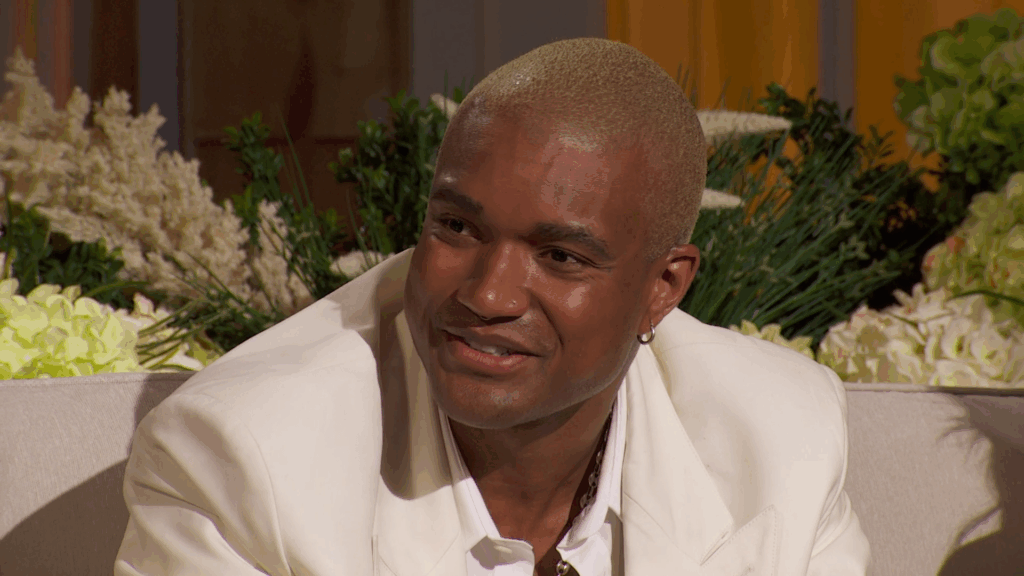
At the ‘Summer House’ Reunion, KJ Dillard had some emotional updates. (Image Credit: Bravo)
‘I actually had to go to the hospital for self-harm’
During Part 1 of the Reunion, KJ revealed that he was hospitalized.
He shared that he had been diagnosed with borderline personality disorder — often abbreviated as BPD.
“I actually had to go to the hospital for self-harm,” KJ confided to Andy Cohen.
“I was there for a week,” he then detailed.
KJ credited two castmates, saying: “Mia [Calabrese] and Ciara [Miller] were there almost every day.”
As he discussed his months of recovery, KJ teared up.
“I got to focus on myself,” he affirmed. “I needed that.”
KJ also shared that he is in therapy and is taking medication to help with his mental health.
“My whole life, I distracted myself and ran away from my issues instead of facing them head-on,” he shared.
When people self-medicate or find other ways to divert themselves (he mentioned impulsive tattoos and piercings, for example), it doesn’t directly address problems in a healthy and lasting way.
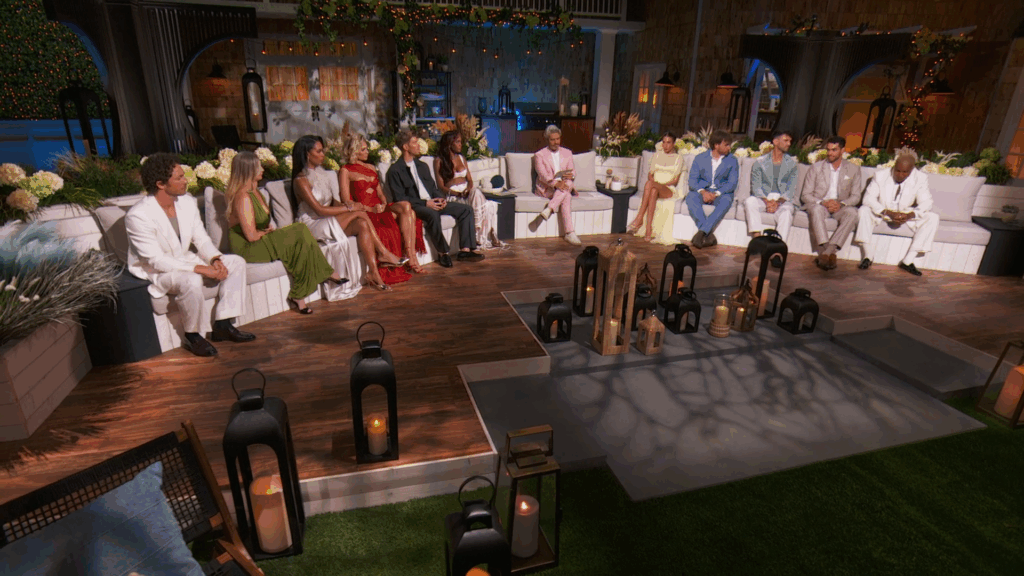
Tensions were high when the ‘Summer House’ Season 10 cast met for the Reunion special. (Image Credit: Bravo)
What is borderline personality disorder?
BPD is a Cluster B personality disorder that involves relationship instability, a (not unrelated) fear of abandonment, and also intense emotional outbursts caused by difficulties with emotional regulation.
These same challenges with emotional regulation can cause the self-harm behaviors that KJ mentioned.
Television and film too often portrays BPD — among other psychiatric diagnoses — as something scary, dangerous, and worthy of stigma. The facts don’t back that up.
Borderline personality disorder primarily impacts the individual, distorting their sense of self.
“I’m grateful that I’m here alive because I could have not been,” KJ expressed during the Reunion.
“I’m thankful for the support of my friends,” KJ affirmed. “Like everyone here has somehow shown their support in their own way. So, I appreciate that.”
He added: “I’m very thankful that the audience is embracing that, because it’s my truth,” he added.
KJ emphasized: “I’m not gonna not be honest about what I’m going through, especially if it can help others.”
He received an outpouring of support from his castmates, including Jesse — who teared up himself after KJ spoke.
Part 2 of the Summer House Reunion special will air on June 2.
Solar panels at the Cold Climate Housing Research Center campus in Fairbanks are seen on June 5, 2025. (Photo by Yereth Rosen/Alaska Beacon)
Alaska’s largest planned solar farm, expected to break ground west of Anchorage this summer, is likely to deliver cheaper electricity than possible with imported natural gas, according to information the state’s largest electric utility shared with state lawmakers this month.
In a May 14 hearing of the Alaska House Labor and Commerce Committee, Chugach Electric government affairs manager Trish Baker said power from the project should cost about the same as power produced from natural gas at current prices.
“We have not brought that project before the (Regulatory Commission of Alaska) yet, but that’s our estimate,” she said.
Because gas prices are expected to rise in coming years amid a growing shortage in Cook Inlet, the solar project is poised to become cheaper than power generated by imported natural gas.
That’s only for the months when solar is an option. In the winter, during peak demand for heating and home electricity use, solar produces minimal energy in much of Alaska.
Natural gas power is cheaper than diesel power, but the economics are driving in the same direction, said Rep. Zack Fields, D-Anchorage, during the May 14 hearing.
“The previous Cook Inlet prices, gas was cheaper. With price escalation, the lines cross and some of these small renewable projects are cheaper. That seems to be the economic environment that we’re in,” he said.
Julie Hasquet, manager of corporate communications with Chugach, said solar power costs “are expected to be comparable to thermal generation costs, resulting in essentially no meaningful impact to electric rates over the life of the project,” she said. A key benefit of the solar project is that it supports diversification in generation which reduces long-term risk and reliance on natural gas.”
She added that she doesn’t see a scenario where Chugach “could rely on all renewables for summer months without some new, major hydro coming online.”
Fields had proposed exempting two of those hydropower projects and the solar project from regulatory commission approval. The RCA has authority over most electricity rates in Alaska.
Other legislators opposed Fields’ proposal, which did not advance.
“I guess I haven’t seen that renewables really bring the cost of anything down,” said Rep. Julie Coulombe, R-Anchorage. “They’re very subsidized,” she said.
Chugach plans to start construction on the Beluga solar project before July 4 in order to stay eligible for federal tax credits that would reduce the overall cost of the project.
The 21-year-old is serving 15 to life for the fatal crash that claimed the lives of her boyfriend and a friend.
Authorities have now released text messages between Shirilla and her late boyfriend.
In them, she accuses Russo of having tried to harm her — even to “kill” her — during a recent incident.
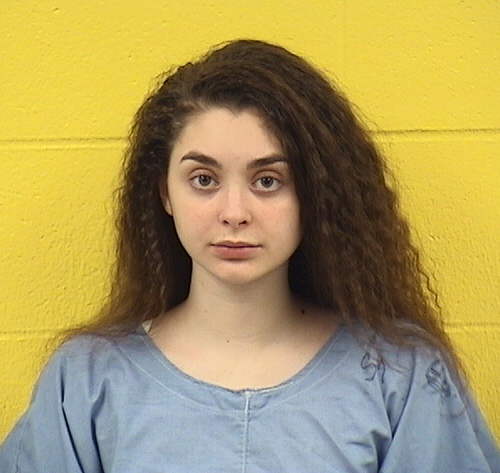
The infamous Mackenzie Shirilla appears in this mugshot. (Photo Credit: Ohio Department of Rehabilitation and Correction)
‘You just tried to kill me’
Strongsville law enforcement has now released text messages that Shirilla exchanged with deceased boyfriend, Dominic Russo.
In the texts, Shirilla appears to tell Russo that she believed that he had been trying to harm her during a then-recent, heated argument.
Following her arrest, investigators learned that she and Russo had gotten into a fight when she was driving erratically mere weeks before the fatal crash.
According to a family friend, Shirilla was allegedly seen striking at Russo.
The individual also reported that she had declared: “I’m going to wreck this car right now!”
Whatever may or may not have happened, Shirilla appears to be confronting Russo on a very serious topic.
“Do you think I would have my car started with you in it knowing that you just tried to kill me,” she asks in one text.
The texts also show that she does not believe that he loves her, as she asks for specific examples.
For context, the two had been dating — with multiple breakups — for four years, having gotten together when she was 13 and he was 16. (Also, yikes.)
The two had also reportedly been living together, albeit with breakups.
🗣️ Steve Shirilla is pushing back on the firestorm surrounding Netflix’s documentary “The Crash” about his daughter, Mackenzie. pic.twitter.com/6SympXpthF
To be clear, these text messages to not prove any criminal wrongdoing on Russo’s part.
In fact, as far as the bench trial that sentenced Shirilla to spend at least 15 years behind bars is concerned, he and their friend, Davion Flanagan, are both the victims of a deliberate homicide.
The victim is not on trial, nor is he meant to be.
However, these texts may help shed light upon things ahead of the crash.
Whether these texts describe actual events before the tragedy or simply Shirilla’s state of mind … that’s a topic of ongoing debate.
To be clear, authorities releasing the texts is likely a result of the high level of interest in the case.
(There have been multiple documentaries, given several sensational aspects of the crime.)
The texts do not change Shirilla’s conviction or sentence.
In her bench trial, the judge convicted her of multiple serious felony counts — despite her insistence that it was a tragic accident.
Shirilla is serving two concurrent life sentences. She will have a chance at parole after 15 years, though some speculate that her notoriety may come back to bite her.
In law and social science, we call this impact a chilling effect – the behavioral tendency for people in face of a threat to self-censor and restrain their activities for self-protection.
It’s increasingly clear to us that these impacts are not incidental or ancillary to Trump administration policy. Rather, the chilling effects are the point. This is the closest thing to a consistent governing strategy in Trump’s second term.
The broader chill of Trump threats
Chilling effects can be subtle, but today they are everywhere. And it’s not just students who are chilled by Trump administration threats.
Law enforcement and regulatory agencies are refusing to investigate Trump-aligned actors inside or outside government, and major national law firms are declining cases challenging Trump administration policies.
In most cases, these people and institutions are not being specifically targeted or threatened by Trump. But they are afraid, and their fear is doing the administration’s work for it. They stay silent, avoid attention and confrontation, and look the other way. In other cases, they change their speech and behavior to accommodate or conform to the administration’s worldview.
Of course, there are counterexamples, such as the winter protests in Minneapolis in response to brutality by agents with U.S. Immigration and Customs Enforcement, and the recent “No Kings” rallies. But even here, the broader but less visible trend – chilling effects – is evident.
For instance, in recent reporting on the latest No Kings rallies, manymedia outlets observed that students were noticeably missing, despite the Trump administration’s unpopularity among younger Americans.
A persistent strategy
We believe none of this is by accident.
In a new book, “Chilling Effects: Repression, Conformity, and Power in the Digital Age,” one of us – Jon Penney – explains how law, technology, and state and corporate power are weaponized to chill and repress, and the dangers this poses for the United States and other democratic societies. The other – Bruce Schneier – has extensively studied the security infrastructure enabling this.
What we see isn’t gratuitous government cruelty, chaos or vengeance. Instead, we see a persistent strategy to maximize fear and chilling effects in ways that are corrosive to freedom and democracy.
In the 1960s, these same tactics were reused by Southern states to chill the Civil Rights Movement. Historians havewritten about how the widespread fear and conformity of these periods reshaped American society in enduring ways, including the destruction of progressive political movements and both delaying and muting the Civil Rights Movement itself.
When such state threats are systematized, they can foment a broader climate of fear, self-censorship and conformity. In that climate, dissenting speech, political opposition, democratic mobilization and other checks on power become increasingly difficult, even dangerous. It is no surprise, for instance, that Trump critics regularly admit to self-censorship, fearing for their safety.
Chilling effects are thus not only repressive – causing self-censorship – but productive. They produce conforming and compliant speech and behavior, which can have longer-term social impacts. They not only undermine protected rights and suppress accountability but can promote social change – even without a popular mandate to do so.
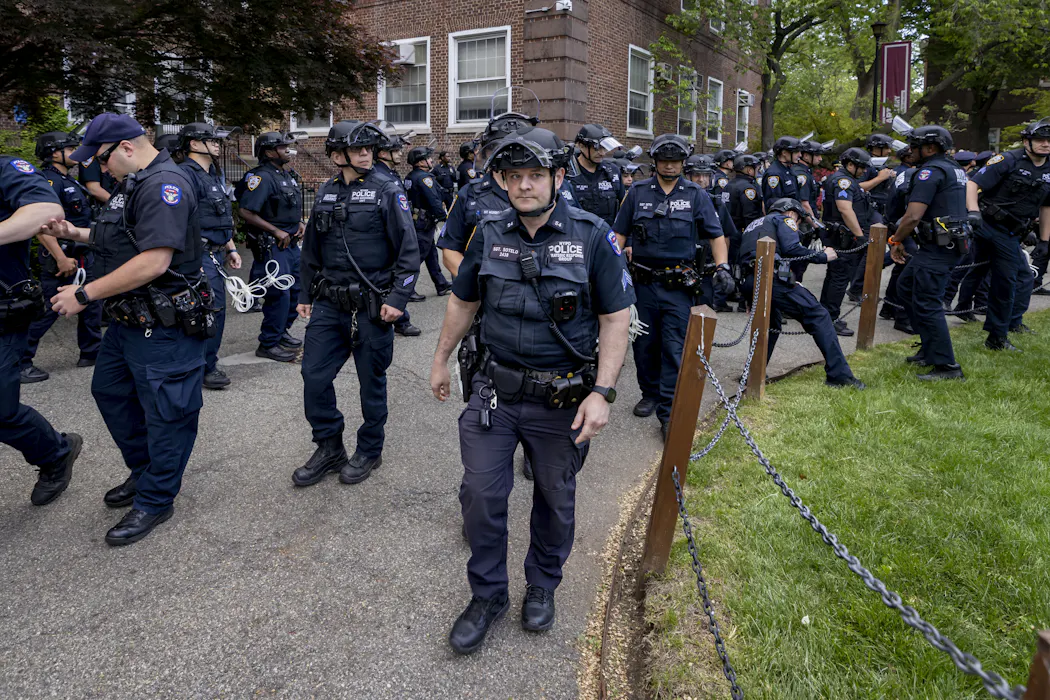
University of Chicago police patrol the campus after dismantling a pro-Palestine encampment on May 7, 2024. Alex Wroblewski/AFP via Getty Images
In the near term, this means an increasingly weakened democratic society, with the government and its patrons enjoying freedom to pursue their objectives. Over the long term, this can mean a changed society as more conformist and compliant speech and culture become more widely accepted and entrenched.
Not inevitable
In our view, this future is not inevitable, just as the McCarthy era “Red Scare” and violent civil rights era repression were not. In both cases, fear and chilling effects were resisted in law and civil society, as they can be today.
But the central mechanisms – surveillance, uncertainty, personal threats and abuse of power – would need to be addressed. For instance, new legislation could ensure justice for lawless government actors and constrain surveillance. Courts can block abuses of federal power, including illegal arrests, detentions and mass citizen databases.
The media, lawyers and civil society can hold the government accountable. And students, teachers, universities and cultural institutions can resist the tendency to self-censor and conform.
The citizen mobilization in Minnesota and the No Kings rallies are examples of that. But to resist chilling effects and their dangers over the long term, this would have to be the norm, not the exception.
Jon Penney has acted as an expert witness, on a pro bono basis, for the American Civil Liberties Association in litigation challenging the legality of government surveillance.
Bruce Schneier does not work for, consult, own shares in or receive funding from any company or organization that would benefit from this article, and has disclosed no relevant affiliations beyond their academic appointment.
We can learn a lot about the toll of IVF through the stories of celebrities. Their candid comments highlight the human side of being unable to conceive.
Health Digest – Health News, Wellness, Expert Insights
Father’s Day is coming up fast, so if you want to make sure your dad has the best possible day (and he loves to grill), make sure you nab him the right gift.
Kane Brown shares who he believes is shaping country music right now, pointing to a couple major names dominating the genre. Continue reading…The Boot – Country Music News, Music Videos and Songs