Chase Matthew says the band member was immediately fired. Continue reading…Country Music News – Taste of Country









Chase Matthew says the band member was immediately fired. Continue reading…Country Music News – Taste of Country

Riley Green’s character Garrett played a huge role in Sunday night’s (May 10) episode of Marshals. Continue reading…The Boot – Country Music News, Music Videos and Songs

Eggs are a versatile protein, but if you’re not seasoning them at the right moment, you’re missing out. We’ve cracked the code on the best time to do it.

Mashed – Fast Food, Celebrity Chefs, Grocery, Reviews

Eric Church delivered a heartfelt keynote address and special performance during UNC-Chapel Hill’s Spring Commencement ceremony on Saturday.
The devoted Tar Heel fan and North Carolina native took the stage at Kenan Stadium in Chapel Hill, where he used the six strings of his guitar as a powerful metaphor to reflect on faith, family, perseverance, resilience, and community. Throughout the speech, Church shared personal wisdom and encouragement with graduates before ending the memorable moment with a performance of “Carolina.”
Upon taking the stage, Church admitted he spent a great deal of time trying to write the perfect commencement speech, only to scrap several versions along the way. Eventually, he decided to lean into what comes naturally to him, telling a story through music.
In true Eric Church fashion, he built his speech around the six strings of a guitar, using each one to symbolize an important pillar of life.
“Six strings. When all six are in tune, the chords they make can stop a conversation cold. Carry a broken person through the worst night of their life or make a room full of strangers fee for three minutes like they’ve known each other forever. But if even one is off, the whole chord unravels. Not gradually, not politely. The moment you strike it, you know I believe your life runs on this principle and I’m going to break it down for you right now and tell you about your strings,” he began.
@bridget_lashae #unc #uncchapelhill #tarheels #northcarolina #ericchurch ♬ original sound – Bridget LaShae • [Bibby]
As the speech continued, Church used each string as a lesson, offering advice and insight about navigating life’s challenges and staying grounded through every season.
Toward the end of the address, he delivered an especially emotional message to the graduating class.
“Six strings. Six strings of life and willingness to keep them in tune. Six principles, six pillars. When all six are in tune with each other, the chord your life makes is full and resonant and truth. All six will drift, not one or two, all six in their own time, in their own season. Your faith will go quiet when you need it loud. Your family will get complicated in a way only the people who love you most can complicate things. You will go through hard seasons with your spouse. Your ambition will hollow out and your resilience will wear thin. Your community will start to feel like an obligation and your world will try to sand down the edges of exactly who you are. This is not failure. This is not weakness. It’s the inevitable universal experience of living in an imperfect world that doesn’t stop to let us tune up.”

Church then encouraged graduates to trust themselves and the path ahead of them.
“Trust what your heart hears and is telling you about your song. So graduates, now I encourage you to take your six strings, make it something worth hearing and play your song as I leave you with mine.”

He concluded the ceremony appearance with a performance of his beloved song “Carolina.”
UNC-Chapel Hill’s Spring Commencement ceremony celebrated 4,453 undergraduate students, along with 1,608 master’s degree recipients and 981 doctoral graduates.
The post Eric Church Uses His Guitar Strings to Deliver Life Advice During UNC-Chapel Hill Commencement Speech appeared first on Country Now.
Country Now

Meetings between Chinese and American leaders are not exactly routine, but few are historically groundbreaking.
The exceptions include the very first visit by a sitting U.S. president to China, when Richard Nixon met with Chairman Mao Zedong in Beijing in February 1972 – at a time when America did not even formally recognize the People’s Republic of China. Deng Xiaoping’s visit to the U.S. in 1979 generated a similarly iconic moment when the reformist Chinese leader donned a Stetson at a Texas rodeo, a sign that he would be willing to engage with America in a way that Mao contemplated only near the end of his life.
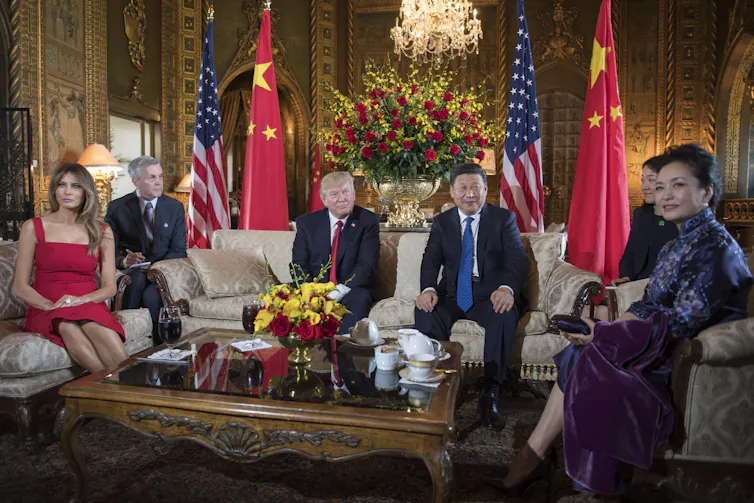
Donald Trump may harbor hopes that his upcoming visit, slated for May 14-15, 2026, could have similar historical significance to those moments half a century ago. It will, after all, be the first face-to-face meeting of U.S. and Chinese leaders in Beijing since Trump’s own visit nearly a decade ago in 2017.
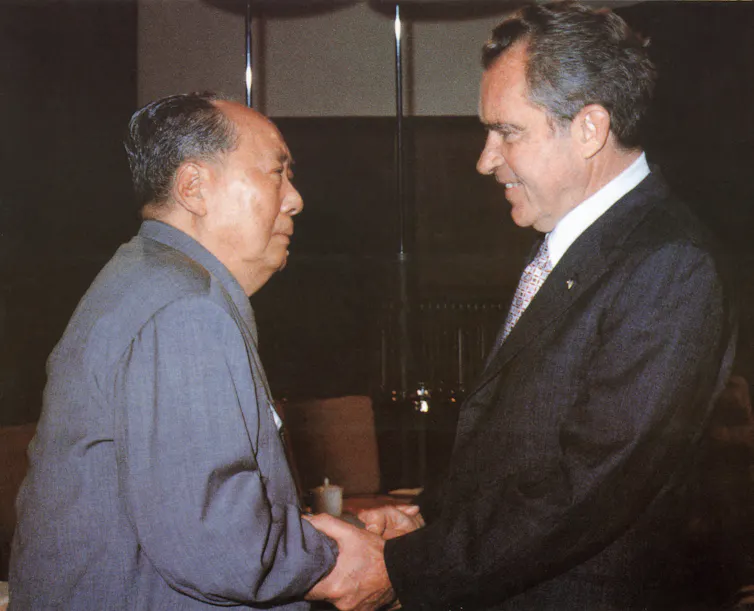
Yet the outcomes of this Trump summit with Xi Jinping are likely to be vague because the goals for both leaders are also only partially evident. The visit is being driven by trade imperatives, but there are other issues that threaten U.S.-China relations in the longer term.
It will be extremely hard for the two sides to address these more deep-rooted divides. Indeed, as an analyst of U.S.-China relations, I believe the world’s two largest economies will have an essentially competitive relationship for years to come, and areas of plausible cooperation – whether on climate change or AI regulation – are increasingly hard to find.
One area that has been a source of contention for quite some time is Taiwan. Xi has made it clear that the unification of the island with the mainland cannot be left to “another generation” but has left it vague – up to now – as to how that goal will be achieved.
The summit has been preceded by lots of chatter about U.S. preparedness to honor its somewhat ambiguous promise to defend Taiwan in the event of an invasion – with Chinese analysts concluding that the war in Iran has severely weakened Washington’s capabilities on this front.
However, there are plenty of signs that Xi would rather find peaceful means to unite with Taiwan that avoid all-out war, particularly as the examples of Russia in Ukraine and the U.S. in Iran show that the outcomes of wars are not predictable.
Instead, China has seemingly concentrated its efforts on influencing the upcoming January 2028 Taiwan presidential election. The leader of the island’s major opposition Kuomintang party, Cheng Li-wun, recently visited the mainland and had a photo op with Xi – a sign that she thinks dealmaking with China might just be acceptable to the Taiwan electorate despite its deep distrust of Beijing.
To further fuel the narrative of a seemingly inevitable path toward unification, it would be helpful for Xi to have signals that the U.S. is no longer committed to defending Taiwan.
China will push for a change from the official position that the U.S. “does not support Taiwan independence” to “the U.S. opposes Taiwan independence.” The latter change sounds minor but would have great significance, as it would essentially be an acknowledgment that the U.S. recognizes unification, by some means, as a legitimate goal in its own right.
Trump has kept his own position ambiguous: He has noted more than once that Taiwan is very close to China and very far from the U.S., but he has also authorized major arms sales to the island that have infuriated Beijing.

Taiwan’s ruling Democratic Progressive Party does not specifically endorse independence, as it knows that’s a red line for Beijing, but it would regard this change in American language as a serious blow to its position. It’s unlikely that the U.S. would make such a major concession during Trump’s visit – but that won’t stop Beijing from asking for it.
A more tentative but increasingly important area for discussion during the Xi-Trump summit is technology in general and AI in particular.
Just three years ago, the attitude of the U.S. government was summed up in the phrase of then national security adviser Jake Sullivan: “small yard, high fence.”
In other words, there would be only a few restricted areas of technology, but they would be fiercely guarded.
In 2026, things have changed. In some areas, tech restrictions have just become looser; the U.S. government now permits the sale to China of some high-specification, American-manufactured chips that were previously restricted. That policy was probably driven by the sense that China was developing its own domestic alternatives anyway and that the U.S. was losing market share.
Yet there is growing concern both in the U.S. and China that AI developments are moving too fast for governments – or companies – to know fully what the technology is capable of doing, let alone being able to regulate it.
China and the U.S. both desire to dominate AI and set the global norms and standards surrounding it. But they are also aware that AI has the potential to cause immense damage.
There has been loose discussion of whether any joint form of supervision or regulation of AI between the U.S. and China might be possible. And that could well form part of the discussions during the leaders’ summit.
But realistically, both sides see themselves in fierce competition, and the likelihood that either American or Chinese companies would restrain themselves may be fanciful.
The most substantial achievements of the summit, however, are likely to be in the least glamorous area: remedying the trade deficit.
Trump’s tariffs aim to make the United States’ global trade partners pay a higher price for entry to the American market, and China’s persistent and massive trade surplus has been a prime target for the U.S. president.
While there are many American products that China would like to buy, most of them are not products that the U.S. government is willing to let them have, including high-tech equipment that could be used for military purposes.
Instead, the key products are likely to be agricultural, including U.S. soybeans and beef. Look out for concessions from China that would benefit farmers in key Republican states, such as Iowa.
The current tariff dispute between the U.S. and China has frozen into a standoff: The U.S. has agreed to allow China’s goods into its immense market at manageable tariff rates, and China has – mostly – agreed to allow critical minerals and rare earths to flow to U.S. manufacturers.
That truce lasts until October, but the summit may see it extended.
Neither side is keen to restart the trade war that marked the summer of 2025, when Trump announced tariffs of over 100% on China and the U.S. was in danger of having key mineral supplies cut off as a result.
So how consequential will the Trump-Xi summit be? Well, don’t expect another “Nixon meets Mao” moment.
The circumstances more than a half-century on are also remarkably different. Today’s China, unlike in 1972, has an economy and military second only to the U.S. and a central position in global organizations, from the United Nations to the World Trade Organization, particularly as the U.S. retreats from such institutions.
Both the U.S. and Chinese sides know that they can expect limited cooperation at best from their opponent.
But after a period, particularly during the COVID-19 pandemic, when communication between the countries atrophied, it’s still important that they are talking at all.

Rana Mitter does not work for, consult, own shares in or receive funding from any company or organization that would benefit from this article, and has disclosed no relevant affiliations beyond their academic appointment.
Politics + Society – The Conversation

Some celebrities over 40 years of age have opted to get a hysterectomy. Women who are thinking of getting this common procedure can learn a lot from them.

Health Digest – Health News, Wellness, Expert Insights

The U.S. is home to a wondrous array of regional foods, and Denver’s Mexican hamburgers are a special part of such widespread dining diversity.

Food Republic – Restaurants, Reviews, Recipes, Cooking Tips

The resourcefulness and creativity demonstrated in Depression-era kitchens are still talked about. This popular sandwich is remembered as a regional favorite.

Mashed – Fast Food, Celebrity Chefs, Grocery, Reviews

The Alaska State Capitol in Juneau is seen on Apr. 24, 2026. (Photo by Claire Stremple/Alaska Beacon)
The Alaska Beacon launched four years ago today, with a mission to connect Alaskans to their state government.
Since then, we have covered four legislative sessions from the Alaska State Capitol in Juneau. We have written 5,670 articles. And our reporting has won 44 awards — including the Society of Professional Journalists’ General Excellence award, an A-Mark Investigative Journalism award and five Alaska Press Club awards this year.
The Alaska Beacon is a four person team: one editor and three reporters. Our stories have and will continue to investigate how state policies affect specific areas, like the economy, environment, health and education.

Yereth Rosen covers health and the environment from Anchorage, but her reporting takes her all over the state. She’s in Juneau this week for the end of the legislative session, but she’s also racked up trips to Nome, Sitka, Homer, Seward and Whittier. Most of that travel has been supported by a fellowship grant through USC Annenberg’s Center for Health Journalism. Yereth has been with the Alaska Beacon since its inception.
James Brooks covers government and politics from Juneau. He’s back in the halls of the state house after taking some leave to bring twin sons into his family this year. In the coming weeks, he will be following how state lawmakers decide to spend a projected increase in state revenue and the fate of various proposals to incentivize the developers of the potential Alaska LNG project. He has been with the Alaska Beacon since its inception.
Corinne Smith joined the Alaska Beacon in 2024, reporting on the education and justice beats. After award-winning coverage of the education funding and policy debates last year, she is monitoring the effects of that policy — and whether lawmakers address education policy again before they gavel out next week.
I rejoined the Alaska Beacon as its editor in late 2025 after several years as the education and justice reporter and a year-long departure to lead the newsroom at KTOO in Juneau. While I still contribute news stories from time to time, my main focus is leading our three-person team in coverage that centers how state politics and policy affect your life.
In the coming year, we plan to continue our coverage with a major focus on the upcoming November elections. You can look forward to our Voter Guide launching in the coming months, and elections coverage in partnership with other Alaska newsrooms, including the state’s public radio network and the Anchorage Daily News.
Thank you for reading the Alaska Beacon over the last four years. In the years to come, we’re looking forward to earning your continued readership, trust and support.

The trans-Alaska pipeline and Dalton Highway are seen on July 4, 2014, in the Brooks Range area near the pipeline’s Pump Station 4, about 270 miles south of Prudhoe Bay. (Photo by Bob Wick/U.S. Bureau of Land Management)
A bill that would impose a toll on oil and gas vehicles using the Dalton Highway was set aside by state lawmakers on Thursday after the public voiced concern that it would target a single industry and raise costs for Alaskans.
Senator Scott Kawasaki, D-Fairbanks and the sponsor of SB 286, introduced the bill in an effort to offset maintenance costs of the 414-mile long highway that runs from Livengood, north of Fairbanks, the the oilfields of Prudhoe Bay.
“We are trying to find ways to balance this budget where the cost causers are the cost payers,” he said Tuesday.
The Alaska Department of Transportation and Public Facilities invests approximately $16.5 million in maintenance on the Dalton Highway each year, with approximately one-third of that funding coming from the federal government.
The bill would set up a toll on two miles of the highway near Deadhorse for vehicles transporting personnel or goods for oil and gas companies. The Alyeska Pipeline Service Company, the company that operates the 800-mile long Trans-Alaska Pipeline System between Prudhoe Bay and Valdez, would be exempted from the toll. The bill would require oil and gas companies to reimburse operators who pay the toll within 30 days of a request for reimbursement.
Alaska Trucking Association President Jamie Benson said that while she supports infrastructure investment, the bill would single out the trucking industry and could increase costs for all Alaskans.
“While it’s framed as a maintenance solution, it functions as a targeted fee on a single industry and its supply chain, including Alaska-based trucking companies,” she told legislators Thursday afternoon.
While the bill aims to raise funds to maintain the Dalton Highway, funds raised from the toll would go into the general fund and be subject to appropriations by the legislature annually.
Members of the trucking, oil and gas industries voiced their opposition during a committee meeting on Thursday.
Robb Christenson, director of sales and pricing at Sourdough Express, expressed concerns about government overreach.
“If we begin carving out small sections of public infrastructure and charging users based on industry, where does it stop? Today it’s two miles on the Dalton Highway, tomorrow it’s roads that access mining, timber or other resource development,” he said.
Cody Hyce, owner of Specialized Transport and Rigging in Wasilla, told legislators that the economic, legal and operational hurdles created by the bill would outweigh the benefits to the state.
“We should be looking for efficiencies in our transportation budget, not nickel and diming the very workers and resources that ensure the state’s energy independence,” he said.
According to Andy Mills, legislative liaison to the Department of Transportation and Public Facilities, Alaska does not currently have authorization from the federal government to establish a toll facility on the highway. The Senate State Affairs committee set the bill aside.
Senator Robert Myers, R-North Pole, told legislators that he understands the issue that they’re trying to fix, but he does not see a toll as the right solution.
Myers, who is a truck driver and travels the Dalton Highway, said that the bill poses legal issues since the highway is being rebuilt using federal funds, an equal protection issue by exempting the Alyeska Pipeline Service Company and operational issues for trucking companies.
SUBSCRIBE: GET THE MORNING HEADLINES DELIVERED TO YOUR INBOX