Maine Democratic Gov. Janet Mills suspended her campaign for Senate on Thursday, as her progressive challenger, oyster farmer Graham Platner, continued to lead in the polls and in fundraising.
It’s a shocking fall off for the incumbent governor, who was once the preferred candidate of national Democrats in the race and remains the only member of her party to win statewide in Maine in nearly two decades.
And it sets up a likely general election matchup between Platner and Sen. Susan Collins (R-Maine), a five-term incumbent with a formidable electoral track record who Democrats are nonetheless hopeful they can knock off amid backlash to Republicans and President Donald Trump.
“While I have the drive and passion, commitment and experience, and above all else — the fight — to continue on, I very simply do not have the one thing that political campaigns unfortunately require today: the financial resources,” Mills said in a statement Thursday morning.
Mills’ campaign had just over $1 million in the bank at the end of March, far less than Platner’s $2.7 million, and had stopped running TV ads earlier this month, a sign of financial troubles.
Her exit from the race is a major loss for Senate Minority Leader Chuck Schumer (D-N.Y.), who recruited Mills and saw her as the most viable option to defeat Collins. On Thursday, Schumer and Democratic Senatorial Campaign Committee Chair Sen. Kirsten Gillibrand (D-N.Y.) released a statement bashing Collins and promising to support Platner.
“After years of allowing Trump’s abuses of power, Senator Collins has never been more vulnerable and we will work with the presumptive Democratic nominee Graham Platner to defeat her,” the pair said in a statement.
It is a remarkable ascension for Platner, who was a complete unknown when he launched his campaign last August and has faced a myriad of scandals including offensive old Reddit posts and a tattoo resembling a Nazi symbol that he later covered up. Platner has said the past comments don’t represent him, but they are likely to feature heavily in the general election matchup against Collins: A super PAC backing her, Pine Tree Results PAC, put millions this week behind ads highlighting the comment and the tattoo.
Republicans seized on Mills’ exit to question Platner’s blue-collar bona fides and highlight his past scandal.
“Chuck Schumer and Senate Democrats just coronated a phony who is too extreme for Maine,” NRSC Chair Sen. Tim Scott (R-S.C.) said in a statement. “Susan Collins has always put in the work for her constituents and delivered. Washington Democrats always fall short in Maine and will again, because they just nominated a dishonest radical.”
Platner has already started running Collins-focused ads, and earlier this week his campaign told donors that they were pivoting to the general election, an early declaration of victory ahead of the June primary.
Mills’ statement announcing she was dropping out did not mention Platner.
Platner praised Mills’ service to the state at a press conference in Augusta, Maine, Thursday morning where he rolled out a slate of state legislative endorsements, saying he looked forward to working closely with her to defeat Collins.
“We both got into this race because we knew how critical it is to defeat Susan Collins, and her decision today reflects a commitment to that project,” he said.
Lauren Alaina got some of her best career advice ever in an unlikely place: The bathroom! Continue reading…The Boot – Country Music News, Music Videos and Songs
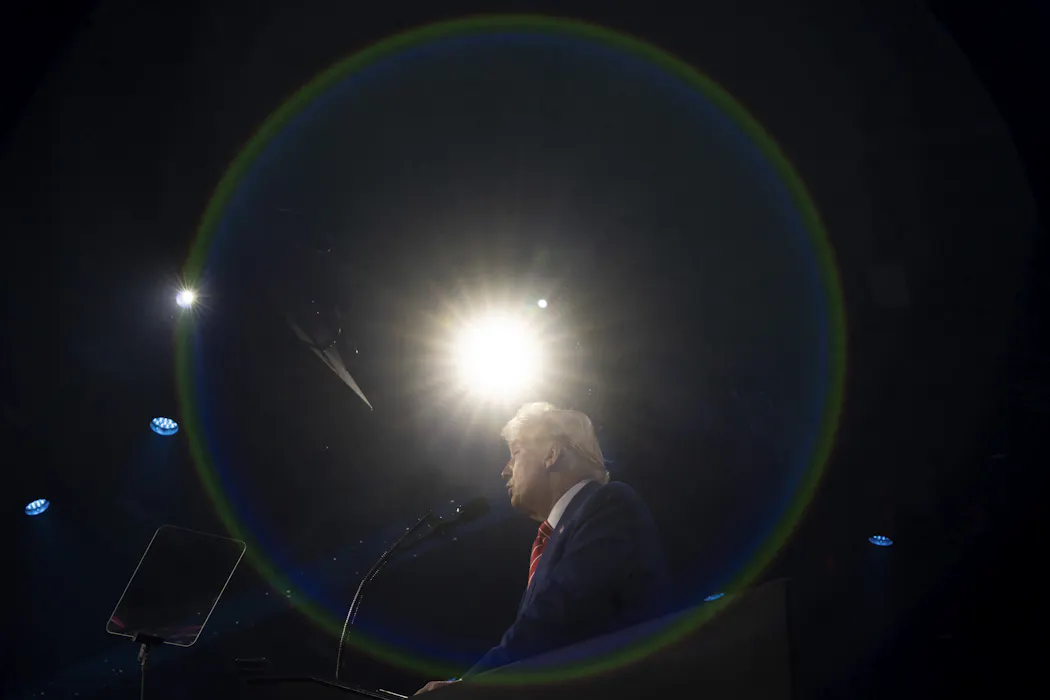
President-elect Donald Trump speaks during Turning Point USA’s AmericaFest at the Phoenix Convention Center on Dec. 22, 2024, in Arizona. Rebecca Noble/Getty Images
Three days later, Trump posted an image depicting Jesus with his left hand on the president’s shoulder. Referring to that post, Trump observed, “Radical Left Lunatics might not like this, but I think it is quite nice!!!”
Political messianism is a style of leadership that places great faith in a single leader who is endowed with godlike attributes. It does not welcome dissent, and it portrays politics as a struggle between good and evil.
Eric Voegelin, a 20th-century political thinker, warned that political messianism often fuels authoritarian rule. It divides society, with a messianic leader’s supporters seeing him as a savior who will deliver their country into a golden age, while opponents foresee a coming apocalypse.
Democratic politics thrive when leaders and followers act with modesty and humility, when no one sees themselves as infallible or indispensable. As someone who teaches and writes about U.S. democracy, I don’t think it can thrive, or even survive, when its leaders see themselves as godlike and when the citizenry is divided into true believers and heretics.
At the Republican National Convention in 2016, he boasted that “I alone can fix it,” referring to a system that was responsible for what he would later call “American carnage.”
In 2023, he described what he had done in his first term this way: “I think you would have a nuclear war if I weren’t elected.” As president, “I was very busy. I consider this the most important job in the world, saving millions of lives.”
And in a Jan. 8, 2026, interview with The New York Times, Trump said, “I don’t need international law,” since his actions as commander in chief were guided only by “my own morality. My own mind.”
The president is not alone in believing in his messiah status, or in comparing himself to Christ. On April 2, 2026, at a White House Easter celebration, Paula White-Cain, one of his spiritual advisers, used Jesus’ death and resurrection to explain what had happened to Trump.
“Jesus taught so many lessons through his death, burial, and resurrection,” she said. “He showed us great leadership, great transformation requires great sacrifice. And Mr. President … you were betrayed and arrested and falsely accused. It’s a familiar pattern that our lord and savior showed us.”
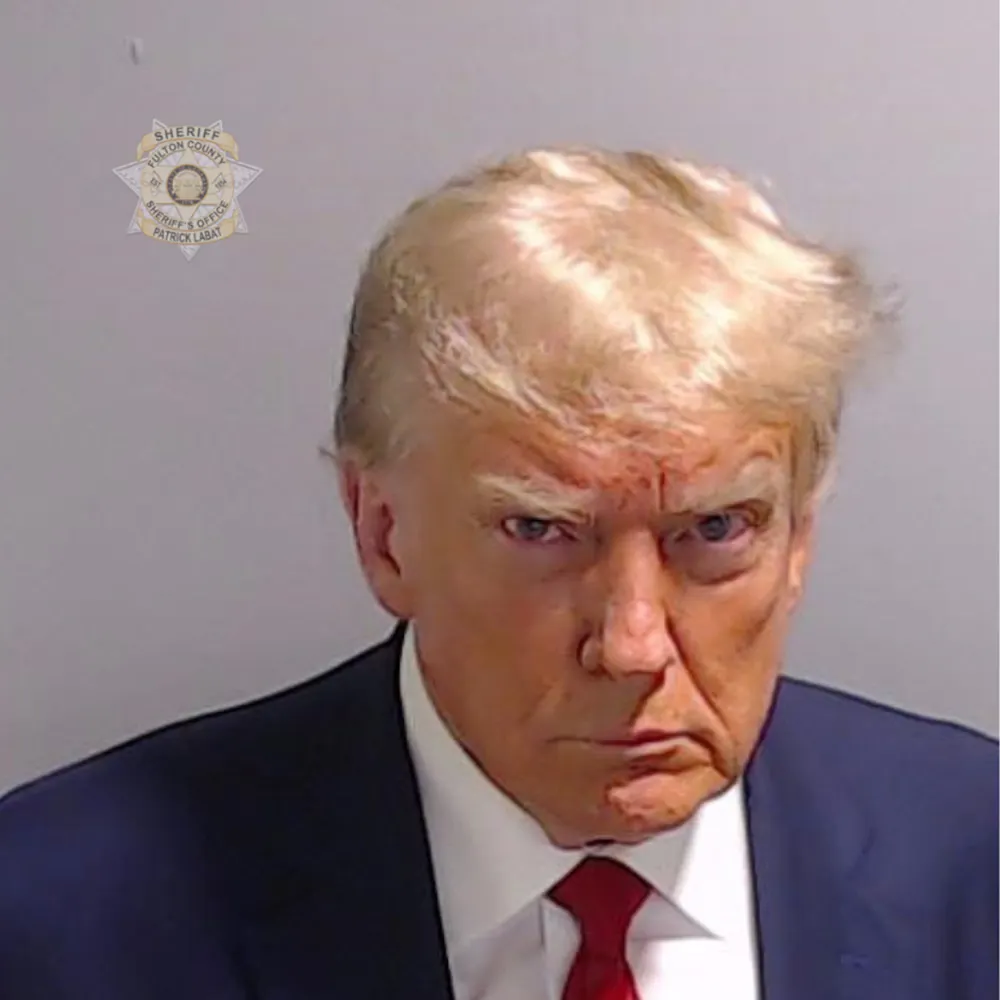
In this handout provided by the Fulton County Sheriff’s Office, former U.S. President Donald Trump poses for his booking photo at the Fulton County Jail on Aug. 24, 2023, in Atlanta, Ga. Fulton County Sheriff’s Office via Getty Images
Democracy and humility
In a democracy, it’s dangerous for leaders to see themselves as better than or morally superior to the people they serve. President Joe Biden captured that insight when, after he was elected, he recalled a family mantra instilled in him by his mother: “‘Joey, no one is better than you. Everyone is your equal, and everyone is equal to you.’”
The political philosophy scholar Michael Sandel, whose book “The Tyranny of Merit” seeks to explain what happens to democracy when people, not just leaders, think that they are better than others, argues that such a view breeds “meritocratic hubris.” Such hubris has “a corrosive effect … on the social bonds that constitute our common life,” he writes.
“Humility is a civic virtue essential to this moment,” he adds. “It’s a necessary antidote to the meritocratic hubris that has driven us apart. It points … toward a less rancorous, more generous public life.”
Michael Walzer, another political theorist, explained the dangers of messianic politics this way: It “poses dangers to social order and national survival.” When it takes hold, he writes, “compromise is preempted by command; moral absolutism leaves no room – or all too little – for maneuver in times of crisis and emergency.”
Presidential fallibility
Even the greatest American presidents have not seen themselves as American saviors. They embraced at least some of the humility Sandel describes.
George Washington described the kind of person who would succeed him in office as just “a citizen,” not a savior or a person of extraordinary gifts. Their task, he thought, would not be grand. They would be chosen “to administer the executive government of the United States.”
Washington acknowledged that his judgment was “fallible” and that he’d made numerous errors during his time in office. “Whatever they may be,” he said, “I fervently beseech the Almighty to avert or mitigate the evils to which they may tend.”
He resisted the idea advanced by John Adams, who wanted the first U.S. chief executive to be called “His Elective Majesty,” “His Mightiness” and even “His Highness, the President of the United States of America and the Protector of their Liberties.” Washington turned down the pompous titles and accepted instead the simple title adopted by the House: “The President of the United States.”
Not a trace of a messiah complex in someone who could understandably have seen himself that way.
This photo illustration created on April 13, 2026, shows a picture of President Donald Trump on a screen and an AI-generated picture he posted on his Truth Social platform depicting himself as Jesus Christ after criticizing Pope Leo XIV. Mandel Ngan/AFP via Getty Images
Or take Abraham Lincoln.
In his Gettysburg Address, considered one of the greatest speeches in American history, Lincoln did not toot his own horn or exaggerate the significance of his own words. Just the opposite.
As Rabbi Menachem Genack observes, Lincoln asserted during the dedication of the cemetery for fallen soldiers at Gettysburg that “’the world will little note, nor long remember, what we say here.’ (T)hat phrase was not an expression of false modesty nor just a poor prediction of how that tribute would be recorded. It was a symbol of deep-seated humility.”
And in an 1860 letter to an admirer who wanted to inscribe a book to him during his first presidential campaign, Lincoln responded that “begging only that the inscription may be in modest terms, not representing me as a man of great learning, or a very extraordinary one in any respect.”
Almost 100 years later, President Harry Truman referred to himself as nothing more than an “old man who by accident became president of the United States.”
‘If men were angels’
Writing in 1788, Alexander Hamilton reminded Americans of a key maxim of life in a constitutional democracy. Government, he said, is “the greatest of all reflections on human nature. If men were angels, no government would be necessary.”
“If angels were to govern men, neither external nor internal controls on government would be necessary,” Hamilton said. “In framing a government which is to be administered by men over men, the great difficulty lies in this: you must first enable the government to control the governed; and in the next place oblige it to control itself.”
Democracy is a mode of government built on the idea that none of us is infallible, including those who assume positions of leadership. Elections give the people the chance to change course and correct mistakes.
Presidential scholar Stephen Hess captured the essence of democratic leadership in a 2009 interview with Reuters. He said: “It’s more important to admit mistakes than to make them.”
In the end, as Walzer observes, there can be no messiahs in a democracy. The leader cannot “cast aside” the people. In a democracy, they must be “chastised, defended, argued with, educated” by those who lead.
Those “activities,” Walzer insists, “undercut and defeat” any pretense that it is only the leader who knows the way.
Austin Sarat does not work for, consult, own shares in or receive funding from any company or organization that would benefit from this article, and has disclosed no relevant affiliations beyond their academic appointment.
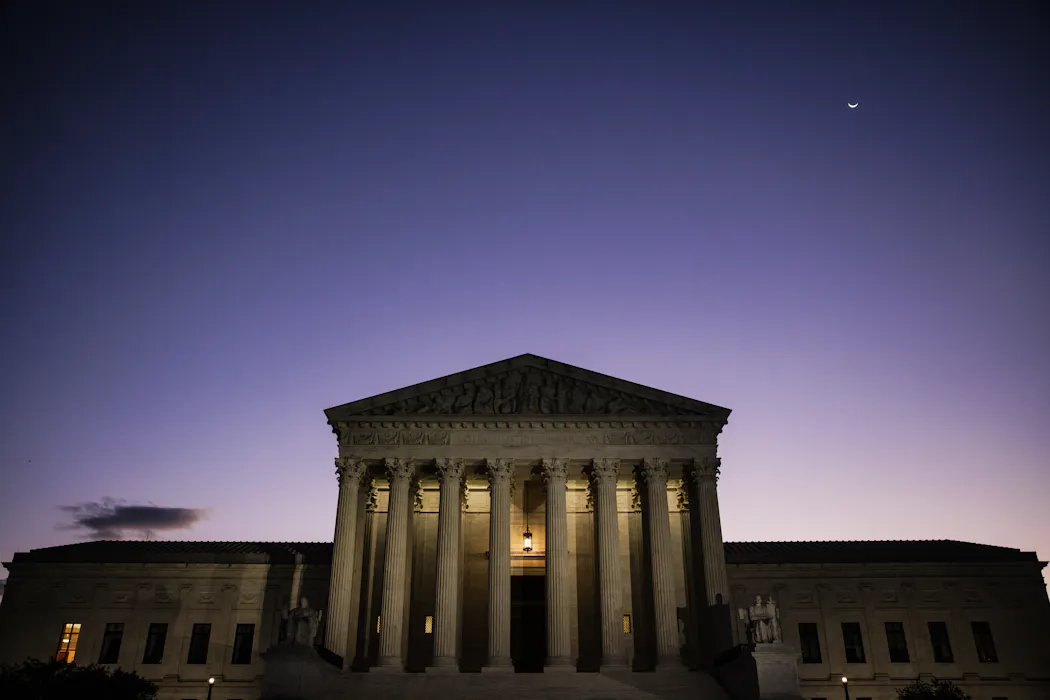
The Supreme Court issued a significant ruling that could limit minority voting rights in states across the country.Bloomberg Creative via Getty Images
Divided along ideological lines, the U.S. Supreme Court on April 29, 2026, issued a ruling that severely weakens a provision of the landmark Voting Rights Act of 1965. That provision, known as Section 2, prohibited any discriminatory voting practice or election rule that results in less opportunity for minority groups to exercise their political clout.
In her dissent on the ruling, Justice Elena Kagan wrote that it is the “latest chapter in the majority’s now-completed demolition of the Voting Rights Act.”
The decision in the case known as Louisiana v. Callais struck down a Louisiana voting district drawn to consolidate Black voters into a district where they would be the majority. The court’s conservative majority deemed the drawing of the district an unconstitutional gerrymander.
That, wrote Kagan, will “systematically dilute minority citizens’ voting power.”
I’m a historian of racial formation and electoral and cultural politics in the U.S. I see this decision by the nation’s highest court as the latest in a long line of successful attempts, by both state and federal authorities, to limit the political power of Black Americans and, most recently, to reverse the gains they won in two periods of civil rights advancement.
While the conservative majority in Louisiana v. Callais did not explicitly strike down Section 2, the ruling appears likely to nonetheless open the floodgates for widespread vote dilution by allowing primarily Southern state legislatures to redraw political districts, weakening the voting power of racial minorities.
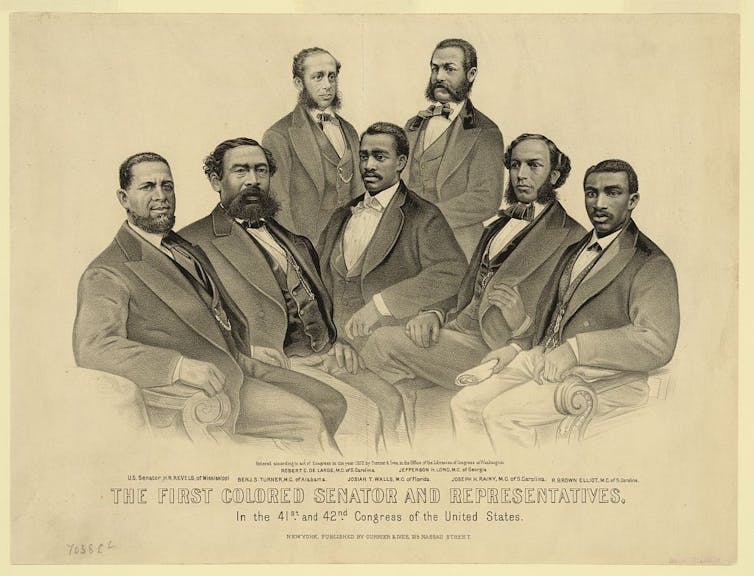
The first Black senator and representatives were elected in the 1870s, as shown in this historic print. Library of Congress
The case was brought by a group of Louisiana citizens who declared that the federal mandate under Section 2 to draw a second majority-Black district violated the equal protection clause of the 14th Amendment and thus served as an unconstitutional act of racial gerrymandering.
Initially designed to enshrine federal civil rights protections for freed people facing a battery of discriminatory “Black Codes” in the postbellum South, the 14th Amendment’s equal protection clause has been the foundation of the nation’s modern rights-based legal order, ensuring that all U.S. citizens are treated fairly and preventing the government from engaging in explicit discrimination.
As I highlight in my new book “Requiem for Reconstruction,” the struggle over the nation’s second founding not only highlights how generational political progress can be reversed but also provides a lens into the specific historical origins of racial gerrymandering in the United States.
Without understanding this history – and the forces that unraveled Reconstruction’s initial promise of greater racial justice – we cannot fully comprehend the roots of those forces that are reshaping our contemporary political landscape in a way that I believe subverts the true intentions of the Constitution.
The long history of gerrymandering
Political gerrymandering, or shaping political boundaries to benefit a particular party, has been considered constitutional since the nation’s 18th-century founding, but racial gerrymandering is a practice with roots in the post-Civil War era.
Expanding beyond the practice of redrawing district lines after each decennial census, late 19th-century Democratic state legislatures built on the earlier cartographic practice to create a litany of so-called Black districts across the postbellum South.
The nation’s first wave of racial gerrymandering emerged as a response to the political gains Southern Black voters made during the administration of President Ulysses S. Grant in the 1870s. Georgia, Alabama, Florida, Mississippi, North Carolina and Louisiana all elected Black congressmen during that decade. During the 42nd Congress, which met from 1871 to 1873, South Carolina sent Black men to the House from three of its four districts.
Initially, the white Democrats who ruled the South responded to the rise of Black political power by crafting racist narratives that insinuated that the emergence of Black voters and Black officeholders was a corruption of the proper political order. These attacks often provided a larger cultural pretext for the campaigns of extralegal political violence that terrorized Black voters in the South, assassinated political leaders, and marred the integrity of several of the region’s major elections.
Election changes
Following these pogroms during the 1870s, southern legislatures began seeking legal remedies to make permanent the counterrevolution of “Redemption,” which sought to undo Reconstruction’s advancement of political equality. A generation before the Jim Crow legal order of segregation and discrimination was established, southern political leaders began to disfranchise Black voters through racial gerrymandering.
These newly created Black districts gained notoriety for their cartographic absurdity. In Mississippi, a shoestring-shaped district was created to snake and swerve alongside the state’s famous river. North Carolina created the “Black Second” to concentrate its African American voters to a single district. Alabama’s “Black Fourth” did similar work, leaving African American voters only one possible district in which they could affect the outcome in the state’s central Black Belt.
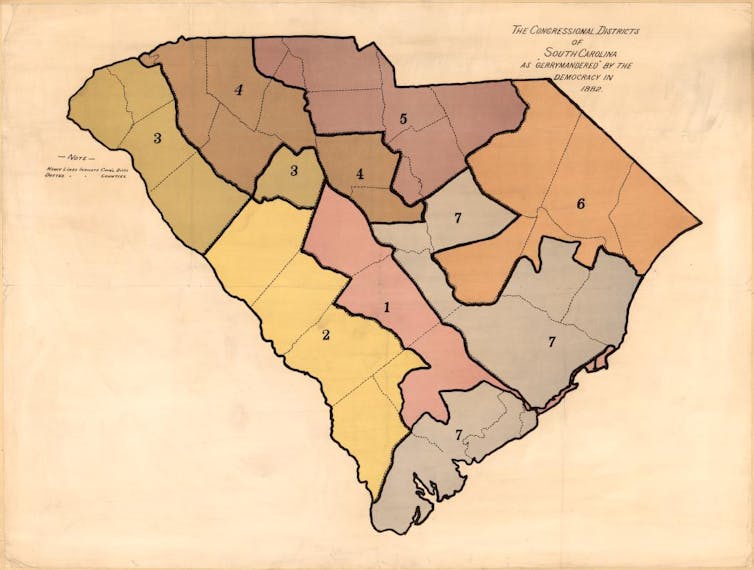
South Carolina’s “Black Seventh” was perhaps the most notorious of these acts of Reconstruction-era gerrymandering. The district “sliced through county lines and ducked around Charleston back alleys” – anticipating the current trend of sophisticated, computer-targeted political redistricting.
Possessing 30,000 more voters than the next largest congressional district in the state, South Carolina’s Seventh District radically transformed the state’s political landscape by making it impossible for its Black-majority to exercise any influence on national politics, except for the single racially gerrymandered district.
South Carolina’s House map was gerrymandered in 1882 to minimize Black representation, heavily concentrating Black voters in the 7th District. Library of Congress, Geography and Map Division
Although federal courts during the late 19th century remained painfully silent on the constitutionality of these antidemocratic measures, contemporary observers saw these redistricting efforts as more than a simple act of seeking partisan advantage.
“It was the high-water mark of political ingenuity coupled with rascality, and the merits of its appellation,” observed one Black congressman who represented South Carolina’s 7th District.
Racial gerrymandering in recent times
The political gains of the Civil Rights Movement of the 1950s and 1960s, sometimes called the “Second Reconstruction,” were made tangible by the 1965 Voting Rights Act. The law revived the postbellum 15th Amendment, which prevented states from creating voting restrictions based on race. That amendment had been made a dead letter by Jim Crow state legislatures and an acquiescent Supreme Court.
In contrast to the post-Civil War struggle, the Second Reconstruction had the firm support of the federal courts. The Supreme Court affirmed the principal of “one person, one vote” in its 1962 Baker v. Carr and 1964 Reynolds v. Sims decisions – upending the Solid South’s landscape of political districts that had long been marked by sparsely populated Democratic districts controlled by rural elites.
The Voting Rights Act gave the federal government oversight over any changes in voting policy that might affect historically marginalized groups. Since passage of the 1965 law and its subsequent revisions, racial gerrymandering has largely served the purpose of creating districts that preserve and amplify the political representation of historically marginalized groups.
This generational work is being undone by the current Supreme Court with its ruling in Louisiana v. Callais.
Robert D. Bland does not work for, consult, own shares in or receive funding from any company or organization that would benefit from this article, and has disclosed no relevant affiliations beyond their academic appointment.
State governments have had trouble regulating what crisis pregnancy centers should tell their clients and donors.AP Photo/Mark Zaleski
The U.S. Supreme Court has cleared the way for a chain of crisis pregnancy centers based in New Jersey to challenge a subpoena from New Jersey’s attorney general.
First Choice Women’s Resource Centers operates at several locations throughout New Jersey. There are more than 2,500 of these Christian-led nonprofits in the United States. Most try to discourage pregnant women from obtaining abortions. Some offer free medical services, such as over-the-counter pregnancy tests and sonograms. Many give their clients clothing, diapers and other items that the parents of babies require.
First Choice caught the attention of Matthew Platkin in 2023 while he served as the state’s attorney general. He suspected that it violated New Jersey’s Consumer Fraud Act by misleading its donors about its mission and operations. According to court filings, Platkin wanted to determine if First Choice had misled its donors and patients into believing that the centers provide “comprehensive reproductive health care services, including abortion care and contraception, when they in fact have an objective of deterring individuals from seeking such services.”
As part of New Jersey’s investigation, Platkin issued a subpoena demanding that First Choice produce donation records, including the personal information of the donors, over a 10-year period so that his office could “contact a representative sample” of them to determine if they had “been misled” by First Choice about what the group does – that is, whether or not it provided abortions.
First Choice asserted that the subpoena violated its First Amendment rights, and that it had a right to sue New Jersey’s attorney general in federal court to quash the subpoena.
In my view as a privacy and constitutional law scholar, the court ruled correctly by concluding that issuing a subpoena for personal information regarding a crisis pregnancy center’s donors may deter those donors from supporting the organization.
Quashing New Jersey’s subpoena
After First Choice sued to block the subpoena, Platkin argued that federal courts lacked jurisdiction to decide the case. That’s because First Choice’s alleged injury – deterring donors from supporting the organization – had not yet materialized because New Jersey had not yet tried to enforce the subpoena in court.
In other words, Platkin argued that the case was premature.
But First Choice argued that merely issuing a subpoena can deter donors from making a gift. To further its argument, First Choice presented what it said was an “anonymous declaration from several donors describing the present chill on their First Amendment-protected association.” In its view, the injury was real and concrete enough for the federal courts to decide the case.
The justices have now cleared the way for First Choice to continue with its lawsuit against New Jersey authorities in federal court.
Court ruled on a related case in 2018
The First Choice case might sound similar to a case the court decided in 2018.
In 2015, California enacted the Reproductive Freedom, Accountability, Comprehensive Care, and Transparency Act, better known as the Reproductive FACT Act. That law required clinics to inform their patients of California’s free or low-cost access to family-planning services, prenatal care and abortion. Several anti-abortion groups objected to California’s mandate, claiming the Reproductive FACT Act unconstitutionally compelled crisis pregnancy centers to disclose a message they do not support.
The Supreme Court agreed. Justice Clarence Thomas, writing for the court, concluded that the Reproductive FACT Act required clinics to “provide a government-drafted script about the availability of state-sponsored activities” that the clinics opposed.
In the court’s view, this violated the clinics’ First Amendment rights because it compelled them to speak a message containing an implicit viewpoint – support for abortion – that the clinics fundamentally opposed.
Both cases sit at the intersection of abortion politics and the First Amendment, but they raise distinct questions. The prior one, which addressed California’s attempt to regulate crisis pregnancy centers, asked whether the government can force those centers to make mandated statements. This new one, First Choice, asks whether the government can force the centers to disclose their donors’ identities.
An abortion rights supporter protests outside the Supreme Court building in 2018, when the court heard a different crisis pregnancy center case. AP Photo/Carolyn Kaster
Precedent set in an old NAACP case
The court has found previously that donations are a form of protected speech, including in its Citizens United v. Federal Elections Commission ruling. In that 2010 decision, the majority recognized that “All speakers, including individuals … use money amassed from the economic marketplace to fund their speech.”
As Justice Neil Gorsuch wrote in the Free Choice ruling, each right protected by the First Amendment “necessarily carries with it a corresponding right to associate with others.” Without such a right, he added, “no two men could safely share the same soapbox.”
This crisis pregnancy center ruling also reaffirms what the court decided about seven decades earlier in NAACP v. Alabama. The NAACP, founded in 1909, is one of the nation’s biggest civil rights groups.
That ruling protected the privacy of NAACP members in Alabama. While there were no donors involved in that case, I believe that the rights of donors in the First Choice case are analogous to the rights of the NAACP’s members in the 1958 case – in that both have the right to the protection of their privacy.
In the 1950s, Alabama Attorney General John Patterson wanted to shut down the local NAACP chapter, based on his belief that the civil rights organization was “causing irreparable injury to the property and civil rights of the residents and citizens of the State of Alabama” by operating within the state as an unincorporated association.
Similarly, in the 2026 First Choice case, Gorsuch, who wrote the 9-0 decision, “demands for private donor information inevitably carry with them a deterrent effect on the exercise of First Amendment rights.”
That is similar to Alabama’s demand for the NAACP’s membership list in 1958.
“It is hardly a novel perception that compelled disclosure of affiliation with groups engaged in advocacy may constitute as effective a restraint on freedom of association,” Supreme Court Justice John Marshall Harlan II declared in the ruling, which essentially shut down Alabama’s effort to ban the NAACP.
“This Court has recognized the vital relationship between freedom to associate and privacy in one’s associations,” Harlan added.
How to read this ruling
Many conservatives today will surely see the court’s decision as a win for the anti-abortion movement and its associated organizations. And many progressives will perceive it as another ruling from a supermajority conservative court that favors the rights of Americans who oppose access to abortion over those who support abortion rights.
I think both interpretations are wrong because this case is more about free speech than abortion.
The fundamental principle the court asserted in NAACP v. Alabama remains intact – there is a vital relationship between the right to privacy and the freedom to associate.
Since its ratification in 1791, the First Amendment has protected much more than the rights that are expressly mentioned in its text. It protects the right to speak freely, just as it protects the right not to speak and the right to speak anonymously.
The First Amendment protects the right to associate with groups and organizations, just as it protects the right to associate with those groups and organizations anonymously.
It protects the right to think freely, to hold certain beliefs and to reject others. And as the Supreme Court reaffirmed in the First Choice case, the First Amendment protects individuals’ rights to associate with organizations that align with their beliefs by donating to them.
Wayne Unger does not work for, consult, own shares in or receive funding from any company or organization that would benefit from this article, and has disclosed no relevant affiliations beyond their academic appointment.
“On behalf of President Donald J. Trump,” read 22 emails sent from the White House Presidential Personnel Office on Friday afternoon, April 24, 2026, “I am writing to inform you that your position as a member of the National Science Board is terminated, effective immediately.”
When asked why the entire board was removed, a White House spokesperson cited the Supreme Court’s 2021 decision in United States v. Arthrex, Inc., stating that the case raised constitutional questions about the National Science Board, its independence and its role in the agency it oversees, the National Science Foundation. Specifically, whether non-Senate confirmed appointees can exercise the authorities that Congress gave the board when it authorized the NSF in 1950.
We argue that the dismissal is not just a political act dressed in constitutional language; it is the resurfacing of an argument almost as old as the National Science Foundation itself — one that nearly killed the agency in its cradle.
Truman’s 1947 veto
In 1945, the science advisor of President Franklin D. Roosevelt, Vannevar Bush, proposed that a new federal science agency be governed by a part-time board of eminent volunteer scientists. This agency came to be called the National Science Foundation, and the board – not the president – was designated to choose its director for a six-year term.
Bush’s intent was to insulate basic research from political pressure. But with Roosevelt’s death in April of that year, it would be up to the following president, Harry Truman, and Congress to make the final decision.
Harley Kilgore, a senator from West Virginia, objected to the board’s formation and its independent role. He argued that vesting public authority in scientists not directly accountable to the president was constitutionally suspect and democratically unsound. The board should not choose the director. President Truman’s 1947 veto signaled agreement.
Vannevar Bush, left, played a key role in the creation of the National Science Foundation, which President Harry Truman, center, ultimately ratified after an initial veto. Abbie Rowe/National Park Service via Wikimedia Commons
A series of lively hearings on the creation of the National Science Foundation served to forge the post-war science system. Out of these debates came the 1950 compromise that finally established NSF and the National Science Board, giving each side something.
The director would be appointed by the president and confirmed by the Senate. Above the director sat the National Science Board – also presidentially appointed and Senate-confirmed, but serving staggered six-year terms designed to outlast any single administration. The board would set NSF policy, approve major grants and report independently to the president and Congress on the state of American science. The director would handle operations.
The structure was deliberately uneasy. It was meant to allow scientific judgment and political accountability to coexist without one absorbing the other.
What the board has done
For 75 years, the National Science Board has carried out three functions. It has overseen the agency’s largest research investments – telescopes, polar research stations, supercomputing facilities. It has produced periodic reports on the state of American science, first issued in 1972. And it has served as an independent voice to advise the president and Congress on long-term scientific priorities.
Through all of this, the dual governance structure held. The board functioned as a bridging device – a mechanism by which scientific judgment could inform federal decisions without scientists becoming political officers, and political priorities could shape research agendas without dictating findings.
Reviving the original argument
The Trump administration’s removal of all sitting members of the National Science Board echoes a debate from the agency’s founding: Should officers with federal authority over spending operate beyond the president’s discretion? An independent board with power over a federal agency is a constitutional outlier, regardless of its competence or track record. The contrary view, which has governed the National Science Board for 75 years, is that expert bodies can be shielded from political pressures.
The Supreme Court has moved partway toward the president’s position in recent years. Seila Law v. CFPB (2020) struck down protections against the removal of the head of an independent agency. Loper Bright Enterprises v. Raimondo (2024) ended a court’s ability to defer to an agency’s interpretation of ambiguous laws.
U.S. v. Arthrex, Inc (2021) – the case the Trump administration cited in its justification for dismissing the National Science Board – held that certain officers who were not confirmed by the Senate had been improperly exercising authority reserved for executive branch officials.
Members of the National Science Board are presidentially appointed and were historically confirmed by the Senate, though this requirement was eliminated by the Presidential Appointment Efficiency and Streamlining Act of 2011.
These legal questions will likely be tested in court.
Separation of science and state
The National Science Board’s ousting sits atop a deeper conflict between science and the state.
The 1950 compromise that founded the National Science Foundation rested on a teetering wager: that scientific inquiry, partially insulated from political control, would over time produce goods useful enough to the American public to justify being unencumbered by political steering.
For 75 years, this wager paid off. American science led the world. The measures the compromise built – peer review, the National Science Board, reports on scientific progress – allowed political and scientific judgment to inform each other without collapsing into one another.
The National Science Board’s firing comes at the heels of billions of dollars of science funding cuts.
The current moment tears the Band-Aid off this old conflict and the complex system underneath. If political accountability requires that no expert body be insulated from presidential control, the 1950 settlement that founded the NSF cannot survive in its present form. Then the question becomes what could replace the NSF – and whether the benefits the state has come to expect from American science can be produced under different arrangements.
The historical record on political intervention in scientific operations is consistent. Soviet biology under Trofim Lysenko. German physics under the Nazis. Chinese science during the Cultural Revolution. In each case, the institution of science survived in name but stopped producing what science is supposed to produce: verifiable, trusted knowledge. While the names on the doors stayed the same, the work changed to serve politics.
The firing of the National Science Board has brought back the old question that Truman thought he had answered in 1950: how much politics should intervene in science. Now, that question is shaking the very foundations of U.S. science.
The authors do not work for, consult, own shares in or receive funding from any company or organization that would benefit from this article, and have disclosed no relevant affiliations beyond their academic appointment.
Whether due to the pressure of looking perpetually youthful or the demands of their profession, many celebrities tried Botox for a time, but have since stopped.
Health Digest – Health News, Wellness, Expert Insights
When buying fresh strawberries, you might think they should go in the fridge as soon as you get home. However, there’s a crucial step that comes before storage.
Mashed – Fast Food, Celebrity Chefs, Grocery, Reviews
Costco has loads of quality foods to choose from to help start the day. We’ve uncovered a list of the best breakfast items available with a price below $15.
Mashed – Fast Food, Celebrity Chefs, Grocery, Reviews