The “golden orb” retrieved from the Gulf of Alaska seafloor during a 2023 Seascape Alaska research cruise is seen in the lab of the Smithsonian Institution. The orb has now been idenfied as a lump of dead cells left by a sea anemone. It is now part of the Smithsonian’s collection, along with other biological samples collected during by expeditions aboard NOAA Ship Okeanos Explorer. (Photo provided by National Oceanic and Atmospheric Administration Fisheries Service)
When a National Oceanic and Atmospheric Administration research project discovered a mysterious object more than two miles underwater in the Gulf of Alaska, scientists were puzzled.
Three years later, NOAA officials can now reveal what the object is: the dead cells that formed the base of a big sea anemone.
Scientists found the orb in deep water west of Prince of Wales Island during an ongoing research program called Seascape Alaska. The program began in 2021 and remains ongoing; it is being carried out to fulfil a national ocean-mapping strategy issued in 2020.
There is a pressing need for such research, according to NOAA. Even today, 61% of the U.S. waters off Alaska remain unmapped, according to the agency.
Accurate mapping is also needed to delineate ocean territorial claims, according to NOAA. Work done through the Seascape Alaska program was used by the U.S. State Department in its 2023 claim to extended continental shelf territory in the High Arctic and Bering Sea.
The puzzling golden orb, which was stuck to a rock, was retrieved by a remotely operated vehicle launched from the NOAA Ship Okeanos Explorer, the primary vessel being used in the Seascape Alaska program.
At the time, scientists speculated that it might be an egg case or a dead marine sponge.
The process of identifying it turned out to be prolonged, and it involved scientists from NOAA Fisheries and the Smithsonian National Museum of Natural History.
The site where the mysterious “golden orb” was discovered in 2023 is shown on this map. It was found on the seafloor about two miles beneath the water’s surface. (Map provided by National Oceanic and Atmospheric Administration)
“We work on hundreds of different samples and I suspected that our routine processes would clarify the mystery,” Allen Collins, a zoologist and director ofNOAA Fisheries’ National Systematics Laboratory, said in a statement released by NOAA. “But this turned into a special case that required focused efforts and expertise of several different individuals. This was a complex mystery that required morphological, genetic, deep-sea and bioinformatics expertise to solve.”
The size and fate of the sea anemone that left the orb is yet unknown, said Emily Crum, a spokesperson for NOAA Ocean Exploration.
The orb is about 4 inches wide, she said by email. The sea anemone species associated with it can grow to large sizes, with tentacles stretching up to 7 feet, she said.
The golden orb was not the only unusual discovery made on the seafloor off Alaska.
In 2024, scientists working aboard the U.S. Coast Guard icebreaking cutter Healy discovered a gas-emitting volcano-like structure rising 500 meters from the seafloor in the Arctic Ocean.
That discovery was also part of the Seascape Alaska program, Crum said.
As the program continues, scientists expect to find more unusual items.
“So often in deep ocean exploration, we find these captivating mysteries, like the ‘golden orb’. With advanced techniques like DNA sequencing, we are able to solve more and more of them,” Capt. William Mowitt, acting director of NOAA Ocean Exploration, said in the NOAA statement. “This is why we keep exploring — to unlock the secrets of the deep and better understand how the ocean and its resources can drive economic growth, strengthen our national security, and sustain our planet.”
Prediction markets like Polymarket and Kalshi are quickly becoming an economic and political force, accruing multi-billion dollar valuations and drawing support from key officials in the Trump administration.
But backlash to the platforms is spreading — in Washington and in state capitals — with accusations of insider trading dogging several midterm election campaigns and accompanying White House military action in Venezuela and Iran and dogging several midterm election campaigns.
Fault lines over who is in charge of regulation are already emerging, with several frontline Democrats pushing to rein in the companies. In March, California Gov. Gavin Newsom signed an executive order barring appointed state officials from using insider information to place bets on prediction markets. Regulation discussions are ongoing in other states, including Arizona and Massachusetts.
Here are some of the most recent incidents that have piqued the anxiety of state and federal lawmakers.
The capture of Nicolás Maduro
Federal authorities on Thursday announced the arrest of a U.S. Army special forces soldier they accused of using confidential information to place more than a dozen bets on Polymarket tied to the January capture of Venezuelan strongman Nicolás Maduro.
Gannon Ken Van Dyke, a 38-year-old soldier who helped plan the Caracas operation, spent roughly $33,000 on the bets, earning more than $400,000 in payouts, the Justice Department said. Authorities charged him with unlawfully using confidential government information for personal gain, among other alleged offenses.
Van Dyke’s alleged actions took advantage of that mission, the government officials argue.
“Our men and women in uniform are trusted with classified information in order to accomplish their mission as safely and effectively as possible, and are prohibited from using this highly sensitive information for personal financial gain,” acting Attorney General Todd Blanche said in a statement Thursday. “Widespread access to prediction markets is a relatively new phenomenon, but federal laws protecting national security information fully apply.”
“Noise aside, the reality is we work proactively with all relevant authorities on any suspicious activity on our marketplace,” Shayne Coplan, the company’s CEO, wrote on X. “We flagged this, referred it, and cooperated throughout the process. This happens constantly behind the scenes, despite what many are led to believe.
U.S.-Iran ceasefire
In the hours before President Donald Trump announced a ceasefire with Iran in early April, at least 50 newly created Polymarket accounts spent thousands betting on a temporary peace, according to an Associated Press report.
One account, created just 12 minutes before Trump’s Truth Social announcement, made $48,500 on a $31,908 bet that a ceasefire would occur. Another cashed out for a profit of $200,000, the AP reported.
Israeli authorities, meanwhile, charged two people in February for using classified information to place bets about military operations on Polymarket, according to NPR.
Congressional bets
On Wednesday, Kalshi announced that it was suspending three 2026 congressional candidates from the platform for betting on their own races. Minnesota Democrat Matthew Klein, Texas Republican Ezekiel Enriquez and Virginia Senate candidate Mark Moran were each given five-year bans and faced fines or penalties ranging from roughly $500 to more than $6,000.
Klein, who is running to replace outgoing House lawmaker Angie Craig in Minnesota’s 2nd District, issued an apology on X.
“This was a mistake, and I apologize,” he wrote. “My experience, like many other Minnesotans, points to the need for clearer rules and regulations for these types of markets.”
Enriquez has not appeared to publicly comment on his wager or suspension.
Moran, a former “FBoy Island” contestant who is running a long-shot bid to challenge Sen. Mark Warner (D-Va.) in Virginia, took a different tack, writing on X that he wanted to be caught.
“I traded $100 on myself, knowing this would happen (also knowing that I wouldn’t be vying for the democratic nomination) and the attention it would create to highlight how this company is destroying young men and as Senator I will go after Kalshi and impose significant penalties on them – 25% – a vice tax – to pay down our national debt,” he said.
Elisabeth Diana, Kalshi’s head of communications, said that bringing the bets from Klein, Enriquez and Moran to light is an example of the company’s efforts to stay above board in its regulation efforts.
“As a federally regulated exchange, we prohibit insider trading and market manipulation and have meaningful surveillance and enforcement programs in place,” she said.
Playing with Mother Nature
Several Polymarket traders made thousands of dollars in profits for accurately predicting sudden, anomalous spikes in the temperature at Paris’ Charles De Gaulle airport April 15, according to the Wall Street Journal.
Météo-France, the country’s weather service, is now investigating the incident, which could be tied to tampering.
MrBeast’s editor
In February, Kalshi reported Artem Kaptur, an editor for MrBeast, one of the world’s biggest influencers and most popular YouTube creators, to federal authorities for allegedly trading “on material, non-public information he obtained because of his employment” regarding the celebrity’s YouTube videos.
The former besties were so cozy during Season 10. But she found out that their close friendship was a lie.
A stunning Summer House reunion leak shared the confrontation — well ahead of when it will air on Bravo.
Andy Cohen is furious. And he’s right to be.
Jesse Solomon, Lindsay Hubbard, West Wilson, Amanda Batula, Kyle Cooke, Ciara Miller and Carl Radke of the cast of Bravo’s ‘Summer House’ appear on SiriusXM’s Front Row Series at SiriusXM Studios on January 27, 2026. (Photo Credit: Jamie McCarthy/Getty Images for SiriusXM)
‘It’s disgusting and illegal’
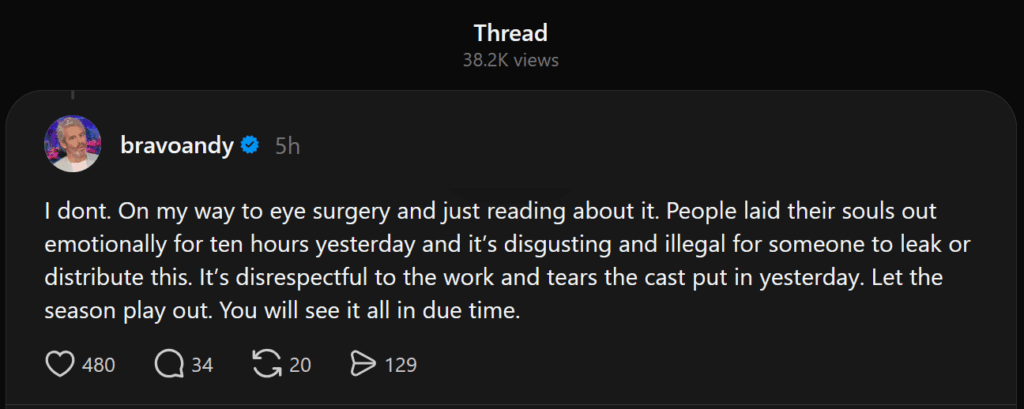
“Good morning,” Andy Cohen wrote on Threads — Meta’s attempt to replace Twitter — on Friday, April 24.
“Andy stay offline please,” a reply urged him. “You won’t like the news.”
While every day’s news brings some new screaming horror, this warning from a fan was more specific.
Dramatic leaked audio from the Bravo series’ reunion special features Ciara Miller and Amanda Batula’s epic confrontation.
This is supposed to be a highlight of the Season 10 reunion, which of course has not yet aired. This is a demoralizing leak, and Andy’s not happy.
Andy Cohen expresses his ire at the Season 10 reunion leak. (Image Credit: Threads)
“I don’t,” Andy told the fan who warned him that he wouldn’t like the news. “On my way to eye surgery and just reading about it.”
He lamented: “People laid their souls out emotionally for ten hours yesterday.”
Andy continued: “And it’s disgusting and illegal for someone to leak or distribute this.”
He added: “It’s disrespectful to the work and tears the cast put in yesterday.”
To fans, Andy encouraged: “Let the season play out. You will see it all in due time.”
‘You’re a snake’
In the leaked audio, Miller excoriates Batula over the latter’s relationship with West Wilson.
Why? Because Wilson is Miller’s ex. And, of course, because Batula kept it a secret until hours before she and Wilson confirmed their relationship publicly.
And we think that Miller does a pretty good job of explaining her ire.
“There are a million other f–king guys in New York City and … you chose the one guy,” Miller pointed out.
She then called her former bestie a “f–king snake.”
“You’re a snake in the f–king grass … and you know you are,” Miller continued. “You move silent, but you’re f–king deadly.”
We don’t think that she meant to stray so close to flatulence humor.
Batula protested that “there were so many layers and complications to it.” She also argued: “You can’t help who you like and are attracted to.”
Reportedly, most of the cast seemed downright subdued upon arrival for the reunion taping on Thursday.
What a mess. We’re sorry about the leak, and we’re looking forward to watching the drama play out in the actual episode.
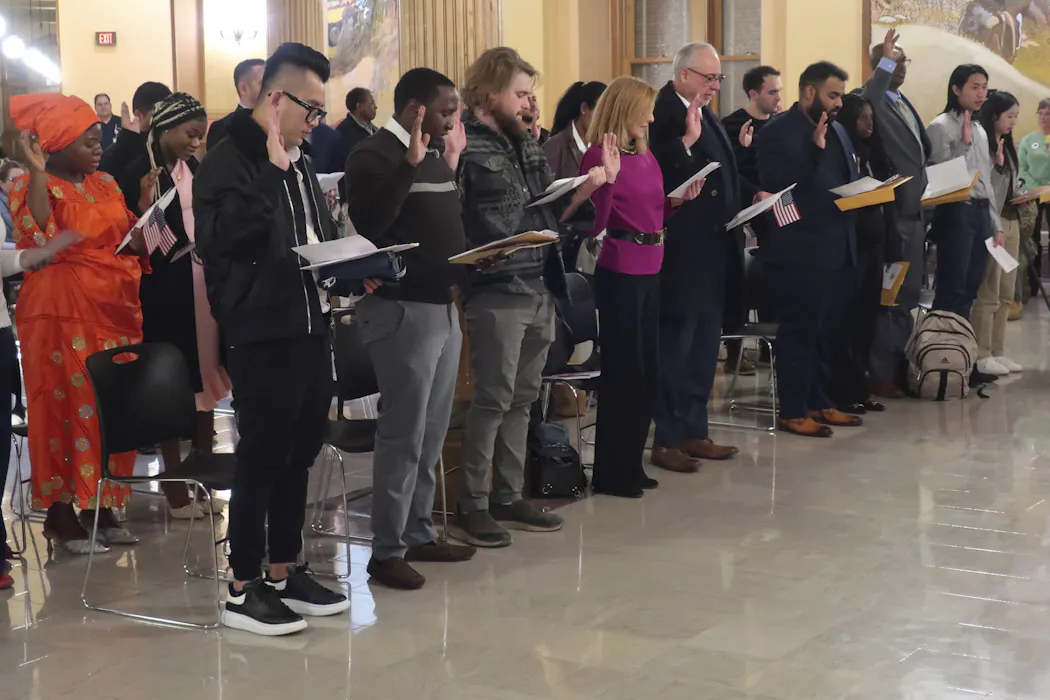
Dozens of immigrants from 18 nations take the oath to become U.S. citizens on Jan. 27, 2025, in Topeka, Kan. AP Photo/John Hanna
The Justice Department has identified 384 foreign-born Americans whose citizenship it wants to revoke as “the first wave” of such measures, according to recent reporting by The New York Times. These cases are being assigned to prosecutors in 39 U.S. attorney’s offices across the country.
The administration has ordered Department of Homeland Security staffers to refer upward of 200 denaturalization cases per month to the Justice Department as part of its crackdown on immigration, compared to an average of 11 cases per year between 1990 and 2017.
This shift comes as the Justice Department faces a severe staffing crisis, having lost nearly 1,000 assistant U.S. attorneys in resignations and firings. The strategy of distributing cases to regional offices appears designed both to increase capacity and to work around the expertise gap created by staff departures.
As we document in recent research, denaturalization risks becoming a tool of political control and intimidation. The lack of any statute of limitations in civil denaturalization gives prosecutors what the Supreme Court in 2017, in Maslenjak v. United States, warned against: “nearly limitless leverage” over naturalized citizens – creating permanent vulnerability for over 20 million naturalized Americans.
A brief history
Denaturalization is different from deportation, which removes noncitizens from the country. With civil denaturalization, the government files a lawsuit to strip people’s U.S. citizenship after they have become citizens, turning them back into noncitizens who can then be deported.
The government can only do this in specific situations. It must prove someone “illegally procured” citizenship by not meeting the requirements, or that they lied or hid important facts during the citizenship process.
The Trump administration’s “maximal” enforcement approach, outlined in a June 2025 Justice Department memo, means pursuing any case where evidence might support taking away citizenship, regardless of priority level or strength of evidence. As our earlier research documented, this has already led to cases like that of Baljinder Singh, whose citizenship was revoked based on a name discrepancy that could easily have resulted from a translator’s error rather than intentional fraud.
For most of American history, taking away citizenship has been rare. But it increased dramatically during the 1940s and 1950s during the Red Scare period characterized by intense suspicion of communism. The United States government targeted people it thought were communists or Nazi supporters. Between 1907 and 1967, over 22,000 Americans lost their citizenship this way.
Everything changed in 1967 when the Supreme Court decided Afroyim v. Rusk. The court said the government usually cannot take away citizenship without the person’s consent. It left open only cases involving fraud during the citizenship process.
After this decision, denaturalization became extremely rare. From 1968 to 2013, fewer than 150 people lost their citizenship, mostly war criminals who had hidden their past.
Sen. Joseph McCarthy appears at a March 1950 hearing on his charges of communist infiltration at the State Department. AP Photo/Herbert K. White
How the process works
In criminal lawsuits, defendants get free lawyers if they can’t afford one. They get jury trials. The government must prove guilt “beyond a reasonable doubt” – the highest standard of proof.
People facing denaturalization get no free lawyer, meaning poor defendants often face the government alone. There’s no jury trial – just a judge deciding whether someone deserves to remain American. The burden of proof is lower – “clear and convincing evidence” instead of “beyond a reasonable doubt.” Most important, there’s no time limit, so the government can go back decades to build cases.
The Supreme Court has called citizenship a fundamental right. Chief Justice Earl Warren in 1958 described it as the “right to have rights.”
In our reading of the law, taking away such a fundamental right through civil procedures that lack basic constitutional protection – no right to counsel for those who can’t afford it, no jury trial, and a lower burden of proof – seems to violate the due process of law required by the Constitution when the government seeks to deprive someone of their rights.
The bigger problem is what citizenship-stripping policy does to democracy.
When the government can strip citizenship from naturalized Americans for decades-old conduct through civil procedures with minimal due process protection – pursuing cases based on evidence that might not meet criminal standards – it undermines the security and permanence that citizenship is supposed to provide. This creates a system where naturalized citizens face ongoing vulnerability that can last their entire lives, potentially chilling their full participation in American democracy.
The Justice Department memo establishes 10 priority categories for denaturalization cases. They range from national security threats and war crimes to various forms of fraud, financial crimes and, most importantly, any other cases it deems “sufficiently important to pursue.” This “maximal enforcement” approach means pursuing not just clear cases of fraud, but also any case where evidence might support taking away citizenship, no matter how weak or old the evidence is.
This creates fear throughout immigrant communities.
About 20 million naturalized Americans now must worry that any mistake in their decades-old immigration paperwork could cost them their citizenship.
A 2-tier system
This policy effectively creates two different types of American citizens. Native-born Americans never have to worry about losing their citizenship, no matter what they do. But naturalized Americans face ongoing vulnerability that can last their entire lives.
This has already happened. A woman who became a naturalized citizen in 2007 helped her boss with paperwork that was later used in fraud. She cooperated with the FBI investigation, was characterized by prosecutors as only a “minimal participant,” completed her sentence, and still faced losing her citizenship decades later because she didn’t report the crime on her citizenship application – even though she hadn’t been charged at the time.
A woman receives a U.S. flag after passing her citizenship interview in Newark, N.J., on May 25, 2016. AP Photo/Julio Cortez
The Justice Department’s directive to “maximally pursue” cases across 10 broad categories – combined with the first Trump administration’s efforts to review over 700,000 naturalization files – represents an unprecedented expansion of denaturalization efforts.
The Trump administration’s strategy of distributing denaturalization cases across 39 U.S. attorney’s offices – many now staffed by less-experienced prosecutors handling unfamiliar constitutional terrain – may prove counterproductive.
These cases will come before dozens of federal judges, creating opportunities for multiple courts to rule against the policy. This pattern has already been seen with the administration’s detention policy: Federal courts have systematically rejected the administration’s attempt to drastically expand immigrant detention without hearings, with immigrants prevailing in 350 out of 362 cases decided by over 160 judges nationwide.
Denaturalization cases raise even more serious constitutional concerns and could face similar widespread judicial pushback.
The Supreme Court, in Afroyim v. Rusk, was focused on protecting existing citizens from losing their citizenship. The constitutional principle behind that decision – that citizenship is a fundamental right which can’t be arbitrarily taken away by whoever happens to be in power – applies equally to how the government handles denaturalization cases today.
The Trump administration’s directive, combined with court procedures that lack basic constitutional protections, risks creating a system that the Afroyim v. Rusk decision sought to prevent – one where, as the Supreme Court said, “A group of citizens temporarily in office can deprive another group of citizens of their citizenship.”
The authors do not work for, consult, own shares in or receive funding from any company or organization that would benefit from this article, and have disclosed no relevant affiliations beyond their academic appointment.
Padma Lakshmi is known for hosting “Top Chef” and other shows, but she was once a regular in gossip columns over drama surrounding her daughter’s paternity.
Mashed – Fast Food, Celebrity Chefs, Grocery, Reviews
Sen. Bill Wielechowski, D-Anchorage, speaks Tuesday, April 15, 2025, on the floor of the Alaska Senate. (Photo by James Brooks/Alaska Beacon)
The Alaska Senate advanced a bill Wednesday to establish a savings program for employees whose workplaces do not offer a retirement program.
The Alaska Work and Save Program is what Sen. Bill Wielechowski, D-Anchorage and the bill’s sponsor, called a solution to a retirement savings problem in Alaska. According to a survey by the AARP, nearly half of private-sector employees in Alaska lack a retirement plan.
“This program will help Alaskan businesses offer a competitive benefit at no cost,” he said.
Wielechowski told legislators that social security payments do not cover the high cost of living for seniors in Alaska, increasing their reliance on SNAP and Medicaid, and small businesses cannot always afford to sponsor a retirement program for their employees. Wielechowski proposed establishing the Alaska Work and Save Program for tax advantaged and portable retirement accounts.
The bill passed with 15 yes votes. Sens. Jesse Bjorkman, R-Nikiski, Robert Myers, R-North Pole, George Rauscher, R-Sutton, and Cathy Tilton, R-Wasilla, voted against it.
Sen. Robert Myers, R-North Pole, said that he was conflicted about the bill because it was unclear to him how businesses would help administer the program.
Senate Bill 21 would develop a retirement program called the Alaska Work and Save Program for employees who are not offered a retirement plan by their employer. Applicants would be able to contribute some or all of their Permanent Fund Dividend and additional contributions through payroll deduction to the individual retirement account. Eligible employees would be automatically enrolled and would be able to opt out of the program.
“It fixes a problem in a way that doesn’t overreach, that helps the business community, that helps workers and is good for our state,” Wielechowski said. “Passing this bill is an important step forward towards genuinely improving the lives of Alaskans by helping them save for a rewarding retirement.”
If the bill becomes law, Alaska would join 15 other states that have automatic savings programs, according to Pew, a nonprofit that oversees the nonpartisan Pew Research Center.
Small businesses owners across Alaska wrote in letters of support that a lack of retirement benefits makes it difficult for small businesses to compete with larger companies, and the proposed retirement system would be beneficial for small businesses.
Forbidden Peak Brewery Co-Owner Skye Stekoll supported the bill and wrote that “easy access to a public retirement program would make both starting the process of investing and making continued regular investments far more attainable for our employees, and also make it conceivable for employers to contribute in prorated ways based on hours worked, longevity, etc., regardless of the industry.”
Rachael Miller, chief advocacy officer for the Food Bank of Alaska, wrote to legislators that the bill could increase food security for Alaskan seniors.
“By creating a pathway for workers to save for retirement through automatic payroll deductions, the Alaska Work and Save Program will help workers, particularly in fishing, tourism, and gig-based jobs, prepare for retirement and reduce future reliance on emergency food assistance,” she stated in a letter.
The Department of Revenue would administer the Alaska Work and Save Program. According to a fiscal note, the program will cost $808,000 in 2027 and approximately $524,000-$589,000 annually.
Emily Ann Roberts and her husband Chris have spent most of their lives growing and learning together. She says he has seen her at the highest highs and the lowest lows, remaining her biggest supporter through every step of her rising career. So, of course, when the songstress found out she had earned her first ACM nomination, he was right there with her to take it all in.
The rising star got the exciting news on April 9, learning that she has been recognized in the category of New Female Artist of the Year alongside Avery Anna, MacKenzie Carpenter, Dasha, and Caroline Jones.
Roberts filmed her reaction as well as her family members when she jumped on facetime with them to make the announcement. Emotions were at an all-time high as tears flowed from her face, taking in this milestone that she has worked so hard for.
Photo Courtesy of Chris, Emily Ann Roberts
One week later, Roberts caught up with Country Now at the inaugural backstage Access Presents in Napa Valley, CA and further reflected on the moment. Despite what appears to be a picture-perfect life that they share together online, Roberts admitted that they’ve walked through the hardest days together as well, which made celebrating the nomination side by side that much more special.
“I love to put on a happy face all the time on stage and on social media, but Chris really sees me when I’m at rock bottom. He sees me on the good days. He sees me on the hard days and he loves me through all of it,” she admitted. “So when I found out that I was nominated for the ACM and we got to experience that win together, that’s just as much a win for him as it is for me because we are a team in this and there is nothing that I don’t walk through in this career that he’s not with me every step of the way on. So I want to experience all my wins with him. He’s just my best friend.”
Roberts first met her now-husband in Spanish class in the second semester of her sophomore year. She jokes that for about five months she had to “convince” Chris that they were meant to be together. Her methods clearly worked because by June 2015, they had officially started dating and in November of 2020 they tied the knot.
“I was 15 and he was 16 and I thought he was so cute and he would not give me the time of day,” she recalled. “He was so shy, but finally I convinced him that I was the love of his life and we have been happily married ever since.”
Photo Courtesy of Chris, Emily Ann Roberts
After almost six years of marriage, Emily Ann Roberts can confidently say that key to making things work for so long is simple: communication.
“Hearing your partner out and them hearing you out is the most important thing in the whole world. And always being quick to forgive and serve one another. That’s a lot,” she noted. “If you put the other person first, then I don’t know if you can mess up after that.”
The couple will get to celebrate her first nomination with an elevated date night at the upcoming ACM Awards on May 17.
“I’m going to get that man looking spiffy. He’s usually in his Walmart jeans and his black t-shirts, but he’s going to be shined up for the ACMs for sure,” she smiled.
Fans can tune into the 61st ACM Awards next month to see which new female artist will take home the trophy. The show is set to stream live exclusively on Prime Video for a global audience across more than 240 countries and territories at 8 p.m. ET / 7 p.m. CT / 5 p.m. PT from the iconic MGM Grand Garden Arena in Las Vegas.
Viewers watching from home can also see all the excitement unfold through the Amazon Music channel on Twitch and through the Amazon Music app.
Roberts also set to join Thomas Rhett on his SOUNDTRACK TO LIFE TOUR and continue headlining select dates throughout the year before heading back overseas this fall to support Cody Johnson.
The Jackson Estate waged a 5-year legal war against HBO.
Ultimately, they won — getting Leaving Neverland permanently removed from HBO Max due to a contract from 1992.
Now, the new Michael biopic is telling a new version of the legendary singer’s story.
The film’s story ends before any allegations of sexual misconduct emerged. And people are furious.
Jaafar Jackson attends the “Michael” Global Fan Premiere at Uber Eats Music Hall on April 10, 2026. (Photo Credit: Andreas Rentz/Getty Images for Universal Pictures)
‘Michael’ tells a very selective story about the King of Pop
In Michael, the titular singer’s own nephew, Jaafar, portrays the larger-than-life King of Pop during his meteoric rise.
Michael Jackson first became famous as part of the Jackson 5.
The siblings’ infamous father’s plans paid off for the entire family, and all that it cost was unspeakable psychological damage that would become a family curse.
Michael himself was the most successful, breakout out into a solo career that is now much better known than the rest of his family’s work combined.
That is covered in the biopic. And basically only that is covered in the biopic.
Michael does not include or address the famous sexual abuse allegations against the late singer.
This was clearly a film intended to cater to fans who enjoyed his music and would simply rather not think about the harrowing allegations of sexual abuse leveled at him by a number men who say that he abused them as children.
The Jackson Estate financially backed the film. Michael uses the singer’s original vocals for some of the numerous vocal numbers.
One genuinely positive thing that critics have had to say is that Jaafar, son of Jermaine Jackson, did an exemplary job of portraying his uncle.
The rest of the film, however, did not receive rave reviews.
Simply put, a lot of people found it straight-up appalling that the biopic ignored the singer’s biggest scandal.
There are many — essentially, anyone who isn’t a fan of his music — for whom his child sex-abuse allegations are more infamous than his songs ever were.
Even many who once enjoyed Michael’s music can certainly agree that the allegations of sex crimes against children are more important than how fun his music was.
“Separating the art from the artist” makes sense if you want to listen to a bop (and the artist or author or whoever is dead and will not benefit from your enjoyment). But it doesn’t really make sense in a biopic, which is inherently about the artist.
According to a stunning report from Variety, Michael would have originally included at least some references to the molestation allegations.
A historic NDA from a settlement with accuser Jordan Chandler forbids his depiction in any form in the film. (Old contracts seem to be doing a lot of favors for the singer’s image.)
This meant a whopping $15 million in reshoots and a partial rewrite. The film ended up covering Michael’s story from the ’60s until the ’80s, at which point it stopped.
Critics have likened this to a biopic about Jeffrey Epstein as a financier, palling around with tech billionaires and powerful politicians, with no mention whatsoever of victims.
But we cannot rule out that someone will eventually make a biopic that matches that description. It takes a lot to make a good movie. But to simply make a movie, all that you need is money.
We should count ourselves lucky that Epstein couldn’t moonwalk or whatever, or maybe such a project would have an audience.
A Southeast Alaska garden does its best work when it is designed as a set of connected systems rather than a single plot of vegetables. Our climate — cool, wet, and long on daylight — is generous in some ways and challenging in others. A healthy garden here tends to be one that works with those conditions instead of fighting them. The Victory Garden plan is built around four interconnected pieces: a water feature that doubles as pest control, a pollinator strategy centered on native flora, active soil stewardship, and a long-term investment in perennial, shelf-stable food.
Pollinators: native flora for yields and pest control
Southeast Alaska’s wild pollinators — bumblebees, native solitary bees, hoverflies, and several moth and butterfly species — already do most of the pollinating work in our gardens. Inviting more of them produces two payoffs: better yields on crops that depend on pollination (squash, beans, berries, tree fruit) and better pest control, because many pollinator-friendly flowers also attract predatory and parasitic insects that eat aphids, caterpillars, and other garden pests.
Rather than relying only on imported ornamentals, we are building pollinator support around native and near-native flora that already thrives here. Adjacent fireweed, lupine and cow parsnip attract bumblebees and long-tongued bees, as do our seeded annual flowers like nasturtium and calendula.
Garden herbs allowed to flower, like chives, oregano, thyme, and cilantro benefit pollinators and beneficial predators throughout the season.
Pollinators need water as well as food, but in Southeast we must hydrate them without adding to the mosquito population. This year we are using bee cups which are small, shallow ceramic or glass dishes tucked among flowers offering safe drinking surfaces that are too shallow for mosquitoes to complete a breeding cycle, even when refilled every day or two.
Soil health: testing, rotation, and managing club root
Soil is where most of Southeast Alaska’s gardening challenges begin and end. Our native soils are typically acidic, often low in available nutrients due to high rainfall leaching and sometimes compacted or poorly drained. Formal soil tests are a must and tell us pH and the levels of nitrogen, phosphorus, potassium, and key minerals so we can amend specifically rather than broadly.
One issue we encountered last year is club root, a soil-borne pathogen that attacks the brassica family (cabbage, broccoli, cauliflower, kale, turnips, radishes, kohlrabi) and thrives in exactly the conditions we have plenty of: cool, wet, acidic soils. Club-root spores can persist in soil for up to 20 years, and replanting brassicas into infected ground simply feeds the problem.
Our strategy this season is disciplined rotation. The main bed will be planted primarily with non-brassica crops — roots, alliums, legumes, greens, and solanaceae (nightshades) under protection — with an isolated section given over to brassicas. Over time, additional tactics will support the rotation:
• Raising soil pH toward neutral with lime, which suppresses club root activity.
• Improving drainage with compost, raised beds, and cover crops to keep roots from sitting in saturated soil.
• Sanitation — cleaning tools between beds and avoiding moving soil from infected areas into clean ones.
Long-term food stability
Annual vegetables feed us for a season; perennials and shelf-stable crops feed us for years. A major focus of the Victory Garden’s plan is building that longer time horizon into the landscape.
We are investing effort in annual crops that store for months without a freezer or canner. Root crops like potatoes, carrots, beets, onions can all be stored in a root cellar and can last until it’s time to start seeds the following spring. Winter squash varieties like kuri, hubbard and long pie pumpkins can mature in a hoop house or in a field in a very warm, sheltered spot. Once cured, they store for months on a pantry shelf without any processing.
Water and the swale
In Southeast Alaska, rain is rarely the problem — managing where it goes is. A well-placed swale (a shallow contour channel that slows and spreads runoff) turns abundant rainfall into an asset. It captures water high in the garden, lets it soak in gradually, and supplies moisture through the occasional summer dry stretches when our usually damp soils can surprise us by drying out. Beyond irrigation, the swale is a habitat feature. A little standing or slow-moving water pulls in the organisms that handle pest control for us. Toads are perhaps the single most effective slug predator we can invite in besides ducks. One boreal or western toad can eat hundreds of slugs in a season, and they need moist, sheltered places to breed and rest.
Systems that support each other
What ties these strategies together is that each one quietly solves more than one problem. The swale is irrigation and pest control. Native flora is pollination and beneficial insect habitat. Bee cups hydrate pollinators while avoiding mosquito risk. Soil testing and rotation protect crops and guard the soil for the next decade.
A Southeast Alaska garden, designed this way, starts to look less like a patch of vegetables and more like a small, deliberate ecosystem — one that uses our rain, our light, and our native life to keep producing, season after season.



















![<a href="https://countrynow.com/emily-ann-roberts-says-first-acm-awards-nomination-feels-like-a-shared-win-with-husband-chris-exclusive/" target="_blank">Emily Ann Roberts Says First ACM Awards Nomination Feels Like a Shared Win With Husband Chris [Exclusive]</a>](https://countrynow.com/wp-content/uploads/2026/04/Untitled-1200-x-633-px-1200-x-800-px-11-4-1024x683.jpg)