Rep. Chris Pappas (D-N.H.) holds a sizable cash advantage over his GOP rivals in the race for New Hampshire’s open Senate seat.
The Democrat raked in $3.3 million to his campaign account over the first quarter of the year as he vies to succeed retiring Sen. Jeanne Shaheen (D-N.H.). Pappas, who faces only nominal opposition for his party’s nomination, entered April with $4.2 million in his war chest, according to his Federal Election Commission filing.
Pappas’ leading GOP competitor, former Sen. John E. Sununu, raised $1.1 million directly to his campaign account and had nearly $1.9 million in cash on hand. He spent just $349,000, per his filing — a significantly lower burn rate than Pappas, who spent $2.3 million over the last three months.
Sununu’s primary rival, former Sen. Scott Brown, lagged even further behind. Brown raised a modest $321,000 and entered the second quarter with $783,000 in his campaign coffers. He spent more money than he brought in, according to his filing.
Pappas leads both of his potential Republican opponents in hypothetical polling match-ups of the general election, though his margin against Sununu is slimmer.
Sununu, who has the backing of the national GOP establishment and President Donald Trump in a state Republicans hope to flip, holds a wide lead over Brown, a former Trump ambassador, in polls of the GOP primary.
Rep. Andy Barr maintained his cash advantage over his GOP rivals in the race to succeed retiring Sen. Mitch McConnell in Kentucky.
Barr raised nearly $1.5 million over the first three months of the year and started April with almost $4.2 million in his war chest — more than five times that of his next-closest rival, according to filings from the Federal Election Commission.
Businessman Nate Morris reported raising $1 million and had roughly $580,000 in his campaign coffers to start the second quarter. But nearly half of that — $450,000 — was a personal loan, per his filing. Morris has now loaned himself $4.9 million over the course of the campaign.
Former state Attorney General Daniel Cameron posted another modest haul; he raised $456,000 and had roughly $765,000 in cash on hand.
Georgia Democratic Sen. Jon Ossoff holds a massive fundraising advantage over the Republicans hoping to unseat him in November, giving him a head start as the GOP field remains fractured.
Ossoff, considered one of the most vulnerable Democratic incumbents of the cycle, raised $14 million during the first quarter of the year and ended with more than $31 million cash on hand — a significant war chest that dwarfs the combined totals of his Republican challengers, according to filings from the Federal Elections Commission.
On the GOP side, Rep. Mike Collins led in first-quarter fundraising, raising just over $1 million and entering the second quarter with $2.1 million in cash on hand. Collins has been a front-runner in public polling of the race, but with a large share of voters still undecided ahead of the May primary, the contest appears increasingly likely to head to a June runoff.
Rep. Buddy Carter raised $469,795, but he ended the quarter with more in the bank than his primary opponents — $3.7 million — thanks in part due to a $3 million he loaned his campaign last year. Former football coach Derek Dooley raised $663,502 and has $2.2 million in the bank.
National Republicans are likely to funnel more money into the contest once a nominee emerges, with the GOP-aligned Senate Leadership Fund already planning a $44 million investment in Georgia. But in the meantime, Ossoff has been able to build a financial lead in what’s expected to be one of the most expensive Senate races of 2026.
Former Rep. Mary Peltola’s (D-Alaska) staggering first-quarter haul comes with a caveat: She spent a lot to raise a lot.
Peltola hauled in nearly $8.7 million directly to her campaign account over the first quarter of the year in her quest to unseat Alaska GOP Sen. Dan Sullivan. She raised four times as much cash as the incumbent, according to filings from the Federal Election Commission. But she spent nearly $3 million, leaving her with $5.7 million in cash on hand.
Sullivan, meanwhile, raised $1.7 million directly to his campaign account and kicked off April with more than $7 million in his war chest.
Both campaigns have argued they’re in strong financial positions in what is already shaping up to be an expensive race by Alaska standards — one that could help decide control of the Senate. Peltola has an early polling advantage and led Sullivan by 5 percentage points in a mid-March Alaska Survey Research poll.
The candidates are getting a boost from outside groups. Democratic-aligned groups have already put more than $3 million into backing Peltola, per the tracking firm AdImpact. The Senate Leadership Fund, a top GOP super PAC, has pledged to put $15 million into defending Sullivan’s seat and has already placed millions of dollars in ad buys.
Rep. Angie Craig (D-Minn.) holds an edge over Minnesota Lt. Gov. Peggy Flanagan in fundraising, well ahead of the state’s Democratic primary in August.
Craig raised $2.5 million in the first quarter of the year, according to Federal Elections Commission filings, besting Flanagan’s haul of $1.3 million. That sets up Craig with $4.8 million in cash on hand, more than the $1.1 million Flanagan has in the bank.
Flanagan’s filing also shows her burning money at a rapid rate: Her campaign spent more than $1 million in the first quarter, nearly as much as it raised.
Campaign contributions are poised to become a wedge issue in the competitive Democratic primary. Flanagan has attacked Craig for accepting contributions from corporate PACs and has pledged not to take their money.
Former Democratic Sen. Sherrod Brown’s fundraising haul is dwarfing his opponent’s, keeping Democrats’ hopes of flipping the Ohio Senate seat alive.
Brown raised $10.1 million in the first quarter of the year compared with GOP Sen. Jon Husted’s $2.9 million, according to Federal Elections Commission filings. Brown carries $16.5 million in cash on hand, more than doubling Husted’s $8.2 million in cash reserves heading into both parties’ uncontested primaries in May.
Senate Republicans are planning major investments to help Husted win his first election after he was appointed to Vice President JD Vance’s former seat last year. Senate Leadership Fund, the top Senate GOP super PAC, pledged to spend $79 million in Ohio.
Democrats are hoping Brown, who served in Congress for over 30 years before he lost reelection to Sen. Bernie Moreno in 2024, can put the red-leaning state back within reach.
A Hunger Games alum is dealing with legal troubles.
Ethan Jamieson—who starred as the District 4 male tribute in the 2012 adaptation of Suzanne Collins’ YA novel—has been arrested and charged with… E! Online (US) – Top Stories
Texas GOP Sen. John Cornyn boasts a significantly larger war chest than his primary opponent, putting the embattled incumbent in a stronger financial position ahead of the May runoff.
Cornyn ended the first quarter of the year with more than $8 million in cash on hand, compared with Texas Attorney General Ken Paxton’s $2.6 million in the bank, according to disclosures filed with the Federal Election Commission.
The Cornyn-Paxton face-off has grown nasty and highly personal as Republicans grow uneasy about beating James Talarico, the Democratic Senate nominee who raised an extraordinary $27 million last quarter and has about $9.9 million cash on hand. President Donald Trump has so far declined to endorse in the race, despite teasing a pick for several weeks.
Cornyn’s joint fundraising committees comprised the vast majority of his roughly $9 million fundraising haul. Paxton reported raising $2.2 million.
Alex Cooper and Alix Earle are both looking to call her out.
The Call Her Daddy podcast host and Dancing With the Stars alum first sparked rumors of a feud in March 2025 after Earle’s Hot Mess… E! Online (US) – Top Stories
President Donald Trump has again threatened to oust Federal Reserve Chair Jerome Powell, putting at risk a keystone of good economic policy and inflation management: central bank independence.
The president said on April 15, 2026, that he would fire Powell if the Fed chair stayed on in that role after his term officially ends on May 15. Powell has said he intends to remain at the helm after that if his replacement has not yet been confirmed by the Senate. Legally, Powell is allowed to do this.
While Trump’s actions are seen as particularly aggressive, as political economists, we are not surprised to see politicians try to exert influence on central banks. For one thing, central banks remain part of the government bureaucracy, and independence granted to them can always be reversed – either by changing laws or backtracking on established practices.
An economic power struggle
At the heart of threats to Powell and Cook – and other moves to undermine the Fed by the Trump administration – is a power struggle.
Central banks, which are public institutions that manage a country’s currency and its monetary policy, have an extraordinary amount of power. By controlling the flow of money and credit in a country, they can affect economic growth, inflation, employment and financial stability.
These are powers that many politicians would like to control or at least manipulate. That’s because monetary policy can provide governments with economic boosts at key times, such as around elections or during periods of falling popularity.
The problem is that short-lived, politically motivated moves may be detrimental to the long-term economic well-being of a nation. They may, in other words, saddle the economy with problems further down the line.
Attacks on the Fed have accelerated in Trump’s second administration. In April 2025, Trump lashed out at Powell in an online post, accusing him of being “TOO LATE AND WRONG” on interest rate cuts, while suggesting that the central banker’s “termination cannot come fast enough!” And in August, Trump took the unprecedented step of firing Cook, which a court later blocked. The Supreme Court is expected to issue a ruling in the case this year.
Moreover, the reason politicians may want to interfere in monetary policy is that low interest rates remain a potent, quick method to boost an economy. And while politicians know that there are costs to besieging an independent central bank – financial markets may react negatively, or inflationmay flare up – short-term control of a powerful policy tool can prove irresistible.
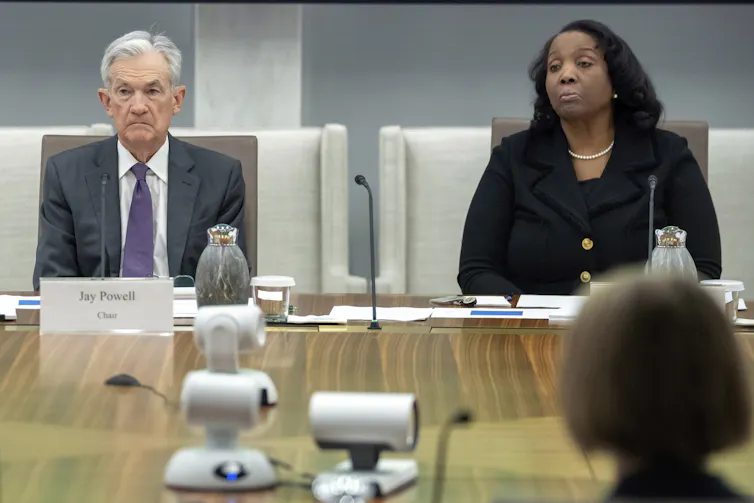
Fed Governors Jerome Powell and Lisa Cook have both been on the receiving end of Trump’s attacks. AP Photo/Mark Schiefelbein
Legislating independence
If monetary policy is such a coveted policy tool, how have central banks held off politicians and stayed independent? And is this independence being eroded?
Broadly, central banks are protected by laws that offer long tenures to their leadership, allow them to focus policy primarily on inflation, and severely limit lending to the government.
Of course, such legislation cannot anticipate all future contingencies, which may open the door for political interference or for practices that break the law. And sometimes, central bankers are unceremoniously fired.
However, laws do keep politicians in line. For example, even in authoritarian countries, laws protecting central banks from political interference have helped reduce inflation and restricted central bank lending to the government.
Around the world, appointments to central bank leadership are political – elected politicians select candidates based on career credentials, political affiliation and, importantly, their dislike or tolerance of inflation.
But lawmakers in different countries exercise different degrees of political control.
A 2025 study shows that the large majority of central bank leaders – about 70% – are appointed by the head of government alone or with the intervention of other members of the executive branch. This ensures that the preferences of the central bank are closer to the government’s, which can boost the central bank’s legitimacy in democratic countries, but at the risk of permeability to political influence.
Alternatively, appointments can involve the legislative power or even the central bank’s own board. In the U.S., while the president nominates members of the Federal Reserve Board, the Senate can and has rejected unconventional or incompetent candidates.
Moreover, even if appointments are political, many central bankers stay in office long after the people who appointed them have been voted out. At the end of 2023, the most common length of the governors’ appointment was five years, and in 41 countries, the legal mandate was six years or longer.
And the Fed chair position has traditionally been protected by law, as Powell himself acknowledged in November 2024: “We’re not removable except for cause. We serve very long terms, seemingly endless terms. So we’re protected into law. Congress could change that law, but I don’t think there’s any danger of that.”
In the 2000s, several countries shortened the tenure of their central banks’ governors to four or five years. Sometimes, this was part of broader restrictions in central bank independence, as was the case in Iceland in 2001, Ghana in 2002 and Romania in 2004.
One of a central bank’s most important duties is to keep consumer prices in check, which becomes harder when its independence is questioned. AP Photo/Matt Rourke
Conflicting objectives can open central banks to politicization. In the U.S., the Federal Reserve has a dual mandate of stable prices and maximum sustainable employment. These goals are often complementary, and economists have argued that low inflation is a prerequisite for sustainable high levels of employment.
Since 2000, at least 23 countries have expanded the focus of their central banks beyond just inflation.
Limits on government lending
The first central banks were created to help secure finance for governments fightingwars. But today, limiting lending to governments is at the core of protecting price stability from unsustainable fiscal spending.
History is dotted with the consequences of not doing so. In the 1960s and 1970s, for example, central banks in Latin America printed money to support their governments’ spending goals. But it resulted in massive inflation while not securing growth or political stability.
Yet over the past two decades, almost 40 countries have made their central banks less able to limit central government funding. In the more extreme examples – such as in Belarus, Ecuador or even New Zealand – they have turned the central bank into a potential financier for the government.
And since mid-2021, major central banks have struggled to keep inflation low, raising questions from populist and antidemocratic politicians about the merits of an arm’s-length relationship.
But chipping away at central bank independence, particularly in the name of lowering interest rates to boost the economy, as Trump appears to be doing by threatening to fire the Fed chair and his attempted removal of a member of the bank’s Board of Governors, is a historically sure way to high inflation.
This is an updated version of an article that was originally published on June 14, 2024.
The authors do not work for, consult, own shares in or receive funding from any company or organization that would benefit from this article, and have disclosed no relevant affiliations beyond their academic appointment.














 A Hunger Games alum is dealing with legal troubles.

 Alex Cooper and Alix Earle are both looking to call her out.