Categories
Sports Fox

2026 NFL Mock Draft: Who’s the First WR Picked? Where Do Ohio State’s Stars Land?

With the 2026 NFL Draft now just hours away, it’s time to get down to the nitty-gritty. After weeks of testing, film-watching and interviews, the scouts are making their final evaluations. So it’s time for me to do the same. The New York Giants’ recent acquisition of the No. 10 pick shifts the landscape. Ohio State’s quartet of top prospects remains in the top 10, as predicted in my most recent mock. Only now, they’re going to different teams. Let’s take a look at where everyone lands, from Fernando Mendoza to the choice of the Super Bowl champs at No. 32. 1. Las Vegas Raiders: Fernando Mendoza, QB, Indiana The Heisman Trophy winner steps into the perfect system for his talents as a high-IQ playmaker. Mendoza’s pinpoint passing skills and underrated mobility mesh well with the play-action-heavy scheme new Raiders head coach Klint Kubiak prefers to run. 2. New York Jets: David Bailey, EDGE, Texas Tech Defensive-minded head coach Aaron Glenn could build his scheme around Bailey’s destructive talents as a pass rusher. As a speed rusher with an explosive first step and a challenging signature move (dip-and-rip), the Texas Tech standout could create more turnover chances with his consistent harassment off the edge. 3. Arizona Cardinals: Arvell Reese, EDGE, Ohio State The versatile defender would add some sizzle to the Cardinals’ defense as a hybrid playmaker with disruptive potential. 4. Tennessee Titans: Jeremiyah Love, RB, Notre Dame Putting an All-Pro-caliber running back behind Cam Ward will not only help the franchise quarterback take his game to another level, but it will also allow the Titans to control the game with a diversified offensive approach. Love is a special playmaker with the potential to have a Christian McCaffrey-like impact on the offense. 5. New York Giants: Jordyn Tyson, WR, Arizona State The oft-injured playmaker is a worthwhile gamble due to his spectacular receiving skills and route-running ability. If healthy, Tyson is an unstoppable force on the perimeter who will force defensive coordinators to change how they defend the Giants’ passing game. 6. Cleveland Browns: Carnell Tate, WR, Ohio State The acrobatic pass-catcher is a dynamic route-runner and playmaker who flashes “take over the game” potential as a WR1. 7. Washington Commanders: Sonny Styles, LB, Ohio State Adding a sideline-to-sideline playmaker would help the Commanders eliminate some of the explosive plays generated by their opponents. Styles’ speed, quickness and burst not only show up on running plays, but it makes him a disruptive force on blitzes and in coverage. 8. New Orleans Saints: Rueben Bain, EDGE, Miami The high-motor defender is the perfect replacement for Cam Jordan on the edge. Bain’s heavy hands and violent approach would complement the rugged approach utilized by Chase Young on the opposite side. 9. Kansas City Chiefs: Kenyon Sadiq, TE, Oregon The ultra-athletic pass-catcher would upgrade the Chiefs’ passing game as a mismatch creator. Sadiq’s speed, quickness and athleticism would force opponents to direct double coverage his way, leading to more one-on-one matchups for Travis Kelce and others on the perimeter. 10. New York Giants: Caleb Downs, S, Ohio State The high-IQ safety is the traffic cop every elite defense needs in the middle of the field. Downs’ instincts, awareness and diagnostic skills led to countless big plays by him and his teammates at Ohio State. 11. Miami Dolphins: Mansoor Delane, CB, LSU The talented cover corner gives new head coach Jeff Hafley a versatile technician to feature in his “vision-and-break” scheme. Delane’s instincts, awareness and diagnostic skills make him an ideal fit for a defense that wants to utilize more zone-based concepts. 12. Dallas Cowboys: Dillon Thieneman, S, Oregon The ball-hawking center fielder will eliminate some of the big plays that tormented the Dallas secondary a season ago. Moreover, Thieneman’s range and ball skills will help the Cowboys produce more takeaways in 2026. 13. Los Angeles Rams: Spencer Fano, OT, Utah Adding a versatile frontline blocker will give Sean McVay the flexibility to reshuffle his offensive line to feature the best front five on game day. Fano’s physicality and toughness will add a dimension to the Rams’ offensive line. 14. Baltimore Ravens: Vega Ioane, OG, Penn State Adding a big-bodied bully to the frontline should help the Ravens get back to the rugged offensive approach that has helped them crush opponents for years. Ioane plays with the violence, physicality and nastiness that the Ravens demand from their offensive line. 15. Tampa Bay Buccaneers: Akheem Mesidor, EDGE, Miami Todd Bowles needs a disruptive edge defender to elevate the Buccaneers’ defense in 2026. Mesidor is a plug-and-play prospect with the talent, tools and potential to become a double-digit sack producer in an aggressive scheme. 16. New York Jets: Makai Lemon, WR, USC Adding a dynamic slot receiver to the lineup should alleviate some of the pressure on WR1 Garrett Wilson to carry the passing game. Lemon is a spectacular route-runner with outstanding hands and ball skills. 17. Detroit Lions: Monroe Freeling, OT, Georgia After moving on from left tackle Taylor Decker, the Lions take a talented developmental prospect to feature at the marquee position of the frontline. Although Freeling will need some time to grow into his role as a blind side protector, the Georgia standout has all the tools to play at an elite level early in his career. 18. Minnesota Vikings: Jermod McCoy, CB, Tennessee If healthy, McCoy is an elite cover corner with the tools to develop into a Pro Bowl-caliber defender on the island. As a featured playmaker in defensive coordinator Brian Flores’ aggressive scheme, the ball-hawking cover corner will force quarterbacks into more tight-window throws. 19. Carolina Panthers: Emmanuel McNeil-Warren, S, Toledo As a rangy center fielder with outstanding ball skills and awareness, EMW will add some much-needed playmaking ability to a unit that needs to generate more turnovers in 2026. 20. Dallas Cowboys: Avieon Terrell, CB, Clemson The versatile cover corner is a pro-ready defender with the tools to flourish in a “see ball, get ball” system that prioritizes tackling and takeaways. 21. Pittsburgh Steelers: Chase Bisontis, OG, Texas A&M Adding a sturdy interior blocker will not endear general manager Omar Khan to the fan base, but the move could stabilize the Steelers’ offensive line for the next five years. The talented technician plays well within the phone booth, exhibiting the nastiness and toughness the Steelers covet in their offensive linemen. 22. Los Angeles Chargers: T.J. Parker, EDGE, Clemson With Khalil Mack’s time nearing an end, the Chargers need a power rusher to fill the role. Parker’s strength, power and burst should make him an effective complementary pass rusher opposite an emerging star. 23. Philadelphia Eagles: Kadyn Proctor, OT, Alabama The super-sized edge blocker could crack the lineup immediately as a guard before bouncing out to right tackle when Lane Johnson retires. 24. Cleveland Browns: Caleb Lomu, OT, Utah As a natural left tackle with flawless footwork in pass protection, the Utah standout gives the Browns a blind side protector for the next decade. Lomu must improve as a run blocker, but his outstanding agility, balance and body control should enable him to effectively shadowbox elite pass rushers on the edge. 25. Chicago Bears: Keldric Faulk, EDGE, Auburn The ultra-aggressive edge defender specializes in stopping the run, but possesses the tools to develop into an effective pass rusher off the edge. 26. Buffalo Bills: Cashius Howell, EDGE, Texas A&M The dynamic pass rusher brings the juice off the edge, providing new defensive coordinator Jim Leonhard a high-energy pass rusher to build around. 27. San Francisco 49ers: Denzel Boston, WR, Washington Adding the big-bodied pass-catcher to the room provides the 49ers with a succession plan after Mike Evans’ eventual departure. With Boston serving as an apprentice to a perennial Pro Bowler, the 49ers’ passing game should be in good hands with their future WR1. 28. Houston Texans: Kayden McDonald, DT, Ohio State The run-stuffing defensive tackle will occupy multiple blockers at the point of attack to create more big-play opportunities for Danielle Hunter and Will Anderson Jr. 29. Kansas City Chiefs: Colton Hood, CB, Tennessee The loss of Trent McDuffie and Jaylen Watkins forces the Chiefs to address the cornerback position with a top pick. Hood is the instinctive cover corner who typically thrives in Kansas City’s ultra-aggressive scheme. 30. Miami Dolphins: KC Concepcion, WR, Texas A&M The pass-catching phenom is the dynamic playmaker new QB1 Malik Willis needs on the perimeter. Despite his struggles with drops, Concepcion terrorizes opponents between the hashes as a catch-and-run specialist who routinely registers his touches on crossers and square-in routes. 31. New England Patriots: Max Iheanachor, OT, Arizona State The big-bodied edge blocker is a work in progress, but the Patriots can redshirt him for a season behind Morgan Moses before he takes over for the veteran at right tackle. 32. Seattle Seahawks: Malachi Lawrence, EDGE, UCF The defending champs add a high-motor pass rusher to a rotation of edge defenders with complementary skills. Lawrence’s fanatical effort and relentless approach fit the Seahawks’ throwback culture.​Latest Sports News from FOX Sports

Categories
Uncategorized

Why the US military is stuck using $1 million missiles against Iran’s $20,000 drones

A drone is seen during a suspected drone strike targeting an oil warehouse near Erbil, the capital of Iraq’s Kurdistan Region, on April 1, 2026. Gailan Haji/Middle East Images/AFP via Getty Images

It may sound hard to believe, but the almost trillion-dollar U.S. military is struggling to fight cheap drones in its war with Iran.

Iran has built a simple drone, the Shahed, with a motorcycle-type engine, loaded it with explosives and successfully targeted its neighbors’ cities and power plants.

Iran has also hit U.S. military bases with these drones, including an early April 2026 attack on the U.S. Victory Base Complex in Baghdad.

The drones cost between US$20,000 and $50,000 to build. In response, the U.S. military sometimes fires missiles worth more than $1 million to shoot one down.

As a former U.S. Air Force officer and now national security scholar, I believe that math is a problem: The U.S. military for now has a $1 million answer to a $20,000 question. This math tells you almost everything you need to know about one of America’s biggest national security headaches.

And the frustrating part is that the U.S. military watched this happen in Ukraine for years. It knew the threat was coming.

The weapon that changed modern war

The Shahed isn’t impressive because it’s high-tech. It’s impressive because it isn’t.

Inspection of captured Shahed drones has found that many of their parts are made by ordinary commercial companies. That includes processors from a U.S. manufacturer, fuel pumps from a U.K. company and converters from China.

These military components aren’t hard to get. You could find similar parts in factories or farm machinery. That’s exactly what makes the Shahed so tough to deal with.

Russia, which also produces the drone, tolerates losing more than 75% of its Shahed stock because even at those loss rates, it’s winning the math battle against Ukraine. Russia or Iran don’t need every drone to hit its target. They just need to keep sending waves of them until their opponent runs out of expensive missiles to shoot back.

Ukraine, which had no choice but to learn fast, eventually figured out a better answer. Ukraine developed cheap interceptor drones that could slam into Shahed drones before they reached their targets. Each interceptor costs about $1,000 to $2,000, and Ukrainian manufacturers are producing thousands of them per month. That’s better math: a $2,000 interceptor against a $20,000 attacker.

A fragment of a drone rests on the ground.
This undated photograph released by the Ukrainian military’s Strategic Communications Directorate shows the wreckage of what Kyiv has described as an Iranian Shahed drone downed near Kupiansk, Ukraine.
Ukrainian military’s Strategic Communications Directorate via AP

Ukraine’s battlefield experience, as a result, has become one of the most valuable resources in the world, with American and allied forces asking Ukrainian drone experts to share their knowledge.

Why can’t the U.S. churn out a solution of its own? Because the U.S. military doesn’t have a technology problem but a bureaucracy problem.

The Pentagon’s three-legged slowdown

The U.S. Department of Defense typically can’t just buy things. It follows a long, complicated process that can take a decade or more to go from “we need something” to “here it is.” That process runs through three separate bureaucratic systems, each of which can cause years of delay.

First, someone must write a formal document, known as a requirement, that explains exactly what they need and why. A military service, such as the Air Force, for example, drafts up a requirement and routes it through an internal service review within only their branch.

Until recently, this service-vetted requirement went through a Pentagon review process, the Joint Capabilities Integration and Development System, where all joint services took a look. This process, which the Department of Defense ended in 2025, required approval from military officials.

Even though the joint requirements process was ended, implementation of a new system is far from complete, and the existing culture potentially remains. Under the old requirements process, it took over 800 days to get a requirement approved.

Second, any new program then needs money. This is handled through the planning, programming, budgeting and execution process, a budget cycle designed in 1961. Getting a new program into the budget typically takes more than two years after the requirement is approved, because the military must submit its budget request years in advance. By then, the threat has potentially already moved on.

Third, once a requirement is approved and money allocated, the program then must be developed and built. The average major defense acquisition program now takes almost 12 years from program start just to deliver an initial capability to troops in the field, according to a 2025 Government Accountability Office report.

Add it up and you get a system where the military sees a threat, begs for a solution, argues for money and waits a decade.

Why the system is built this way

The Shahed drone exposed a gap that defense experts have been warning about for years: The U.S. military is very good at building the most advanced, most expensive weapons in the world, but it struggles to build cheap, simple things fast. That is the opposite of what this new kind of warfare demands.

It would be easy, but inaccurate, to blame the military for the decade-long contract process. The real answer is more complicated.

A man in a suit stands next to a drone and speaks to a group of seated people.
House Speaker Mike Johnson speaks next to an Iranian Shahed-136 drone on May 8, 2025, at the U.S. Capitol in Washington.
Tom Brenner for The Washington Post via Getty Images

The Pentagon’s lengthy process was designed by the Department of Defense and Congress for a reason. Policymakers created the current system during the Cold War to combat excessive and redundant spending by the separate service branches. The system is built with checkpoints, reviews and approvals to make sure taxpayer money isn’t wasted.

Legacy military contractors also benefit from this dysfunctional process and resist change. They have the capital and know-how to wait out the predictable and stable existing contracts, while vying for new ones. These military contractors rarely need to worry about upstart contractors because they know small companies cannot survive waiting for a decade to secure funding for their prototypes.

The problem is that those rules were built for a world where the biggest threat was another superpower’s expensive jets and missiles. It wasn’t built to fight a flying bomb made from tractor parts. This type of threat requires fast innovation from lean companies, the exact companies that struggle in the current budget process.

What’s changing

There are signs of movement. In August 2025, the Pentagon killed its old requirements process entirely and replaced it with a faster, more flexible system.

However, killing the requirements process dealt with only one leg of the three-legged monster. The 1960s-era budget process that determines how money flows remains largely intact.

The most important reforms still need Congress to act, and Congress moves slowly, too. Congress has launched studies into reforming this system numerous times, with the answers being too politically difficult to implement.

Officials are expanding the use of flexible contracting tools, such as Other Transaction Authority, that let the military skip some traditional rules to get anti-drone technology faster. Yet these flexible contracting tools still represent a small slice of the Defense budget, and their effectiveness is unclear.

Ultimately, instead of using flexible contracting tools to quickly buy new prototypes, the bureaucratically easier solution could be to buy more of the expensive, already approved missiles.

This quick fix would reload the military’s stock of interceptors with existing weapons systems, which is the source of the bad math. The math would get worse and at the same time the operational imperative to find cheaper and better solutions might disappear.

So, as the Shahed keeps flying, the most powerful military in the world is still figuring out the paperwork and looking to other countries for help.

The Conversation

Aaron Brynildson served in the U.S. Air Force from 2016-2025.

​Politics + Society – The Conversation

Categories
Sports Fox

Tyler Reddick’s ‘Going to Break’ Wins Record in 2026, Kevin Harvick Says

We’re seeing a new and improved Tyler Reddick during the 2026 NASCAR Cup Series season. Entering the season, he had a total of eight Cup race wins — three with Richard Childress Racing in 2022 and five with 23XI Racing across 2023 and 2024. But in 2026 alone, he might match that total as he currently owns five wins through nine races. FOX Sports NASCAR analyst Kevin Harvick certainly thinks the mark is possible. “He’s going to break the record for most wins in a Gen-7 car,” Harvick said on the latest edition of “SPEED With Harvick and Buxton”. “The record is six right now… He’s going to break that record.” Reddick, Harvick believes, will join the likes of Kyle Larson, William Byron and Denny Hamlin in terms of most victories achieved in a single season in the newest generation car, introduced in 2022. It’s a mountaintop he can soon reach because of the changes he, individually, has made, and the upgrades 23XI Racing have put in place this season. “When you get the momentum, and the car’s right, and the pit crew, and everything’s lined up right, and you have an elite driver — like you do with Tyler Reddick — you can get on a roll,” Harvick said. “I think the biggest difference for Tyler Reddick and 23XI this year… they’re able to really focus on who they are as a race team.” Harvick first noticed that before the Daytona 500. When he was preparing for the broadcast, a crew member told him that Reddick was already out and ready for his interview. That stood out to Harvick as he had never seen that punctuality from Reddick. “That was the first time that I had really heard, ‘Wow, Tyler Reddick’s going next level Cup racing this year with himself, mentally,” Harvick said. [NASCAR POWER RANKINGS: Tyler Reddick Too Hot & Can’t Be Stopped] Harvick expressed to Reddick that he was impressed with him showing up early and prepared to do the Daytona 500 interview, and Reddick replied: “Had to change. Had to get my stuff together. I needed to be on time.” That commitment to preparedness was the final step in Reddick’s rise to being elite. He, Harvick explained, was “handpicked by Hamlin and Michael Jordan” to race for 23XI because “his ability within the race car is elite.” Now that he’s honed in on the mental side and increased his focus, there’s nothing stopping him from fulfilling Harvick’s prediction and breaking the record for wins in a Cup series season during the current generation. CHECK OUT THE FULL EPISODE OF “SPEED”:​Latest Sports News from FOX Sports

Categories
Entertainment

Meghan Markle Blasted For ‘Shocking’ Decision to Name Daughter After Queen

Reading Time: 2 minutes

When Meghan Markle and Prince Harry announced the name of their daughter Lilibet, millions applauded the adorable tribute to Harry’s grandmother.

Lilibet was the nickname used by Queen Elizabeth II’s husband, Prince Philip, and Harry and Meghan likely believed that they were paying tribute to the monarch in moving fashion.

But according to one royal expert, the couple was dead wrong.

Prince Harry, Duke of Sussex and Meghan, Duchess of Sussex greet members of the public at the Cruising Yacht Club of Australia on April 17, 2026 in Sydney, Australia.
Prince Harry, Duke of Sussex and Meghan, Duchess of Sussex greet members of the public at the Cruising Yacht Club of Australia on April 17, 2026 in Sydney, Australia. (Photo by Cameron Spencer/Getty Images)

Hugo Vickers is a royal historian who’s currently promoting his new book, titled Queen Elizabeth II: A Personal History.

During a recent appearance on the “Daily T “podcast, Vickers lashed out at Harry and Meghan for naming their daughter after the queen’s intimate nickname.

“Wasn’t it rather sweet for them to call their daughter Lilibet after the queen’s name?” host Camilla Tominey asked.

“Oh, well, that was odious,” Vickers replied, adding:

“To use the queen’s name that was used by her actual private family? No. That’s absolutely shocking.”

As Vickers and others have noted, the name did not originate with Philip, but rather with Elizabeth’s father, King George VI.

Queen Elizabeth II, Prince Harry, Duke of Sussex and Meghan, Duchess of Sussex on the balcony of Buckingham Palace as the Royal family attend events to mark the Centenary of the RAF on July 10, 2018 in London, England.
Queen Elizabeth II, Prince Harry, Duke of Sussex and Meghan, Duchess of Sussex on the balcony of Buckingham Palace as the Royal family attend events to mark the Centenary of the RAF on July 10, 2018 in London, England. (Photo by Chris Jackson/Getty Images)

The name stemmed from the queen’s inability to pronounce “Elizabeth” when she was a young child.

“Lilibet is my pride. Margaret is my joy,” George famously quipped when both the queen and her sister, Princess Margaret, were in their youth.

When Philip passed away in 2021, at the age of 99, Elizabeth placed a note atop his coffin that read, “In loving memory, Lilibet.”

Many royal observers believed that that would be the last time the queen’s intimate nickname would ever be used in a public setting.

So it came as quite a shock when Harry and Meghan announced just two months later that they had christened their daughter with the moniker.

While Lilibet was just a nickname for the queen, Harry and Meghan’s daughter is legally named Lilibet Diana.

The queen never spoke publicly about the name, but there have been rumors that she was not as honored as Harry and Meghan hoped she would be.

The decision probably was not as controversial as Vickers is making out to be, but it does seem that Harry and Meghan did not consult the queen before choosing their daughter’s name.

Meghan Markle Blasted For ‘Shocking’ Decision to Name Daughter After Queen was originally published on The Hollywood Gossip.

​The Hollywood Gossip

Categories
Entertainment

Caitlyn Jenner is Now Victim of Anti-Trans Trump Policy She Voted For, But Totally …

Reading Time: 4 minutes

She never thought that the leopards would eat her face.

Caitlyn Jenner has spoken against trans women athletes, even though she’s the most famous trans athlete on the planet.

She’s arguably thrown cis women’s rights under the bus, too. And her political support puts her at odds with vast swathes of America.

Now, however, she’s facing discrimination from the policies that she voted for. She’s shocked, and appealing to Trump to personally intervene.

Caitlyn Jenner on Tomi Lahren.
During an interview on ‘Tomi Lahren Is Fearless,’ Caitlyn Jenner complains about the discriminatory policies for which she voted. (Image Credit: YouTube/Fox News)

Her passport is wrong, and Trump isn’t likely to fix it

In a recent interview, Caitlyn spoke to Tomi Lohren about a myriad of topics — including her own humiliation at the hands of the Trump regime.

The 76-year-old Olympian and reality TV personality revealed that she had recently updated her passport.

Unfortunately, it came back with a gender marker of “M.” This does not accurately represent her gender, so she submitted a request for this to be corrected. It was not.

“What do I do?” she asked Tomi. “This is a safety factor. I can’t travel internationally anymore. I can’t use my passport.”

This isn’t a paperwork error on Cait’s part. She had all of her documentation updated over a decade ago. This is malice at the federal level.

“All my documentation was right: my passport, my Global Entry,” Caitlyn emphasized. “I traveled around the world,”

She admitted: “I’m trying to figure out at this point what to do. For a lot of people, this is a huge issue.”

Cait shared that she had written a letter to Trump “explaining all of this to him, how it’s affecting me and a lot of other people.”

She lamented: “I haven’t heard from him.”

Caitlyn has been voicing support for Trump since the 2016 election cycle. He name -dropped her during the Republican primary that year, in a then-positive light. None of that matters now, clearly.

Tom Lahren and Caitlyn Jenner
Tomi Lahren interviews Caitlyn Jenner. Both women have, in their own ways, discovered that being conservatives gets them acceptance from other conservatives … until it’s no longer convenient. (Image Credit: YouTube/Fox News)

She’d never blame Trump for Trump’s policies, of course

“He’s kind of busy right now,” Cait claimed without specifying. “My gender marker is not big on the issue. OK.”

Though it sometimes feels like Donald Trump spends all day posting to social media and repeatedly pressing a button labeled sabotage economy, he also takes time to golf and attend UFC fights. Didn’t he also visit Vegas a few days ago?

“So I get that, and I’m not blaming him whatsoever,” Caitlyn assured. “I love the guy, and I love what he’s doing.”

She also highlighted that this policy could impact her ability to vote.

(It’s unclear why she’s saying this, as she famously resides in Malibu, where she is presumably registered to vote. Some states have implemented voter ID laws and similar voter suppression policies, but California has not.)

According to Caitlyn, she believes that this policy was not “really thought out, what this means.”

Unfortunately, that is not the truth.

Though incompetence is a defining feature of the Trump regime, this particular policy making her feel hurt, unsafe to travel, and possibly unable to vote means that it’s working exactly as intended.

She is transgender. Like countless other policies flowing out of the Trump White House, sabotaging her identification documents like this is a deliberate attempt to make her feel disenfranchised, to make her life more difficult, and to make her

Cait isn’t even the first trans celebrity to run into this problem. Euphoria actress Hunter Schafer raised the alarm back in February 2025.

Caitlyn Jenner on Tomi Lahren's podcast.
Even as Caitlyn Jenner complains about the discriminatory policies for which she voted, she affirms her support for her preferred candidate. (Image Credit: YouTube/Fox News)

This is inevitable for Trump supporters who aren’t straight, white, able-bodied, Christian, cisgender men

This is another clear example of the classic tweet: “‘I never thought leopards would eat MY face,’ sobs woman who voted for the Leopards Eating People’s Faces Party.”

Caitlyn voted for this, but never thought that it would harm her — just vague other people who aren’t her.

She voted for this because she believed that her support for Trump, her celebrity status, or her immense wealth would insulate her from the policies designed to harm countless Americans.

Ultimately, supporting fascists does not protect you from their policies. The true believers do not see you as a person. And the bulk of fascists — opportunists with juvenile worldviews — see you as an inconvenience as soon as you stop being a useful idiot.

Trump has no need to reward Caitlyn for her loyalty unless she can give him something that he wants. She’s one of many marginalized individuals who voted for Trump for their own complex-yet-inexcusable reasons, only for this vote to blow up in their faces.

Will Cait learn a lesson from this? Probably not.

Caitlyn Jenner is Now Victim of Anti-Trans Trump Policy She Voted For, But Totally … was originally published on The Hollywood Gossip.

​The Hollywood Gossip

Categories
Food

This Texas Roadhouse Fried Catfish Po’boy Hack Isn’t Worth The Time Or Effort

While the Texas Roadhouse fried catfish po’boy hack may sound like a good idea in theory, the number of steps involved isn’t really worth the effort.

​Food Republic – Restaurants, Reviews, Recipes, Cooking Tips

Categories
Music

SoFi and CMA Partner With Kelsea Ballerini to Empower Emerging Artists Through ‘Amplify Your Ambitions’ Contest

SoFi, a one-stop shop for digital financial services, is teaming up with the Country Music Association and Kelsea Ballerini to launch the “Amplify Your Ambitions” contest, which aims to empower the next generation of emerging artists. The nationwide search gives artists the chance to win up to $200,000 and perform at an exclusive CMA Fest concert.

Now through April 30, artists can enter for the grand prize of $200,000 or one of two $50,000 runner-up prizes. SoFi will select three finalists, and a panel of judges across music and finance, alongside a public vote, will determine the winner. Judges include Ballerini, Vivian Tu, SoFi’s Chief of Financial Empowerment and founder of Your Rich BFF, and four-time GRAMMY Award-winning songwriter Shane McAnally.

Photo Courtesy of Kelsea Ballerini

The winner will be revealed on June 4, when all three finalists perform an intimate concert in Nashville in front of the judges. Entrants will be evaluated on the originality of their sound, the creativity of their storytelling, the quality of their performance, and how they intend to use this opportunity to grow and develop in their musical careers.

“I know firsthand how much it takes to build a career in music, especially when you’re funding it on your own,” said Ballerini. “That’s why I’m excited to partner with SoFi on this. We’re looking for artists with passion, determination, and a strong sense of who they are, artists who are not only committed to their craft but thoughtful about how they invest in themselves and their music.”

The contest also highlights the reality that success in music often requires more than talent alone. According to SoFi, 75% of artists are self-funding their careers, with more than half carrying debt from their creative pursuits. Through “Amplify Your Ambitions,” SoFi aims to demonstrate how the assistance from financial tools and resources can help artists nationwide advance in their careers.

“At SoFi, we’re focused on helping people take control of their financial futures,” said Lauren Stafford Webb, Chief Marketing Officer at SoFi. “Our partnership with Kelsea and CMA reflects a shared commitment to investing in the next generation of artists and the fans who support them. As the presenting sponsor for CMA Fest, we’re extending our commitment by empowering SoFi members with the financial tools and support they need to build stability, grow their money, and make meaningful progress towards their long term goals.”

Photo Courtesy of SoFi

Aspiring artists who are musicians, solo artists or groups can submit entries at AmplifyYourAmbitions.com, running now through April 30 at 11:59 p.m. ET. Entrants must be 18 or older, U.S. residents, and have a registered SoFi account.

For official rules, please visit amplifyyourambitions.com/rules.

The post SoFi and CMA Partner With Kelsea Ballerini to Empower Emerging Artists Through ‘Amplify Your Ambitions’ Contest appeared first on Country Now.

​Country Now

Categories
Entertainment

4 Types Of Food John Wayne Loved To Eat

John Wayne was a known steak-and-potatoes man, but those weren’t the only foods he favored. Here are a few others his loved ones say he enjoyed.

​Mashed – Fast Food, Celebrity Chefs, Grocery, Reviews

Categories
Food

The 15 Best Italian Subs In America

A good Italian sub might not be hard to find, but a truly great one is a treasure. These are the best of the very best Italian subs in the country.

​Food Republic – Restaurants, Reviews, Recipes, Cooking Tips

Categories
Music

Hannah Harper Turns Criticism Into a ‘Redemption Moment’ on ‘American Idol’s’ Disney Night

Hannah Harper leveled up her performance and had her “redemption moment” on Monday evening as she returned to the American Idol stage for Disney Night.

The Season 24 contestant opened up to this week’s guest judge Jennifer Hudson about how her previous performance of Jo Dee Messina’s “Heads Carolina, Tails California” sparked criticism online with users claiming her performance level doesn’t match the talent of her voice. With that feedback in mind, Harper made a strong effort to go out of her comfort zone and add some choreography to her delivery.

“Two weeks ago, I had all this choreography planned for ‘Heads Carolina, Tails California’ and I went out there and I froze like a statue,” Harper admitted. “And then as soon as I got online, everyone’s like, ‘Her voice is okay, but she sucks at performing.’ And I was like, ‘Yes, she does. They’re not wrong.’ This week is my redemption moment.”

Hannah Harper; Photo by Disney/Eric McCandless

Luckily, Hudson was there to help ease Haper’s nerves. The pair of artists practiced a bit of light choreography that helped the singer feel more comfortable with moving around the stage as she sang “Almost There” from Princess and the Frog. Hudson gave her the idea to just imagine that she’s at home dancing around the house with her three boys.

“Bringing me back home is super helpful just because it reminds me that’s my comfort zone. Acting like I’m just singing to my babies and just carrying on and that will change everything for me,” Harper reflected.

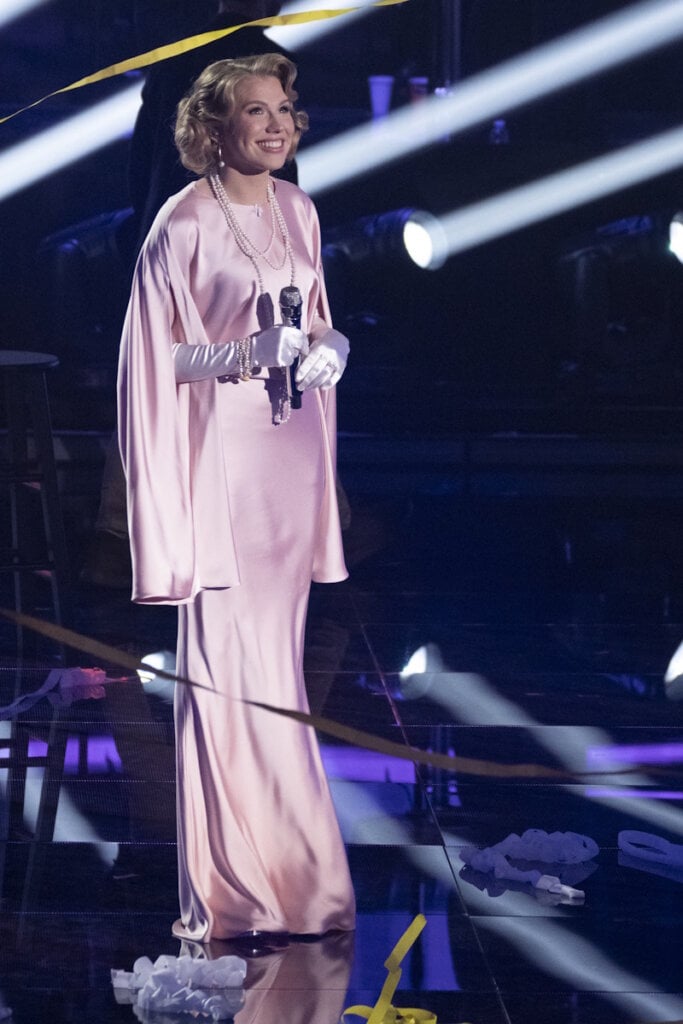
She began the performance seated on a stool beside the piano, wearing a stunning pink silk gown with matching gloves and a hairstyle reminiscent of the 1920s era the film is set in. Harper fully stepped into the character behind the song, starting with a softer, more intimate delivery before gradually rising from her seat and moving across the stage.

As the performance built, she connected with the audience more and more, leaning into the moment and letting the energy of the song take over. By the final chorus, she was moving freely across the stage and delivered a final note to remember. Her powerful vocals once again stood out, earning a standing ovation from the judges, her fellow contestants, and the live audience.

Luke Bryan was first to speak from the judging panel, and without hesitation admitted he “loved” the performance, calling it “one of my favorite performances you’ve ever done.”

“It made my heart smile. It made me smile watching you grow into…You kind of started with this Reba McEntire attitude thing and then you grew into your character, and you didn’t overdo anything. You did it perfectly,” he praised.

Lionel Richie also commended her delivery but offered some helpful advice at the same time.  

“I learned this long time ago. What you do is…whatever shoes you’re going to wear on stage, make sure you wear them in rehearsal so that your shoes don’t scare you to death when you start moving. I saw you concentrating on ‘how much can I dare on that step?’ Otherwise, your performance was amazing.”

Hannah Harper; Photo by Disney/Eric McCandless

Next up was Carrie Underwood, who revealed that she related to Harper’s situation as she too was criticized during her Idol days for not being a very strong performer.

“This is another way that you remind me of myself because I got dragged when I was on this show for not moving enough. And honestly, it was just, I had never done anything like this before. And now I can’t not move. I can sing with my entire body,” she explained, giving the singer some hope that she will learn and grow with time.”

“So I feel like you are on your way. Just keep taking those steps. Keep getting more comfortable in the space that you’re in. You were in character. You sounded beautiful. You look gorgeous. You should be very proud,” Underwood added.

Luke Bryan, Carrie Underwood, Lionel Richie; Photo by Disney/Eric McCandless

Hudson agreed with her fellow judges and congratulated Harper on all the progress she made, even just from their time together backstage to the full-blown performance.  

“Everything they just said and more, you look absolutely beautiful, first of all. And I love how you were natural and true to yourself in this moment. And I know that’s not your cup of tea to be able to perform and sing, but you stood there and you sang this song and you gave us a little bit here and there. You’re on your way,” she told Harper.

Hannah Harper’s performance earned her enough of American’s votes to move forward in the Top 7. She is joined by Daniel Stallworth, Keyla Richardson, Jordan McCullough, Chris Tungseth, Brooks Rosser, and Braden Rumfelt.

Next week on American Idol the remaining contestants will take part in “Taylor Swift Night,” performing hits from the superstar’s catalog in hopes of securing a spot in the Top 5. Comedian and “Swiftie” Nikki Glaser will also join as a guest judge.

American Idol airs Mondays at 8/7c on ABC and Disney+ and steams the next day on Hulu.

The post Hannah Harper Turns Criticism Into a ‘Redemption Moment’ on ‘American Idol’s’ Disney Night appeared first on Country Now.

​Country Now