Since I wrote my piece comparing a lease to sharecropping, I have received quite a bit of feedback. I regret getting involved in a dispute between two parties who were not seeking resolution but dissolution of their business relationship. I was unaware of the tenant’s past-due rent, and I should have reached out to the landlord before writing what I did. For this, I am sorry.
I still believe that tenants should advocate for their best-case scenarios in their leases, and if you don’t know what that is, consult a lawyer. I hired Andrew Juneau from Faulkner Banfield in Juneau.
I was wearing my chef hat when I wrote that piece, and now I am eating it. I wasn’t considering my role at the Chamber of Commerce. What I did was a divisive act. While I thought I was defending a chamber member, I should have looked at the full picture first. When a restaurant struggles, it is usually because of multiple compounding issues, not one.
It is important to help each other in a small community, but boundaries matter. Our most meaningful impact comes from our daily work and how we show up for people. We live in expensive, stressful times — especially in rural Alaska — and it is easy to lay blame. It is harder to work together. I’ve always preferred the hard way, and I am sorry that my anger got the best of me.
In photos obtained by TMZ, Taylor and Dakota are both sporting facial injuries that were allegedly caused by one another.
Taylor Frankie Pail and Dakota Mortensen on ‘Secret Lives of Mormon Wives’ reunion episode. (Hulu/YouTube)
That doesn’t change the fact that Taylor is on camera hurling metal barstools at Dakota. But she may have been telling the truth when she claimed she was a victim as well as an aggressor.
Whatever the case, there’s more good news for Paul, as we now know that she will not face any new criminal charges in connection with further claims made by Mortensen.
According to People, the Salt Lake County District Attorney’s Office announced on April 14 that it will not pursue charges stemming from additional alleged incidents involving Paul and Mortensen.
The office said some of the allegations fell outside the statute of limitations, while others either did not rise to the level of criminal offenses or lacked sufficient evidence and specificity to move forward.
As the DA’s office explained in letters obtained by People, some incidents lacked ‘specificity as to when and what actually occurred or corroboration.”
The office also noted that the case was reviewed by “multiple attorneys” due to Paul’s public profile.
Bodycam footage from Taylor Frankie Paul’s arrest shows her very intoxicated and upset. (YouTube)
Following the news, Paul took to social media with an emotional statement.
“Cried when I got the call. THANK YOU to those that have stood with me,” she wrote (per People).
Clearly, Taylor is grateful to those who supported her through the legal and personal turmoil of the past several weeks.
The reality star’s response reflected a sense of relief after weeks of uncertainty surrounding the investigation.
This latest decision applies only to the new allegations investigated in 2026.
As People notes, this does not change the 2023 case, in which Paul previously pleaded guilty in abeyance to aggravated assault after a separate incident involving Mortensen.
The Secret Lives of Mormon Wives star Taylor Frankie Paul seems to lean into controversy in this screenshot. (Image Credit: Hulu)
That earlier case remains a significant part of the public conversation surrounding Paul, particularly after leaked footage of the incident led ABC to cancel Taylor’s season of The Bachelorette.
For now, however, prosecutors have made clear that no new charges will be filed in connection with the most recent allegations.
And for Paul, that development appears to have brought at least some measure of relief amid what has been a deeply public and painful chapter.
“It’s sad to see the latest installment of his never-ending, desperate, attention-seeking, destructive campaign to harm Taylor without any regard for the consequences for their child,” a rep for the reality star said in a statement last month.
“Releasing an old and selectively edited video on their son’s birthday is a reprehensible attempt to distract from his own behavior.”
Hopefully, now Taylor and Dakota can both move on from this messy incident.
Jack Schlossberg didn’t quite love this story of his family.
The grandson of President John F. Kennedy and Jaqueline Kennedy Onassis revealed that while he and his mother Caroline Kennedy didn’t… E! Online (US) – Top Stories
A king salmon swims underwater. (Courtesy/Ryan Hagerty,U.S. Fish and Wildlife Service)
Haines’ king salmon sport fishery is once more open to anglers, even as state fish forecasters project a smaller run of Chilkat kings this year.
For nearly a decade, sport fishing for king salmon has been shut down in the Upper Lynn Canal — a response to historically low returns.
From 2011 to 2018, the number of kings spawning in the Chilkat River came in below the state’s sustainability goal — also known as escapement — all but one year.
This year, beginning on June 14, Alaskan anglers in the Haines area may catch two 28-inch or bigger king salmon per day, with no total limit for the season.
Non-resident anglers are limited to one large fish per day and three total through June 30, then limited to one total after that date.
The past decade of restrictions on fisheries have been effective in pulling the Chilkat run out of its decline. Whereas about 20% of the run annually was being harvested 10 years ago, the harvest in recent years has been about 5% of the run, said Alaska Department of Fish and Game biologist Brian Elliott last year. Now, the run has made escapement seven of the last eight years.
Last year’s return of 4,054 spawning-size Chilkat kings exceeded the top end of the escapement range and the pre-season forecast of 3,000 fish.
Nevertheless, some continue to worry about the run’s long-term health.
Longtime angler and gillnetter Stuart DeWitt this week questioned the decision to reopen the sport fishery without an annual limit.
“A run that’s been closed for so long, why wouldn’t you err on the side of caution?” DeWitt said. “I want to be able to (catch kings), I’ll take any opportunity to do it, but three fish per person for a family in a year — that’s plenty of meat.”
The first indication of run strength will come from tagging in May, said Daniel Teske, Fish and Game’s Juneau-area sportfish biologist. With that data, he said, managers may still consider in-season restrictions, particularly on non-resident anglers.
But overall, Teske pointed to last year’s return and the recent run of higher-escapements as evidence of a run that can support this year’s opening.
As the Haines-area sheds the stringent restrictions of the past decade, the fishery is now mostly in line with the rest of the region.
The daily- and season-limits are the same as the general Southeast king salmon sportfish regulations, though the start of the season in Haines is delayed to June 14. This year’s two-fish daily limit for kings in Southeast doubles last year’s one-fish daily limit.
The June 14 start date means fishing will only open toward the tail end of traditional run-timing, Elliott said, which Fish and Game hopes will minimize over-harvest.
The new sport fish regulations follow the January release of Fish and Game’s annual preseason forecast. According to the forecast, state biologists predict the Chilkat will see 2,650 spawning-size king salmon. That number — calculated assuming zero-harvest — falls well within the escapement range, but is lower than both last year’s return and last year’s forecast.
According to Elliott, that’s not a cause for worry. The largest proportion of spawners in the Chilkat run have been 5-year old fish, and last year’s 5-year old age class was particularly large. The forecast still exceeds the specific point goal within the escapement range of 2,200 spawners, Elliott said, leaving room for some harvest.
On the commercial side, management is expected to “remain conservative” this season, with restrictions remaining similar to past years, said Fish and Game’s Haines commercial fisheries manager Nicole Zeiser.
Using Haines School for a privately funded “Easter” celebration wherein thousands of pieces of candy are distributed to children, is unhealthy, wasteful and inappropriate — but exemplifies our health crisis.
Instead of maladaptive festivals of refinement and glucose-spiking junk, schools, churches and donors (and community organizations generally) might consider serving and offering heartfelt gratitude and whole, real, and traditional disease-fighting foods.
Human health is way more complex than food alone; reducing daily stressors, getting sufficient sleep and exercise, and healthy relationships are also key to productivity, thriving, creativity, and disease avoidance.
We now know tons about how to lower risks for vascular disease, type-2 diabetes, kidney problems, cancer, Alzheimer’s, depression, and so forth. What’s the missing super sauce? Simply informed people taking collectivecare and action, which come free of charge.
A few sobering numbers illustrate the scale of America’s problem. Chronic disease is expected to cost the U.S. an insane $47 trillion over the next 15 years, probably more. Over half U.S. adults live with two or more chronic disease diagnoses. The frequency of type-2 diabetes has tripled the rate of vision-loss due to diabetic retinopathy since 1990, and this year alone about 155,000 U.S. amputations will be performed because of complications of type-2 diabetes. By 2050, the U.S. rate of overweight and obese (now about 40-percent) will hit 60 percent — which will likely include children currently enrolled at Haines School.
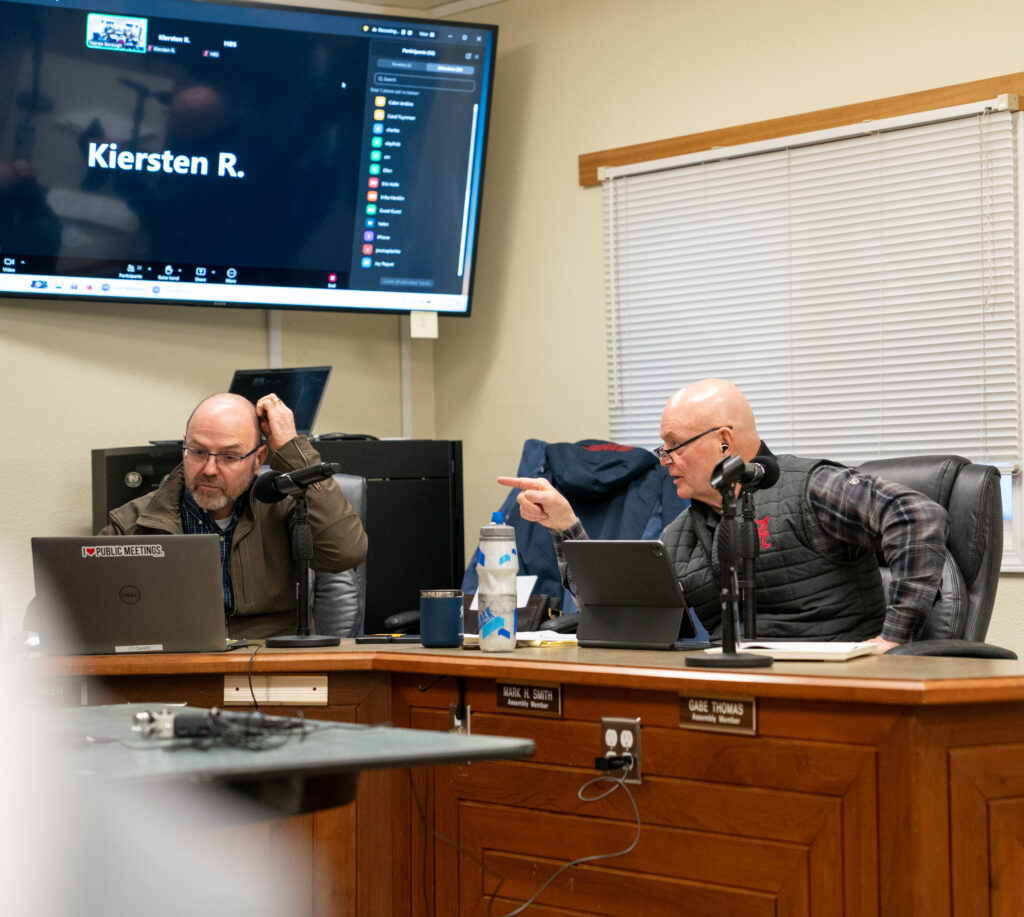
(Lizzy Hahn/ Chilkat Valley News) Assembly member Mark Smith talks during the assembly meeting Tuesday, March 10, 2026 in Haines, Alaska.
Severance tax fails
A flurry of final votes on major legislation, all coinciding at Tuesday’s meeting, came at somewhat of an inconvenient time. As has become familiar in recent weeks, the assembly requires four votes — a majority of the full body — to pass legislation. That remains the case even with assembly members missing, which was the case Tuesday.
Absences from assembly members Cheryl Stickler and Kevin Forster left only four assembly members present, meaning a unanimous vote was the only way to pass any legislation. Functionally, that meant each assembly member had a veto, with any no vote able to derail any motion to pass, amend, or even postpone legislation.
A severance tax was the first to fall, losing out in a 2-2 vote.
The proposal has been to tax the value of raw materials extracted in the borough but exported and sold outside — specifically mineral ore, timber, gravel, sand and coal. Exports up to $5,000 in value would have been exempted from the tax.
The idea has long been on the table, failing in front of multiple recent assemblies. Former assembly member Debra Schnabel spoke in favor of the tax during public comment, saying that she saw “no embarrassment in charging for a commodity we have that people need.”
“I’m disturbed by the idea that this tax is something that is going to hurt business,” she added. “The consumer is the one that pays the severance tax we’re talking about right now. We have a commodity people want, and it’s important to take advantage of that, especially in our time of need.”
Prior to the meeting, assembly member Mark Smith had submitted a list of objections to the proposal, namely that rates were set too high, the tax would not be legally defensible, and the borough would be better served with alternatives like a negotiated payment-in-lieu-of-tax, or PILT.
The legislation had been “vetted” by the borough’s attorney, borough staff said.
During the meeting, Smith proposed sending the severance tax proposal back to committee, but assembly member Eben Sargent objected, citing the months it had already spent in committee.
Smith then moved to take a final vote, which failed with him and assembly member Gabe Thomas voting no.
Bulk-ore containerization postponed
The severance tax was the lone-member of the most significant ordinances to make it to a final vote. The rest were put off, including a vote on new ore-handling regulations in the borough.
Those regulations, put forward by Thomas and Forster, would require mineral-ore containers to remain sealed within borough boundaries, even as they are loaded onto ships. In theory, that would assuage concerns about environmental contamination, in the event of an active Chilkat Valley mine, similar to that of Skagway’s ore terminal.
But rather than make a final decision, assembly members Tuesday decided to send the proposal to committee.
Sargent, who said he supported the intent of the proposal, argued committee review would ensure the intent was reflected in the actual language of the legislation.
“We’re dealing with big industry and big money and we need to be careful we don’t create loopholes or redundancies that will cost us money later,” he said.
ADU future still controversial, still uncertain
The accessory dwelling unit proposal has changed from last year, but the conversation around it remains just about the same.
The overall idea is to allow individual homeowners to build a small rental unit on a single-family lot, which some say could help cut into Haines’ housing shortage.
Sargent, who has led the charge on the measure, described it as a way to “unlock a quiet source of development capital and land.”
In other words, individuals who wouldn’t finance large new housing-development projects might be willing to spend a smaller amount to repurpose an existing structure or build on their own property to have an extra stream of income.
Allowing accessory dwelling units, often referred to as ADUs, wouldn’t be a significant change to existing regulations, at least on its face. Residents in single-family zones are already allowed to rent out garage apartments or units attached to their homes. The new rules would allow them to rent out slightly larger units and units on the property but not attached to the primary residence.
But the impact of that, some residents say, would be large. As has been the case at all public hearings on ADUs, many spoke out Tuesday arguing the change would increase crowding in single-family neighborhoods. Many objections came from Lutak and Mud Bay residents who had been exempted from last year’s version of the ordinance.
Compared to that previous proposal, the current version adds new restrictions in an effort to address density concerns. For instance, the proposal now requires lots must be of a certain size to have an accessory dwelling unit by right, otherwise the ADU permit must go through a stringent conditional use permit process, which includes the input of neighbors. It also requires lots to have a state-approved septic-system or borough sewer connection in order to host an ADU.
But still, Thomas described it as a “sweeping zone change” that “will not work,” citing the high cost of building an extra unit.
“If this doesn’t work, no ADUs get built and no one’s losing anything,” responded mayor Tom Morphet.
In the end, the four-member assembly voted unanimously to send the current version of the proposal to the planning commission for review. The assembly will then hold a third public hearing and possibly take a final vote at their next meeting on April 28.
Smith to write check
In perhaps the quickest resolution to a non-profit funding discussion in recent assembly history, Smith said Tuesday he’ll be signing over $10,000 of his own money to the Chilkat Valley Preschool.
Chilkat Valley Preschool had come to the assembly as a whole for funding Tuesday, asking for up to $10,000 to fund a new program for toddlers, including new equipment and licensing. That youngest age group currently has the biggest shortage of childcare providers in the valley, many, including childcare providers, have said.
After some initial discussion amongst the assembly, Smith interjected. His offer to the preschool: withdraw the request to the assembly and he’d write out a check after the meeting. Staff at the preschool quickly accepted.
High costs to get town hall meeting
Amid skyrocketing global fuel costs, over 500 Haines residents have signed a petition asking the assembly to cut the summer sales tax rate by 2.5%.
According to Delta Western spokesperson Di Do, the fuel-provider hasn’t raised Haines prices yet — last raising them March 13. But the global increases have already been seen in other areas, including a major increase to rates from freight company Alaska Marine Lines.
Across the board, assembly members on Tuesday seemed receptive to residents’ struggles with rising prices. The tougher question is what they’ll decide to do about it.
Borough finance director Jila Stuart has raised concerns with significantly slashing the sales tax rate.
“I think people are asking for a kind of relief valve from the rising prices,” Stuart said Tuesday. “I think taking (sales tax) from 7% to 4.5% is way more than a relief valve. It’s totally unraveling our sales-tax structure.”
According to her projections, the summer sales-tax cut could result in a loss of over $1 million in revenue for the borough, roughly 2% of the annual operating budget.
There’s also a question of legality: the seasonal sales-tax rates were passed by voters at the ballot in October, and the assembly is not allowed to immediately overturn a vote from residents. The more clear solution would be to hold a special election, allowing voters to pass the temporary rate change, Morphet said.
But there are other options for temporary price relief, including some suggested by Stuart. Stuart’s ideas included temporarily eliminating tax on electricity bills or exempting groceries. Those proposals would have a smaller impact in terms of total dollars, exempting roughly $100,000 and $400,000 of tax, respectively, over four months, Stuart said.
They may also favor residents over tourists more than the overall sales-tax rate cut by targeting services more heavily used by residents.
Smith also brought to the meeting an idea to temporarily eliminate sales tax on “all fossil fuels.”
No decisions were made, and the assembly has scheduled a town hall on April 22 to hear residents’ concerns and ideas for price relief.
“I’m living on tuna fish now,” Morphet said. “I think it’s incumbent on us to hear how badly people are hurting. It’s important information.”
Plastic bag ban get canned
Plastic bags at Olderud’s have been a persistent topic in the assembly, coming up against a plastic-bag ban that is theoretically on the books in borough code.
The ban had been originally championed by a sixth-grade class. Two members of that class, now graduated, spoke at a January assembly meeting encouraging the assembly to enforce the ban.
One of those Haines High graduates, Willa Stuart, spoke about the class’s plastic-bag efforts in her valedictorian speech last year.
“This is about whether we honor our own laws and honor our young people who say, ‘you said you were going to do something and you don’t do it,’” Morphet said at that January meeting.
On Tuesday, new legislation was up for introduction that would have clarified the existing ban by adding a specific plastic thickness threshold, something Sargent said was common around the state.
Smith, however, said he wouldn’t vote for it, saying he was “against any law that can’t be enforced.”
Smith’s lack of support, plus Thomas’ later when it came to a vote, meant the legislation failed to be introduced.
“Not taking action on this ordinance doesn’t make (plastic bags) legal,” Sargent said. “This was a good faith effort to make it super clear. This was created by school children. Although it’s probably the most realistic lesson that if you put something into code it’ll probably be cheated, that’s not the lesson I’d like to teach in this room.”
“I get the whole kid thing,” Smith responded. “That’s not serious in my world. There’s a reason they’re not in Congress.”
AMG tour permit
The assembly approved a tour permit for Alaska Mountain Guides to operate a boat to Eldred Rock Lighthouse. An AMG application to run boat tours in Lutak Inlet remains undecided.
The Lutak Inlet tour faced some opposition from area residents due to concerns over boat noise, crowding, and disturbance to wildlife.
AMG owner Sean Gaffney said the tours would have a beneficial effect on the area, easing concerns of congestion following new state-regulations this year banning large tour buses. The large-bus ban may increase the total number of vehicles in the state recreation area — something that would be helped by putting tourists onto the water, Gaffney said. He did not specifically say
Gaffney also said the tour would be limited, spending only 30 minutes in Lutak Inlet twice a day when cruise ships were docked in town.
By only approving the uncontroversial Eldred Rock route, the assembly is asking Gaffney to resubmit the Lutak Dock tour as a separate permit for consideration.
Justin Letson of Keep the Pool Open during their set at the Alaska Folk Festival, Saturday, April 11, 2026. (Will Steinfeld/Chilkat Valley News)
For the third year, Holly Davis has organized a butterfly migration at the Haines library. She said kids build a “butterfly tree” using children’s book illustrator Eric Carle’s style of painting vibrant textures using brushes and sponges. Then, they cut the butterflies for the tree. She was helped by Ava Stanford, Lolly Minor, and Maren Billings. Davis says in the fall the butterflies on the tree will be replaced with leaves that children will also make.
Patty Brown recently spent time in west Texas on what she called a “solo pro-democracy tour.” Her kickoff was participation in a rally in Austin on March 28. She also visited the memorial honoring 21 children and teachers killed in Uvalde. Brown spent three days outside of the Dilley Family Detention Center protesting the conditions and prolonged stays by children and families. Brown went on to camp at Big Bend National Park. While there she joined locals at a rally protesting a border barrier in a sensitive riparian zone impeding access to the Rio Grande River for hundreds of miles.
American Bald Eagle Foundation director, Kathy Benner loaded up two bald eagles, Arden and Vega for a ferry ride to Juneau this week. Benner received permission from state and federal permittees to transport the eagles to get imaging and bloodwork.. This will set a baseline for their future medical needs. Benner has been taking eagles for X-rays for 20 years. She put her skills to work loading Arden and Vega into the dog kennels incident free and the two remained well-behaved for the journey. She was in the unique position to note that two adult eagles in a vehicle for a long time offered a distinct smell.
The Haines swim team competed in Juneau last weekend. Sydney Wray said everyone swam well. Sally Andersen was the sole Masters swimmer participating from Haines, and she “crushed it.” The ten and under boys Elias Mason, Dames Gregg, Stanley Johnson, Azeo Walsh and Aurora Mason achieved personal best times in all events they completed. McConnell Robinson scratched from day one and two only to continue on to a personal record in his 100m fly. Hazel Wray swam the 400 individual medley for the first time and managed four personal best times. Grady Robinson highlighted the meet – becoming a new Alaska State Swimming Championship qualifier in the 50 meter free with a time of 26.96. Robinson, Wray and McConnell Robinson will represent the Haines Dolphins at the end of the month in Anchorage.
The 51st annual Juneau Folk Fest once again inspired plenty of people to flock to Juneau from Haines. Some former Haines residents were spotted enjoying the festivities. Dr. Len Feldman played the accordion. John Hunt performed on the main stage playing auto harp and also ukulele. Katya Kirsch played banjo with 16 women on Saturday night. Tony Tengs was spotted by Tom Morphet enjoying the music as well as former CVN reporter Steve Williams and his wife Michele Drucker.
A few Haines folk-festers found themselves learning to cut a rug together at a popular clogging workshop taught by Annie Bartholomew and held at Centennial Hall. Nene Wolfe was part of the three piece band providing the music, she was on accordion. Leslie Evenden,, Mardell Gunn, Patty Brown, Lizzy Jurgeleit, Anna Jurgeleit and former Haines resident Andrew Cardella made up a few of the nearly 40 cloggers – yours truly included– who followed the step by step instruction on the clogging. They also practiced fundamentals of Appalachian flatfooting – some with more success than others.
Hannah Trujillo attended her very first Juneau Folk Fest. Trujillo says that her mom was a fiddle player. She loves fiddle music and she “had a hankering to dance.” This likely will not be her last trip to folk fest. Anna Jurgeleit has attended 10 folk fests so far. Her favorite band to perform over the years was “Texas Maniacs.” Tom Morphet has also attended 10. Nancy Berland says she has been to the event at least 25 times, but was out done by Berl Sheldon. He has attended at least 30. Both Berland and Sheldon agree that “Hot Club of Cowtown” was their favorite band to see during their history attending the festival. Mardell Gunn has only missed two folk festivals since 1995, and says that any year Rhiannon Giddens plays is the best year to attend.
Gerald “Jerry” Everett Blood, beloved husband of Barbara Blood and devoted father and grandfather, passed into the Lord’s presence surrounded by his family Sunday, March 22, 2026, in Fairbanks after a 10-year battle with chronic lymphoma and heart disease.
He was born on August 22, 1944, in Douglas, Ariz., while his father served in the U.S. Army. He and his parents moved to Seattle when he was 2 years old. In 1955, the family moved to Fairbanks, where his father worked as a meat cutter at a local grocery store.
Jerry graduated from Lathrop High School in 1963 and attended University of Alaska for one year. He was drafted into the Army in 1965 and served one year in Vietnam from 1966 to 1967.
After discharge, he joined his family in Anchorage and followed in his father’s footsteps as a meat cutter, working at Anchorage Cold Storage. In 1978, he began work at Park’s Place grocery in Glennallen. He met Barb while she was serving as a missionary nurse at Faith Hospital.
They went on their first date in July 1980, got engaged in September and married in December of that same year. Barb described it as a “whirlwind romance,” but one that would last 45 years.
They were blessed with two children, Janie in 1983 and Matthew in 1985. The family moved to Haines in 1990 for Jerry to begin work as a meat cutter at Food Center. After serving 13 years as a volunteer firefighter/EMT, he was hired by the Haines Volunteer Fire Department as a paid employee for the remaining years of his working life, retiring at 66.
Jerry turned his life over to his Lord and Savior, Jesus Christ, through the ministry of Victory Bible Camp in 1972. For five years, he would leave his job in Anchorage for the summer and volunteer as the horse wrangler at the camp. He went on to become an elder and deacon, Sunday School teacher, and kids’ club leader, both at Glennallen Community Chapel, and later at Port Chilkoot Bible Church in Haines.
Throughout his years in Glennallen and Haines, he was known as a good and kindhearted man, hard worker and committed volunteer. He was well known for his woodcutting skills. Even after he didn’t need wood to heat his own home, he continued cutting, splitting and stacking wood as a gift for others. He was famous for his neat stacks of firewood, having three years’ worth of wood stacked, ready and dried for the cold winters.
He was a loving husband, father and grandfather. He adored his five grandchildren, both in Sitka and in Fairbanks. In 2020, he and Barb bought a condo to be “snow birds” in Sitka, but because of his failing health, they made Sitka their permanent residence in 2025. He loved living near his two Sitka granddaughters, but made frequent trips to Fairbanks to see the grandkids there as well. His Fairbanks family loved traveling to Sitka to spend time with him.
Survivors include his wife, Barbara; two children, Janie Hall (Tim) and Matthew Blood (Holly); five grandchildren, Natalie and Grace Hall and Taylor, Makenna and Charlie Blood; one brother, Derryl Blood (Jenett); and two brothers- in-law, Bob (Carol) and Paul (Wendy). He was preceded in death by his parents and two brothers.
His ashes will be laid to rest at Sitka National Cemetery at a later date.
Donations in his memory may be to Echo Ranch Bible Camp Haines, PO Box 210608, Auke Bay, AK 99801.
In Driver’s Eye with James Hinchcliffe, the six-time INDYCAR winner will bring you inside the mind of a racer while breaking down the nuts and bolts of the sport for fans. I am itching to get back to the track, and I don’t think I’m alone in feeling that way after INDYCAR’s two-week break (decidedly not a vacation, though). And what a track we are going to… The Acura Grand Prix of Long Beach is the fifth stop for INDYCAR this season, and it is easily near the very top of the best race weekends of the year. In Southern California, it’s one of the longest-running races we have, and, after the Indianapolis 500, has to be at the top of the list of races drivers want to win the most. That is in equal parts because of the decades of history, the incredible crowds and atmosphere and the unique challenges of the race track itself. I was fortunate enough to have a lot of success at Long Beach. There, I got my first Indy NXT (then called Indy Lights) pole position and win, my first INDYCAR top-5 finish and podium, and I managed to take the checkered flag back in 2017. That win stands as one of the biggest of my career because of the status that this race holds in motorsports world. That said, let’s talk about what makes this track so much fun for drivers. THE GOOD, THE BAD AND THE FAST: LONG BEACH Long Beach has a lot of unique qualities for a street track. Yes, it has walls, bumps and surface changes, which we see on pretty much all street courses. But there are a few standout attributes that make it different — and difficult — from behind the wheel. First, you have a decent amount of elevation for a street course. TV doesn’t always do it justice, but as soon as you head into Turn 4, the track starts to fall down quite a bit. That really affects the balance, as it has a tendency to make the front end wash out and lose grip, which pushes you closer and closer to the exit wall. We normally see a lot of drivers brush — or smash — the exit wall there. If you survive that, then you’re dealing with a quick change as the track shoots uphill on the brake zone for Turn 5, which totally changes how you approach that corner. Obviously, going uphill means the car stops faster for the same brake pressure (thanks, gravity!), so you have to recalibrate your brain a bit to make sure you get the braking just right. If uphill makes the car stop faster, you guessed it, downhill makes the car harder to slow down! Welcome to Turn 6. The track goes downhill aggressively on the entry, which means it is so easy to carry too much speed and end up very wide, or worse, in the run-off. Then mid-corner, it climbs again as you’re getting to power before falling away again on the entry to the next corner, Turn 8. Bit of a roller-coaster feeling in that section of track. Next, this track has a few important curb strikes — literally, purposely, hitting the curb — that are key for faster lap times. When you think of tracks like the streets of St. Petersburg or Arlington, the curbs are either painted on the track — so not an issue to drive over — or so big you can’t even think of touching them in an Indy car. Long Beach has two curb-strike opportunities, Turn 1 and Turn 5, that you can really use to pick up speed. Turn 5 is especially critical to nail. Too little curb means you don’t get the car turned enough and risk hitting the outside wall. But too much curb and the car bottoms out, lifts the front wheels off the ground and… you risk hitting the outside wall! It’s tough to be consistently fast through there, especially on cold or old tires. And finally, the geometry of the corners themselves stand out. Many street tracks feature a lot of 90- and 180-degree corners because you are pretty restricted by the literal streets you’re driving on, which tend to be straight roads. But Long Beach has a unique curved front straightaway and some great corners — like the 2-3 complex, Turn 6 and Turn 10 — that are unlike any other corners on the calendar. Oh, and let’s not forget the famous hairpin, Turn 11. It is the slowest corner of the entire season — slower than pit lane speed — at around 30 miles an hour. And it feels terrible. Indy cars are not designed to go 30. They are designed to go 230! So getting through one of the most iconic corners of the year is so tough and not friendly behind the wheel of one of these beasts. SOUND LIKE AN INDYCAR EXPERT On Sundays on the broadcast, you always hear us talking about the push-to-pass system — as long as we are on a road or street track, because we don’t use it on ovals! At a place like Long Beach, where passing is at a premium, there are a few different ways you can use this tool to help your race. The most obvious one is using it to make a pass. The run out of Turn 11, along Shoreline Drive, is the best place to use it and set up a pass into the first turn. But you have to be careful because you only get 200 seconds, and that’s a long run down the front straight. Get a little too eager, and you might not have enough left for the other times in a race where you need it. For instance, you might need some seconds banked to play defense when a car gets a good run on you or during your in-and-out laps of a green-flag pit stop. The time — and, as a result, positions on the track — you can gain back by having strong in-and-out laps is huge, so drivers will often spend a whole lap spraying the P2P on their way into the pits, and then again on the out lap to get back up to speed. But you don’t want to burn it all on the last pit stop of the day, just in case you have a late restart and need some to attack or defend before the checkered flag. Showing discipline on the button is harder than it looks, but it’s crucial. We’ve talked about the when and why of P2P, but let me quickly touch on the how. We say it a lot, we know it gives you a boost, but what is really happening to these 2.2-liter, twin-turbo V6s when a driver pushes the button? The extra power comes from two different areas. First, the rev limit goes up. Under normal conditions, the engines are limited to 12,000 rpm, which is already pretty impressive. Typical street cars don’t go much higher than 5,000 rpm most of the time! But on the P2P button, that limit goes up to 12,200 rpm. Might not sound like much, but every rev counts when you’re racing a stopwatch. To help get it up to that limit faster, the on-board computer that controls the engine, called the ECU, allows the amount of boost pressure from the turbocharged engine to sneak up ever so slightly. It delivers a rev increase and roughly 10% extra in boost pressure, which simply means more power from the turbocharger. These two things combined give the driver about 50 extra horsepower to play with. Your heart wants to hit it every lap! But your brain knows it will run out fast and that’s not the best way to win the race. 1 FOR THE ROAD I hate that we are doing this again, but I have to sign off this week by taking a moment to remember Jim Michaelian, the president and CEO of the Grand Prix of Long Beach. He died last month at 83 years old, but his impact will endure. Jim was due to oversee his last race this year, something he had done as president since 2001, at an event he had helped build for more than 50 years. So much of what makes this race so special — to the teams, drivers, fans and people of Long Beach — was because of the heart and soul that Jim put into this race. His legacy of creating the greatest street race on the continent will be remembered forever. Thank you, Jim. MORE DRIVER’S EYE:Latest Sports News from FOX Sports
Healy Power Plant is seen in this undated photo. (Image courtesy of Dan McIntosh)
Earlier this month, Golden Valley Electric Association held a community meeting in response to growing frustration among its members. The standing-room-only crowd at the Noel Wien Library included many familiar faces involved in Fairbanks energy issues. But what stood out were the people I didn’t recognize: residents who don’t typically show up to these kinds of meetings, clearly searching for answers to their high energy bills. A military mom with a toddler. A retired, disabled veteran trying to make ends meet.
GVEA CEO Travis Million laid out some of the key challenges facing the Interior — not only around cost, but supply as well. One issue that received particular attention was the absence of inexpensive “economy power” from Southcentral via the Alaska intertie.
Historically, GVEA has had two primary ways to access lower-cost power from Southcentral, much of it associated with Cook Inlet gas. One is to purchase gas directly from producers and contract with Southcentral utilities to generate electricity using that gas and send it north over the intertie. The other is to purchase excess generation from those same utilities — regardless of the fuel source — which can often be produced at relatively low marginal cost.
But with tightening gas supply in Cook Inlet, neither option is available — there simply isn’t surplus to go around. As a result, deliveries of lower-cost gas-fired power to the Interior have been declining for some time, but last year was the first time they effectively dropped to zero.
The result is that Fairbanks is replacing that lower-cost supply with much more expensive diesel-based generation — this winter, that has averaged around 250,000 gallons per day. And much of that fuel is being burned in older, less efficient units. GVEA has been trying to move away from fuel oil for years, so investing in new oil-based generation hasn’t made much sense.
The cost implications are significant. As GVEA noted during the meeting, changes in global diesel prices due to the war in Iran are now translating more directly into local electricity costs, not to mention the cost of heating oil.
To put this in perspective, each $1 increase in diesel prices corresponds to roughly $250,000 per day in additional expenses for GVEA — about $7.5 million more per month in generation costs.
The implications are being felt directly in residents’ pocketbooks. Right now, residential customers in GVEA’s service territory pay an effective rate of about 32.9 cents per kilowatt-hour (kWh). That’s roughly 7–10 cents per kWh higher than what residents in Anchorage and the Mat-Su pay. Nearly all of that difference comes from the Cost of Power Adjustment — the COPA. This is the line item on your bill that reflects how current fuel costs compare to a set base rate. At around 12.8 cents per kWh, GVEA’s COPA is two to three times higher than that of Anchorage residents. That’s the story: we are spending far more on fuel. And that takes us right back to the 250,000 gallons of diesel per day.
To close out the presentation, GVEA outlined several steps it is taking to address the high cost of fuel, including plans for new local generation such as a second LM6000 in North Pole — essentially a jet engine adapted for power generation. It would join an existing unit running on naphtha refined at the Petro Star facility from oil pulled directly off the pipeline. The project is expected to go before the board next month, but even if approved, it would likely take three years to come online. A 30-megawatt wind project in Delta is also in the works, but it has recently encountered permitting delays at the federal level.
When the floor opened for questions, hands shot up immediately. What about solar? Nuclear? How much power do the military bases consume? How much is your salary—can’t we cut costs somewhere? And don’t we have cheap local coal?
The bottom line is that none of these options fully address the immediate challenge of high energy costs — at least not in the short term. Fundamentally, Fairbanks is not particularly well positioned geographically when it comes to energy resources. We lack significant hydro potential, and we are not located near a major natural gas resource like Cook Inlet or the North Slope.
We do have coal, and it is already an important resource. The two mine-mouth plants in Healy make up a significant share of GVEA’s baseload and are, arguably, among the lowest-cost sources of reliable generation available to the system. But they’re not without challenges. I’ve heard anecdotally that Healy Unit 2 has been giving operators and dispatchers fits this winter. It’s definitely not performing like the steady, dependable baseload resource that coal is often assumed to be.
Then there’s the UAF coal plant. I work on campus, and around mid-winter I started to notice that emissions from the smokestack were less consistent than I expected. So I began paying closer attention. By my count, the plant has operated roughly 28 days since January 1st — about a quarter of the time.
When it’s offline, UAF shifts to burning heating oil to heat the campus, which is a higher cost fuel than coal. It then purchases electricity from GVEA, which in turn places even more demand on a system that is already relying heavily on diesel generation. This layering effect increases overall liquid fuel use locally, putting additional strain on supply to the point where fuel is now being trucked up from the refinery in Valdez to meet demand. I suspect we’re in for a sobering financial realization when UAF’s energy bills are finally tallied.
The Healy Power Plant is seen in this undated image. (Photo courtesy of Dan McIntosh)
Is Fairbanks Rural Alaska?
In rural Alaska, energy costs are a major burden — one that families and communities deal with every day. Fuel must be imported over long distances, and power systems remain largely diesel-dependent, driving electricity prices to very high levels. To address this issue, the State of Alaska developed Power Cost Equalization, or the PCE program, around 40 years ago. The idea was that when investments were made by the state, such as in hydroelectric projects that benefited one community or region, other money would be put aside to help subsidize costs in diesel dependent communities.
In statute, the PCE program is designed to equalize the cost of electricity for residential customers to something close to the average of Anchorage, Fairbanks and Juneau. These locations were selected as the major population centers at the time the program was created. It was assumed that each one of these communities would have access to relatively low-cost power that was at least in part state-subsidized: Juneau through the Snettisham hydroelectric project, and Anchorage, the Kenai Peninsula and Fairbanks through interconnected infrastructure supported by state investment in both generation and the transmission backbone now known as the Alaska Intertie.
Under this framework, rural communities would receive a subsidy to bring residential rates closer to that urban benchmark. The intent was that, at least in theory, all residential customers across the state would have access to reasonably comparable electricity rates — something akin to a shared, or “postage stamp,” average.
In practice, however, things work differently. The relatively high rates in Fairbanks are effectively canceled out by the very low-cost hydropower in Juneau. And because Chugach Electric Association in Anchorage sells the largest share of electricity, Anchorage ends up disproportionately influencing the so-called “PCE base rate” — the “floor” price that rural residents pay after the subsidy is applied.
For example, the PCE base rate last year was 19.92 cents per kWh, which in turn was largely derived from Chugach’s 2024 average rate of around 21 cents per kWh. If a rural utility is well run and doesn’t have a lot of non-allowable costs inflating its rates, rural residential customers should pay something close to that level — at least for the first 750 kWh per month which is covered by the program, which is a reasonable amount for most households.
This has worked out well for rural residents, and is a cornerstone program for making living costs slightly more affordable in rural Alaska. But Fairbanks is struggling.
In 2025, Fairbanks residents paid about 11.5 cents per kWh more than residents in places like Akiak, Akutan, Anaktuvuk Pass, Atmautluak, and Atqasuk. Those are just the communities starting with the letter “A” in the annual PCE report published by the Alaska Energy Authority, that have managed to hit that PCE floor of about 20 cents per kWh.
Looking across all 188 communities that received PCE last year, Fairbanks residents paid more than about 140 of them. That’s sobering. And if the goal of the program is to offset diesel costs, consider this: GVEA burned more diesel fuel last year than all of rural Alaska combined. This year, it won’t even be close. Our 250,000 gallons per day dwarfs the roughly 70,000 gallons rural Alaska consumes on average for power generation.
So what does this mean? It raises questions about how Fairbanks fits within the broader structure of Alaska’s energy system. Should it be viewed more like rural Alaska in certain respects? Should we consider expanding the PCE program to cover Fairbanks residents? For many, that idea is heretical — and not without reason. PCE currently serves about 80,000 residential customers; extending it to GVEA would effectively double the program.
Some of my colleagues have suggested this is a temporary disparity, driven by the loss of gas-fired economy power, and that rates could moderate over time. But looking at historical data, Fairbanks has always been above the PCE base rate benchmark — roughly 10 cents per kWh higher for virtually all of the past decade.
So why are we noticing it so much more now? It may be that rates are reaching a breaking point for local residents. Crossing the 30 cents per kWh threshold stands out as a kind of high-water mark — likely because, historically, it is. But the floodwaters are still rising. I would not be surprised to open my bill in July and see rates approaching 35 cents per kWh.
So what about the Alaska intertie?
When Alaska lawmakers began shaping their vision for an equitable energy system, the solution for Fairbanks was, in part, the Alaska Intertie. The idea was that physical interconnection would allow lower-cost power to move across regions, benefiting everyone connected to the grid. So why hasn’t it worked as intended?
Part of the challenge is that while the system is connected physically, it’s not integrated operationally. This means the system is not dispatched as a single, coordinated grid where the lowest-cost generation is brought online first for the benefit of all customers. Instead, it continues to function more like three loosely connected regions — the Kenai, Southcentral, and the Interior — each making decisions within its own boundaries.
The result is that some of the most efficient generation is not fully utilized, while higher-cost resources continue to run elsewhere on the system. This dynamic is a classic prisoner’s dilemma: the best overall outcome comes from cooperation, but each utility is incentivized to act in its own interest because that is what it can directly control.
If this were happening in the Lower 48, utilities would likely be required to operate under a more coordinated system due to regulatory frameworks established decades ago to support regional power markets. Alaska, however, falls largely outside of thoseFederal Energy Regulatory Commission requirements, which are tied to interstate transmission and wholesale power markets. Because Alaska’s grid does not cross state lines, it is exempt from many of these rules.
One result is that the governance structure of the Railbelt has evolved differently — and in some ways, more slowly. Without the same regulatory drivers, the system has remained more fragmented, with each utility continuing to operate largely within its own footprint.
This has implications across the grid, but the effects are not evenly distributed. Communities at the edges of the system tend to feel these dynamics most acutely. While this commentary has focused on Fairbanks, similar pricing pressures can be seen in other peripheral areas, including Homer Electric Association and the City of Seward, albeit for somewhat different reasons.
The fix is ultimately a governance fix when it comes to the Railbelt. We can’t build our way out of high energy prices — at least not in the near term. And the reality is that high prices are going to be with us for a while. That doesn’t mean we are without options. But it does mean that the most meaningful progress will come not from the next project, but from how we choose to operate the system we already have.
Today, we are not consistently dispatching the lowest-cost resources across the grid, nor are we planning and operating the system as a single, coordinated network. That gap has real consequences. It means we carry unnecessary costs, underutilize our best assets and expose some regions — particularly those at the edges of the system — to higher and more volatile prices.
We have done hard things before. We built legacy hydropower projects around the state that continue to benefit residents with access. We also created mechanisms to share resources across communities through the PCE program. And we have taken meaningful steps toward greater coordination on the Railbelt as well. In Southcentral, utilities now operate more closely together through coordinated dispatch arrangements, and regionally we have established organizations like the Railbelt Reliability Council and the Railbelt Transmission Organization to support more integrated planning and operations.
These are important steps in the right direction — but they are still incomplete. The next step is less about infrastructure and more about alignment: establishing the structures and incentives needed to operate the Railbelt as a single system. Until we do that, we will continue to fall short of what this grid was designed to deliver.













 Jack Schlossberg didn’t quite love this story of his family.