Christina Haack has never gone this long without being married since the public first knew her.
Now, after about a year and a half with her new man, is it time?
She recently stepped out wearing a Cartier ring on that finger. What does she have to say for herself?
Christina Haack attends HGTV’s first-ever event at the Bachelor Mansion to Celebrate “Bachelor Mansion Takeover” at The Bachelor Mansion on March 12, 2026. Notice that ring on her finger? (Photo Credit: Tommaso Boddi/Getty Images for HGTV)
There’s a ring, and presumably a story behind it
Recently, headlines have speculated about Christina’s relationship status.
The ring on her left ring finger — typically the finger that houses an engagement ring, a wedding band, or both — had drawn eyes.
HGTV viewers have seen her marriages to Tarek El Moussa, to Ant Anstead, and worst of all, to Josh Hall.
More recently, she has been dating Christopher Larocca. They began dating in autumn 2024.
It is only natural that fans would wonder if they are engaged. But some may have jumped the gun.
During the fifth episode of ‘The Flip Off,’ Christina Haack faces off with her competition. (Image Credit: HGTV)
On Sunday, March 15, Christina Haack took to her Instagram Story to call out a headline.
“Christina Haack flashes a ring on her wedding finger as she says she WOULD get married again… after 3 divorces,” read a headline.
Sure enough, she was sporting a ring in the photo.
The photo stemmed from Christina’s attendance of a March 12 event, HGTV’s Bachelor Mansion Takeover.
Christina’s response? An eyeroll emoji alongside the words: “Bad reporting.”
Addressing the confessional camera on ‘The Flip Off,’ Christina Haack discusses her miscalculations. (Image Credit: HGTV)
So what’s with the ring?
To be clear, Christina was wearing a ring at the event.
In her Story post, she explained that it was a special piece of jewelry — one that she had purchased for herself, years ago.
“That ring (that I’ve worn for almost 10 years) is a Cartier love ring (a gift to myself) with my kids’ initials,” she shared.
“And ‘Marriage is just not on my radar right now,’ was my exact quote,” Christina specified.
Oof!
During the first teaser trailer for The Flip Off, star Christina Haack tells her ex-husband that she has just officially split with her most recent husband. (Image Credit: HGTV)
From 2009 until their very public split in 2018, Christina was married to Tarek El Moussa.
Later in 2018, she and Ant Anstead married, splitting in 2021.
In 2021, she married Joshua Hall.
That pretty famously did not last, as we have all witnessed from their very public and contentious divorce.
This relationship with Christopher Larocca is the longest — by far — that the public has seen her go without being married. That is very wise of her.
On ‘The Flip Off,’ Christina Haack voices the feeling that her most recent ex is hoping to ‘retire’ off of her after their marriage, which spanned less than three years. (Image Credit: HGTV)
Everyone needs time to be themselves
Christina’s fans are hoping that she will take some time to be herself for a while before she remarries — if she remarries at all.
She has admitted to doing some “stupid things,” romantically speaking, since her split with Tarek.
(That’s not a nice way to refer to Josh … we’re joking!)
No one’s saying (where we’ve seen, anyway) that Christopher isn’t a good dude or potential marriage material.
It’s just that Christina doesn’t need a husband, right? Fans don’t think so, anyway. But ultimately, only she gets to decide that.
President Donald Trump’s nasty jabs at Governor Gavin Newsom’s dyslexia backfired miserably, especially considering questions about his own cognitive health.
Health Digest – Health News, Wellness, Expert Insights
More than a third of people in state prisons have served time in a juvenile facility, according to The Sentencing Project.SAKDAWUT14/iStock via Getty Images Plus
Data released in January 2026 to Allegheny County officials offers a clear look at who is being held at Highland Detention Center – and how much it costs taxpayers. The numbers show short stays, significant racial disparities and millions spent to operate the facility. These findings raise new questions about whether detention is being used effectively in the county’s youth justice system.
In 2025, 220 young people passed through the center. The county paid nearly US$800 per day for each of the 12 beds in the facility, whether they were occupied or not.
The center operates at the site of the former Shuman Juvenile Detention Center in Allegheny County. After a documented history of child abuse, medical issues, unauthorized use of restraints and other violations, Shuman closed in September 2021 when the Pennsylvania Department of Human Services revoked its license.
Shuman opened in 1974 with an occupancy of approximately 120 beds. At the time it was closed, the daily population had dropped to 20 juveniles at an annual cost of $11 million.
As a professor of social work at the University of Pittsburgh, I study law, policy and child welfare. I have spent my career studying how the juvenile justice system can shape – and also damage – the lives of young people while creating significant costs to taxpayers.
Here’s what local taxpayers in Pennsylvania are paying for juvenile detention.
The county agreed to pay $650.25 per bed, per day for the first year of the contract. That rate, the contract specifies, “shall be adjusted each year.” By the end of 2025, it had already climbed to $825 per day. In total, the county paid Adelphoi nearly $7 million last year to hold kids for an average stay of 13 days.
The facility offered 12 beds in 2025. The contract calls for that number to increase to 60 beds, with the costs also rising to $19 million annually. The county has an option to renew the contract when it expires at the end of 2028.
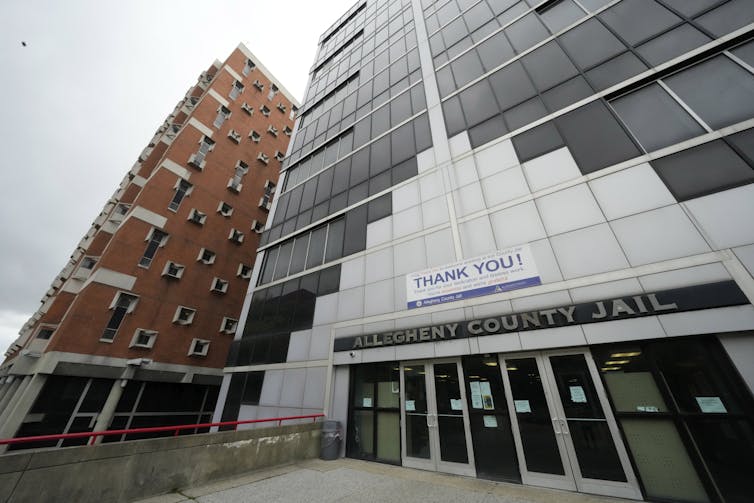
In March 2026, there were seven juveniles being held at Highland. As of late February 2026, there were approximately 12 to 14 juveniles held in the Allegheny County Jail. They can be held in the jail for a variety of reasons but are primarily there if they are being charged as an adult.
Who’s being locked up
Statistics show a correlation between juvenile detention and adult involvement with the criminal legal system.
According to The Sentencing Project, a Washington, D.C.-based nonprofit, more than a third of people in state prisons have served time in a juvenile facility.
Black youth are more than five times more likely to be placed in juvenile facilities than white peers, and two-thirds of state prisoners experienced an arrest before age 19.
Roughly a dozen juveniles are being held in the Allegheny County Jail. AP Photo/Gene J. Puskar
In the juvenile system, detention is intended to be short term and is generally used prior to an adjudication, the determination of someone’s guilt or innocence.
Detention is typically used for kids who pose a threat of committing additional crimes or a risk of not appearing in court, based on a determination by a probation officer, a state risk-assessment test or a judge, typically. Dentention is not a destination but part of a continuum with a goal of moving a young person to less restrictive alternatives, such as community-based programs and services that allow youth to remain at home, in school and in their communities while receiving supervision, treatment and support. These alternatives are often more effective at reducing recidivism and less costly than secure confinement.
While kids in detention have the right to receive a free public education and should be offered physical, behavioral, mental health and recreational services, according to state law, detention is not a treatment facility.
Based on available data and my own experience working in and with detention facilities, it is clear that youth locked in these facilities are not only those at risk of committing another crime or not appearing in court. Many have education, mental health and substance abuse needs, come from poor families or identify as LGBTQ+. In many respects, detention facilities have served as a dumping ground for youth dealing with a vast array of issues in their lives.
The juvenile justice system was built primarily around managing risk and ensuring court appearances. It does little to address the underlying needs of the children moving through it. Unstable housing, missed school and lack of supervision can trigger detention even when a child poses no real threat. In many cases, juvenile detention ends up filling a gap left by social services.
Doubling down on detention
Despite its limited capacity, the Allegheny County Highland Detention Center dashboard shows 220 youths were detained at Highland in 2025. Eighty-six percent of these kids are Black. Firearms charges are the most common offense.
More than half had an individualized education plan, a legally binding document that outlines the specific educational support and services a student with a physical or mental disability is entitled to receive in school.
Over 60% were involved with the child welfare system, 88% had family involvement in the Supplemental Nutrition Assistance Program, or SNAP, and 72% had received a crisis mental health service at some point before entering Highland.
Research shows that young people who are detained are more likely to commit additional offenses when they are released, experience educational and economic disruption, and face increased mental health challenges. Detention does not promote the social development of young people or community safety.
Restorative justice programs bring victims, accused youth and trustworthy adults in their lives together to discuss the harm caused by the offense. They come up with a plan to help make things “right” between the parties to avoid subsequent offenses and help the youth learn from the incident.
The dollars being spent to confine kids in Allegheny County could be reinvested in the young people themselves and in their families, schools and communities. The new advisory board was appointed to Highland in July 2025. The board was created to provide a layer of accountability over the facility and Adelphoi – but what that looks like in practice remains up in the air.
Jeffrey Shook does not work for, consult, own shares in or receive funding from any company or organization that would benefit from this article, and has disclosed no relevant affiliations beyond their academic appointment.
In matters of food, the clock often looms large. The timing of a steakhouse visit can determine whether your meal feels rushed and even how much you pay.
Mashed – Fast Food, Celebrity Chefs, Grocery, Reviews
In a surprising twist, Florida’s potential ban on cousin marriages has fizzled out, keeping the door wide open for unconventional love stories. Continue reading…The Boot – Country Music News, Music Videos and Songs
In a surprising twist, Florida’s potential ban on cousin marriages has fizzled out, keeping the door wide open for unconventional love stories. Continue reading…Country Music News – Taste of Country
Cottage cheese is a protein-rich staple but it requires careful production and storage to remain food safe. Here are the worst cottage cheese recalls in the US.
Mashed – Fast Food, Celebrity Chefs, Grocery, Reviews
The country superstar is reportedly worried about his relationship with daughters Sunday and Faith after his divorce from Nicole Kidman, but he remains determined to stay close. Continue reading…Country Music News – Taste of Country