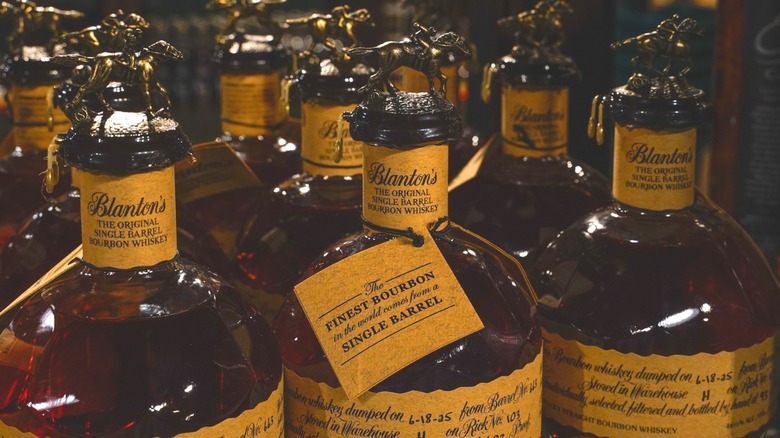
If you collect liquor or closely study “John Wick” movies in your spare time, there’s a chance you’ve heard of Blanton’s bourbon and its famed bottle stoppers.
Mashed – Fast Food, Celebrity Chefs, Grocery, Reviews









If you collect liquor or closely study “John Wick” movies in your spare time, there’s a chance you’ve heard of Blanton’s bourbon and its famed bottle stoppers.
Mashed – Fast Food, Celebrity Chefs, Grocery, Reviews

 Eiza González is hoping her friendship with Taylor Jenkins Reid will translate from the page to the screen.
As rumors continue to swirl that the 3 Body Problem actress may be playing the titular…
E! Online (US) – Top Stories

The Canning River, seen here in 2018, flows from the Brooks Range into the Beaufort Sea along the western edge of the Arctic National Wildlife Refuge. (Photo by Lisa Hupp/U.S. Fish and Wildlife Service)
The story of a family is a story of the world, and the story of the world is that of a family. That premise is at work in a new book by Alaska author Ch’igiioonta She Holds a Child, who explores the displacement of the Nendaaghe Dena people through her own family stories. Readers interested in the precolonial history of the Western Brooks Range will see how no one element or person stands alone in Ïyaġaaġmiut: People Who Live Among the Rock Caches. From multiple viewpoints, Ch’igiioonta brings out what belonging to one another and the land requires amid great and complex changes.
The Nendaaghe Dena people were called Ïyaġaaġmiut by their Iñupiat neighbors, who characterized them as the ones who live among rock caches — a reference to pits they dug below permafrost levels to store caribou and other meats. As Ch’igiioonta tells their story, she refers to their homeland as their “estate. The author defines “estate” as a territory and economic unit formed from Indigenous peoples’ knowledge of the land, existing trail systems and natural boundaries, each with distinct features and ability to sustain a number of persons.
Throughout the book, many colorful maps guide readers through the storied, “late prehistory” geographies of the Nendaaghe Dena Estate in extended kinships with others of Northwestern “Alaska.” The full “map-in-progress” of the focal area is printed at the book’s front. I recommend viewing a larger version of the “Map of Athabascan and Inupiat Estates in Northern Alaska, ca. 1800” on the website of AthabascanWoman.com. The author’s discussions are replete with place names and changes in place names across multiple languages and cultures—Iñupiatun, and three Athabascan ones, Dinjii Zhuh K’yaa —the author’s own, Denaakk’e, and Lower Tanana and their various subgroups. The whole book is organized with an introduction and five chapters, featuring multiple family genealogies and six useful glossaries listing regional, place and family names as well as some Indigenous word definitions and a chronology of key events.
This work develops two mutually contributing historical contentions, an environmental one and an economic-colonialist one. At the same time, Ch’igiioonta’ shows their interactions. Her environmental argument, an underrecognized one, links volcanic eruptions that cause worldwide weather cooling with Iñupiat and Athabascan oral histories of two back-to-back winters with no intervening summer. Consequences included Arctic famine and depopulation with consequential demographic and societal shifts. With brilliant sleuthing, the author pinpoints the 1815-16 eruption of Tambora in Indonesia as the likely culprit. She does so by contributing the oral genealogies and family stories her father, Stephen, taught her, as well as ones shared by others. She combines these teachings with nineteenth-century ship logs and maps showing coastal ice conditions, tree ring evidence, and other ecological and climatological sciences.
Lethal environmental hardships, including consequences of subsequent volcanic eruptions, and adaptive recoveries from them interact with the chronologically overlapping economic-colonialist contention. From the late eighteenth century new trade items brought changes to established economic relationships within and among estates and their families. This was followed by appearances of European and Russian explorers, naval expeditions, and Hudson’s Bay company traders themselves, and Christian missionaries. Nineteenth-century incursions also included smallpox and scarlet fever epidemics and introductions of guns. Whereas customary respect among Arctic Indigenous citizens called on those from another estate to take up the ways and language of their hosts, many Europeans arrivals expected and began administering adherence to their own views and ways brought from outside.
Through many stories, the author shows how environmental forces, causing fluxes of food availability, overlapped with Europeans’ press into long-established socio-economic-cultural networks. The book shows those forces and intrusions cannot be separated from internecine conflict, altered ecologies, adaptive kinship patterns, traditional boundaries and outright dispossession. In one of my favorite stories from the book, I learn how the Nendaaghe’s Tłeevihiti’ family included a man whose life was protected while battling Iñupiat. This was because—although they were not from the same people—the two men were brothers. In the author’s words, “a person’s relationships had everything to do with survival.”
Amid intense climatological changes, violent conflict and the ongoing march of empire, there is something to learn—particularly for those with deep family ties—for every serious reader interested in Alaskana, world history, climatology, geography, colonialism, decolonization, Indigenous languages, worldviews, self-determination and more-than-survival for everyone. As Ch’igiioonta’ herself writes: “As with all my writing this will not be your bedside reading.” Ïyaġaaġmiut is a rich, authoritative book well worth reading while wide awake.
SUBSCRIBE: GET THE MORNING HEADLINES DELIVERED TO YOUR INBOX

For less than a buck fifty, you can get this find at Dollar Tree and keep your food hot or cold for hours, perfect for picnics and parties alike.

Food Republic – Restaurants, Reviews, Recipes, Cooking Tips

 Jessica Simpson wanna love her daughter Birdie Mae forever.
In fact, the “Irresistible” singer rang in the 7-year-old’s recent birthday with a sweet tribute, sharing photos of Birdie making a…
E! Online (US) – Top Stories

 The skin on your neck deserves jut as much love and attention as the skin on your face. That’s why a good neck cream is a crucial part of any anti-aging skincare routine.
The good news is you…
E! Online (US) – Top Stories
![<a href="https://countrynow.com/kayley-green-on-career-evolution-and-stepping-into-her-rebrand-era-exclusive/" target="_blank">Kayley Green on Career Evolution and Stepping Into Her ‘Rebrand Era’ [Exclusive]</a>](https://countrynow.com/wp-content/uploads/2026/03/Kayley-Green-6-683x1024.jpg)
Kayley Green is stepping into a defining chapter of her career, one where her voice and her songwriting are taking center stage in a brand-new way. She has built a strong reputation for her talent through performances at Dierks Bentley’s Whiskey Row as well as her standout moment on stage with Keith Urban back in 2022. Green is now honing in on finding a sound all her own through songs that reflect her growth and evolution as an artist.
Born and raised in Florence, South Carolina, the songstress grew up inspired by powerhouse vocalists like Martina McBride and Faith Hill, singing in church and performing weekly gigs at local restaurants and bars while still in high school. Her move to Nashville to attend Belmont University only deepened her craft. She later caught the attention of Sony Music Nashville, who signed her to the label.
To this day, Green continues to honor her musical heroes by incorporating country classics into her sets like McBride’s “Independence Day” and Shania Twain’s “Man! I Feel Like A Woman.” At the same time, she is also gaining more attention on her original music and is eager to share more on this next chapter.
In this Q&A from Country Radio Seminar (CRS) in Nashville, Kayley Green opens up about her songwriting journey, the unreleased tracks shaping her “rebrand era,” how she’s connecting with fans beyond the stage, and more.
Can you give an update on where you’re at in your career right now, and what you are most looking forward to this year?
I released all the songs that I had recorded previously. So now it’s kind of, I feel like I’m in this rebrand era almost, just like figuring out … I think I have spent my life singing everyone else’s songs and I like a lot of different music. So I think the first group of songs was kind of throwing darts and figuring out what worked and who I was and everything else. And so I think this era is just really me honing in and figuring out exactly where I’m going.
In what ways would you say that you have grown as an artist as the world has gotten to know you more over these last few years?
I think the biggest area of growth for me has been the songwriting thing. I was writing songs before, but it was like, I was so busy and all my friends that I was writing with were also so busy. So it was like once in a blue moon that we would sit down and write. So like getting thrown into the songwriting world and really learning it and figuring out what makes a great song and what I want to say, I mean, I think that’s been the biggest area of growth for me and I’ve loved it.
Where do you feel like you’re most inspired these days?
I think I always feel inspired when I go home. I grew up near the beach, so anytime I’m like either around family or near the beach, I feel the most inspired for sure…I go home a couple times a year, usually like once for a family vacation and then for Christmas and Holidays. So around the holidays I go a bunch, but during the other parts of the year, maybe once or twice. But my parents come up here a lot, and my little brother lives here now too, which is so nice.
You grew up inspired by artists like Martina McBride and you still perform her hit “Independence Day.” Talk about that influence and why this song is still one you keep in your sets?
She’s absolutely shaped my music. When I was little, my granddad, there was a Crossroads episode with Train and Martina McBride and that was like my first, of course I’d heard her music on the radio, but that was the first time I’d like put a name with it and realized what a powerhouse she was. And my granddad asked me, she played “A Broken Wing” and my granddad asked me if I could sing that. And I said, “I can’t sing that. My voice doesn’t do that.” And so I would like shut my doors and turn my speaker up as loud as it would go so my brothers couldn’t hear me and I would just scream until I could figure out how to hit those notes. And so it’s really how I found my voice and how I kind of learned what I wanted to sing like. And so I think that it’s been very pivotal for me and like totally shaped me as a singer and where I want to go.
“Wedding Gown” and “Little Bit Lonely” are two original songs you’ve been teasing on socials. How do these tracks represent this musical chapter that you’re in right now?
Those are two of the ones that, they’re not released yet. I’ve been teasing them on social media, the ones I’m like the most excited about right now. I think “Little Bit Lonely” is really honest. I am in a single season of my life and it’s been awesome, don’t get me wrong, but I also love love and I want to find that person and I think that there is somebody for everyone out there. And so “Little Bit Lonely” is just that honest place. When we wrote it, I walked in and she was like, “What are you the most afraid of?” And I said, “Probably being single forever” and that’s what came out. I cried the whole day, whatever. It’s fine. It’s just very true to where I’m at in life. And “Wedding Gown” is more lighthearted. I think it’s so fun. I think the sounds on the demo are like fresh and fun and there’s a flute in the demo. It’s crazy, but it’s fun and it’s easygoing and it just feels like an exciting place for me to kind of chase.
@kayleygreenmusic didn’t have time to film a GRWM lol sorryyy 🩷
What does it mean to you when you put your heart into these vulnerable songs like these and then you hear fans start to connect with them on such a deep level before it’s even out?
It’s amazing. Social media, I think it can be really hard for everyone on it, but it is a place that you like do feel a little less lonely. You find people that really connect with you and it’s really special.
Have there been any moments recently in your live shows that have really stood out to you?
I’ve been in town for so long. I moved here in 2013 and so I’ve said this on stage a couple times, but anytime that I look out and there are people singing words that I wrote back to me that I don’t know, like it’s not my mom, it’s not my cousin, it’s like strangers that know my songs and my story and connect with it. It’s just the coolest feeling in the whole world. It’s just amazing.

What goals did you set for yourself going into this year?
I just want my music to connect with more people. I want my music to be very true to where I’m at in life and I just want to be honest and yeah, I want it to work. So yeah, hopefully it does.
Lastly, if someone was going to spend a full day with you, someone who doesn’t know you, what do you think would like surprise them the most about you?
I don’t know. I think it would probably surprise them that I don’t do a whole lot. My life is like not super exciting. I like to walk my dogs, but I live like a pretty normal, easy life.
Fans can follow Kayley Green on Instagram and TikTok.
The post Kayley Green on Career Evolution and Stepping Into Her ‘Rebrand Era’ [Exclusive] appeared first on Country Now.
Country Now

Hard-boiled eggs are nutritious, easy to make, and taste delicious. If you want to pick up the level of the flavor, it’s as simple as sprinkling on one thing.

Mashed – Fast Food, Celebrity Chefs, Grocery, Reviews

 This conversation may be too hot for Harry Jowsey to handle.
After Jessi Draper said her estranged husband Jordan Ngatikaura accused her of having an affair with the Too Hot to Handle alum after…
E! Online (US) – Top Stories

 Whitney Leavitt is breaking her silence on Taylor Frankie Paul’s domestic violence scandal.
Close to one week after a video from Taylor’s 2023 dispute with ex Dakota Mortensen was released,…
E! Online (US) – Top Stories