One buffet-style pizza chain provides a shining example of how Chapter 11 protections can benefit a business – with a significant assist from Walmart.

Food Republic – Restaurants, Reviews, Recipes, Cooking Tips









One buffet-style pizza chain provides a shining example of how Chapter 11 protections can benefit a business – with a significant assist from Walmart.
Food Republic – Restaurants, Reviews, Recipes, Cooking Tips

The automotive giant has issued another major recall. Continue reading…The Boot – Country Music News, Music Videos and Songs
The automotive giant has issued another major recall. Continue reading…Country Music News – Taste of Country

Spring Creek Correctional Center is seen in an undated photo. (Photo courtesy of Alaska Department of Corrections)
The Dunleavy administration has proposed a $523 million budget for the Alaska Department of Corrections for the next fiscal year, which House lawmakers with a finance subcommittee advanced without substantial changes last week.
It’s the largest corrections budget proposal to date, according to state data. It includes just over $514 million requested in state funding, $475.5 million of which is unrestricted general funds for the agency’s 13 state prisons and jails and estimated 2,127 employees. DOC officials expect an additional $9.3 million in federal funding for inmates held on federal charges.
The Department of Corrections has become one of the state’s most expensive departments in recent years. This year the Department of Health, which has requested $1.1 billion in unrestricted general funds, and the Department of Education and Early Development, which has requested $1.4 billion, would spend more. The Permanent Fund dividend could also be a bigger expense — if the state pays out a $1,000 dividend like last year, it would cost the state $660 million.
While the number of people in Alaska’s prisons and jails has remained relatively consistent, costs are soaring. Last year, DOC officials reported that state corrections booked nearly 26,000 people and just over 16,000 unique individuals, so roughly 9,000 people were repeat offenders. DOC also held nearly 450 people in involuntary commitments, which is for those who are deemed a danger to themself or others, or gravely disabled as a result of mental illness. The state cost for incarcerating an individual is an average of $223 per day.
Initially, corrections officials submitted a $500 million budget request, but later added an additional request for $20 million for staffing and inmate transportation, and $3.3 million for healthcare and medical staffing.
The proposed budget breaks down to roughly 60% for state prison institutions, lawmakers heard on Feb. 24. Roughly 20% is for health and rehabilitation, 10% for pretrial, probation and parole, 4% for administration, 3% for maintenance and operations and just 0.4% to administer the Board of Parole.
Costs to staffing Alaska’s prisons have ballooned in recent years, along with healthcare costs for an aging inmate population and increasing health needs, DOC officials told members of a House finance subcommittee for corrections.
“Staffing being the first, and then the second being our medical costs,” Jen Winkelman, corrections commissioner, told lawmakers. “The fees for medical in Alaska is through the roof, and every single individual that’s coming to us — that we don’t know we’re going to be getting — have significant medical issues.”
DOC has a 11.5% staff vacancy rate statewide, according to a spokesperson in February. DOC officials told lawmakers that recruitment and retention is an ongoing challenge, especially because prisons must be staffed 24/7.
April Wilkerson, deputy commissioner for the department, told lawmakers in a presentation on Feb. 24 that DOC officials analyzed the budget over the last ten years, and saw a total increase of an estimated $182 million for operational costs in that time. She said roughly one third of cost increases since fiscal year 2016 were driven by employee contracts, salary and benefit increases.

“Collective bargaining agreements, salary adjustments and health insurance changes — that makes up over 30% of the growth of the general funds within the department’s budget, which is outside of the department’s control,” Wilkerson said.
Wilkerson said an estimated 40% of cost increases have been due to “policy changes” from the Legislature. She pointed to the repeal of Senate Bill 91 enacted in 2020, when lawmakers increased prison sentences for most felonies and misdemeanors, and increased penalties for violating conditions of release. She also pointed to the state’s increased contributions to employees’ retirement benefits in 2022.
Lawmakers asked DOC officials for policy recommendations to curb costs across the department. Rep. Donna Mears, D-Anchorage, also asked the commissioner to address the problem of the department spending over its allocated budget.
“Funds allocated to DOC last year included cuts that the department just said, ‘Nope, we can’t do that.’ I think on a larger basis, there needs to be more discussions about that,” Mears said. “There’s this tension between the executive branch and requests for the department to make cuts, and that’s not happening.”
DOC officials reported all 13 state prisons spending over budget for the fiscal year ending in June, resulting in the department requesting an additional $20 million from the legislature to cover personnel costs, plus an estimated $3 million to cover health care costs.
Winkelman said the department had to partially make up for legislative cuts in their budget last year. A department spokesperson confirmed the supplemental budget request makes up for a $13.8 million reduction made by lawmakers last year.
Winkelman told lawmakers the department has not been able to fill its vacancies, which has resulted in high overtime costs. She said DOC has had to manage a legislative directive to cut costs by closing a housing unit at Spring Creek Correctional Center in Seward. “We were tasked with closing a housing unit, and we did that, and it is not achieving the savings, and as a matter of fact, it’s bottlenecked some of our population management,” she said.
Winkelman also pointed to unexpected health care costs for inmates as a driver of the department’s increased budget need. “We just recently had an inmate leave us that was with us for a year, that cost us over a million dollars in medical. We didn’t plan for that. We didn’t know that she was going to have that much of a cost associated. So going back to your question, and not being able to achieve some of these,” she said, referring to state budget allocations. “Because we don’t know what’s going to come through the back door.”
Winkelman recommended the creation of a new task force to tackle the question of how to curtail and manage the corrections budget.
“We were going to need some sort of a task force with other agencies, with the legislature, with law enforcement,” Winkelman said. “Some sort of a group to take a look at the broader system to figure out which policy changes are going to make that difference in order for us to be able to stay within our means.”
Rep. Ky Holland, D-Anchorage, said he found the proposal concerning: “If a task force is needed, why aren’t all the folks that are doing these jobs coming together and doing the work of a task force? Why do we have to somehow create that and then fund it?”
Holland said it was difficult for him to see that lawmakers are required to pay increasing budgets for DOC because of legal staffing requirements and said he wished the state’s education system had the same safeguards. “I wish we could tell our teachers that they had a maximum class size of the number of students that they had in a classroom because we had a standards council that had the force of law,” he said.
Winkelman said DOC officials are trying to address the budget challenges. “We are constantly at the table trying to figure out how to solve this, if you will,” she said.
She then walked back the task force idea, and said hiring a consultant could be another option. “I think our recommendation is to maybe hire a consultant, hire an expert in this world, to kind of take all the pieces together,” she said.
Winkelman acknowledged Holland’s concerns about the state’s financial pressure with competing budget priorities, and said she understands the corrections budget is eating into funding for schools.
“Right now, above working for the Department of Corrections for 25 years and fighting this battle, I’m a mom with two kids in school, and that’s most important,” she said. “I’m fighting this battle every day of how expensive Corrections is, and I know it is taking from our school systems.”
House members with the finance subcommittee for corrections heard several weeks of presentations about the department’s budget and asked questions of DOC officials. Rep. Mike Prax, R-North Pole, introduced several amendments to the budget, proposing millions in cuts until the department could provide further explanation on how the items would be spent and fulfill the department’s goals. But the committee voted them down before advancing the budget proposal without changes.
The corrections budget now moves to the full House Finance Committee for further consideration.

Reading Time: 3 minutes
Back in the summer of 2025, Jenelle Evans sent her teenage son Jace back to North Carolina to live with his grandmother.
Jenelle remained in Las Vegas, where she allegedly blocked Jace on social media — a real Mother of the Year moment.
These days, Jenelle is back with her abusive ex, David Eason, and it seems that she was so upset by Jace’s reaction to the news that she had him committed.
According to a new report from The Ashley’s Reality Roundup, Jace was “infuriated to find out that Jenelle was back with David.”
“Jace was very upset, and Barbara called Jenelle about it and told her. That’s when cops were called and Jace was taken to a local hospital,” The Ashley’s source continued.
Jace’s reaction is entirely reasonable, of course.
David has been charged with misdemeanor child abuse and felony assault by strangulation in connection with incidents involving Jace.
And in requesting a restraining order against her ex, Jenelle told the authorities that she and her children were terrified of David’s violent tendencies.

And now Jace is reportedly being punished for getting upset at the news that his mother has welcomed the family’s alleged abuser back into their lives.
“Jenelle asked that Jace be committed to a facility long-term,” the source claims.
“She wants Jace to be institutionalized. She is also, as an alternative if long-term commitment can’t happen, trying to get the court to allow her male friend in North Carolina to get Jace. It makes absolutely no sense.”
Yes, Jenelle allegedly wants Jace to be long-term institutionalized for the crime of being angry that his mother is endangering herself and her children.
“All this time, Jenelle is portraying that she is just giving Jace ‘his privacy’ and acting involved in his life, but in reality she put him in the hospital and doesn’t want him speaking out,” says the source.

“He had every right to get upset that his mom is back with the man she promised Jace and the other kids she’d never go back to,” the insider continued. adding:
“While Jace was in the hospital, she was out with David in Vegas, going out to eat, having him take her OnlyFans photos and enjoying life, while the child that gave her fame and everything is suffering. He’s furious and rightfully so.”
The insider says that Jenelle might be seeking to discredit Jace, who is reportedly set to testify in David’s upcoming trial.
“Now that Jenelle is back with David she doesn’t want him to end up convicted of the crimes,” the source said.

Across social media, Jenelle is receiving an avalanche of justified criticism, including some harsh words from her estranged sister, Ashleigh, who accused Jenelle of selling her version of Jace’s story to TMZ.
“I’m at the point right now where I don’t give 2F’s. I’m sick and tired of my sister selling stories with her lowlife friends for cash making lies about my family especially the children drama everyone’s so tired of her. She needs a real reality check… there’s no arguing w/an evil POS sister,” Ashleigh wrote (via The Ashley’s Reality Roundup), adding:
“My nephew wants nothing to do with my sister Jenelle because of what his mother has done to him and betrayed him.
“Jenelle canceled his medical insurance last year abandoned him refused to do medical treatment for him while [he was] living with my mom. Other family has medical insurance for him because Jenelle refuses to step up and be a mom. She abandoned him such a shame.”
Jenelle said she was moving to Vegas in part to escape the drama of her checkered past.
Unfortunately, she’ll still be herself no matter where she resides.
Jenelle Evans Sent Son Jace to Psychiatric Hospital After He Learned She Was Back With … was originally published on The Hollywood Gossip.
The Hollywood Gossip
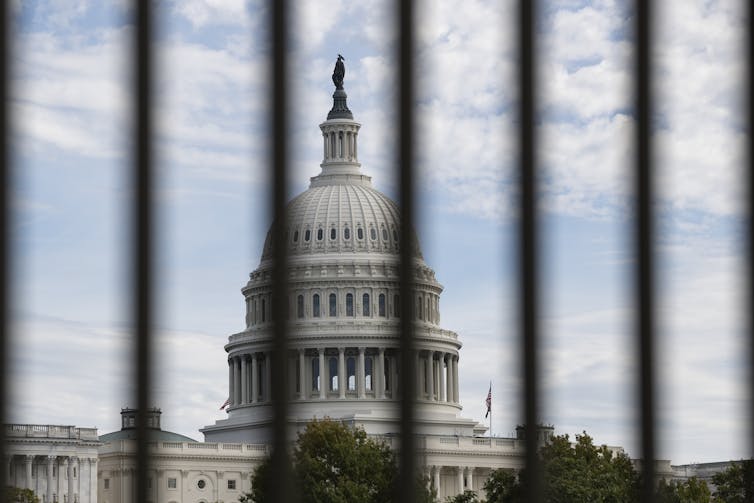
By all measures, the ability to see what the government is up to in the United States has plummeted to new depths since the beginning of the second Trump administration.
For National Sunshine Week in 2025, I wrote about secrecy creep, the adoption of federal secrecy protections implemented by state and local authorities. In Florida and throughout the United States, this threatens the public’s right to be informed about its government.
A year later, this creep toward secrecy has become an all-out slide.
As director of the Joseph L. Brechner Freedom of Information Project at the University of Florida, I track the state of government transparency in the U.S. What has changed since January 2025 is unprecedented.
Florida is a good example of this slide. Once viewed as a leader in transparency, the Sunshine State now charges exorbitant copy fees that discourage average people from requesting public records.
According to the nonprofit MuckRock, 24% of public records requests in Florida come with a copy fee, averaging US$1,623. Only Oregon charges fees more often, at 28% of the time. Fees are intended to help agencies cover the cost of large requests, but they tend to be arbitrary and are often used as a way to get pesky people to go away.
And that’s assuming you even get the information you want. One of my own studies from 2019 indicated that, on average, if you requested a public record in Florida, you would receive it about 39% of the time, placing the state 31st in the nation.
In 2025, MuckRock put the percentage dipping lower, at 35%. In March 2026, it was at 34%.
In Florida, more and more government agencies are thwarting the public’s right to know, including attempts to hide the details behind Alligator Alcatraz, the temporary immigrant detention center built in the Florida Everglades in June 2025. The state’s Department of Government Efficiency, or DOGE, office has pushed cities to be more transparent while withholding its own records.
Members of the state Legislature are attempting to strengthen the public records law. This would improve transparency in Florida’s state government, but I’d argue it doesn’t go far enough. Other states, such as Ohio, Pennsylvania and Connecticut, have implemented stronger laws, including independent enforcement of their sunshine laws, to ensure their governments comply.
State and local governments appear to be taking their cues from the federal government.
President Donald Trump’s administration heralds itself as the most transparent in history, pointing to the president’s willingness to talk informally to the press or directly to the public through social media.
While that may be one definition of transparency, the federal government’s willingness to provide documents that show what the government is doing – not just what it says it is doing – has been eviscerated under the second Trump administration. Examples include:
Refusing to provide tax returns, again, unlike every other president in modern history, and then suing the IRS for $10 billion when some returns were leaked.
Removing government websites and databases.
Firing the national archivist and the director of the Office of Information Policy, the agency within the U.S. Department of Justice that oversees government agencies’ compliance with requests under the Freedom of Information Act, or FOIA.
Firing and pushing out experienced staffers assigned to handle FOIA requests as part of the 2025 U.S. DOGE purges. This led some agencies, such as the Department of Energy, to apply unorthodox practices, including closing out pending requests.
Axing the new Open Government Federal Advisory Committee, which was launched to find ways of improving FOIA.
Pulling out of the Open Government Partnership, which the U.S. helped found in 2011 to foster transparency around the globe.

Typically, the Department of Justice releases annual statistics on FOIA requests every March. When I examined initial reports posted in January, when just 11 agencies had provided their reports, backlogs – that is, requests that remain unresolved after a year – had increased 67% from the previous fiscal year. The time to process simple requests nearly doubled.
In order to understand how secrecy in the United States now compares to historical precedent, I reached out to people who have researched freedom of information for decades, some going back to the 1970s.
I asked them a simple question: How does the current state of affairs in freedom of information compare historically?
Here is what they told me:
Jane Kirtley is a longtime FOIA scholar from the University of Minnesota who wrote in 2006, “The Bush administration’s contempt for the public’s right to know amounts to an organized assault on freedom of information that is unprecedented since the enactment of the Freedom of Information Act 40 years ago.”
Today, in comparison? “Abysmal,” she wrote to me via email. “It was abundantly clear from the moment Elon Musk and his ‘musketeers’ invaded and pillaged government electronic records that we have entered a new era of deletion, obfuscation, fabrication and utter contempt for the concept of data integrity and the public’s right to know.”
Thomas Susman, who helped craft the 1974 FOIA amendments and currently assists the American Bar Association, wrote in 2005 that increasing delays and backlogs threatened FOIA’s intended purpose.
In February 2026, he wrote to me that the “arc of the FOIA universe has for six decades bent toward greater public access to government information − until now. If ‘democracy dies in darkness’ (according to The Washington Post’s official slogan), America’s democracy is threatened with becoming dead meat. We’ve survived the Civil War, the Great Depression, Vietnam, Watergate and more. If we fight back hard enough, this too shall pass, though not quickly, and likely with lasting scars.”
Patrice McDermott directed Open the Government from 2006 to 2017 and pointed in 2007 to an underlying tension throughout government: “the ability – and willingness – to harness the promise of digital information for public access and accountability while not abusing its potential for control of that information.”
Today, she writes that, as Benjamin Franklin put it, we “have a Republic … if (we) can keep it” and are committed to the fight for our constitutional form of government.
Perhaps advances can be made to reverse the secrecy trend and carry out the intentions of the Freedom of Information Act, as expressed by Lyndon B. Johnson upon its adoption nearly 60 years ago: “I signed this measure with a deep sense of pride that the United States is an open society in which the people’s right to know is cherished and guarded.”

David Cuillier has received funding from the Democracy Fund and John S. and James L. Knight Foundation to study the state of freedom of information. He is a board member of the National Freedom of Information Coalition and he coordinates national Sunshine Week.
Politics + Society – The Conversation

The war that the U.S. and Israeli governments launched against Iran on Feb. 28, 2026, is unprecedented in its scope across the Middle East. With the Arab Gulf states under Iranian attack, and Israel targeting Iran’s militia ally Hezbollah, even experts on the Middle East like me cannot predict the war’s course and especially its likely political consequences.
Still, to better understand this complex situation, I am paying particular attention to four major questions. How these specific issues play out will shed light on how this war might end and what it will mean for Iran, the rest of the Middle East and the world.
What does the US hope to accomplish?
One leader who began the war, Israeli Prime Minister Benjamin Netanyahu, has been dead set for decades on crippling, and ideally toppling, Iran’s Islamic Republic. Iran has a long track record of sponsoring militant threats to Israel and American Arab allies.
Yet U.S. President Donald Trump has not been clear on what the goals of this war are and has said even less about what conditions would lead the U.S. to cease hostilities.
Early signs are that Iran’s capacity to project force across the Middle East is now diminished. What amount of damage to Iran’s military might be enough for the White House to believe that its mission was accomplished? Or does Trump expect Iran’s current authoritarian, theocratic political system to be removed, and for Iranians to establish a government more favorable toward American interests?
Any clarity from Washington on the true aims of this war will help observers understand under what circumstances it can end and what future Iranian-American relations might look like.
How will the war affect Gulf states’ short-term or long-term relations with Washington?
The U.S. has long prioritized deep economic and strategic relationships with the Gulf Arab states, especially Kuwait, Qatar, Saudi Arabia and the United Arab Emirates. These relationships have grown closer under Trump’s presidency.
So far, Iranian attacks have not caused significant casualties or damage to oil or commercial infrastructure in Gulf Arab states, collectively the source of 10% of the oil used in the U.S.
Indeed, some Gulf Arab states, including the United Arab Emirates, already collaborate enough with Israel that being subjected to attacks from Iran has solidified their current alliance with it and the U.S.
At the same time, Gulf Arab states value long-term political stability to preserve their status as major exporters of oil and natural gas, centers of global commerce and trade and global travel hubs. While each country has its own geopolitical priorities, none wants conflicts that leave it vulnerable.
Iran’s military strategy seems designed to raise the economic and human costs for Gulf Arabs who support the U.S. and Israel.
Greater pain for citizens of the Arab Gulf could fuel leaders there to pressure Washington to stop the war. It’s also possible that Gulf leaders will rethink or rebalance their relations with the United States or Israel should the end state of the war undermine their sense of security.
Such a rethink is more likely if the war continues for weeks and creates major shocks to the global economy. Even if the war ends well for Gulf leaders, by ending concerns about Iranian regional aggression, Washington’s willingness to put Gulf states in the path of destabilizing conflict may lead them to seek less alignment with the U.S.
Who will likely rule Iran?
Mojtaba Khamenei, the hard-line son of the previous supreme leader, Ayatollah Ali Khamenei, has just been named his father’s replacement. This is a clear signal that Iran is not yet moving toward the more cooperative government that the Trump administration wants. But with the fluid state of the war and its effects in Iran, perhaps the most important question is who will ultimately govern the country. Given Iran’s large size, predicting a long-term political outcome at this point makes little sense.
However, several factors do not bode well for a democratically representative government that could benefit ordinary Iranians. First, the Islamic Republic has been in power for decades, going to great lengths to prevent unified political opposition. Iranians’ recent waves of protests have not meant consensus on a future political order.
Second, Iran’s political system may still have support, including among members of the clergy and army. Third, the Trump administration may hope that Iranian ethnic minorities, such as the Kurds, may attack or dislodge the remnants of the government. Yet such groups lack the level of military force to ensure success.
For these reasons, the current government or a similarly authoritarian one may well remain in place after this war.

How do Iranians and people throughout the region view the war?
The Islamic holy month of Ramadan runs this year from Feb. 18 to mid-March. It changes the basic rhythm of life for most Muslims to one in which they fast from dawn to dusk and enjoy family and communal festivity late into the night. Throughout Iran and the Arab Gulf countries, these longtime practices have been disrupted by war and nighttime bombings.
Religion is not the primary driver of this war. Still, that war began during a sacred time is one example of an issue that might influence how the people in the middle of this conflict experience it. A less militaristic, more democratic Iranian government is a desirable outcome from a devastating war launched in violation of international law.
How popular attitudes in the region unfold will matter both to Iran’s political outcome and to whether Iran has better relations with Washington in the future.
For now, it is hard to know whether Iranians’ support for the government is growing during a major foreign attack, as it did when Iraq’s Saddam Hussein began a war against Iran in 1980. Certainly, a large swath of Iranians are content with the end of decades of Ayatollah Khamenei’s stifling rule.
Gulf Arabs may be frustrated with Washington and Tel Aviv for starting the war but also want Iran to end up with a less militant government. Most Lebanese have no love for Israel. Yet many also blame their local Iran-backed Hezbollah faction for dragging their country into the current war.
The experiences and views of these diverse populations matter. Trump has launched a war that is different from earlier American wars in the Middle East, both in the number of countries directly experiencing attacks and in the degree of direct coordination with Israel.
In addition to this war’s illegitimacy under international law, Washington has a long record of failing to achieve political results favorable to American interests after using military force in the Middle East. Given this, it is hard to believe that Operation Epic Fury will be an epic success in the long run.
However, how these four questions come to be answered in the weeks ahead will provide better indication of what this new war’s political consequences will actually be.

David Mednicoff does not work for, consult, own shares in or receive funding from any company or organization that would benefit from this article, and has disclosed no relevant affiliations beyond their academic appointment.
Politics + Society – The Conversation

It has been said that trust is like glass: Once it is shattered, nothing will ever be the same. In the case of the enduring hostility between the Islamic Republic of Iran and the United States over the past 47 years, even this metaphor may be an understatement.
The tone of the relationship is indicative of this fact.
In 2020, Iran’s supreme leader denounced President Donald Trump as a “clown” who only pretends to support the Iranian people while ultimately plunging a “poisonous dagger” into their backs.
And in a U.S. version of this hostility, Trump’s special envoy Steve Witkoff said on Feb. 23, 2026, about the president’s approach to Iran: “I don’t want to use the word ‘frustrated,’ because he understands he has plenty of alternatives, but he’s curious as to why they haven’t … I don’t want to use the word ‘capitulated,’ but why they haven’t capitulated.”
The war that began on Feb. 28, 2026, hews to a familiar but dangerous pattern. Deep, historical mistrust, incompatible strategic interests, domestic political constraints on both sides, miscommunication and misperception, zero-sum thinking and repeated diplomatic overreach gradually pushed the relationship between Iran and the U.S. toward open conflict.
When Tehran refused to yield to Trump’s demands, he described Iranian leaders in blunt terms: “They’re sick people. They’re mentally ill. Sick people. They are angry. They are crazy. They are sick.”
For a deeper understanding of Iran, policymakers in Washington could have looked to the insights of John W. Limbert, a distinguished diplomat with four decades of experience in Iranian affairs and a hostage during the Iran hostage crisis.
In 2008, as part of a U.S. Institute of Peace study of Iranian negotiating style, Limbert outlined 15 principles for Americans seeking successful negotiations with Iranian counterparts. Among his most important observations was that each side tends to assume the worst about the other, viewing its adversary as “infinitely devious, hostile, and duplicitous.”
Little evidence suggests that such hard-earned wisdom has informed recent rhetoric.
Instead, American leaders’ and media’s discussions of Iran over the past few decades have often relied on a familiar narrative: the portrayal of Middle Eastern leaders as irrational or “lunatic” figures − first, revolutionary leader Ayatollah Ruhollah Khomeini, then Saddam Hussein, followed by Moammar Gadhafi, Bashar Assad, and now Ali Khamenei.
This narrative conveniently overlooks inconvenient facts.
It was Trump who withdrew the United States from the 2015 nuclear agreement with Iran during his first term. It was also the United States that during renewed negotiations in 2025 and 2026 chose to bomb Iranian targets twice while talks were still underway.
Nor were the negotiations ever strictly bilateral. There was always an unoccupied chair at the table metaphorically reserved for a ghost participant: Israel. In my view, Prime Minister Benjamin Netanyahu skillfully used political leverage and diplomatic pressure to shape the process publicly and privately.
When it came to Iran, Trump often violated a basic principle of diplomacy: asking Iran to concede without any reciprocity. Meanwhile, Netanyahu would repeatedly move the goal posts − asserting that Iran was on the verge of acquiring a nuclear weapon, insisting it had no right to enrich uranium on its own soil, demanding the dismantling of its nuclear infrastructure, calling for the elimination of its ballistic missile capability, and ultimately advocating regime change.
The extent to which Israeli pressure shaped successive American policies is a question historians and investigative journalists will continue to debate.

Yet responsibility for the breakdown cannot be placed on Washington and Jerusalem alone. Iranian leaders contributed significantly to making the conflict with the United States so intractable.
A corrupt, repressive and economically struggling regime relied heavily on performative anti-American politics for domestic legitimacy. Tehran matched American and Israeli rigidity with intransigence and strategic overreach of its own.
Limiting inspections by the International Atomic Energy Agency, failing to provide credible answers about past nuclear activities, constructing secret facilities and attempting to negotiate from a position of weakness ultimately proved disastrous when dealing with an impatient and impulsive American president.
What comes next?
If regime change does not occur in Tehran, the two sides will almost certainly find themselves negotiating again once the fog of war dissipates.
The hostility between them will not disappear, and diplomatic niceties may become rarer. Yet diplomacy rarely requires trust; it requires interests.
I believe that future talks are therefore likely to be transactional rather than transformational. Technical and legal parameters will still need to be negotiated. Hawks and doves will continue to compete for influence in both capitals.
And the oldest rule of bargaining will remain unchanged: When you lack leverage, acquire it – then negotiate.

Mehrzad Boroujerdi does not work for, consult, own shares in or receive funding from any company or organization that would benefit from this article, and has disclosed no relevant affiliations beyond their academic appointment.
Politics + Society – The Conversation

When popping a lid is all the effort you can muster, don’t settle for bland salsa. There’s an incredibly easy trick to liven up any jarred variety.

Food Republic – Restaurants, Reviews, Recipes, Cooking Tips

The ‘Intelligence for Your Life’ host is still fighting cancer 10 years after doctors gave him 18 months to live — and he credits his wife with helping save his life. Continue reading…The Boot – Country Music News, Music Videos and Songs