Categories
Alaska News

As waters around Alaska warm, algal toxins are turning up in new places in the food web

Over the past two summers, a pair of remote and treeless volcanic islands in the eastern Bering Sea broadcast signals of climate change danger in the marine ecosystem that feeds Alaska residents and supports much of the state’s economy.

The Pribilof Islands, a four-island archipelago in the eastern Bering Sea, are seen on a map of Alaska. In inset shows a close-up of St. Paul Island and St. George Island. (Map provided by the National Oceanic and Atmospheric Administration Fisheries Service)

Tribal employees monitoring St. Paul Island’s beaches came across 10 dead but seemingly well-fed northern fur seals in August of 2024, their bodies lying amid piles of dead fish and birds.

Testing revealed that the seals had been killed by an algal toxin that causes paralytic shellfish poisoning. It was the first ever conclusive case of marine mammals killed by saxitoxin, the algal toxin that causes paralytic shellfish poisoning.

The people living on St. Paul, numbering about 400, most of them Unangax, are highly dependent on the marine environment for their food. They are aware of the algal toxins that pose risks of paralytic shellfish poisoning in faraway Southeast Alaska. But seal deaths from algal toxin poisoning on their own island came as a big surprise to local people, said Aaron Lestenkof, who is part of the tribe’s Indigenous Sentinels Network.

“It never occurred to us that it may happen to our marine mammals here,” Lestenkof said. “I guess it was just a matter of time.”

St. Paul Island is seen on Nov. 6, 2010. About 400 people live on the islandm, which is about 750 miles west of Anchorage in the Bering Sea. (Photo by Jim Greenhill/Alaska National Guard)
St. Paul Island is seen on Nov. 6, 2010. About 400 people live on the island, which is about 750 miles west of Anchorage in the Bering Sea. (Photo by Jim Greenhill/Alaska National Guard)

The St. Paul die-off was not a one-time incident. In August of 2025, tribal residents found 21 dead fur seals on a beach at St. George Island, a sister island of St. Paul. Along with the seals were two dead fin whales, a dead sea lion and several dead seabirds.

The events show that deadly levels of algal toxins, once believed to be confined to the warmest waters in the warmest months in southernmost Alaska, are spreading north and into regions and parts of the food web that previously caused no worry for local people.

“This is the scary, ‘I-don’t-know’ moment of this event now happening in consecutive years,” said Mike Williams, one of the National Oceanic and Atmospheric Administration biologists who happened to be on scene at St. George to gather samples and document the event.

St. Paul and St. George, which has about 70 residents, are the only inhabited islands in the four-island Pribilof archipelago. Located about 750 miles west of Anchorage and 300 miles from the mainland, the islands are far from Alaska’s population centers. But the Pribilofs are at the center of a Bering Sea ecosystem so rich with marine life that they are sometimes called the “Galapagos of the North.”

The waters around the islands support some of the nation’s biggest seafood harvests, with vessels catching pollock, cod, halibut, crab and other fish. Millions of migratory seabirds of a dozen species flock each year to nest in the Pribilofs. The Pribilofs are the breeding grounds for two-thirds of the world’s approximately 1 million northern fur seals. Each summer, they gather on the islands’ rocky beaches in noisy congregations to give birth to and nurture their young, molt their fur and rest.

Parakeet auklets perch on a rocky ledge in Alaska Pribilof Islands in 2010. (Photo by Allen Shimada/National Oceanic and Atmospheric Administration)

The algal discoveries on the St. Paul and St. George beaches point to a bigger phenomenon in the ecosystem, but how much bigger is yet to be determined.

“The problem is they die at sea. They’re being poisoned at sea, and they can’t even make it back to land, right?” Williams said.  “We don’t know how this may have population consequences because we don’t really have a true estimate of the number of animals that are dying.”

Paralytic shellfish poisoning: a history

Paralytic shellfish poisoning is a long-known hazard in the southern coastal areas of Alaska and other warmer parts of the world. Alaskans still know a spot in Southeast Alaska as Poison Cove, named for the approximately 100 people who died in 1799 after eating tainted mussels. The victims were Native hunters, either Unangan or Alutiiq, who had been brought to the site by Russian colonizers.

Saxitoxin is colorless and odorless. It cannot be cooked out or frozen out of food. Once ingested, there is no antidote. The poison acts within minutes, interfering with signals from the nervous system that enable vital bodily functions. In mild cases, many of which may go unreported, patients feel some numbness and possibly nausea and other symptoms before recovering. In fatal cases, saxitoxin blocks the nervous system’s functions, causing paralysis that suffocates victims.

From 1992 to 2021, 132 people in Alaska were reported sickened with paralytic shellfish poisoning, according to state epidemiologists. Between 1994 and 2020, five people died after eating saxitoxin-tainted food.

A chain of Alexandrium catenella cells is seen under a microscipe. (Photo by Brian Bill/National Oceanic and Atmospheric Administration)
A chain of Alexandrium catenella cells is seen under a microscope. (Photo by Brian Bill/National Oceanic and Atmospheric Administration)

Understanding the exact chemical process that leads to paralytic shellfish poisoning took decades of scientific research. Saxitoxin was first identified in 1937 in an Alaska butter clam by a team led by Hermann Sommer at the University of California, San Francisco. They named the toxin for the species of the clam in which it was found: Saxidomus gigantea.

In later decades, researchers purified saxitoxin extracted from host clams and mussels. That led to a covert military operation. During the 1950s, the Central Intelligence Agency made mass purchases of tainted Alaska clams and developed saxitoxin into an alternative to the cyanide capsules that spies would use to kill themselves as a last resort if caught. Francis Gary Powers, the spy plane pilot who was shot down over the Soviet Union in 1960, was carrying a lethal dose of saxitoxin hidden in a modified silver dollar. He did not use it; he was freed in a spy trade in 1962.

The days of saxitoxin as a military tool are over. Now the ominous factor is climate change.

Saxitoxin is produced by a particular algae species, Alexandrium catenella, that blooms in warm conditions. The association of warmth and algal toxin risks was well-known; an old rule of thumb for harvesters was to gather clams only in months with the letter R in their names. An even older guideline was to use the end of herring spawning — an event usually in late spring — as the signal to pause harvests of clams for the season.

There are inescapable facts about the proliferation of Alexandrium and other harmful algae in Alaska: Ocean waters are getting warmer, and staying warmer longer, meaning there are more blooms producing more toxins and creating more exposure risks for marine life and for the people who depend on food from the sea.

Kathi Lefebvre, a NOAA Fisheries research biologist who specializes in algal toxins, ran through the trends during a presentation at January’s Alaska Marine Science Symposium in Anchorage. She showed charts and graphs of reduced sea ice, warming temperatures and Alexandrium blooms even in Arctic waters north of the Bering Strait.

One of two dead fin whales found on beach at St. George in August 2025 is show splayed on beach. At the same site, 21 dead northern fur seals were found, along with some dead birds and a dead sea lion. Logistics precluded testing of the dead whales, but the fur seals were found to have been killed by saxitoxin, the algal toxin that causes paralytic shellfish poisoning. (Photo provided by Lydia Kleine/National Oceanic and Atmospheric Administration)
One of two dead fin whales found on beach at St. George in August 2025 is shown splayed on beach. At the same site, 21 dead northern fur seals were found, along with some dead birds and a dead sea lion. Logistics precluded testing of the dead whales, but the fur seals were found to have been killed by saxitoxin, the algal toxin that causes paralytic shellfish poisoning. (Photo provided by Lydia Kleine/National Oceanic and Atmospheric Administration)

“Do we predict that these blooms will continue to increase and toxins will be increasing in Arctic food webs? Yes, they will,” Lefebvre said in her presentation.

Risks increasing in the Bering Sea and farther north

Eight years before the St. Paul die-off, Lefebvre and her colleagues published a landmark study that documented at least trace amounts of algal toxins in each of the 13 marine mammal species tested, as far north as the Beaufort Sea in the Arctic. Toxins detected included a domoic acid, produced by an algae called Pseudo-nitzschia and the cause of mass die-offs of sea lions, seals and other marine mammals in California. Domoic acid has not yet proved to be a problem in Alaska, but scientists are watching for trends.

A more recent study led by Lefebvre found saxitoxin in feces of bowhead whales swimming in the Arctic.

In 2019, an especially warm year, scientists retrieved clams from the Bering Strait and Chukchi Sea that had levels of saxitoxin well above the threshold for safe consumption by people. That coincided with a large Alexandrium bloom in the region. Three years later, in another warm year, the Northern Bering Sea had one of the largest and densest Alexandrium blooms ever recorded in the nation, indicating more risks for poison-laden clams.

In July of 2024 and July of 2025, a month before each of the Pribilof seal die-offs, large blooms developed around those islands.

Don Anderson, an expert on harmful algal blooms who runs a lab at the Woods Hole Oceanographic Institution in Massachusetts, said there are now two major sources of far-north blooms.

Alexandrium catenella cyst distribution as mapped in surface sediments during 2018 and 2019 research cruises. (Map provided by Don Anderson/Woods Hole Oceanographic Insitution)
Alexandrium catenella cyst densities in the shallow sedimentr, as indicated by sampling during a 2024 research cruise. (Map from Lefebvre et al., "Saxitoxin Linked to Deaths of Northern Fur Seals in the Southeast Bering Sea," Marine May 26, 2025)
Alexandrium catenella cyst densities in the shallow sedimentr, as indicated by sampling during a 2024 research cruise. (Map from Lefebvre et al., “Saxitoxin Linked to Deaths of Northern Fur Seals in the Southeast Bering Sea,” Marine May 26, 2025)
An Alexandrium bloom near the Pribilofs, as tracked from Aug. 2 to Aug. 4, 2025 by scientist aboard the research vessel Sikuliaq, is shown on a map. The bloom was detected just before fur seals and other marine mammals, along with some birds, were found dead on St. George Island, (Map provided by Evie Fachon/Anderson Lab, Woods Hole Oceanographic Institution)
An Alexandrium bloom near the Pribilofs, as tracked from Aug. 2 to Aug. 4, 2025 by scientists aboard the research vessel Sikuliaq, is shown on a map. The bloom was detected just before fur seals and other marine mammals, along with some birds, were found dead on St. George Island. (Map provided by Evie Fachon/Anderson Lab, Woods Hole Oceanographic Institution)

Most of that algae is believed to have been carried north by ocean currents. But climate change has created a possible bigger local source of blooms, he said: germination from massive seed beds that are, by far, the largest and most concentrated ever documented in the world.

The Bering, Chukchi and Beaufort seas used to be dead ends for Alexandrium cysts, the equivalent of seeds. They settled in the sediment after decades and centuries of being washed north, remaining dormant in the cold temperatures.

“We kept having repeated inputs of transported blooms from the south, and that gave us these enormous cyst concentrations that we haven’t seen anywhere else in the world, something we’ve called the sleeping giant,’” Anderson said in a presentation at the marine science symposium in Anchorage.

The warm conditions that enable them to germinate have arrived, albeit sporadically. If temperatures at the seafloor reach a little over 8 degrees Celsius, the cysts can germinate within about 10 days and proliferate during the long daylight hours of Alaska summers, he said.

The new findings have created unease for some Western Alaska residents.

Valerie Tony of Alakanuk, a Yup’ik village near the mouth of the Yukon River, is one of them. At a February workshop on algal toxins held in Anchorage, she asked about the abundant freshwater clams that her people harvest from tundra ponds.

“Does that mean our clams are no good now?” Tony asked. “Any kinds of toxins, we’ve never had to deal with these before.”

The bivalves enjoyed in Alakanuk and other Yukon-Kuskokwim Delta villages are actually mussels colloquially known as Yukon floaters. They should be safe for now, said Thomas Farrugia, coordinator of the Alaska Harmful Algal Bloom Network, a multiagency program.

For St. Paul and St. George residents, food questions are a bit different.

The traditional subsistence diet in the Pribilofs relies little on clams or mussels, wild foods that are the usual sources of the toxins that give people paralytic shellfish poisoning. But residents of St. Paul and St. George rely heavily on the sea for food. That includes fish, like halibut, cod and crab, but also fur seals that are legally hunted in traditional Indigenous harvests.

It is unclear how the fur seals are getting exposed to saxitoxins. Unlike marine mammals considered to be at risk for algal toxins like clam-gobbling walruses and sea otters,  fur seals do not eat bivalves. They do eat squid and schooling fish, including a tiny, slender, silvery fish called sand lance, which is known to absorb large concentrations of saxitoxin.

Lydia Kleine and Mike Williams, National Oceanic and Atmsopheric Administration scientists who were on scene at St. George Island in August 2025, stand on Jan. 27, 2026, by a poster describing the die-off of fur seals there. Kleine and Williams presented information at the Alaska Marine Science Symposium in Anchorage about the dead fur seals, whales and other animals they found on the island. (Photo by Yereth Rosen/Alaska Beacon)
Lydia Kleine and Mike Williams, National Oceanic and Atmsopheric Administration scientists who were on scene at St. George Island in August 2025, stand by a poster describing the die-off of fur seals there on Jan. 27, 2026. Kleine and Williams presented information at the Alaska Marine Science Symposium in Anchorage about the dead fur seals, whales and other animals they found on the island. (Photo by Yereth Rosen/Alaska Beacon)

Luckily for seal hunters, Lestenkof said, the new pattern of Alexandrium blooms seems to be timed to late summer, in between early summer and autumn hunts. But whatever fish the dead seals were eating could be food that the people eat as well.

Sitka a model of testing

About 1,300 miles east of St. Paul, in the rainforest-surrounded coastal town of Sitka, a tribally-operated lab was established in 2016 to help keep locally harvested food safe.

The Sitka Tribe of Alaska Environmental Research Lab is the state’s main algal toxin testing facility for personal harvests. The other main lab in the state, located in Anchorage and operated by the Alaska Department of Environmental Conservation, focuses on commercial harvests.

The Sitka lab accepts any samples brought or sent to it. Mostly, those have been from harvests from Southeast Alaska, though it has tested samples from as far away as Nome.

The lab uses a method called Receptor Binding Assay, a widely used scientific method that measures how well certain chemicals bind to selected materials.

As Environmental Lab Manager Matteo Masotti describes it, the process used in Sitka is intended to parallel what would happen if people ate the tested clams, mussels and other items.

Nicole Filipek, environmental lab analyst at the Southeast Alaska Tribal Ocean Resarch laboratory operated by the Sitka Tribe of Alaska, holds a horse clam sent for algal toxin sampling, Dec. 15, 2025. (Photo by Yereth Rosen/Alaska Beacon)

The testing starts with a slurry created once shellfish are delivered. “We blend them up into what we call a shellfish smoothie,” Masotti said. Effective testing generally requires six individuals or 100 grams of tissue, he said.

From there, acid is extracted, “basically simulating the pH of the stomach as if someone was digesting.” Then samples are tested for how well they bind to a swine tissue, a stand-in for a human stomach membrane. Once samples bind, another material is added that converts their chemical radiation into flashes. Those flashes reveal saxitoxin quantities.

It is only one method of testing shellfish. Other labs, such as the state’s Anchorage lab, use different methods, each of which have advantages and disadvantages.

The goal in Sitka is to get results to people within a couple of days, which is not always easy.

“The people out there have to harvest the shellfish, they have to get it to the airport, send it to us – assuming it doesn’t get delayed at the airport and assuming we pick it up immediately, which we try to be really good about,” he said. “We get them, we have to blend them up, we have to extract them, we have to then run them on the test, and then we have to analyze the test. And so we try to give people results in one to two business days after submission. Not always possible, but we do our best.”

There is even a slogan for the process of waiting for test results: “Harvest and Hold.”

In a lot of ways, the Sitka operation is a big success story.

Amos Philemonoff a fraditional foods assistant for the Sitka Tribe of Alaska, stands outside the resource protection building on Dec. 15, 2025. He is from St. Paul but has been living in Sitka and is a graduate of Mount Edgecumb High School. (Photo by Yereth Rosen/Alaska Beacon)
Amos Philemonoff, a traditional foods assistant for the Sitka Tribe of Alaska, stands outside the resource protection building on Dec. 15, 2025. He is from St. Paul but has been living in Sitka and is a graduate of Mount Edgecumbe High School. (Photo by Yereth Rosen/Alaska Beacon)

Sienna Reid, a young tribal employee who grew up in Sitka, said the lab’s operations are giving people confidence that their traditional harvests are safe.

She said she has seen no decline in clamming, despite what is now an abundance of information about algal toxins’ presence in the environment. That was not the case in the past, she said. “I remember clam digging growing up. I don’t remember even thinking about algal toxins,” she said.

But for Amos Philemonoff, another young tribal employee who happens to be from St. Paul, information about algal toxins is still off-putting.

When he learned from a St. Paul friend about the 2024 seal paralytic shellfish poisoning deaths, he was taken aback. “I thought that was so weird. I’ve never heard of that before,” he said.

Though he enjoys plenty of wild food, Philemonoff stays away from clams, even though they are widely enjoyed in his adopted home of Sitka. That is specifically because of algal toxins, which he learned about when he was attending Sitka’s Mount Edgecume High School, a boarding school. “It’s kind of scary now, after learning about it in marine biology,” he said. “I kind of stepped away from eating shellfish.”

Nicole Filipek, Environmental Lab Analyst, and Matteo Masotti, environmental lab manager, stand on Dec. 15, 2025, behind equipment used at the Southeast Alaka Tribal Ocean Research lab to analyze shellfish samples for levels of saxitoxin, the algal toxin that causes paralytic shellfish poisoning. (Photo by Yereth Rosen/Alaska Beacon)

New challenges in old places

While paralytic shellfish poisoning is a long-recognized hazard in Southeast and Southcentral Alaska, climate change has exacerbated the threat in those regions.

The old guidelines about months with the letter R or timing of herring spawning no longer hold because algal toxins are present beyond the summer.

A significant bloom of Alexandrium was detected last September in Southcentral Alaska’s Kachemak Bay. It was the highest abundance measured since 2016. Blue mussels and butter clams found that month had saxitoxin levels about the safety threshold. The bloom followed a spate of bird and marine mammal die-offs earlier in the summer in the bay, and it did not dissipate until early October.

There are algal toxin  hotspots even in winter. In the far Southeast community of Hydaburg, for example, information from the shellfish data system includes a butter clam found on Dec. 5 with saxitoxin levels more than four times the safety threshold for human consumption. It turns out that some bivalve species, like butter clams, can retain algal toxins in their tissues for several months, and sometimes for more than a year.

Matteo Masottienvironmental Lab manager for the Sitka Tribe of Alaska, holds a net on Dec. 15, 2025, used to collect algae for water testing. The net is used to collect algae in the water; once the types of algae are identified, lab workers can get indications of risks at tested sites. The tribe operates the Southeast Alaska Tribal Ocean Research laboratory, which tests harvested shellfish for algal toxins, among other research tasks. (Photo by Yereth Rosen/Alaska Beacon)
Matteo Masotti, environmental Lab manager for the Sitka Tribe of Alaska, holds a net on Dec. 15, 2025, used to collect algae for water testing. The net is used to collect algae in the water; once the types of algae are identified, lab workers can get indications of risks at tested sites. The tribe operates the Southeast Alaska Tribal Ocean Research laboratory, which tests harvested shellfish for algal toxins, among other research tasks. (Photo by Yereth Rosen/Alaska Beacon)

Another challenge facing the Sitka lab, also related to warming conditions, is the proliferation of invasive European green crabs in the most southern parts of Southeast Alaska.

The invasive species, known for mowing down eelbeds and devouring native fish, was not seen in Alaska waters until 2022. Last year, the tribal government in Metlakatka, in the far southeast corner of the state, trapped more than 40,000 of them.

To avoid spreading the invasion further, the Sitka lab requires that samples sent from the most southeastern part of the state be frozen for at least 24 hours to kill any green crab larvae that might be attached.

Replicating Sitka success

Compared to other states, Alaska has little safety testing for personal harvest of shellfish. Tribal and science organizations are trying to change that.

The Sitka lab’s services are available free of charge to all personal-use harvesters in the state, but deliveries from remote areas outside of the Southeast Alaska region are logistically difficult.

A beachcomber walks at the end of Homer Spit on Oct. 22, 2025. The spit extends out into Kachemak Bay. (Photo by Yereth Rosen/Alaska Beacon)

Locally focused shellfish-screening labs have also been set up on the Kenai Peninsula south of Anchorage: in Seward, at the Native-owned Alutiiq Pride shellfish hatchery, and last summer in Homer at the Kachemak Bay Research Reserve.

An innovative research program led by the Knik Tribe, based in the Matansuka-Susitna Borough near Anchorage, has been tracking the movement of toxins through the food chain. It has gathered samples from various parts of the state, including some from as far away as the Bering Strait. Tests are conducted at the state Department of Environmental Conservation lab.

The Paralytic Shellfish Poisoning Risk Management Project is examining not just clams and mussels but also crabs and finfish, and the program has discovered high levels of saxitoxin in some unexpected places.

Livers and digestive tracts of salmon from the Yukon River and Cook Inlet turned out to have saxitoxin levels above the safety threshold. Hermit crabs from the Kodiak Archipelago and the Alaska Peninsula were found to have saxitoxin levels 15 to 17 times the safety threshold. And a stickleback from Wasilla north of Anchorage was found with a level more than 50 times the safety limit. Sticklebacks are small spiny fish found in different varieties and widely abundant in Alaska in both freshwater and saltwater systems; they are not generally eaten by people, but they are important prey for birds and larger fish.

Funding for the four-year research program, provided by the federal government, ends this year. The Knik Tribe and the Alaska Federation of Natives have urged the state to take up responsibility for funding the program into the future.

A Nov. 6, 2010, street scene in the village on St. Paul Island show the Russian Orthodox church and a tour bus used to shuttle visitors. (Photo by Jim Greenhill/Alaska National Guard)
A Nov. 6, 2010, street scene in the village on St. Paul Island shows the Russian Orthodox church and a tour bus used to shuttle visitors. (Photo by Jim Greenhill/Alaska National Guard)

No lab in the state tests marine mammals for saxitoxin. Tests of the dead Pribilof northern fur seals were conducted at a lab in Seattle that is part of a West Coast program monitoring toxins in marine mammals.

For residents of St. Paul and St. George — both remote and often fog-bound islands dependent on air service that is spotty, inconsistent and expensive — relying on distant labs for toxin testing has been burdensome.

“I mean, there’s just a million billion things that sometimes are against us to get this information back to the community in a timely manner,” said Chelsea Campbell, marine mammal programs manager for the Aleut Community of St. Paul Island. It can take weeks to get results back to the island, she said.

That is why the tribal government is planning to add algal toxin testing to its on-island science program, Campbell said. The tribe already operates a facility, the Bering Sea Research Center, that tracks things like mercury and microplastics in the ecosystem. It is taking the necessary steps to add algal-toxin testing as early as this summer, as long as equipment arrives and workers are available and trained, she said.

A subadult fur seal is hauled out on St. Paul Island in 2007. About two-thirds of the world's northern fur seal population uses the Pribilofs for breeding. (Photo by Carla Stanley/U.S. Fish and Wildlife Service)
A subadult fur seal is hauled out on St. Paul Island in 2007. About two-thirds of the world’s northern fur seal population uses the Pribilofs for breeding. (Photo by Carla Stanley/U.S. Fish and Wildlife Service)

The hope is that in time, the St. Paul lab will serve other remote communities in Western Alaska, from the Aleutians to the Bering Strait. “It’s going to be much easier for Saint George to send us samples than it is to send samples to Seattle, right?” she said.

Such a lab would be a big improvement over status quo in Western Alaska, which is to either take risks or use an old-fashioned screening process that Alex Zaochney, a researcher and tribal council member with the Native Village of Atka, described at the Anchorage workshop on harmful algal blooms.

“I wouldn’t recommend it,” Zaochney said. “Traditionally, we would touch the tip of your tongues on it and wait 20 minutes. If you start to get a tingle, that is not good.”

This article was produced as a project for USC Annenberg’s Center for Health Journalism and Center for Climate Journalism and Communication 2025 Health and Climate Change Reporting Fellowship.

The post As waters around Alaska warm, algal toxins are turning up in new places in the food web appeared first on Chilkat Valley News.

Categories
Alaska News

‘Because I’m president’: Trump explains why he voted by mail yet opposes voting by mail

WASHINGTON — President Donald Trump, who wants to ban mail-in voting, said he had the right to vote by mail-in ballot in Florida’s special election Tuesday “because I’m president of the United States.”

The president’s statement at his Cabinet meeting Thursday comes as he aggressively pushes U.S. Senate Republicans to break the long-standing filibuster to pass a restrictive voting bill ahead of the 2026 midterm elections. 

The legislation, which would require a birth certificate and other documentation for voter registration, also would federally prohibit universal voting by mail without special approval, according to the Brennan Center and other sources.

“Because I’m president of the United States, and because of the fact that I’m president of the United States, I did a mail-in ballot for elections that took place in Florida because I felt I should be here instead of being in the beautiful sunshine,” Trump told reporters at the White House. 

“We have exceptions for mail in ballots. You do know that, right?” he said to the reporter who asked about his mail-in ballot. “So if you’re away, we have an exception. If you’re in the military, we have an exception. If you’re on a business trip, we have an exception. If you’re disabled, we have an exception. And if you’re ill, if you’re not feeling good. So I was away mostly in Washington, D.C., so I used a mail-in ballot.”

The president regularly travels on Air Force One between the nation’s capital and Florida, including taking a trip to his Palm Beach home this past weekend.

The White House declined to comment on whether someone other than the president requested, picked up and dropped off or mailed the president’s mail-in ballot. 

Florida election law states that only a person’s immediate family member or legal guardian can do so.

“As President Trump has said, the SAVE America Act has commonsense exceptions for Americans to use mail-in ballots for illness, disability, military, or travel — but universal mail-in voting should not be allowed because it’s highly susceptible to fraud. As everyone knows, the President is a resident of Palm Beach and participates in Florida elections, but he obviously primarily lives at the White House in Washington, D.C. This is a non-story,” White House spokesperson Olivia Wales said in a written statement.

Trump’s statement also was made three days after conservative Supreme Court justices appeared skeptical that federal law allows states to accept mail-in ballots postmarked by Election Day but not received until after polls close, during a five-day grace period. While the case was out of Mississippi, 14 states — both red and blue — have similar laws.

2020 election refrain

Discrediting mail-in voting has been a common refrain of Trump’s since the 2020 presidential election, which he lost but still falsely claims he won.

Roughly 30% of voters cast mail-in ballots in the 2024 election, according to the U.S. Election Assistance Commission.

Eight states and Washington, D.C., allow all elections to be conducted entirely by mail, according to the National Conference of State Legislatures. They are: California, Colorado, Hawaii, Nevada, Oregon, Utah, Vermont and Washington state.

Nebraska and North Dakota permit counties to opt into conducting elections via mail.

Idaho, Minnesota, New Jersey and New Mexico allow mostly mail elections for certain small jurisdictions. A handful of other states permit mail voting for local elections.

SAVE America Act and filibuster

Writing on his social media platform Thursday morning, Trump said: “When is ‘enough, enough’ for our Republican Senators. There comes a time when you must do what should have been done a long time ago, and something which the Lunatic Democrats will do on day one, if they ever get the chance. TERMINATE THE FILIBUSTER, and get our airports, and everything else, moving again. Also, add the complete, all five items, SAVE AMERICA ACT items. Go for the Gold!!! President DJT”

Trump complicated negotiations Monday when he said at an event in Memphis, Tennessee, that he would not approve a deal to end the shutdown of the Department of Homeland Security, ongoing since mid-February, unless senators could find a way to also pass his voting bill, dubbed the SAVE America Act.

The filibuster requires nearly all legislation to receive 60 votes to advance to passage in the Senate. With all Democrats against the legislation, the bill would not garner enough support in the upper chamber, which is split 53-47.

The post ‘Because I’m president’: Trump explains why he voted by mail yet opposes voting by mail appeared first on Chilkat Valley News.

Categories
Alaska News

Washington state man convicted on drug charges related to two overdose deaths in Skagway

A man was convicted by a federal court jury in Juneau on Wednesday of shipping fentanyl pills to Skagway that resulted in the deaths of two people, according to the U.S. Attorney’s Office.

Jacob Cotton, 34, of Spokane, Washington, shipped a parcel with the pills to a person in Skagway who received it in January of 2023, according to a press release issued Wednesday.

Anthony Bowers, 28, who received the pills, and James Cook, 44, who was among the people seeking to buy some of the pills, both died of overdoses — the first Skagway deaths officially linked to fentanyl, according to a KHNS report at the time Cotton was arrested.

The U.S. Attorney’s office release states Skagway was “dry” — meaning no fentanyl was available — when Cotton agreed to send about 150 pills to the community.

“The object of the conspiracy was to have Cotton buy fentanyl in Spokane for a cheaper price, ship it to Alaska and then charge a premium price for purchase in Skagway,” the release states. “Cotton and the individual agreed to split any distribution proceeds.”

Bowers received the pills on Jan. 11 or 12, 2023, and contacted multiple individuals about purchasing the drugs, according to the U.S. Attorney’s office.

“On Jan. 13, around 11:30 p.m., the individual selling the pills was found unresponsive on his bathroom floor and later declared deceased after attempts to revive him,” the release states. Subsequently, at about 4:30 p.m. on Jan. 14, “the 44-year-old man was found dead in his bedroom.”

Cotton was arrested in June of 2024, according to KHNS. Prosecutors during the five-day trial presented evidence of records confirming Cotton’s shipment of drugs, digital messages and other forms of payment connected to the illegal drug sales, according to the U.S. Attorney’s office.

Cotton was convicted of one count of conspiracy to distribute and possess with the intent to distribute fentanyl resulting in death, and one count of distribution of fentanyl resulting in death, according to the release. The federal jury also found Cotton guilty of a “death resulting” enhancement for both victims, which required proof that the fentanyl pills Cotton distributed were the cause of each victim’s death.

Cotton faces between 20 years and life in prison on each count. Sentencing will be scheduled at a future date.

This story was originally published by the Juneau Independent.

The post Washington state man convicted on drug charges related to two overdose deaths in Skagway appeared first on Chilkat Valley News.

Categories
Alaska News

Wednesday Gold Medal elimination day sends eight teams out of tournament

This year’s Gold Medal memorial presentation on Wednesday, March 25, at the Juneau Lions Club 77th Gold Medal Basketball Tournament in the Juneau-Douglas High School: Yadaa.at Kalé George Houston Gymnasium featured white paper bags with loved ones’ names written on them illuminated by lights inside. (Courtesy/Klas Stolpe, Juneau Independent)

Wednesday’s 77th annual Juneau Lions Club Gold Medal Basketball Tournament was an elimination day. That means if teams lose, they don’t have to go home but they can’t play in the tournament anymore this year.

Eight quality teams fell in the fourth day of Gold Medal action.

The day started with a classic Angoon/Hydaburg classic B-style matchup, with Angoon getting 11 three-point shots and Hydaburg 10. Angoon’s Aquino Brinson closed out the third quarter with a shot past the arc and then on a turnover, Brinson was double-teamed and teammate Beebucks Kookesh cut back door, missed a shot, but rebounded for a cutback score and a 66-58 lead. That lead evaporated in the opening moments of the fourth quarter, as Hydaburg opened with an 11-2 run behind two shots past the arc by Jaren Carl, one from Vinnie Edenshaw and a basket inside by Trevor Olsen off an Edenshaw assist. Edenshaw then drove for a score and a 71-70 lead. Angoon came back with two shots past the arc by Clayton Edwin and regained the lead at 80-75 with two minutes left and closed out the game 85-77.

Hydaburg's Vinnie Edenshaw is defended by Angoon's Aquino Brinson during their B bracket elimination game on Wednesday, March 25, at the Juneau Lions Club 77th Gold Medal Basketball Tournament in the Juneau-Douglas High School: Yadaa.at Kalé George Houston Gymnasium. Angoon won 85-77. (Klas Stolpe / Juneau Independent)
Hydaburg’s Vinnie Edenshaw is defended by Angoon’s Aquino Brinson during their B bracket elimination game on Wednesday, March 25, at the Juneau Lions Club 77th Gold Medal Basketball Tournament in the Juneau-Douglas High School: Yadaa.at Kalé George Houston Gymnasium. Angoon won 85-77. (Klas Stolpe / Juneau Independent)

Kake then nipped Angoon 71-69 behind 30 points from Rudy Bean — and despite giving up a 10-point lead late in the game. Angoon tied the game late, Kake took a two-point advantage, and Angoon had a last-second shot miss as Kake’s defense limited a good look for a score. Angoon was led by 14 points from Michael Pitka, 13 from John Croasmun JR and 11 from Guy Hunter. Kake added 14 points from Derek Knudsen and 10 from Shea Jackson.

Not to be outdone for a thriller, the boys of FILCOM toppled Mt. Edgecumbe 100-91 in A bracket double-overtime behind 32 points from Samuel Lockhart and 24 points from Brady Caranadang. MTE had 32 points from Jamal Alstrom. Tied at 75-75, the first extra five minutes featured an opening free throw by FILCOM’s Bryce Swofford and was answered by a drive by MTE’s Tyrell Cromer. The two teams exchanged baskets, with MTE pulling out to an 80-77 lead with a behind the arc shot by Cromer. FILCOM tied the score with two free throws by Carandang and a drive by Alwen Carrillo. A loose ball scramble twice went to MTE and with 2.1 seconds left, Jamal Alstrom scored and was fouled for an old-fashioned three-point play and an 83-80 lead. A timeout gave FILCOM the ball at the side and Carandang hit a long-distance jumper to tie the game at 83-83 as the buzzer rang. Swofford kick-started FILCOM in the second extra five minutes with a rebound score and a free throw. MTE’s Jaylin Prince hit a free throw and missed the next. FILCOM’s Swofford rebounded and started a fast break basket by Carandang to push the score to 88-84. MTE’s Alstrom hit from the arc to pull to 88-87, but a free throw by FILCOM’s Lockhart and his swish past the arc pushed the advantage to 92-87. MTE would be forced to foul down the stretch and FILCOM’s Lockhart, Carandang and Phillip Gonzalez all hit a pair from the line to secure the win.

Gold Medal fans cheer on their team during elimination games on Wednesday, March 25, at the Juneau Lions Club 77th Gold Medal Basketball Tournament in the Juneau-Douglas High School: Yadaa.at Kalé George Houston Gymnasium. (Klas Stolpe / Juneau Independent)

The second half of the day saw Angoon defeat Kake 56-48 behind 14 points from Tasha Heumann, Kiara Kookesh added 13, Mary Johnson 11 and Cheyenne Kookesh 10. Kake’s Katie Jackson scored a game-high 24 points in the elimination game loss.

Sitka defeated Angoon 73-48 in their Masters bracket elimination game behind 22 points from Jeremy Plank, Efren Arce added 17 and Jimmie Jensen 14. Angoon’s Levi Johnson scored 17.

Sitka's Jimmie Jensen (center) battles for a rebound with Angoon's Travis See (34) and Levi Johnson (21) during their Masters bracket elimination game on Wednesday, March 25, at the Juneau Lions Club 77th Gold Medal Basketball Tournament in the Juneau-Douglas High School: Yadaa.at Kalé George Houston Gymnasium. Sitka won 73-48. (Klas Stolpe / Juneau Independent)
Sitka’s Jimmie Jensen (center) battles for a rebound with Angoon’s Travis See (34) and Levi Johnson (21) during their Masters bracket elimination game on Wednesday, March 25, at the Juneau Lions Club 77th Gold Medal Basketball Tournament in the Juneau-Douglas High School: Yadaa.at Kalé George Houston Gymnasium. Sitka won 73-48. (Klas Stolpe / Juneau Independent)

Metlakatla toppled Yakutat 65-53 in their C bracket elimination game behind 27 points from Mace Hayward and Clifton Guthrie added 17. Yakutat was led by 18 points from Adam Johnson.

Metlakatla also won their Womens bracket elimination game 66 – 32 over Hoonah behind 17 points from Alexis Russell 17 and 14 from Ryley Booth.  Hoonah’s Jonelle Staveland scored 13 and Antonia Fogg 10.

In the nightcap game Kake jumped out to an 18-3 lead against Hoonah and ran away with a 71-45 win behind a game-high 29 points from Ethan Kadake. Hoonah was led by 13 points from Oroin Dybdahl and 12 from Samuel Lamebull.

Kake's Rudy Bean helps Angoon's Curtis Lane up during Kake's 71-69 C bracket elimination game win over Angoon on Wednesday, March 25, at the Juneau Lions Club 77th Gold Medal Basketball Tournament in the Juneau-Douglas High School: Yadaa.at Kalé George Houston Gymnasium. (Klas Stolpe / Juneau Independent)
Kake’s Rudy Bean helps Angoon’s Curtis Lane up during Kake’s 71-69 C bracket elimination game win over Angoon on Wednesday, March 25, at the Juneau Lions Club 77th Gold Medal Basketball Tournament in the Juneau-Douglas High School: Yadaa.at Kalé George Houston Gymnasium. (Klas Stolpe / Juneau Independent)

B – Angoon 85 (2-1), Hydaburg 77  (1-2) eliminated

Angoon 25 19 24 17 — 85

Hydaburg 20 13 25 19 — 77

Angoon — Tajaun Jamestown 22, Aquino Brinson 20, Jonathan Jack-Nixon 14, Isaiah Nelson 9, Clayton Edwin 6, Christian Nelson 4, Gregory Bennum 4, Duncan O’Brien 4, Beebucks Kookesh 2. 18 2PT / 11 3PT / 14-21 FT / 9 fouls – C. Nelson 3.

Hydaburg  — Vinnie Edenshaw 28, Jaren Carl 22, Jessie Louie 16, Greg Frisby 7, Trevor Olsen 4. 17 2PT / 10 3PT / 10-11 FT / 17 fouls – Carl 5, Frisby 4.

C – Kake 71 (1-1), Angoon 69 (0-2) eliminated

Kake 15 25 14 17 — 71

Angoon 20 8 19 22 — 69

Kake — Rudy Bean 30, Derek Knudsen 14, Shea Jackson 10, Dean Cavanaugh 8, Travis Aceveda 4, Kelly Brown 3, Trevor Rostad 2. 17 2PT / 9 3PT / 5-15 FT / 11 fouls – Rostad 2, Bean 2, Aceveda 2, Jackson 2.

Angoon — Michael Pitka 14, John Croasmun JR 13, Guy Hunter 11, Logan Lee 9, Curtis Lane 9, Michael Howard 7, Thomas Bell 6.  11 2PT / 11 3PT / 14-16 FT / 15 fouls – Croasmun JR 4, Pitka 3, Lane 3.

FILCOM's Alwen Carrillo (3) shoots under pressure from Mt. Edgecumbe's Tyrell Cromer (34) during their 100-91 double overtime A bracket elimination game win on Wednesday, March 25, at the Juneau Lions Club 77th Gold Medal Basketball Tournament in the Juneau-Douglas High School: Yadaa.at Kalé George Houston Gymnasium. (Klas Stolpe / Juneau Independent)
FILCOM’s Alwen Carrillo (3) shoots under pressure from Mt. Edgecumbe’s Tyrell Cromer (34) during their 100-91 double overtime A bracket elimination game win on Wednesday, March 25, at the Juneau Lions Club 77th Gold Medal Basketball Tournament in the Juneau-Douglas High School: Yadaa.at Kalé George Houston Gymnasium. (Klas Stolpe / Juneau Independent)

A – FILCOM 100 (1-1), Mt. Edgecumbe 91 (0-2) eliminated

Filcom 21 19 18 17 8 17 — 100

Mt. Edge. 24 20 18 13 8 8 — 91

Filcom — Samuel Lockhart 32, Brady Carandang 24, Bryce Swofford 15, Alwen Carrillo 13, Sean Oliver 7, Phillip Gonzalez 4, Męki Toutaiolepo 4, Tony Yadao 1. 22 2PT / 12 3PT / 20-28 FT / 9 fouls – Swofford 3.

Mt. Edgecumbe — Jamal Alstrom 32, Tyrell Cromer 17, Jaylin Prince 14, Aaron Porter 12, Jake Friske 9, RJ Didrickson 5, Andrew Friske 2. 20 2PT / 15 3PT / 6-10 FT / 21 fouls – Alstrom 4, A. Friske 4, Porter 4, J. Friske 3.

W – Angoon 56 (1-1), Kake 48 (0-2) eliminated

Angoon 10 13 17 16 — 56

Kake 6 9 17 16 — 48

Angoon — Tasha Heumann 14, Kiara Kookesh 13, Mary Johnson 11, Cheyenne Kookesh 10, Frances Mills 4, Gabbi George Frank 2, Joylynn Tripi 2. 14 2PT / 4 3PT / 16-38 FT / 16 fouls – Johnson 4, George Frank 4, Heumann 3, Tripi 3.

Kake — Katie Jackson 24, Courtney James 9, Monica Ashenfelter 7, Brenda See-Williams 3, Talia Davis 2, Jordan Wagner 2. 10 2PT / 5 3PT / 13-21 FT / 24 fouls – Davis 5, Jackson 5, Ashenfelter 4, James 4.

Angoon's Tasha Heumann (32) defends Kake's Katie Jackson during Angoon's 56-48 Womens bracket elimination game on Wednesday, March 25, at the Juneau Lions Club 77th Gold Medal Basketball Tournament in the Juneau-Douglas High School: Yadaa.at Kalé George Houston Gymnasium. (Klas Stolpe / Juneau Independent)
Angoon’s Tasha Heumann (32) defends Kake’s Katie Jackson during Angoon’s 56-48 Womens bracket elimination game on Wednesday, March 25, at the Juneau Lions Club 77th Gold Medal Basketball Tournament in the Juneau-Douglas High School: Yadaa.at Kalé George Houston Gymnasium. (Klas Stolpe / Juneau Independent)

M – Sitka 73 (1-1), Angoon 48 (0-2) eliminated

Sitka 17 18 17 21 — 73

Angoon 8 19 11 10 — 48

Sitka — Jeremy Plank 22, Efren Arce 17, Jimmie Jensen 14, Justin Bagley 7, Thomas Anderson 7, David Johnson 2, Steve Edenshaw 2, Cliff Richter 2. 19 2PT / 8 3PT / 11-15 FT / 7 fouls – Anderson 2, Jensen 2, Plank 2.

Angoon — Levi Johnson 17, Ken Willard JR 9, Demetrius Johnson 6, Travis See 6, Al Tagaban 3, Kyle Johnson SR 3, Byron Jack JR 2, Nick Nelson 2. 11 2PT / 8 3PT / 2-4 FT / 13 fouls – K. Johnson SR 2, See 2, D. Johnson 2, Marti Fred 2.

C – Metlakatla 65 (1-1), Yakutat 53 (0-2) eliminated

Metlakatla 9 16 18 22 — 65

Yakutat 18 12 11 12 — 53

Metlakatla — Mace Hayward 27, Clifton Guthrie 17, Jason Enright 8, Chris Booth 6, Apollo Marsden 5, Dan Marsden 2. 19 2PT / 7 3PT / 6-11 FT / 12 fouls – Hayward 3, A. Marsden 3, Enright 3.

Yakutat — Adam Johnson 18, Stephen Adams 15, Sam Ferguson 10, Jay Sin 5, Ralph Wolfe 3, Jay Johnson 2. 11 2PT / 9 3PT / 4-9 FT / 12 fouls – Ferguson 3, Wolfe 3.

Hoonah's Janelle Staveland (14) drives under pressure from Metlakatla's Alexis Russell (12), Ryley Booth (5) and Sally King during their Womens bracket elimination game on Wednesday, March 25, at the Juneau Lions Club 77th Gold Medal Basketball Tournament in the Juneau-Douglas High School: Yadaa.at Kalé George Houston Gymnasium. Metlakatla won 66-32. (Klas Stolpe / Juneau Independent)
Hoonah’s Janelle Staveland (14) drives under pressure from Metlakatla’s Alexis Russell (12), Ryley Booth (5) and Sally King during their Womens bracket elimination game on Wednesday, March 25, at the Juneau Lions Club 77th Gold Medal Basketball Tournament in the Juneau-Douglas High School: Yadaa.at Kalé George Houston Gymnasium. Metlakatla won 66-32. (Klas Stolpe / Juneau Independent)

W – Metlakatla 66 (1-1), Hoonah 32 (0-2) eliminated

Metlakatla 17 22 17 10 — 66

Hoonah 9 6 7 10 — 32

Metlakatla — Alexis Russell 17, Ryley Booth 14, Drena Hayward 14, Ashley Huffine 8, Jezimay Ribs 4, Myra Guthrie 2, Talia Marsden 2, Vanessa Anniskett 2, Sally King 2, Disney Williams 1. 20 2PT / 4 3PT / 14-22 FT / 10 fouls – Booth 4.

Hoonah — Jonelle Staveland 13, Antonia Fogg 10, Larissa Dybdahl 5, Alona Howland 2, Krissy Bean 2. 6 2PT / 5 SPT / 5-13 FT / 14 fouls – Carlynn Caspersen 3, Dybdahl 3, Bean 3.

B – Kake 71 (2-1), Hoonah 45 (1-2) eliminated

Kake 18 20 23 10 — 71

Hoonah 5 15 9 16 — 45

Kake — Ethan Kadake 29, Keontay Jackson 9, Tristan Ross 9, Simon Friday 8, Shawn Merry 7, Dominic Ross 5, Bryce Knudsen 2, Jonah Davis 2. 18 2PT / 11 3PT / 2-4 FT / 16 fouls – Knudsen 3, Kadake 3, T. Ross 3.

Hoonah — Orion Dybdahl 13, Samuel Lamebull 12, Sean Oliver 7, Jaylin Prince 6, RJ Didrickson 6, Tyrell Cromer 1. 12 2PT / 3 3PT / 12-18 FT / 10 fouls – Malakai Nichols 4.

THURSDAY GAMES

9 a.m. – C bracket elimination, Kake (1-1) vs. Metlakatla (1-1)

10:30 a.m. – Womens elimination, Metlakatla (1-1) vs. Angoon (1-1)

Noon – B bracket elimination, Angoon (2-1) vs. Kake (2-1)

1:30 p.m. – Masters, Hoonah (1-0) vs. Klukwan (1-0)

4 p.m. – C bracket, Hydaburg (2-0) vs. Hoonah (2-0)

5:30 p.m. – A bracket, AML (1-0) vs. Metlakatla (1-0)

7 p.m. – B bracket, Haines (2-0) vs. Yakutat (2-0)

8:30 p.m. – Womens, Craig (1-0) vs. Yakutat (2-0)

Hoonah's Orion Dybdahl (21) shoots against Kake's Bryce Knudsen (20) and Tristan Ross (30) during their B bracket elimination game on Wednesday, March 25, at the Juneau Lions Club 77th Gold Medal Basketball Tournament in the Juneau-Douglas High School: Yadaa.at Kalé George Houston Gymnasium. Kake won 71-45. (Klas Stolpe / Juneau Independent)
Hoonah’s Orion Dybdahl (21) shoots against Kake’s Bryce Knudsen (20) and Tristan Ross (30) during their B bracket elimination game on Wednesday, March 25, at the Juneau Lions Club 77th Gold Medal Basketball Tournament in the Juneau-Douglas High School: Yadaa.at Kalé George Houston Gymnasium. Kake won 71-45. (Klas Stolpe / Juneau Independent)

SUNDAY SCORES

10:30 a.m. B bracket – Haines 98 (1-0), Klawock 58 (0-1)

12:00 p.m. Womens – Kake 62 (1-0), Metlakatla 46 (0-1)

1:30 p.m. B bracket – Hoonah 66 (1-0), Angoon 65 (0-1),

4:00 p.m. Masters – Hoonah 56 (1-0), Angoon 50 (0-1)

5:30 p.m. Womens – Yakutat 51 (1-0), Angoon 46 (0-1)

7:00 p.m. B bracket – Yakutat 65 (1-0), Metlakatla 58 (0-1)

MONDAY SCORES

9 a.m. B bracket – Hydaburg 82 (1-0), Kake 80 (0-1)

10:30 a.m. Womens – Craig 58 (1-0), Kake 50 (1-1)

12 p.m. C bracket – Hydaburg 94 (1-0), Yakutat 59 (0-1)

1:30 p.m. B bracket – Haines 79 (2-0), Hoonah 71 (1-1)

4 p.m. Womens – Yakutat 71 (2-0), Hoonah 26 (0-1)

5:30 p.m. Masters – Klukwan 86 (1-0), Sitka 66 (0-1)

7 p.m. B bracket – Yakutat 69 (2-0), Hydaburg 54 (1-1)

8:30 p.m. C bracket – Hoonah 82 (1-0), Angoon 51 (0-1)

TUESDAY SCORES

10:30 a.m. B bracket – Angoon 82 (1-1), Klawock 70 (0-2) eliminated

Noon C bracket – Hydaburg 95 (2-0), Kake 71 (0-1)

1:30 p.m. Open – AML 87 (1-0), Mt. Edgecumbe 79 (0-1)

4 p.m. C bracket – Hoonah 76 (2-0), Metlakatla 72 (0-1)

5 p.m. Open – Metlakatla 86 (1-0), FILCOM 75 (0-1)

7 p.m. B bracket – Kake 86 (1-1), Metlakatla 58 (0-2) eliminated

WEDNESDAY SCORES

9 a.m. B bracket – Angoon 85 (2-1) vs. Hydaburg 77 (1-2) eliminated

10:30 a.m. C bracket – Kake 71 (1-1), Angoon 69 (0-2) eliminated

Noon A bracket – 2 OT, FILCOM 100 (1-1), Mt. Edgecumbe 91 (0-2) eliminated

1:30 p.m. Womens – Angoon 56 (1-1), Kake 48 (0-2) eliminated

4 p.m. Masters – Sitka 73 (1-1), Angoon (0-2) eliminated

5:30 p.m. C bracket – Metlakatla 65 (1-1), Yakutat 53 (0-2) eliminated

7 p.m. Womens – Metlakatla 66 (1-1), Hoonah 32 (0-2) eliminated

8 p.m. B bracket – Kake 71 (2-1), Hoonah 45 (1-2) eliminated

Angoon fans react to a made three-point shot during Angoon's 85-77 B bracket elimination game win over Hydaburg on Wednesday, March 25, at the Juneau Lions Club 77th Gold Medal Basketball Tournament in the Juneau-Douglas High School: Yadaa.at Kalé George Houston Gymnasium. (Klas Stolpe / Juneau Independent)
Angoon fans react to a made three-point shot during Angoon’s 85-77 B bracket elimination game win over Hydaburg on Wednesday, March 25, at the Juneau Lions Club 77th Gold Medal Basketball Tournament in the Juneau-Douglas High School: Yadaa.at Kalé George Houston Gymnasium. (Klas Stolpe / Juneau Independent)

This story was originally published by the Juneau Independent.

The post Wednesday Gold Medal elimination day sends eight teams out of tournament appeared first on Chilkat Valley News.

Categories
Alaska News

The deadline to apply for the PFD is next week

The 2026 Alaska Permanent Fund filing deadline is quickly approaching on March 31.

The online application is available through 11:59 p.m. next Tuesday. Paper applications can be mailed, with residents being reminded to ensure they receive a certified mail receipt or their envelope gets postmarked by the post office no later than the deadline. Paper applications can be delivered to PFD office locations in Anchorage, Fairbanks, or Juneau by March 31 between 10 a.m. and 4 p.m.

The Juneau office is located at 333 Willoughby Ave. on the 11th floor, side B of the State Office Building. The mailing address is Alaska Department of Revenue Permanent Fund Dividend Division, P.O. Box 110462

Juneau, AK 99811-0462.

Documents can also be faxed to (907) 465-3470 or emailed to dor.pfd.info@alaska.gov. A phone number for additional support is (907) 465-2326.

After filing, it is recommended by the PFD office to keep proof of the application for each family member. Applications that are received or postmarked after March 31 will be denied as a late application.

The Permanent Fund website notes the division is experiencing a staff shortage.

“Documentation mailed or emailed to PFD will be worked as quickly as is possible. We appreciate your patience as we get through the filing season,” the website states. “The most important thing right now is to get your application submitted to the division before the filing deadline ends. Supplemental documents/information can be submitted later.”

Last year’s PFD was $1,000, the lowest ever when adjusted for inflation since dividends were first issued in 1982, due to what state lawmakers called a serious fiscal crisis resulting in part from low oil prices. Oil prices have skyrocketed during the past month due to the Iran war and the Alaska Department of Revenue in an updated forecast earlier this month declared the state may get more than $500 million extra during the coming fiscal year — in theory enough to boost the PFD of all eligible recipients by several hundred dollars.

But Sen. Bert Stedman, a Sitka Republican who co-chairs the Senate Finance Committee, said Tuesday he is still telling Alaskans to expect a PFD similar to last year’s.

“My personal opinion is concentration on deferred maintenance is a pretty high priority,” he said. “We’ve got schools that are virtually falling down.”

However, a debate among legislators is likely. House Minority Leader DeLena Johnson, R-Anchorage, when asked about uses for extra revenue during a recent press conference, said higher PFDs should be a priority.

This story was originally published by the Juneau Independent.

The post The deadline to apply for the PFD is next week appeared first on Chilkat Valley News.

Categories
Alaska News

Alaska prepares to get rid of historic ferry Matanuska, one of state’s oldest

The state of Alaska is looking for someone to take the Matanuska, one of the first three ships built as part of the Alaska Marine Highway System after statehood.

In a public notice published Friday afternoon, the Alaska Department of Transportation and Public Facilities said it is now looking for “interested parties regarding the opportunities to dispose of the vessel in a manner that honors its historic significance while allowing it to continue serving Alaska in new innovative ways.” 

DOT is primarily looking for people or groups interested in operating the Matanuska “as a museum vessel, maritime training ship, tourism or hospitality venue, community facility, research platform, heritage site, or other maritime or public-serving use,” according to a detailed document accompanying the public notice.

Any applicant would have to demonstrate that they have the financial resources necessary to take care of the ship.

Retired ferries are notoriously expensive to operate, and idealistic plans for other ships have repeatedly fallen apart. The former Washington state ferry Kalakala was turned into a cannery in Kodiak, recovered and towed back to Washington, but fell derelict and almost sank into a canal before being scrapped in 2015.

The Alaska ferry Taku was intended for use as a hotel after its retirement, but it ultimately ended up being scrapped in India

The ferry Malaspina was retired by the Alaska Marine Highway System in 2022 and is now being used as housing at a cruise ship terminal in Ketchikan. The business partners behind that effort are now fighting in court over a variety of issues.

Built in 1963, the Matanuska served as an active ferry for almost 60 years and still has a gold-painted funnel indicating its status as the “Queen of the Fleet,” the oldest operating ship in state service.

Despite that honor, the Matanuska has been out of regular service for at least three years, and has been laid up in Ketchikan for use as a “hotel ship” by the ferry system. Last year, DOT officials said the ferry system lacked the money needed to return the ship to service, and they recommended fully retiring it.

Proposals for the Matanuska’s future are due to DOT by 2 p.m. April 14. 

“Letters of interest proposing scrapping, dismantling, or scuttling the vessel may be submitted for informational purposes,” the agency said, but for the time being, it’s looking at ideas to reuse the ship.

The post Alaska prepares to get rid of historic ferry Matanuska, one of state’s oldest appeared first on Chilkat Valley News.

Categories
Alaska News

Juneau officially has its snowiest winter on record

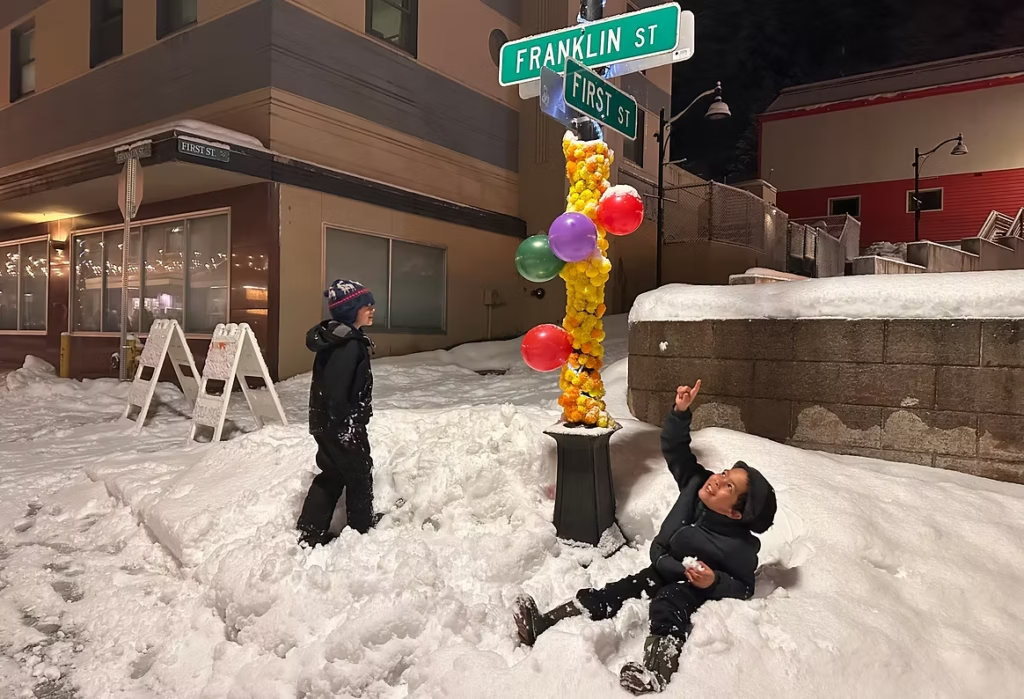
Darius Heumann, 6, right, and Alden Reed, 6, play in the snow in downtown Juneau, which is decorated for a celebration of the Hindu festival Holi, on the evening of Monday, March 23, 2026. The city officially set a new winter snowfall record during the evening as the total accumulation at Juneau International Airport since Oct. 1 as of 11:59 p.m. Monday reached 201.2 inches. (Courtesy/Mark Sabbatini, Juneau Independent)

This time there’s no doubt and Mother Nature provided a last-minute surge of snow just to be sure.

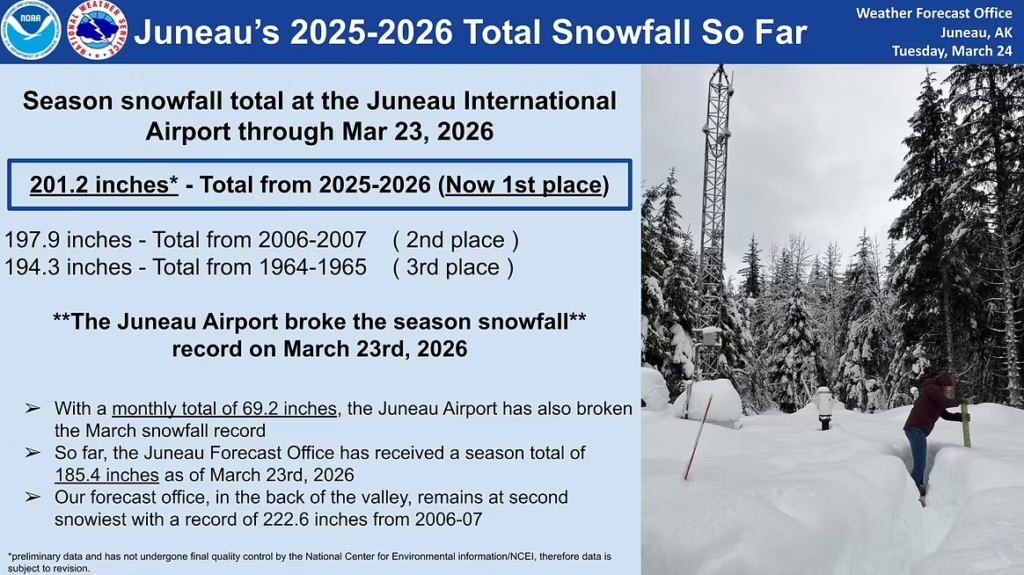
Juneau officially set the all-time record for winter snowfall on Monday, with a record 5.4 inches at the airport as of 11:59 p.m., putting the total since Oct. 1 at 201.2 inches, according to the National Weather Service Juneau. The city began the day 2.1 inches short of the record — to the surprise of many, including weather officials who on Sunday raised the previous record to 197.9 inches after discovering 7.5 inches of “missing” snowfall from 2006-2007 data.

About an inch fell at Juneau International Airport by early afternoon Monday, at which point NWS Juneau issued a “special weather statement” calling for one to three inches of snow the rest of the day.

What happened was indeed special.

“Basically what happened is we had a boundary just stall across the Juneau area and just had moisture running over top that boundary, and that just allowed us to have continuous snowfall into the evening until we started to get those winds to kind of increase and pick back up to move that boundary out,” Nick Morgan, a NWS Juneau meteorologist, said Tuesday morning.

A new winter snowfall record is proclaimed by weather officials in Juneau. (National Weather Service Juneau)

Juneau’s snowfall for the month of March is 69.2 inches, which is also a new record.

The weather forecast doesn’t call for any more snow until possibly Sunday night. But much like some other periods this winter where breaks in the snow were accompanied by record cold spells, the mostly sunny skies forecast today and tomorrow are accompanied by weather conditions of official concern as a wind advisory is in effect for Juneau until Wednesday afternoon.

“Specifically for the downtown Juneau area, starting Tuesday afternoon into probably Wednesday afternoon, people will probably see some sustained winds of 15 to 25 miles an hour, with some gusts up to 50 miles an hour,” Morgan said.

“We’re having a fun winter, aren’t we?” he added.

A wind advisory is in effect for Juneau and Skagway through Wednesday afternoon. (National Weather Service Juneau)

Juneau’s record season of snow began in mid-November with the first of what would be many newsworthy events. City officials tore down a homeless encampment near the airport, citing a need to keep the area clear for plows in anticipation of the first significant accumulation during the coming days.

Exactly one inch of snow fell during November, well below the historical average of 13.8 inches — to say nothing of the 69.8 inches that fell in 1994, the all-time high since recordkeeping at the airport started in 1948.

On Dec. 11, the Juneau Independent published a story with the headline: “Weather service says to expect a dry, cold winter. Here are ways to be prepared.”

“We’re looking all the way out through the rest of January into February, we’re looking less precip and colder temperatures pretty much through most of this next winter, for the next three-month outlook in Southeast Alaska,” Jeff Garmon, head meteorologist at the Juneau weather service station, said at the time. “So we’ll probably get a little less snowfall than we typically would, and we’re probably going to be colder than we normally would be, which means drier, colder air from the Interior.”

Vehicles clear a runway of snow at Juneau International Airport on Saturday, Dec. 6, 2025. (Mark Sabbatini / Juneau Independent)

The weather clearly had other ideas.

A record 9.6 inches fell at the airport on Dec. 6, resulting in the first measurable snowpack that month at the airport. Another four inches fell Dec. 7, causing widespread power outages. Then on Monday, the first instance of heavy snow being followed by intense cold occurred, with the first sub-zero temperature of the winter recorded Dec. 10 at minus 5.8 degrees Fahrenheit.

Snow returned in force on Dec. 15 when yet another record was set with 9.2 inches of accumulation, putting the monthly total at 29.3 inches — well past the monthly average of 20.2 inches. But what Juneau residents now commonly refer to as “Snowmageddon” or “Snowpocalypse” was just getting started.

Finn Taintor, 9, nears the finish line of the second annual Solstice Sweater Shuffle along the Treadwell Mine Historic Trail on Saturday, Dec. 20, 2025. (Mark Sabbatini / Juneau Independent)

Another sub-zero cold snap — which had homeless campers pleading for heating fuel bottles, and caused problems with water pipes at Eaglecrest Ski Area and elsewhere — had Juneau in a deep freeze leading up to winter solstice. Daily cold-temperature records were set three times during a four-day period ending Dec. 22.

A mass snowfall event began Dec. 27, with Juneau receiving the most accumulation during a five-day period in recorded history, with some areas reporting depths of more than six feet. The December snowfall total at Juneau’s airport reached 82 inches, shattering the old record of 54.7 inches set in 1964.

The results were dire in many ways as boats and their shelters sank, roofs at businesses collapsed, water pipes burst and froze, and residents in some small Southeast communities were isloated without plane or ferry service for extended periods.

A sunken boat at the dock in Aurora Harbor on Tuesday, Dec. 30, 2025. (Natalie Buttner / Juneau Independent)

The situation didn’t arrive with the arrival of the New Year as, among other things, the fuel canopy at Fred Meyer’s gas station collapsed on Jan. 1 and the store itself was evacuated due to roof safety concerns. Snowload concerns at that store and the Nugget Mall would result in both being closed for multiple-day stretches.

A snowfall disaster declaration, announced Jan. 6 by Juneau’s municipal government by the city and Central Council of the Tlingit and Haida Indian Tribes of Alaska, was ratified by the Juneau Assembly a day later, allowing state aid to help with clearing and repair efforts. The record-breaker situation put Alaska’s capital city in the global media spotlight, with legitimate media and AI-driven websites covering the situation with varying degrees of accuracy and folly.

More heavy snowfall during the first half of January also saw heavy rain that resulted in high avalanche, roofload and flooding concerns. An evacuation advisory for hundreds of residents living near slide paths resulted in an emergency shelter being set up at Centennial Hall where some families lived for days, while some residents in other areas struggled to keep their homes from being deluged by floodwaters.

St. Ann Avenue residents maintain a snow berm built to redirect water on Saturday, Jan. 10, 2026. (Jasz Garrett / Juneau Independent)

On Jan. 13, City Manager Katie Koester told Assembly members that — with the help of more than 200 people flown in on one plane and a load of shovels on another — more than 3 million pounds of snow from municipal facilities and schools following the storms from previous weeks.

The airport received 21.1 inches of snow during the month of January, below the historical average of 24.5 inches. But the February total of 27.9 inches surpassed the average of 16.7 inches, including a record 9.6 inches on Feb. 28. In a moment of supreme irony, a study released that month declared the length of Juneau’s winters are shrinking faster than any other city in a national study due to climate change.

March came in like a lion and kept roaring, with a record 7.3 inches of snow March 3, followed by a series of snow showers during the next few weeks that put Juneau within seeming reach of the all-time record by last Thursday, with total airport accumulation at 181.7 inches. The long-held assumption was the official record was 194.3 inches set in 1964-65.

More snow showers, including a daily record of 3.6 inches on Sunday, put Juneau’s total at 195.8 inches — except that was also the day NWS Juneau officially changed the record by adding 7.5 inches to the total from 2006-07, setting the new benchmark of 197.9 inches.

A spotty situation at Juneau International Airport during the early morning hours of Monday, March 23, 2026. (Jasz Garrett / Juneau Independent)

Nicole Ferrin, warning coordination meteorologist for the Juneau weather station, said Monday that Aaron Jacobs, an employee at the station since 2002, raised concerns about the accuracy of local climate records based on having worked and lived through the winter of 2006-07.

“He’s the one that pointed out to the rest of us that this was a problem, and they’d actually attempted to fix the climate record quite a few years ago,” she said. “And I guess we didn’t have the paper copies back then to back it up, but we found other sources to get the climate record correct.”

Ferrin said local staff spent the previous week examining records trying to confirm — and update if necessary — the data, with an eye on making sure any declaration a new snowfall record for Juneau is indeed accurate.

A short time later on Monday, NWS Juneau issued its special weather statement calling for up to three inches of snow — and when the clock reached midnight about nine hours later the winter of 2025-26 was officially one for the history books.

This story was originally published by the Juneau Independent.

The post Juneau officially has its snowiest winter on record appeared first on Chilkat Valley News.

Categories
Alaska News

Dunleavy seeks huge tax break for Alaska LNG Project, says state won’t benefit from any revenue if it isn’t built

Glenfarne President Adam Prestidge, right, Alaska Gas Line Development Corp. Commercial Director Matt Kissinger, center, and Northern Compass Group LLC President Mark Begich discuss the Alaska LNG Project during a House Resources Committee meeting Monday, March 23, 2026, at the Alaska State Capitol. (Courtesy/Mark Sabbatini, Juneau Independent)

Gov. Mike Dunleavy, who in January declared “there is simply no shortage of good news” about the Alaska LNG Project on the same day its developer said it was moving into an “execution phase,” is now proposing a massive tax cut for the company so the project doesn’t stumble.

A bill introduced by the governor Friday, exempting the pipeline from property taxes and instead imposing a tax on the volume of gas flowing through it, is part of a series of recent actions at the Alaska State Capitol indicating the long-discussed project is still far from certain.

Many policymakers say the gasline is indeed closer to reality than in past years, due largely to President Donald Trump’s aggressive push for expanded oil and gas drilling in Alaska. But there are strong differences about taxation and other details.

Critics of Dunleavy’s bill say it could cost the state billions of dollars in revenue compared to current taxation, while municipalities where the pipeline passes through would lose property taxes on that infrastructure. The governor told the Anchorage Daily News on Friday that if the pipeline isn’t built, then the state and municipalities will get nothing.

“So it’s a catalyst to billions upon billions upon billions of dollars and decades of future (revenue), not to mention the thousands of jobs and the other economic benefits from that,” Dunleavy told the newspaper.

A press release issued by the governor’s office on Friday asserts “the Alaska Department of Revenue estimates the legislation can raise more than $26 billion in tax and royalty revenue over 30 years, including more than $22 billion in state revenue (and) nearly $4 billion in local revenue.”

Those figures are being challenged by some lawmakers and policy analysts who are awaiting further details of the bill expected to be presented during legislative hearings this week. Among the concerns are a decade-long delay until the production tax begins, plus a complex array of rules and formulas involving taxes and royalties.

There is universal support — or nearly so — for a natural gas pipeline in the Alaska Legislature, said Senate Rules Chair Bill Wielechowski, an Anchorage Democrat who has made oil tax reforms a major plank in his political platform, in an online town hall Saturday. But in sketching out a hypothetical scenario, based on likely market conditions, he said Alaska in 10 to 15 years would be getting a pittance of its fair share under Dunleavy’s bill

“We’re in a situation where you’re going to have gas sold for $25 in which the State of Alaska gets maybe 15 to 20 cents — a very, very low amount,” Wielechowski said. “We don’t want to jeopardize the project, but we need to ensure that we’re getting, as a state, our constitutional maximum value for the resource.”

The Alaska LNG Project is an 800-mile pipeline transporting natural gas from the North Slope to Southcentral Alaska, with the intent of in-state use of the gas as well as export to foreign countries. The majority owner with a 75% stake is Glenfarne Group LLC, with the Alaska Gasline Development Corp. (a state-owned corporation) the minority owner.

The most recent official cost estimate for the project is $44 billion. Project supporters say it will create at least 7,000 construction jobs, plus hundreds of permanent year-round jobs during the operation of the pipeline, which has a 50-year projected lifespan.

Glenfarne issued a triumphant declaration on Jan. 22 that “a series of major advances” had moved the first phase of the project “from development into early execution” phase. Dunleavy, in his final State of the State address that night, stated a range of agreements and partnerships announced by Glenfarne meant the company “deserves enormous credit for this outstanding work that will benefit all of us.”

But Glenfarne still has not officially made a final investment decision to build the pipeline, and many of the agreements announced are pledges of intent or interest — not ironclad contracts to buy gas or otherwise invest in the project. Meanwhile, some key legislative leaders say they haven’t gotten enough information from the company to consider what taxes and other terms are appropriate to impose.

“It’s a little difficult for us to say this is the tax relief we should give,” Senate Majority Leader Cathy Giessel, an Anchorage Republican, said during a press conference last Tuesday.

The pipeline would bring in about $1 billion annually for the state under current property tax laws, if the project is assessed at $50 billion and 3.5 billion cubic feet of gas moves through it daily, Larry Persily, a former Alaska deputy commissioner of revenue, told the Anchorage Daily News. He said under Dunleavy’s plan — a tax of six cents per 1,000 cubic feet of gas, with a 1% annual rate increase — the state would get $75 million the first year the production tax is in effect.

The flow tax would not begin until either 10 years after gas starts flowing through the pipeline, or the daily annual flow is 1 billion cubic feet, whichever comes first. The 3.5 billion cubic feet figure is its projected flow once in full production.

The first of this week’s legislative hearings about the Alaska LNG Project occurred Monday when Glenfarne President Adam Prestidge, Northern Compass Group LLC President Mark Begich and Alaska Gas Line Development Corp. Commercial Director Matt Kissinger presented their arguments in favor to the House Resources Committee.

“In front of us right now, and in front of the state Legislature, is an incredible opportunity to develop and lead one of most important infrastructure projects in the entire world right now,” Prestidge said in his opening remarks to the committee.

The governor’s proposed tax change, Senate Bill 280, is scheduled to get its first hearing at 3:30 p.m. Wednesday by the Senate Resources Committee.

This story was originally published by the Juneau Independent.

The post Dunleavy seeks huge tax break for Alaska LNG Project, says state won’t benefit from any revenue if it isn’t built appeared first on Chilkat Valley News.

Categories
Politics

Andy Beshear’s 2028 playbook: How a Democrat wins in Trump Country

Andy Beshear’s 2028 playbook: How a Democrat wins in Trump Country

lead image

​Politics

Categories
Alaska News

Alaska Legislature passes stopgap budget, amid uncertainty around war-driven oil revenues

Members of the Alaska House of Representatives convene on the first day of the second session of the 34th Alaska State Legislature on Jan. 20, 2026 (Photo by Corinne Smith/Alaska Beacon)

Members of the Alaska House of Representatives convene on the first day of the second session of the 34th Alaska State Legislature on Jan. 20, 2026 (Photo by Corinne Smith/Alaska Beacon)

The Alaska Legislature on Wednesday approved a stopgap budget bill amid an ongoing debate among lawmakers around war-driven oil revenues and whether to draw from state savings.

The stopgap budget bill contains $449.6 million in state spending including for disaster relief, construction, education, correctional officer overtime and some public assistance programs — expenses accrued since the Legislature and Gov. Mike Dunleavy adopted the state budget last year.

But the question of how and when all the items will be funded is still uncertain. Lawmakers chose to rely on anticipated oil revenue to fund the bill rather than drawing from savings. 

The Alaska Senate passed the budget bill by a 19 to 1 vote on Wednesday, with Sen. Robert Meyers, R-North Pole opposing. The bill was quickly transferred to the Alaska House where it passed unanimously by all 40 members. The bill now moves to the governor’s desk for his consideration.

The Legislature created a select bicameral conference committee to hammer out differences between House and Senate versions of the budget bill over the last week

The final bill includes $75 million for disaster relief to cover the state’s response to the Western Alaska storms last fall, and almost $100 million for fire suppression. It contains $20 million for the Alaska Department of Corrections for overtime spending, as well as $34.4 million for Medicaid and $12.8 million for other public assistance programs through the Alaska Department of Health. The bill allocates nearly $130 million toward the Alaska Higher Education Fund which provides grants and scholarships to students.

The spending bill also includes a time-sensitive appropriation for Alaska’s construction industry. It contains $70.2 million in state dollars to unlock roughly $630 million in federal grant funding that industry groups have said is essential for the summer construction season.

But how the nearly $450 million budget bill is funded is still in question. 

Legislators have been closely watching oil prices since the start of the Iran war, which state forecasters have projected could potentially generate hundreds of millions in state revenue for Alaska. 

Lawmakers agreed that if oil-driven state revenues from now until June 30, the end of the fiscal year, are not sufficient to cover the stopgap budget, then the Legislature will draw from state savings. That roughly pencils out to an average of $74 per barrel of oil through June to cover state spending, according to data provided by the House Finance Committee. 

But that vote to confirm drawing from savings again failed in the House on Wednesday — the fourth vote held in the House this year. To draw from Alaska’s main $3 billion savings account requires support from three-quarters of the House and Senate.

The Senate approved the immediate draw from savings on Wednesday by a 16 to 4 vote, but it failed to pass the House by a vote of 22 to 18. It takes 30 votes in the House to spend from the savings reserve. 

On Thursday, House Speaker Rep. Bryce Edgmon, I-Dillingham, expressed concern at sending the budget bill to the governor with what he said was no “backstop” funding from savings.

“So if the price of oil goes down, the governor may not have the money ultimately, to finish up or to pay for operations,” he said for this fiscal year. 

Edgmon said he is concerned with banking on future oil prices to pay the state’s bills. 

“It’s the first time, I think maybe perhaps in Alaska’s history, we’ve ever done it this way,” he said. “It’s going to be very interesting to see how this plays out, because oil prices can certainly go up as well, but they can also go down. And it’s not the way that I like to operate in terms of being fiscally responsible.”

Members of the Republican House minority caucus in opposition from drawing from savings expressed confidence in oil revenues providing enough funding to cover state expenses.

“Everything in this bill the state currently projects enough revenues to fund,” said Rep. Will Stapp, R-Fairbanks on Wednesday. “We still have many days in session, happy to revisit in the event oil price changes and we need to structure something in order to meet our obligations. That is not a requirement at this moment.” 

The stopgap budget bill now moves to Dunleavy who can sign or veto the bill or let it pass into law without his signature.