Categories
Uncategorized

Most of the 1 million Venezuelans in the United States arrived within the past decade

The extraction of Nicolas Maduro was welcome news to many Venezuelans living in the United States. Giorgio Viera/AFP via Getty Images

In 2024, the most recent year for which we have data, an estimated 1 million immigrants from Venezuela lived in the United States. According to the U.S. Census Bureau’s American Community Survey, these Venezuelans constitute about 2% of the total immigrant population.

We are demographerssocial scientists who specialize in understanding the changing U.S. population, including changes due to immigration.

With all the coverage of Venezuela in the U.S. news right now, we were interested in looking at the data to learn about this group of immigrants and where they live.

By the numbers

Notably, Venezuelan immigrants have lived in the United States for barely 10 years on average, considerably less than the nearly 23-year average for the total immigrant population. More than half of Venezuelan immigrants report arriving in the U.S. in the past five years, coinciding with the highly disputed 2018 Venezuelan election in which Nicolas Maduro retained power.

Data from the Office of Homeland Security Statistics illuminates this difference, pointing to recent dramatic growth in the Venezuelan population in the U.S. Annual counts of Venezuelans obtaining legal permanent residence permits, commonly called green cards, have more than doubled since 2018. Moreover, the number of green cards going to Venezuelans has increased 600% since 1999, when Venezuela’s previous autocratic leader, Hugo Chavez, took power.

A large number of Venezuelans living in the U.S. arrived within the past five years under temporary protected status. In 2021, just 21,000 Venezuelans were in the U.S. with this status. By the end of 2025, more than 600,000 Venezuelan immigrants had been granted this status, making them the largest nationality with temporary protected status. Of that number, more than 200,000 were living in Florida.

At the same time, the number of refugees and asylum-seekers has also spiked dramatically in recent years. More than 5,000 Venezuelans were granted these statuses in 2023.

In 2023 – the most recent year of data – fewer than 20,000 Venezuelans received green cards, making up less than 2% of all newly granted permanent resident permits. For comparison, over 180,000 green cards were granted to Mexican immigrants in that year.

While there is no reliable data on undocumented immigrants by nationality, the Office of Homeland Security Statistics reports that the federal government removed just 488 Venezuelans from the country in 2022 – a tiny fraction of all reported removals. This suggests to us that most Venezuelans living in the United States have legal status. However, there is no available data yet on removals during the second Trump administration.

At the same time, the share of Venezuelan immigrants who are U.S. citizens is relatively small. Data from the 2024 American Community Survey shows that just a quarter have become citizens, compared to over half of immigrants overall. Because U.S. law requires many green card holders to reside in the U.S. for at least five years before applying for citizenship, this difference likely reflects the fact that most Venezuelans arrived recently.

A highly concentrated population

Venezuelans stand out from other immigrant groups with respect to where they settle after arriving in the United States. The 2024 American Community Survey data indicates that 40% of Venezuelan immigrants live in Florida.

Indeed, Florida Gov. Ron DeSantis has asked the state’s Department of Justice to press additional charges against Maduro, claiming that Maduro’s policies are responsible for an outsize population of Venezuelan immigrants in Florida. DeSantis also claims Maduro has encouraged gang activity and drug running in the Sunshine State.

The state of Texas constitutes a distant second, home to 18% of Venezuelan immigrants.

Zooming in geographically, Venezuelans are highly concentrated in just a few cities nationally, with the Miami-Fort Lauderdale, Orlando, Houston, Dallas and New York City metro areas home to the majority of this population.

Like many recently arrived immigrant groups, Venezuelans in the United States tend to be low income. The 2024 American Community Survey tells us that 18% live in poverty, which is nearly double the national average of 10.4%. In addition, 6.9% of adults are unemployed, and 19% lack health insurance of any kind. However, 82% of Venezuelan immigrants speak at least some English, and 44% of adults have a college degree.

What now?

After Maduro’s removal was announced, Venezuelans celebrated in the streets of major U.S. cities, with many expressing the hope of returning to their homeland.

But when or whether that will be possible is unclear. Maduro may be gone, but his administration remains in power, which may make mass migration back to Venezuela difficult.

However, the U.S. government is encouraging Venezuelans to return home. Secretary of Homeland Security Kristi Noem revoked TPS status for more than 500,000 Venezuelan immigrants in October 2025, effectively immediately. At this point, it has not been reinstated.

Where the 1 million Venezuelan immigrants in the U.S. who hold various statuses may go next remains unclear. Florida in particular is likely to feel the impact of whatever comes next, given its large population of affected immigrants.

The Conversation

The authors do not work for, consult, own shares in or receive funding from any company or organization that would benefit from this article, and have disclosed no relevant affiliations beyond their academic appointment.

​Politics + Society – The Conversation

Categories
Uncategorized

One cure for sour feelings about politics − getting people to love their hometowns

A young girl holds Old Glory at an Independence Day celebration. SDI Productions/E+ via Getty Images

Eileen Higgins won a historic victory in December. She became the first woman ever elected mayor of Miami, as well as its first Democratic mayor since 1997.

Although the stakes in the city’s Dec. 9, 2025, runoff election were high, interest was not − 4 in 5 registered voters stayed home.

Low turnout is common in municipal elections across the country. While much of the nation’s political attention stays focused on Washington, the leaders who control the nation’s streets, schools and neighborhoods are typically chosen by a small fraction of citizens.

Although many Americans can identify their U.S. senators or members of Congress, far fewer can name even one of their local elected officials, such as a city council member. To cite one example, a North Carolina study, found that 86% of state residents could not identify their own elected leaders, including local government officials.

Turnout in local elections regularly falls below 20%, often leaving critical decisions in the hands of small, unrepresentative groups, creating an electorate that’s disproportionately white, elderly and affluent.

My research as a political scientist suggests an overlooked factor explains why some people engage with their communities while others tune out: local patriotism, or how they feel about their town.

The power of local patriotism

For my book “Patriotism and Citizenship,” I commissioned a nationally representative survey of 500 Americans. We asked a simple question: How do you feel about the town you live in? Those who responded could choose from five options, ranging from “hate it” to “love it.”

About half said they “liked” their town, 20% loved it, but a full quarter expressed no positive feelings whatsoever; 3% said they outright “hated” where they lived.

Such attitudes have real-world effects. Even after accounting for factors such as age, education, income and general interest in politics, loving one’s town strongly predicted participation in local politics.

People who loved their town were more likely to attend city council meetings, contact local officials, volunteer for campaigns and discuss local issues with friends. The same pattern held for civic participation – from volunteering with community groups to organizing neighborhood cleanups.

Local patriotism also correlated strongly with trust in local government.

Determining the stakes

To test whether these feelings actually change civic behavior, I ran two experiments.

Participants were first asked to identify the biggest problem facing their town. Some mentioned traffic congestion, others cited crime or homelessness. Then came the test: Would they donate $1 they’d earned for taking the survey to help solve that problem?

In the first experiment, one group was asked “Thinking about feelings of love or hate toward your town, would you like to donate this $1 to help your town solve the problem that you just listed above?” The other group received no such prompt about their feelings and was just asked to donate to solve the problem.

The results were striking. Among those primed to consider their feelings about their town, 18% gave away their payment. In the control group, just 3% donated – a sixfold difference.

A second experiment replicated this finding. When people were prompted to think about loving their town, 8% donated. Even asking them to consider feelings of hate led 5% to give. But in the control group with no emotional prompt? No one donated.

Why this matters for democracy

Local patriotism appears to address a fundamental puzzle in political science: why anyone participates in local politics at all. The time and effort required almost always exceed any tangible benefit an individual would receive.
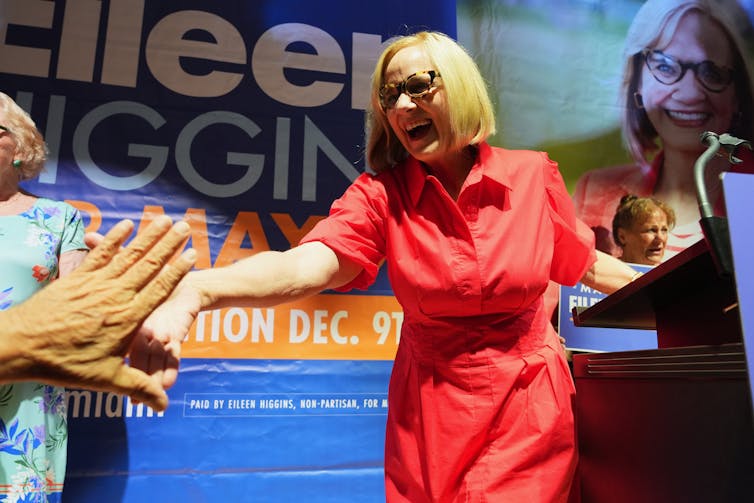
Eileen Higgins, newly elected mayor of Miami, reaches out to grasp a supporter's hand.
Because election turnout was low, Eileen Higgins was elected mayor of Miami by just a small fraction of residents.
Lynne Sladky/AP

But when people care deeply about their community, the calculation changes. The emotional reward of helping a place you love becomes a plus. The sacrifice feels worthwhile not because it will definitely make a difference, but because you’re investing in something that matters to you.

This has important implications. The positive feelings people have toward their community translate directly into civic engagement, without the risk of increasing negative feelings such as jingoism or xenophobia.

For local leaders frustrated by low turnout and apathy, the message is clear: Before asking residents to show up, give them reasons to care. Build pride of place, and engagement will follow.

The good news is that local attachment isn’t fixed. My experiments showed that simply prompting people to think about their feelings toward their town could motivate civic action.

A few ways to foster local patriotism

Here are some strategies that can help foster local patriotism:

• Create civic rituals: Regular community events, from farmers markets to fireworks, build emotional ties to place.

• Celebrate iconic places: Whether it’s a waterfall, clock tower or mountain view, promote the landmarks that symbolize your community. These shared images give residents a common point of pride and visual shorthand for what makes their town special.
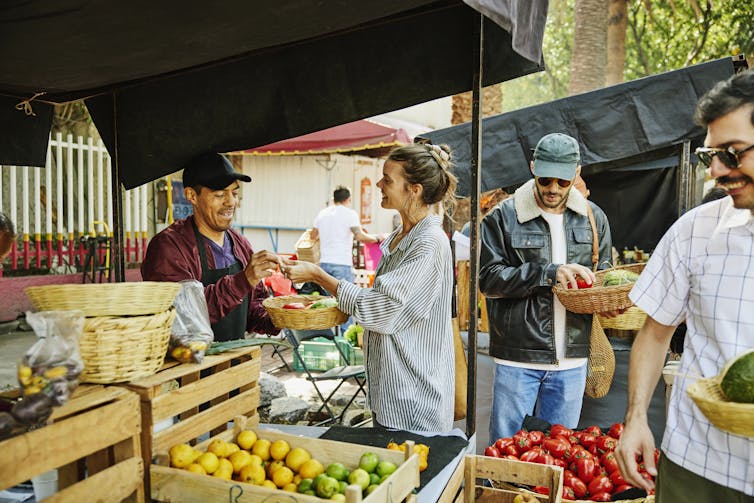
A fruit vendor talks with a customer by his display at a farmers market.
Holding local events such as farmers markets can foster a sense of community, increasing residents’ sense of attachment to their town.
Thomas Barwick/DigitalVision via Getty Images

• Bring children to community events and have them participate in local organizations: Parents who take their kids to town festivals, parades and events, or sign them up for youth art and sports programs, aren’t just keeping them entertained. They’re building the next generation’s emotional connection to place and creating civic habits that can last a lifetime.

The evidence shows that emotional connection to community is a powerful but largely untapped resource for strengthening democracy from the ground up.

In an era of declining civic engagement and deepening partisan divisions, fostering local patriotism might be exactly what the country needs.

The Conversation

Sean Richey does not work for, consult, own shares in or receive funding from any company or organization that would benefit from this article, and has disclosed no relevant affiliations beyond their academic appointment.

​Politics + Society – The Conversation

Categories
Uncategorized

Supreme Court likely to reject limits on concealed carry but uphold bans on gun possession by drug users

The Supreme Court recognizes an individual right to self-defense with firearms in public spaces. wildpixel/Getty Images

The U.S. Supreme Court in early 2026 will hear oral arguments in two cases testing the limits of gun rights under the Constitution.

Can a state outlaw carrying a concealed weapon in businesses or restaurants unless the owners post a sign allowing it? And can the federal government criminalize the possession of firearms by a habitual drug user?

The plaintiffs in both cases claim that these laws violate their Second Amendment rights. As a close observer of the Supreme Court, I suspect the rulings will split. The court will likely strike down the limitation on concealed carry and uphold the law denying gun rights to drug users.

History will tell

The Supreme Court recognizes an individual right to self-defense with firearms in public spaces. But it has also upheld the power of the government to enforce legitimate limits on that right.

The question is how can Americans know which limits are constitutional and which are not.

In 2022, the Supreme Court answered that question in a ruling, New York State Rifle & Pistol Association v. Bruen, that struck down several states’ limitations on issuing what’s called “concealed carry” licenses. That ruling set a new standard for defining the boundaries on a constitutional right: if the right was allowed at the time of America’s founding and the early republic.

In the view of originalists, who see the meaning of the U.S. Constitution and the subsequent amendments as fixed by the understanding of its authors and ratifiers, the Second Amendment recognizes a preexisting individual right of self-protection. That self-protection right can be restricted but not removed. It can be limited but not eliminated.

In the Bruen ruling, Justice Clarence Thomas wrote that current laws must be “consistent with the Nation’s historical tradition of firearm regulation.” The appropriate method, he wrote, is to examine “how and why” the regulation functions, and see if the same kinds of laws were accepted by the founders.

If so, the current laws in question are legitimate limits to the right. If not, they are unconstitutional infringements.

The first test of the new standard for a constitutional regulation came in the United States v. Rahimi case in 2024. The court upheld the federal law criminalizing gun possession by someone subject to a domestic violence restraining order.

The court examined the historical record and found several examples of laws removing firearms from people who threatened others. The record revealed established law in four states at the time of the founding that fit the same general reason and mechanism as the current federal regulation targeting domestic abusers.

Concealed carry

On Jan. 20, the court will hear arguments in Wolford v. Lopez about what the historical record reveals regarding limitations on carrying concealed firearms in public.

After the Bruen decision, Hawaii and a few other states enacted laws restricting citizens from bringing a licensed firearm on private property held open to the public unless the owner gives permission. Usually that is accomplished by posting “clear and conspicuous signage at the entrance.”

The plaintiffs, Jason and Alison Wolford, argue that the Hawaii ban makes it “impossible as a practical matter to carry a firearm.” Most establishments will not post any sign, meaning it would be a criminal offense to conduct normal errands such as entering a grocery store or shop.

tktk
Hawaii Gov. Josh Green signs gun control legislation in Honolulu on June 2, 2023. The law prohibits people from taking guns to a wide range of places, including beaches, hospitals, bars and movie theaters.
AP Photo/Audrey McAvoy, File

The U.S. Court of Appeals for the 9th Circuit in 2024 upheld the Hawaii law on the grounds that a 1771 New Jersey law and an 1865 Louisiana law are historical “dead ringers” for the Hawaii law. The court found that those laws meet the requirement of “an established tradition” limiting citizens from carrying firearms onto private property without consent.

The Republican-appointed majority on the Supreme Court, I believe, is likely to conclude that this is a misunderstanding of Justice Thomas’ method described in Bruen.

The standard the court has set is not to find any one or two similar laws that were not struck down as unconstitutional. Instead, the standard is to demonstrate a clear pattern of a recognized form of accepted regulation. If the law existed for only a short period of time, in a limited geography, or for reasons we would now see as unacceptable, this does not demonstrate a tradition of legitimate legal limitation.

Advocates for the plaintiff argue that the New Jersey law from the 1770s was intended to deal with the problem of hunters using private land without permission. They say it did not apply to businesses open to the public.

The Louisiana law enacted immediately after the Civil War was part of the Black Codes designed to keep firearms out of the hands of freed slaves. The law was not intended to be enforced against whites but had the clear intent to restrict the civil rights of freedmen. The plaintiffs argue that it is wrong to cite an openly racist post-Civil War regulation as a justification for contemporary law.

A man stretches on a beach
Todd Yukutake, a director of the Hawaii Firearms Coalition, stretches before exercising in a beach park in Honolulu on June 29, 2023. The coalition sued to block a Hawaii law that prohibits carrying guns in sensitive locations, including parks and beaches.
AP Photo/Jennifer Sinco Kelleher

The court is likely to agree. The majority of the court will likely rule that these laws are exceptions and not a legitimate pattern of historical regulation.

The legal scholar Neal Katyal describes the objections to these two examples as “flyspecking” – nitpicking small details.

But the historical analogies have clear flaws. If the majority follows the doctrine laid out in Bruen and Rahimi over the past few years, the court will strike down the Hawaii law.

Drug use

The second challenge to gun regulations will be heard in March.

United States v. Hemani addresses the federal law criminalizing firearm possession by anyone “who is an unlawful user” or “addicted to any controlled substance.”

Ali Hemani argues that his prosecution is unconstitutional because U.S. tradition only disarms citizens who are currently drunk or high, not alcohol abusers or addicts who may be clearheaded at other times.

History does not seem to be on Hemani’s side. While illicit drugs such as cocaine or heroin were largely unknown at the time of the nation’s founding, drunkenness was common and alcohol consumption was dramatic.

An amicus brief submitted for the case by a group of Colonial historians argues that “at the Founding, alcohol consumption, unlike drug use, was commonplace, and the Founders were aware of the risk that alcohol could cause a lapse in judgment.”

More importantly, the historians argue that “numerous laws disarmed those under the influence, recognizing that alcohol, which impedes judgment and self-control, is a dangerous combination with guns.”

These laws also applied to habitual drunkards, the mentally ill and others determined to be dangerous to the public.

Given the conservative leanings of the current court, it seems likely that the majority will find these historical laws on alcohol and guns to be close enough in purpose and method to uphold the current federal law on drugs and guns.

These two rulings may come down at the end of term in June 2026, when the most controversial cases tend to be announced. The court’s historical focus seems likely to yield nuanced results, striking down some regulations and upholding others.

Perhaps most importantly, we will see what the historical emphasis reveals about the balance between the constitutional right to self-defense and the collective power to ensure public safety.

The Conversation

Morgan Marietta does not work for, consult, own shares in or receive funding from any company or organization that would benefit from this article, and has disclosed no relevant affiliations beyond their academic appointment.

​Politics + Society – The Conversation

Categories
Health

RFK Jr. Calls Out Donald Trump’s ‘Unhinged’ Diet And The Bizarre Reason He Prefers McDonalds

On “The Katie Miller Podcast,” Robert F. Kennedy Jr. discussed the unusual reason that Donald Trump prefers McDonald’s over something healthier.

​Health Digest – Health News, Wellness, Expert Insights

Categories
Food

Martha Stewart Reaches In Her Pantry For A Unique Way To Thicken Soup

Sure, you can use flour to make a roux or cornstarch to make a slurry, but Martha Stewart has an even more unique (and nutritious) way to thicken soup.

​Food Republic – Restaurants, Reviews, Recipes, Cooking Tips

Categories
Music

FDA Recalled Deadly Cheese Sold Exclusively in These 20 States

Here’s which states have been affected by a serious cheese recall. The FDA warns that consuming the recalled cheese could be life-threatening. Continue reading…​The Boot – Country Music News, Music Videos and Songs

Categories
Music

FDA Recalled Deadly Cheese Sold Exclusively in These 20 States

Here’s which states have been affected by a serious cheese recall. The FDA warns that consuming the recalled cheese could be life-threatening. Continue reading…​Country Music News – Taste of Country

Categories
Politics

Bill Cassidy raises $1.65 million for reelection fight

Sen. Bill Cassidy raised $1.65 million in the latest fundraising quarter and has $11 million in cash on hand, his team told POLITICO, as he seeks to ward off a right-wing primary challenge.

The Louisiana Republican is facing several primary challengers on the right fueled by his past criticism of President Donald Trump. Cassidy voted to impeach Trump following the Jan. 6, 2021, attack against the Capitol, a stance that angered the GOP base in Louisiana.

Cassidy has consistently posted slightly higher fundraising numbers than his opponents, John Fleming, the state treasurer and a former congressman, and state Sen. Blake Miguez, but has a significantly larger war chest. Cassidy has raised more than $17 million this cycle to date. Fleming and Miguez haven’t released their latest numbers; they had just over $2 million and $2.5 million in the bank respectively as of the end of September. Rep. Julia Letlow (R-La.) has also flirted with a bid, though sources told POLITICO she is not expected to run; she had $2.3 million in the bank as of the end of September.

The senator will have some help. A pair of super PACs supporting Cassidy’s reelection will show they had $5 million in cash on hand at the end of 2025 and received an additional $2 million in the first two weeks of January, according to a person close to those efforts. The PACs expect to spend between $13 million and $15 million on his behalf.

Cassidy is one of a trio of GOP senators facing tough reelection fights where Trump is declining to endorse a candidate, along with Texas Sen. John Cornyn and Maine Sen. Susan Collins.

Cassidy’s Senate GOP colleagues are backing his reelection. On Thursday, Majority Leader John Thune will host a fundraiser for Cassidy in Baton Rouge that’s expected to bring in $600,000.

​Politics

Categories
Music

Lainey Wilson Spoke Her Spot on Stapleton’s Tour Into Existence

Lainey Wilson is making waves with a surprise tour spot alongside Stapleton. Her journey to the stage is as inspiring as her music — stick around for the details. Continue reading…​The Boot – Country Music News, Music Videos and Songs

Categories
Music

Lainey Wilson Spoke Her Spot on Stapleton’s Tour Into Existence

Lainey Wilson is making waves with a surprise tour spot alongside Stapleton. Her journey to the stage is as inspiring as her music — stick around for the details. Continue reading…​Country Music News – Taste of Country