Kenny Chesney picks his favorite of his own songs — and it’s not one of his biggest hits. Continue reading…Country Music News – Taste of Country









Kenny Chesney picks his favorite of his own songs — and it’s not one of his biggest hits. Continue reading…Country Music News – Taste of Country

Reading Time: 3 minutes
Another Trump administration attack dog might be on the verge of leaving Minneapolis with her tail between her legs.
Just hours after multiple outlets confirmed that Border Patrol Commander Greg Bovino will be returning home to California, it’s now being reported that DHS Secretary Kristi Noem will be relieved of her duties in Minnesota.
According to CBS News, Noem had a long meeting with Trump and his Chief of Staff Susie Wiles on Monday, and it’s now believed that she and her top aide Corey Lewandowski will be removed from Minneapolis and relocated to the US border with Mexico.
The decision to promote Bovino to “commander” a title that did not previousy exist in the Border Patrol and place him in charge of the situation in Minneapolis was a controversial one from the start.
And now, many believe that Noem will be the one to pay the price for that decision.
She won’t be fired, or even demoted — at least not yet — but her removal from Minneapolis will be taken for what it is: a sign that the administration is not happy with her performance during these weeks of crisis.
As you’re no doubt aware, a 37-year-old mother and American citizen named Renee Good was shot and killed by an ICE agent on January 7.

And this past weekend, a 37-year-old ICU nurse named Alex Pretti was shot and killed by multiple federal agents, who may have fired as many as ten bullets.
In many cases, Noem and other Trump administration officials blatantly lied about the events of those shootings.
Now, a growing number of Democrats are demanding that Noem be impeached.
Such a move might have been unthinkable just a few weeks ago, but it’s hard to overstate the extent to which average Americans disapprove of recent ICE and DHS actions in Minneapolis.
In a clear sign that the Trump administration is trying to lower the temperature in Minnesota (likely with an eye toward ending its wildly unpopular Operation Metro Surge), the White House announced this week that it’s been working with Governor Tim Walz and will replace Bovino with border czar Tom Homan.

“And so he’s obviously very qualified. He has the full trust and faith of the president,” White House Press Secretary Keroline Leavitt said of the decision.
At least one anonymous DHS agent has spoken out against Noem’s recent statements and decisions.
“When we gaslight and contradict what the public can plainly see with their own eyes, we lose all credibility and it’s going to damage our reputation for generations,” a source told CBS this week.
According to the outlet, “dozens more congressional Democrats agreed to join as co-sponsors of legislation seeking to impeach Noem, amid the torrent of negative headlines and controversy” this week.
The situation could lead to a partial government shutdown as early as Friday if Democrats vote against a spending bill that would provide additional funding to ICE and DHS.
We will have further updates on this developing story as new information becomes available.
Kristi Noem Expected to Be Relieved of Duties in Minneapolis Amid Growing Demands For … was originally published on The Hollywood Gossip.
The Hollywood Gossip

While you might be tempted to discard excess chicken drippings, that liquid is actually flavor-dense magic capable of transforming a basic jar of Alfredo sauce.

Food Republic – Restaurants, Reviews, Recipes, Cooking Tips

There are many different ways to upgrade your kitchen with new tech, but some are more worthwhile than others. Here’s one not worth the hype.

Mashed – Fast Food, Celebrity Chefs, Grocery, Reviews
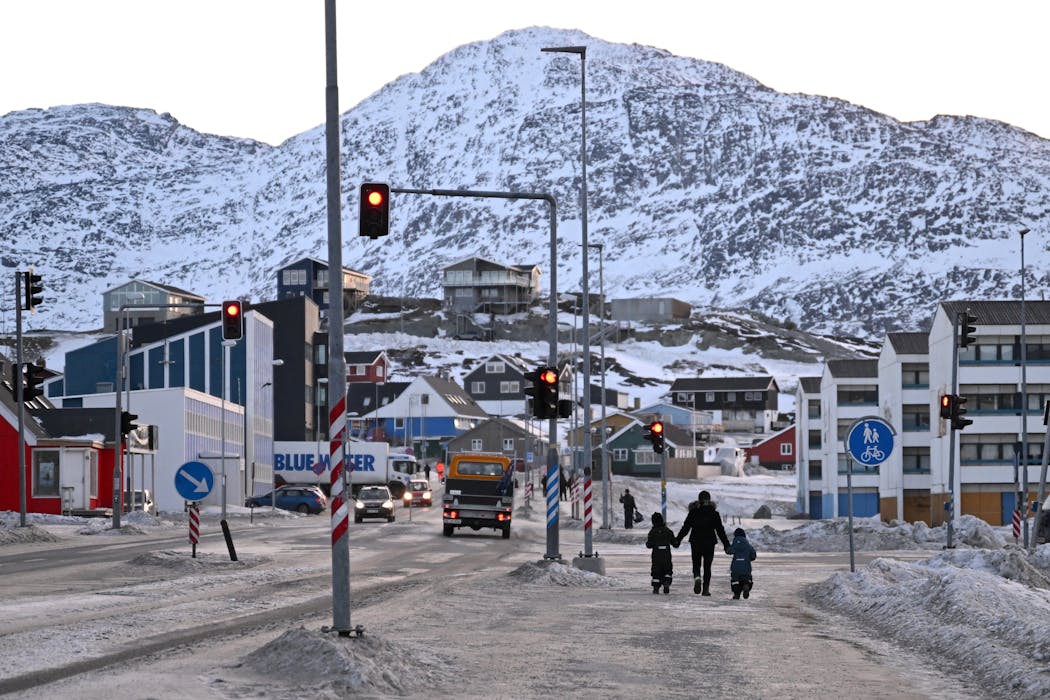
Amid the discussion between U.S. President Donald Trump and Danish and European leaders about who should own Greenland, the Inuit who live there and call it home aren’t getting much attention.
The Kalaallit (Inuit of West Greenland), the Tunumi (Inuit of East Greenland) and the Inughuit (Inuit of North Greenland) together represent nearly 90% of the population of Greenland, which totals about 57,000 people across 830,000 square miles (2.1 million square kilometers).
We are Arctic anthropologists who work in a museum focused on the Arctic and its people. One of the areas we study is a land whose inhabitants call it Kalaallit Nunaat, or land of the Kalaallit. Known in English as Greenland, it is an Indigenous nation whose relatively few people have been working for decades to reclaim their right to self-determination.
For nearly 5,000 years, northwestern Greenland – including the area that is now the U.S. Space Force’s Pituffik Space Base, formerly known as Thule Air Force Base – was the island’s main entry point. A succession of Indigenous groups moved eastward from the Bering Strait region and settled in Siberia, Alaska, Canada and Greenland.
Approximately 1,000 years ago, the ancestors of the Inuit living in Greenland today arrived in that area with sophisticated technologies that allowed them to thrive in a dynamic Arctic environment where minor mishaps can have serious consequences. They hunted animals using specialized technologies and tools, including kayaks, dog-drawn sleds, complex harpoons, and snow goggles made from wood or bone with slits cut into them. They dressed in highly engineered garments made from animal fur that kept them warm and dry in all conditions.
Their tools and clothing were imbued with symbolic meanings that reflected their worldview, in which humans and animals are interdependent. Inughuit families who live in the region today continue to hunt and fish, while navigating a warming climate.

At Qassiarsuk in south Greenland, around the time Inuit arrived in the north, Erik the Red established the first Norse farm, Brattahlíð, in 986, and sent word back to Iceland to encourage others to join him, as described in an online exhibit at the Greenland National Museum. Numerous Norse families followed and established pastoral farms in the region.
As Inuit expanded southward, they encountered the Norse farmers. Inuit and Norse traded, but relations were sometimes tense: Inuit oral histories and Norse sagas describe some violent interactions. The two groups maintained distinctly different approaches to living on the land that rims Greenland’s massive ice sheet. The Norse were very place-based, while the Inuit moved seasonally, hunting around islands, bays and fjords.
As the Little Ice Age set in early in the 14th century, and temperatures dropped in the Northern Hemisphere, the Norse were not equipped to adjust to the changing conditions. Their colonies faltered and by 1500 had disappeared. By contrast, the mobile Inuit took a more flexible approach and hunted both land and marine mammals according to their availability. They continued living in the region without much change to their lifestyle.
In Nuuk, the modern capital of Greenland, an imposing and controversial statue of missionary Hans Egede commemorates his arrival in 1721 to establish a Lutheran mission in a place he called Godthåb.
In 1776, as trade became more important, the Danish government established the Royal Greenland Trading Department, a trading monopoly that administered the communities on the west coast of Greenland as a closed colony for the next 150 years.
By the 19th century some Kalaallit families who lived in Nuuk/Godthåb had formed an educated, urban class of ministers, educators, artists and writers, although Danish colonists continued to rule.
Meanwhile, Kalaallit families in small coastal communities continued to engage in traditional economic and social activities, based on respect of animals and sharing of resources.
On the more remote east coast and in the far north, colonization took root more slowly, leaving explorers such as American Robert Peary and traders such as Danish-Greenlandic Knud Rasmussen a free hand to employ and trade with local people.
The U.S. formally recognized Denmark’s claim to the island in 1916 when the Americans purchased the Danish West Indies, which are now the U.S. Virgin Islands. And in 1921, Denmark declared sovereignty over the whole of Greenland, a claim upheld in 1933 by the Permanent Court of International Justice. But Greenlanders were not consulted about these decisions.


World War II brought the outside world to Greenland’s door. With Denmark under Nazi control, the U.S. took responsibility for protecting the strategically important island of Greenland and built military bases on both the east and west coasts. The U.S. made efforts to keep military personnel and Kalaallit apart but were not entirely successful, and some visiting and trading went on. Radios and broadcast news also spread, and Kalaallit began to gain a sense of the world beyond their borders.
The Cold War brought more changes, including the forced relocation of 27 Inughuit families living near the newly constructed U.S. Air Force base at Thule to Qaanaaq, where they lived in tents until small wooden homes were built.
In 1953, Denmark revised parts of its constitution, including changing the status of Greenland from a colony to one of the nation’s counties, thereby making all Kalaallit residents of Greenland also full-fledged citizens of Denmark. For the first time, Kalaallit had elected representatives in the Danish parliament.
Denmark also increased assimilation efforts, promoting the Danish language and culture at the expense of Kalaallisut, the Greenlandic language. Among other projects, the Danish authorities sent Greenlandic children to residential schools in Denmark.
In Nuuk in the 1970s, a new generation of young Kalaallit politicians emerged, eager to protect and promote the use of Kalaallisut and gain greater control over Greenland’s affairs. The rock band Sumé, singing protest songs in Kalaallisut, contributed to the political awakening.
In a 1979 Greenland-wide referendum, a substantial majority of Kalaallit voters opted for what was called “home rule” within the Danish Kingdom. That meant a parliament of elected Kalaallit representatives handled internal affairs, such as education and social welfare, while Denmark retained control of foreign affairs and mineral rights.
However, the push for full independence from Denmark continued: In 2009, home rule was replaced by a policy of self-government, which outlines a clear path to independence from Denmark, based on negotiations following a potential future referendum vote by Greenlanders. Self-government also allows Greenland to assert and benefit from control over its mineral resources, but not to manage foreign affairs.
Today, Nuuk is a busy, vibrant, modern city. Life is quieter in smaller settlements, where hunting and fishing are still a way of life. While contemporary Greenland encompasses this range of lifestyles, Kalaallit are unified in their desire for self-determination. Greenland’s leaders have delivered this message clearly to the public and to the White House directly.

Susan A. Kaplan has received funding from NSF, NEH, IMLS, SSHRC and private foundations to pursue anthropological and archaeological research in Nunatsiavut, NL, Canada; and offer Arctic-focused outreach programs, museum exhibits and conferences.
Genevieve LeMoine receives funding from the National Science Foundation, Office of Polar Programs, the National Geographic Society, and the Social Sciences and Humanities Research Council of Canada. She has conducted fieldwork in Avannaata Kommunia, Kalaallit Nunaat in collaboration with Nunatta Katersugaasivia Allagaateqarfialu/Greenland National Musuem and Archives and the University of California, Davis.
Politics + Society – The Conversation

We’re counting down the 20 memorable moments in Daytona 500 history ahead of this year’s race on Feb. 15.FOX Sports Digital
![<a href="https://theboot.com/ixp/204/p/country-music-grammy-winners-full-list/" target="_blank">Every Country Music Grammy Winner From 1958 To 2025 [Full List]</a>](https://townsquare.media/site/204/files/2026/01/attachment-toc-editorial-1-12.jpg?format=natural)
We wanted to make it easy to find country music winners at the Grammys. Continue reading…The Boot – Country Music News, Music Videos and Songs
We wanted to make it easy to find country music winners at the Grammys. Continue reading…Country Music News – Taste of Country

It’s a savvy strategy to visit different grocery stores for specific items, but one section you may want to avoid at Walmart is the meat department.

Food Republic – Restaurants, Reviews, Recipes, Cooking Tips
Famed American composer Philip Glass on Tuesday announced he is pulling the premiere of his newest symphony, titled “Lincoln,” from the Kennedy Center, becoming the latest performer to cut ties with the beleaguered institution since its takeover by President Donald Trump.
“Symphony No. 15 is a portrait of Abraham Lincoln, and the values of the Kennedy Center today are in direct conflict with the message of the Symphony,” Glass said in a post on social media. “Therefore, I feel an obligation to withdraw this Symphony premiere from the Kennedy Center under its current leadership.”
He joins a growing list of artists who have canceled performances at the Kennedy Center since Trump’s overhaul of Washington’s premier arts center. Grammy winner Renee Fleming canceled performances set for May, the institution announced on its website. More performers, including banjo player Béla Fleck and singer Sonia De Los Santos, as well as groups such as the Martha Graham Dance Company and the Seattle Children’s Theater, have also canceled planned shows.
Trump has made rebranding the Kennedy Center a priority since returning to the White House early last year. He axed several members from the center’s board and installed himself as chair in February 2025, later bringing on longtime ally Richard Grenell to serve as interim executive director.
In December, the newly reformed Kennedy Center’s board voted to add the president’s name to the building. One lawmaker, Rep. Joyce Beatty (D-Ohio), an ex officio member of the board, sued in protest.
Trump has also taken a personal interest in a refurbishment of the Center, including overseeing details down to the theater’s armrests.
Glass, 88, is one of the country’s most celebrated living composers, an early pioneer of minimalism in classical music and famous in part for scores in films such as 2002’s “The Hours” and “The Truman Show,” starring Jim Carrey.
“We have no place for politics in the arts, and those calling for boycotts based on politics are making the wrong decision,” Roma Daravi, the institution’s vice president of public relations, said in a statement. “We have not cancelled a single show. Leftist activists are pushing artists to cancel but the public wants artists to perform and create—not cancel under pressure from political insiders that benefit from creating division.”
Politics