Categories
Politics

‘I just couldn’t stop crying’: How prison affects Black men’s mental health long after they’ve been released

Black men who have been incarcerated have elevated rates of PTSD, depression and psychological distress. da-kuk/E+ Collection via Getty Images

Mike returned home to Philadelphia after a 15-year prison sentence and suffered an emotional breakdown.

“I just couldn’t stop crying … I don’t know. It was the anxiety. It was just a lot,” he said. “I was under a lot of pressure and it just came crashing down.”

Mike, who was in his late 40s when we spoke, told me about his childhood filled with abuse, his first arrest at age 14, and the over 20 years of his life that he spent behind bars.

As a registered nurse and nurse scientist who studies how incarceration affects mental health, I know Mike’s experience after release from prison is not uncommon. Studies show that Black men who have experienced incarceration have higher rates of PTSD, depression and psychological distress compared with Black men who have never been incarcerated.

Working in psychiatric hospitals in Philadelphia, I met many patients in crisis who had been incarcerated at some point in their lives. As a part of my doctoral research, funded by the National Institute of Nursing Research, I interviewed 29 formerly incarcerated Black men to understand how incarceration has affected their mental health.

My peer-reviewed findings were published in the journal Social Science & Medicine. All quotes shared here use pseudonyms to protect the men’s privacy.

Trauma of incarceration

Mass incarceration in the U.S. has serious health consequences for individuals, families and communities. In Philadelphia alone, over 20,000 people return home from incarceration each year.

While incarceration rates are declining in Philadelphia, the needs of those coming home remain significant.

Many formerly incarcerated men described experiencing or witnessing violence, including being beaten by correctional officers and witnessing close friends get assaulted or killed.

“You know you are not regular because you come from a traumatic situation, right?” said Thomas, 44, who spent 18 years incarcerated.

The participants expressed that racism was common, especially while incarcerated in facilities located in the rural central and northern regions of Pennsylvania.

“I ain’t gonna sugar coat it – Black people going up into them white people mountains, they call you [n-word] all day long and you basically there to accept it,” Antonio told me.

Incarceration was especially difficult for those who were held for months pretrial without ever being convicted and those incarcerated during COVID restrictions who spent more than 23 hours a day in their cells.

‘Even though I’m free, I ain’t free’

Participants described life on parole or probation, or in transitional housing, as another form of confinement.

Ken, 56, has been out of prison for over a decade but said, “I’m still locked up, even though I’m free, I ain’t free. You just get a whole new set of rules and regulations.”

Men described significant anxiety related to community supervision requirements, including difficulty sleeping the night before a probation appointment.

Participants also described distress caused by “no association” restrictions. These are common parole and probation requirements that prohibit people under supervision from interacting with others who have criminal records, are also under supervision or are currently incarcerated. Violating this requirement can lead to a technical violation and reincarceration.

While these requirements are meant to reduce the risk of reoffending, they often isolate people from supportive relationships and resources, including housing and employment.

“[There are] a lot of smart brothers in there. And it hurts my heart. And that’s where the depression coming in too,” said Reese, who spent six years incarcerated. “I can’t contact them in jail. … That’s just how it is in the system.”

Philadelphia has the highest rate of community supervision – including probation and parole – among the largest U.S. cities, according to a 2019 analysis by The Philadelphia Inquirer.

At that time, the Inquirer reports, 1 in 23 adults in Philadelphia were under community supervision – and 1 in 14 Black adults in Philadelphia.

The men I interviewed said they felt like parts of them never left jail or prison, while others felt that they brought prison or jail home with them.

Tyrese, 34, said he stays home as often as he can.

“I’ve been out of the joint for seven years now and feel like I’m still institutionalized, I guess,” he said. “I know people that don’t even come outside,” referring to other formerly incarcerated men.

Others had dreams that they were back in a cell, or at home still wearing jail clothing. Long after release, many described constant hypervigilance and anxiety.

“I can be walking to the bus station and there be people walking around me, I’m constantly watching them,” said Anthony, who was first incarcerated at age 18 and served 16 years. “I’m watching every movement they’re doing. That’s a habit I had from jail.”

Man in black hoodie that says 'Free Meek' interacts with crowd of supporters in street
Philly rapper Meek Mill, shown here at a 2018 rally outside a Center City courthouse, was sentenced to probation for 10 years after a conviction on drug and gun charges. He became an advocate of criminal justice reform.
Michael Candelori/Pacific Press/LightRocket via Getty Images

Finding work

People who have been incarcerated often struggle to find employment after release, as many employers are unwilling to hire a person with a criminal record.

This leaves about 35% of formerly incarcerated Black men unemployed.

At the time of our interview, Tay, 31, was working part-time in carpentry. “Because I had felonies on my record a lot of places won’t hire me,” he said. “And a couple of places that I was working with, they ended up firing me once they did the background check.”

These frustrations can easily spill over into family life.

Mark, 30, also works part-time and said he found himself frequently becoming agitated and snapping at his kids, other family members and his girlfriend. “I can’t get the job I want or the job that I need to do what I need to do for my family and I’ll be frustrated,” he shared.

Participants struggled with having to depend on others for basic needs upon release. Kenny, who is now self-employed as a caterer, recalled his experience a few years earlier. “I was crying. I was a grown man, almost 40 years old, and my mother had to buy me underwear, socks,” he said.

The importance of fatherhood

Despite their many hardships, some of the men spoke with joy about reconnecting with their children.

“I think the most positive thing that happened since I’ve been out of prison is I got custody of my sons,” said Ken, a father of two. “Them kids saved me.”

Like many of the other participants with children, however, he was frustrated about being unable to provide for them and worried about repeating harmful cycles.

“You want to do good, but it makes you think bad stuff when you don’t have the right resources,” he continued. “You don’t want [your kids] to do the same things you did.”

Others struggled to bond with their children after years of separation.

John, 29, explained, “The bonding is kind of awkward, because you wasn’t there, especially during the pandemic when there was no visits allowed.”

Returning to disadvantaged neighborhoods

Most people released from incarceration return to neighborhoods with high rates of poverty, violence and other disadvantages.

Shawn, who lives in pubic housing, showed me abandoned buildings and boarded storefronts in his neighborhood and described how the environment made rebuilding his life harder.

For many participants, returning to divested communities brought stress. They experienced frequent exposure to substance use, violence and negative police encounters, and they had limited access to basic resources and job opportunities needed to support recovery and stability.

“This is my real life. It’s not fake. It’s not no, ‘Well, why did he go back and do this or that?’” he said. “I live in an underserved, impoverished, danger zone – period.”

Moving forward

The experiences these men shared with me demonstrate how traumatic incarceration is, even many years after release.

Supporting the mental health of formerly incarcerated Black men requires trauma-informed services, such as culturally responsive counseling, peer support and care that acknowledges the lasting effects of incarceration.

It also means helping them build or rebuild their financial resources, reconnect with their children and loved ones, and supporting the broader communities they return to through investment in housing, employment and accessible health and social services.

The Conversation

Helena Addison received funding from National Institute of Nursing Research of the National Institutes of Health under Award Number F31NR020434, the Substance Abuse and Mental Health Administration and American Nurses Association Minority Fellowship Program, the University of Pennsylvania’s Presidential PhD Fellowship, and Jonas Philanthropies to support this study and/or her PhD training. The content is solely the responsibility of the authors and does not necessarily represent the official views of the National Institutes of Health, or any other funding organizations or institutions. The views expressed in written training materials or publications and by speakers and moderators do not necessarily reflect the official policies of the Department and Human Services; nor does mention of trade names, commercial practices, or organizations imply endorsement by the U.S. Government.

​Politics + Society – The Conversation

Categories
Politics

How the ‘big, beautiful bill’ will deepen the racial wealth gap – a law scholar explains how it reduces poor families’ ability to afford food and health care

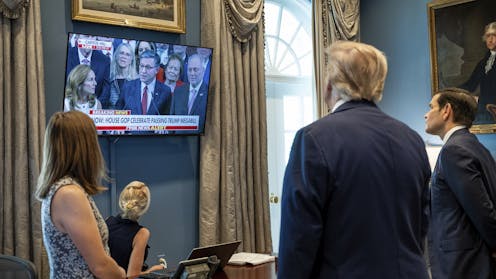
President Donald Trump and Secretary of State Marco Rubio watch Speaker of the House Mike Johnson on television after the House passed the bill on July 3, 2025. Joyce N. Boghosian/White House via AP

President Donald Trump has said the “big, beautiful bill” he signed into law on July 4, 2025, will stimulate the economy and foster financial security.

But a close look at the legislation reveals a different story, particularly for low-income people and racial and ethnic minorities.

As a legal scholar who studies how taxes increase the gap in wealth and income between Black and white Americans, I believe the law’s provisions make existing wealth inequalities worse through broad tax cuts that disproportionately favor wealthy families while forcing its costs on low- and middle-income Americans.

The widening chasm

The U.S. racial wealth gap is stark. White families’ median wealth between 2019 and 2022 grew to more than $250,000 higher than Black families’ median wealth.

This disparity is the result of decades of discriminatory policies in housing, banking, health care, taxes, education and employment.

The new legislation will widen these chasms through its permanent extension of individual tax cuts in Trump’s 2017 tax reform package. Americans have eight years of experience with those changes and how they hurt low-income families.

The nonpartisan Congressional Budget Office, for example, predicted that low-income taxpayers would gain US$70 a year from the 2017 tax cuts. But that figure did not include the results of eliminating the individual mandate that encouraged uninsured people to get health insurance through the federal marketplace. That insurance was heavily subsidized by the federal government.

The Republican majority in Congress predicted that the loss of the mandate would decrease federal spending on health care subsidies. That decrease cost low-income taxpayers over $4,000 per person in lost subsidies.

The Congressional Budget Office examined the net effect of the 2025 bill by combining the tax changes with cuts to programs like Medicaid and food assistance. It found that the bill will reduce poor families’ ability to obtain food and health care.

A woman speaks outdoors in front of a microphone as several peopple holding a banner stand behind her.
Rep. Melanie Stansbury of New Mexico speaks during a news conference at the Capitol focused on the One Big Beautiful Bill Act, on June 3, 2025.
AP Photo/Rod Lamkey Jr.

Wealth-building for whom?

Perhaps the most revealing part of the bill is how it turns ideas for helping low-income families on their head. They are touted as helping the poor – but they help the wealthy instead.

A much publicized feature of the bill is the creation of “Trump Accounts,” a pilot program providing a one-time $1,000 government contribution to a tax-advantaged investment account for children born between 2025 and 2028.

While framed as a “baby bonus” to build wealth, the program’s structure is deeply flawed and regressive. Although the first $1,000 into the accounts comes from the federal government, the real tax benefits go to wealthy families who can avoid paying taxes by contributing up to $5,000 per year to their children’s accounts.

As analysts from the Roosevelt Institute, a progressive economic and social policy think tank, have pointed out, this design primarily benefits affluent families who already have the disposable income to save and can take full advantage of the tax benefits.

For low-income families struggling with daily expenses, making additional contributions is not a realistic option. These accounts do not address the fundamental barrier to saving for low-income families – a lack of income – and are more likely to widen the wealth gap than to close it.

This regressive approach – regressive because the wealthy get larger benefits – to wealth-building is mirrored in the bill’s renewal and enhancement of the New Markets Tax Credit program. Although extended by the “big, beautiful bill” to drive investment into low-income communities by offering capital gains tax breaks to investors, the program subsidizes luxury real estate projects that do little to benefit existing low-income residents and accelerate gentrification and displacement. Studies show that there is very little increase in salaries or education in areas with these benefits.

A harsh new rule

The child tax credit is another part of the bill that purports to help the poor and working classes while, in fact, giving the wealthy more money.

A family can earn up to $400,000 and still get the full $2,200 tax credit per child, which reduces their tax liability dollar for dollar. In contrast, a family making $31,500 or less cannot receive a tax credit of more than $1,750 per child. And approximately 17 million children – disproportionately Black and Latino – will not receive anything at all.

More significantly, the law tightens eligibility by requiring not only the child but also the taxpayer claiming the credit to have a Social Security number. This requirement will strip the credit from approximately 4.5 million U.S. citizen children in mixed-status families – families where some people are citizens, legal residents and people living in the country without legal permission – where parents may file taxes with an Individual Taxpayer Identification Number but lack a Social Security number, according to an April 2025 study.

A man in suit and tie sits outdoor at a table holding a gavel as dozens of people stand behind him and clap.
President Donald Trump, joined by Republican lawmakers, holds a gavel after signing the One, Big Beautiful Bill Act into law, on July 4, 2025 in Washington, DC.
Eric Lee/Getty Images

A burden on the poor

Perhaps most striking is the law’s “pay-fors” – the provisions designed to offset the cost of the tax cuts.

The legislation makes significant changes to Medicaid and the Supplemental Nutrition Assistance Program, lifelines for millions of low-income families.

The law imposes new monthly “community engagement” requirements, a form of work requirement, for able-bodied adults to maintain Medicaid coverage. The majority of such adults enrolled in Medicaid already work. And many people who do not work are caring full time for young children or are too disabled to work. The law also requires states to conduct eligibility redeterminations twice a year.

Redeterminations and work requirements have historically led to eligible people losing coverage. For SNAP, the bill expands work requirements to some Americans who are up to 64 years old and the parents of older children and revises benefit calculations in ways that will reduce benefits.

By funding tax cuts for the wealthy while making cuts to essential services for the poor, the bill codifies a transfer of resources up the economic ladder.

In my view, the “big, beautiful bill” represents a missed opportunity to leverage fiscal policy to address the American wealth and income gap. Instead of investing in programs to lift up low- and middle-income Americans, the bill emphasizes a regressive approach that will further enrich the wealthy and deepen existing inequalities.

The Conversation

Beverly Moran does not work for, consult, own shares in or receive funding from any company or organization that would benefit from this article, and has disclosed no relevant affiliations beyond their academic appointment.

​Politics + Society – The Conversation

Categories
Entertainment

Kate Beckinsale Mourns Late Mother in Emotional Tribute

Reading Time: 3 minutes

Kate Beckinsale is mourning her late mother.

Earlier this summer, the actress acknowledged that she was going through a difficult, even miserable time.

Months earlier, she had asked fans to keep her mom in their thoughts.

Now, she is opening up to the world about the passing of her mom, Judy Loe.

Kate Beckinsale on December 5, 2023.
Actress Kate Beckinsale arrives for Elle’s 2023 Women in Hollywood celebration, at Nya Studios in Los Angeles, California, on December 5, 2023. (Photo Credit: MICHAEL TRAN/AFP via Getty Images)

Kate Beckinsale is grieving her dearly departed mother

On Thursday, July 17, Kate Beckinsale took to her Instagram page to share a heartbreaking tribute to her late mom.

She also had to break the tragic news. Judy Loe passed away on Tuesday, July 15. She was 78.

In July of last year, Loe received a stage 4 cancer diagnosis.

“I don’t want to post this,” Beckinsale began her caption alongside photos of her mom. “I am only posting this because I have had to register my mother‘s death certificate and it will soon become public record.”

“She died the night of July 15th in my arms after immeasurable suffering,” the actress revealed.

“I have not picked all the best photos, nor the best videos,” Beckinsale admitted.

“Because I cannot bear to go through my camera roll yet.”

Kate Beckinsale on February 6, 2025.
Kate Beckinsale speaks onstage during the 27th Costume Designers Guild Awards (CDGA) at Wilshire Ebell Theatre on February 06, 2025. (Photo Credit: Randy Shropshire/Getty Images for CDGA)

She is not ready to go through photos — or her mother’s contacts

“I deeply apologize to any of her friends who are finding out this way or through the press,” Kate Beckinsale expressed, “but I cannot go through her phone. I am paralyzed.”

She wrote: “Jude was the compass of my life, the love of my life, my dearest friend. The vastness and huge heart of this tiny woman has touched so many people who love her dearly.”

Beckinsale affirmed:

“She has been brave in so many ways, forgiving sometimes too much, believing in the ultimate good in people and the world is so dim without her that it is nearly impossible to bear.”

A dark mode screenshot of Kate Beckinsale's tribute to her late mom.
Late on July 17, 2025, Kate Beckinsale took to Instagram to share the tragic news of her mother’s passing, along with a moving tribute to her dearly departed mom. (Image Credit: Instagram)

“Mama, I love you so much,” Beckinsale mourned.

“This has been my greatest fear since finding my father dead at five,” she admitted, “and I am here.”

The grieving actress concluded:

“Oh my Mama.. I’m sorry, I’m so sorry. I am so sorry.”

Kate Beckinsale on May 23, 2023.
Kate Beckinsale attends Chopard ART Evening at the Martinez on May 23, 2023. (Photo Credit: Pascal Le Segretain/Getty Images for Chopard)

We will keep Beckinsale and the rest of her family in our thoughts

In February of 2025, Kate Beckinsale asked fans to pray for her mother.

At the time, she did not share why her mother needed the spiritual support.

Now, the actress herself is in need of emotional support as she processes this tremendous loss.

Our heart goes out to her, her family, and to her late mother’s friends.

Kate Beckinsale Mourns Late Mother in Emotional Tribute was originally published on The Hollywood Gossip.

​The Hollywood Gossip

Categories
Entertainment

Tom Girardi: Erika Jayne’s Husband Reports to Prison to Begin 7-Year Sentence

Reading Time: 3 minutes

Last month, Tom Girardi was sentenced to seven years and three months in prison for fraud.

The conviction came on what happened to be his 86th birthday.

Today, the estranged husband of Erika Jayne reported to a federal correctional facility to begin serving his sentence.

Erika Jayne and Tom Girardi at Dinner
Erika Jayne and Tom Girardi are pictured here on an episode of The Real Housewives of Beverly Hills. (BRAVO)

Tom Girardi, 86, begins lengthy prison sentence

According to a new report from Page Six, a spokesperson for the Federal Bureau of Prisons reveals that Girardi turned himself in Thursday in “the late afternoon.”

The report adds that Girardi is currently in the custody of the Metropolitan Detention Center (MDC) in Los Angeles.

Girardi, a disbarred attorney, was found guilty of embezzling millions from clients through his law firm, Girardi & Keese,

In addition to prison time, he was also ordered to pay $2.3 million in restitution to and a $35,000 fine.

Erika Jayne and Tom Girardi on The Real Housewives
The Real Housewives of Beverly Hills star Erika Jayne and husband Tom Girardi sit in beautiful purple lighting. (Bravo)

Girardi’s legal situation complicated by health issues

According to his attorneys, Girardi is suffering from late on-set Alzheimer’s and dementia.

The judge rejected their request to have him serve his sentence at a long-term care facility.

In 2021, a doctor who examined Girardi declared that he was unfit to attend his trial.

“Dementia impairs his ability to understand the hearing,” the physician wrote at the time.

Erika Girardi attends the 2017 American Music Awards at Microsoft Theater on November 19, 2017 in Los Angeles, California.
Erika Girardi attends the 2017 American Music Awards at Microsoft Theater on November 19, 2017 in Los Angeles, California. (Photo by Neilson Barnard/Getty Images)

“His emotional distress is directly related to his dementia and exacerbated by his confusion.”

The doctor also observed “moderate impairment” to Girardi’s short-term memory and ability to concentrate, and noted that he appeared to be suffering from “moderate” delusions.

Erika appears to have moved on

Erika, of course, was also not on hand for any part of Tom’s legal proceedings.

The Real Housewives of Beverly Hills Star and her second husband have been separated since 2020, and by all accounts, their split was not an amicable one.

Erika Jayne speaks very forcefully while wearing a pink top.
RHOBH viewers are not surprised that Erika Jayne is not about to back down. (Image Credit: Bravo)

Jayne has blasted Girardi as an unrepentant cheater who made her life hell during their marriage.

And she seems to have had no trouble moving on in the years since they parted ways.

We recently learned that Erika hooked up with Summer House star Jesse Solomon, who is 22 years her junior.

It does not appear that she and Jesse are in a relationship, but it does seem that she’s enjoying the single life.

As for Tom, a seven-years-and-change sentence is basically a life sentence at his age and with his health problems, so you can bet that his high-priced legal team will continue to appeal his conviction.

We’ll have further updates on this developing story as new information becomes available.

Tom Girardi: Erika Jayne’s Husband Reports to Prison to Begin 7-Year Sentence was originally published on The Hollywood Gossip.

​The Hollywood Gossip

Categories
Entertainment

Dylan Dreyer Announces Split From Husband Brian Fichera

Reading Time: 2 minutes

We have surprising news from the world of daytime television today:

Dylan Dreyer has revealed that she and husband Brian Fichera have decided to end their marriage.

The Today show co-host shared the news with fans on her Instagram page on Friday:

Dylan Dreyer hosts a SiriusXM TODAY Show Radio special with the cast of "Stick" on June 10, 2025 in New York City.  on June 10, 2025 in New York City.
Dylan Dreyer hosts a SiriusXM TODAY Show Radio special with the cast of “Stick” on June 10, 2025 in New York City. on June 10, 2025 in New York City. (Photo by Slaven Vlasic/Getty Images for SiriusXM)

Dylan Dreyer shares difficult news with Instagram followers

“For many years I have shared my family with you all — the highs and lows. The ups and downs. And all of the blessings and beautiful memories in between,” Dylan wrote over a photo of a dock at sunset.

“I am incredibly grateful for the support and love you’ve given me through it all. For that reason, I want to share with you that a few months ago, Brian and I made the decision to separate,” she continued, adding:

“We began as friends, and we will remain the closest of friends. Most importantly, we will continue to co-parent our three wonderful boys together with nothing but love and respect for another. Thank you as always for your support.”

Dreyer was not wearing her wedding ring during Friday’s broadcast of the Today show.

Insiders say this announcement has been a long time coming

According to a new report from Page Six, Dylan and Brian have “been separated for months,” but have remained friends and are still living together while co-parenting their three kids.

That claim is corroborated by the fact that less than a week ago, the exes attended the American Century Championship golf tournament in Lake Tahoe, California.

Dylan, who is an avid golfer, joked that she came in second place — in the ACC’s post-tournament celebrity karaoke contest.

“One of the best parts of @acchampionship is all the fun that happens off the course! Boat rides, jersey swaps, connecting with friends and making new ones! Thanks for another great year!!” Dreyer wrote on Instagram.

Dylan Dreyer attends the 2023 Broadcasting + Cable Hall Of Fame Gala at The Ziegfeld Ballroom on May 03, 2023 in New York City.
Dylan Dreyer attends the 2023 Broadcasting + Cable Hall Of Fame Gala at The Ziegfeld Ballroom on May 03, 2023 in New York City. (Photo by Arturo Holmes/Getty Images)

“There is no divorce set yet,” an insider tells Page Six.

The same source revealed that Fichera, who makes his living as a freelance cameraman, is “taking time off work to focus on family.”

Needless to say, it sounds like the separation has been an amicable one so far.

Here’s hoping these two will be able to remain on such good terms now that they’ve gone public with their split — especially as divorce proceedings loom.

We will have further updates on this developing story as new information becomes available.

Dylan Dreyer Announces Split From Husband Brian Fichera was originally published on The Hollywood Gossip.

​The Hollywood Gossip

Categories
Entertainment

Courtney Stodden Reveals She’s 3 Days Sober, Says Abusive Husband Taught Her How to …

Reading Time: 2 minutes

Courtney Stodden is opening up about a difficult new journey in her life.

In an Instagram video posted on Friday, Courtney revealed that she’s 72 hours sober.

And while she seems proud of the achievement, she also tearfully admitted that she’s anxious about her future and angry about her past.

Courtney Stodden blames Doug Hutchison for alcohol addiction

As you may recall, Courtney first entered the public eye back in 2011, as a result of her marriage to actor Doug Hutchison.

She was just 16 at the time of their wedding, and Hutchison was 51.

Stodden has since accused Hutchison of abusing her throughout their relationship.

And she’s now coming to terms with the fact her “groomer” — allegedly an alcoholic himself — caused her to develop a drinking problem.

Courtney Stodden attends the Hall of Fame Party: Big Game Weekend Edition at Sunset Room Hollywood on February 12, 2022 in Los Angeles, California.
Courtney Stodden attends the Hall of Fame Party: Big Game Weekend Edition at Sunset Room Hollywood on February 12, 2022 in Los Angeles, California. (Photo by Robin L Marshall/Getty Images)

According to Courtney, Doug would drink “bottles and bottles of alcohol” a day, and he provided her with booze so that he could “control” her.

She says drinking provided her with a way of coping with the abuse she endured at Hutchison’s hands.

These days, Courtney is married to Jared Safier and her second marriage seems to be a vast improvement over her first one in every way.

Courtney Stodden announces decision to break up with alcohol

Like the vast majority of people who have struggled with addiction, Courtney is clearly having a hard time with early sobriety.

Her latest update comes on the heels of a post in which she announced her decision to “break up” with alcohol.

Courtney Stodden attends the Mercy For Animals 20th Anniversary Gala at The Shrine Auditorium on September 14, 2019 in Los Angeles, California.
Courtney Stodden attends the Mercy For Animals 20th Anniversary Gala at The Shrine Auditorium on September 14, 2019 in Los Angeles, California. (Photo by Alberto E. Rodriguez/Getty Images)

“Alcohol, I’m breaking up with you. It’s been a toxic relationship for years. Something I used to cope, to escape, to survive. But it’s hurt me more than it’s ever helped me—publicly and privately,” Stodden wrote on Instagram.

“But it’s hurt me more than it’s ever helped me — publicly and privately. Last night was the last time. I’m done letting it control me. I’m done feeling sick and ashamed,” she continued, adding:

“I want to be fully present in my life. I want to face my past, my trauma, and my current reality with clear eyes and real strength. To those who understand this battle — thank you. Please respect my space as I walk this new path. It’s not easy, but it’s necessary.”

We wish Courtney all the best on her recovery journey.

Courtney Stodden Reveals She’s 3 Days Sober, Says Abusive Husband Taught Her How to … was originally published on The Hollywood Gossip.

​The Hollywood Gossip

Categories
Entertainment

Andy Byron, Astronomer CEO, Placed on Leave in Wake of Viral Cheating Scandal

Reading Time: 2 minutes

Good news for Andy Byron:

The embattled Astronomer CEO will have a whole lot of time in the near future to attend as many concerts as he wants to!

In a decision made just days after Byron and Chief People Officer Kristin Cabot were caught canoodling while watching Coldplay perform in Massachusetts, the aforementioned company has placed both executives on leave.

Astronomer has done so along with making a statement of its own.

(LinkedIn)

“Astronomer is committed to the values and culture that have guided us since our founding,” the message on X read.

“Our leaders are expected to set the standard in both conduct and accountability. The Board of Directors has initiated a formal investigation into this matter and we will have additional details to share very shortly.”

During Coldplay’s concert in Boston this week, a camera swung around and caught Byron cuddling his HR boss, Kristin Cabot.

As the big screen focused on them, Byron quickly hid behind a barrier while Cabot covered her face with her hands. It was amazing.

“Either they’re having an affair or they’re very shy!” said lead singer Chris Martin as the crowd laughed loudly… and videos of the awkward moment spread quickly online.

The footage has grown into a huge internet topic because Byron is married with two kids, while Cabot leads the company’s human resources team.

(Twitter)

In the past 24 hours, more than 22,000 news articles were written about Astronomer and roughly 9,000 were written about Byron, according to Muck Rack data.

“The Board of Directors has initiated a formal investigation into this matter and we will have additional details to share very shortly,” concluded Astronomer today.

In the wake of what certainly appears to be a cheating scandal, Byron’s wife changed her last name on Facebook and then deleted her account.

Astronomer is the company behind Astro, “the industry-leading data orchestration and observability platform powered by Apache Airflow,” per its company website.

It was estimated to be worth between $1.2 and $1.3 billion after its Series D funding round in May 2025.

Andy Byron, Astronomer CEO, Placed on Leave in Wake of Viral Cheating Scandal was originally published on The Hollywood Gossip.

​The Hollywood Gossip

Categories
Politics

Mainers’ message to Trump on Susan Collins

President Donald Trump would like to see a “better option” than Maine Republican Sen. Susan Collins to represent the state. He probably can’t get one.

The moderate GOP senator causes frequent headaches for the White House when it comes to securing her crucial vote, which is needed to pass key elements of Trump’s agenda.

That’s led White House officials to discuss a potential Collins replacement in the state if she opts not to run for reelection, though there are no thoughts of actually launching a primary challenge.

But in a state that continues to trend blue, local Republicans warned, Collins is effectively the lone Republican who can fend off high-level Democratic challengers in the state. Republicans point to her seniority in the upper chamber and appropriations role as unique advantages no other candidate would match. And while Collins may frustrate the MAGA wing, a different Republican more in line with Trump’s agenda would also be much more likely to lose the seat.

For Collins to drop out “may be for very conservative people a wish list item,” said Andre Cushing, a Penobscot County commissioner and former Republican state senator.

“But, candidly, I think she’s made her announcement and she is the kind of person that doesn’t do those things lightly,” Cushing said. “She certainly has my support even when I disagree with her.”

Collins’ unique position in Maine shows the limits of Trump’s political power. The president has been fiddling with all levers of the midterms equation — ordering Texas Republicans to redraw a map, pressuring battleground House Republicans to seek reelection rather than run for higher office and now exploring primary challenges against the handful of incumbents who have bucked him. Collins, the Senate Appropriations Chair, has been frustrated by White House attempts to clawback spending that she supports, and has been vocal about her disagreements.

There appears to be little appetite — in either party — for challenging Collins, who won reelection by 9 points in 2020, despite Joe Biden easily winning the state.

That victory, which followed record Democratic spending and a wave of public polls suggesting Collins would lose, has left Democrats facing their own struggles to find a formidable challenger this year, even as they point to her dipping approval rating.

Top Maine Democrats including former Maine Senate President Troy Jackson and Secretary of State Shenna Bellows, who ran against Collins in 2014, have opted to run for the state’s open governorship instead. Rep. Jared Golden of the 2nd District is running for reelection.

That has left national Democrats without a top recruit in what should be one of their most competitive offensive targets. Gov. Janet Mills, who is term-limited, would be their top recruit. But Mills, 77, is older than Collins, 72, and the two women have generally had a good working relationship. The Democratic governor doesn’t seem eager for what would likely be a bruising Senate battle.

Even as some Republicans in Washington grow frustrated with Collins, there is no appetite to primary her back home.

“I don’t think any reasonable person that might be interested in that position would think about challenging her,” said Maine GOP strategist Alex Titcomb.

Collins has already publicly indicated plans to run for reelection. Her fundraising surged in the second quarter of the year, according to campaign finance reports filed this week. And a super PAC planning to back her said it raised $5.6 million so far this year. The National Republican Senatorial Committee is already cutting digital ads for Collins.

Democrats’ best hope to flip the seat would be if Collins did not seek reelection. Republicans would have to scramble in their attempts to find a replacement — she is the only GOP candidate to win statewide in Maine since 2014.

“Everybody knows that Susan Collins is a gift to the Republican Party in Maine,” said Garrett Mason, the former Maine Senate majority leader and GOP gubernatorial candidate.

Collins has ruffled some GOP feathers in the first six months of Trump’s term with high-profile votes to oppose his defense secretary, Pete Hegseth, and the sprawling “One Big Beautiful Bill.”

A similar dynamic played out during Trump’s first term in office, when conservatives slammed her vote against the Affordable Care Act repeal. But Collins largely rallied the Republican base in her favor for her 2020 reelection campaign, even earning an endorsement from former Gov. Paul LePage, who had previously been critical of her.

But Republicans in the state know that when it comes to Maine’s Senate seat, there is no “better option.” A Collins retirement — or primary loss — likely means the GOP loses the seat. And many in the state still pride themselves on her senior status in the Senate, something even another Republican could not immediately replicate.

“If someone were able to run against her and by chance beat her, that would be a really bad thing for Maine,” said Mason, the former majority leader. “But I just don’t see that happening. That’s not what’s on the ground here.”

​Politics

Categories
Politics

Sen. Eric Schmitt says isolationist label ‘is a slur’

Sen. Eric Schmitt says isolationist label ‘is a slur’

lead image

​Politics

Categories
Health

What Is Chronic Venous Insufficiency? How The Diagnosis May Impact Trump’s Life Expectancy

Donald Trump fans were shocked when pics emerged of the president with swollen ankles, later confirmed to be caused by chronic venous insufficiency. What is it?

​Health Digest – Health News, Wellness, Expert Insights