By: James Brooks, Corinne Smith and Yereth Rosen
This article was last updated Nov. 4 at 2:55 a.m.
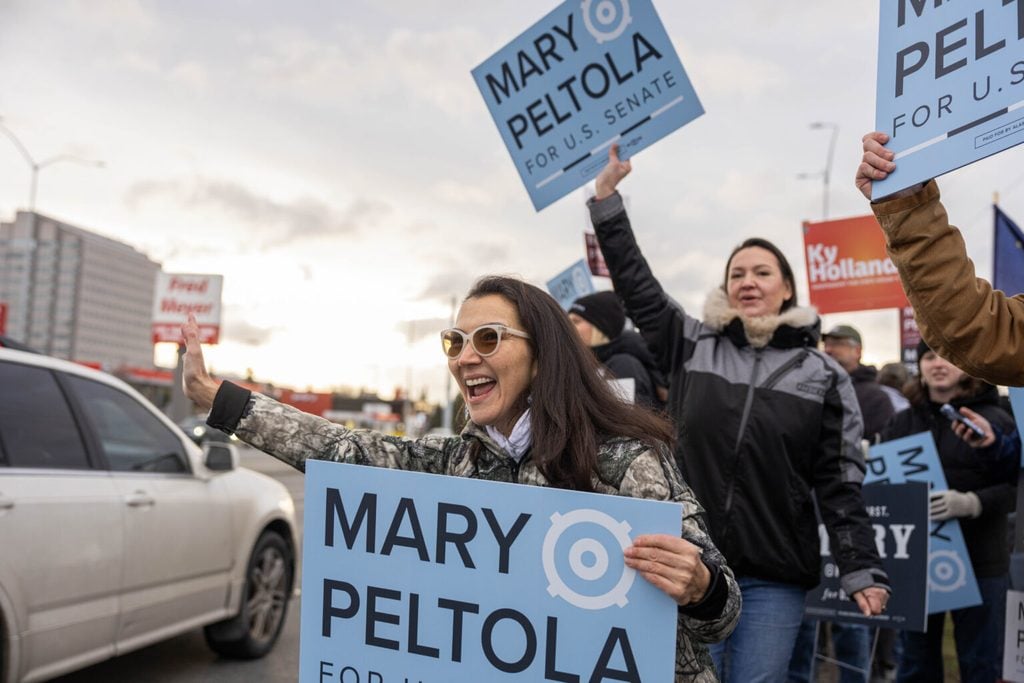
Alaska’s closely watched U.S. Senate race remained too close to call early Wednesday morning as Democratic challenger Mary Peltola led incumbent Republican Dan Sullivan by only a few hundred votes with thousands more remaining to be counted.
The result of the race could extend already-enormous Democratic gains in the Senate or offer a gram of relief to Republicans who endured heavy losses on Election Day.
With 394 of 401 precincts reporting results Tuesday night, Peltola had 48% of voters’ first-choice votes. Sen. Dan S. Sullivan had 47.7%.
“I’m confident when all the votes are counted, I will have the honor of representing you in the United States Senate,” Sullivan told supporters in a speech Tuesday night.
As of 3 a.m. Wednesday, the candidates were separated by just 626 votes out of 213,873 cast.
Independent challenger Dan J. Sullivan had 1.7%, or 3,583 votes, and Republican challenger Gerald Heikes had 2.3%, or 4,821.

Thousands of absentee and early votes cast before Election Day remain uncounted, as do some votes from rural precincts believed to favor Peltola.
“The results are not going to be fast, but Alaskans are patient,” Peltola told supporters at an Election Day rally. “We just want to make sure the folks from the Lower 48 know it won’t be hours. It won’t be days. It will be weeks. It will be weeks. We know this. We know this. This is how it’s always been. This is normal. This is Alaska normal.”
Sullivan’s narrow lead followed a series of Democratic victories in U.S. Senate races across the country Tuesday night. If Peltola prevails, she is expected to be the 55th or 56th Democratic senator in a large Democratic majority. If Sullivan wins, he would be a member of a shrunken Senate Republican caucus that will now be in the minority.
In addition, if Peltola prevails, she and U.S. Sen.-elect Peggy Flanagan, D-Minnesota will be the first female indigenous Senators in American history.
Talking to supporters after polls closed Tuesday, Sullivan thanked his staff, family and volunteers before he lambasted Peltola, alluding to a New York Times article that said she was verbally and physically abusive to staff.
“We are not the kind of campaign office or official congressional office that burns through 25 people in two years … we’re not blowing through 25 people after they get physically and emotionally abused, but I’m digressing. But you know what the hell I’m talking about,” he said.
“We have run a campaign based on our record, and character, and truth, and integrity, and respect for Alaskans, and that’s what Alaskans want,” Sullivan said.

Some Republican officials said before the first results that they would challenge the legality of a Peltola victory, citing a different New York Times article that said Democratic campaigners recruited independent candidate Dan J. Sullivan in an attempt to siphon votes from the incumbent Dan S. Sullivan.
Speaking on Fox News early Tuesday, Attorney General Todd Blanche said he would continue to fight the issue “tooth and nail.”
The U.S. Department of Justice escalated a criminal investigation about the Dan J. Sullivan recruitment on Election Day, sending subpoenas to Democratic campaigners cited in the reporting.
But late Tuesday, President Donald Trump — who ordered civil challenges against Peltola — told the Times he would not challenge the results of the election.
How does Alaska’s election system work?
In Alaska, all candidates for an office run in a single primary election. The four who get the most votes — or everyone, if there are four or fewer candidates — advance to the November general election.
In that election, voters rank the candidates in order of preference.
If a candidate gets at least 50% of the first-preference votes, they win.
If none have 50%, the candidate with the fewest first-choice votes is eliminated. Voters who picked them have their votes go to their second choice.
The eliminations continue until only two candidates are left, and the person with the most votes wins.
“No one from the Lower 48 is going to tell us anything about ourselves or our state. I’m looking out at this room of hundreds of people who are smart people and know exactly who they’re voting for,” Peltola told supporters in a speech after the polls closed.
Peltola’s speech was about 13 minutes long. At one point, she took a selfie with the crowd, many of whom were holding campaign paddles with her face.
She repeatedly stated that she and supporters are part of a broader movement that is immune to Outside influence.
“I see hundreds of people in this room who do not care how much money Elon Musk has put into this race. We do not care. We do not care what Elon Musk thinks,” Peltola said. “We know exactly how we feel. We know exactly what we think. We are standing up. We are fighting back. And it just feels so good to be part of this movement.”