By: Corinne Smith, Alaska Beacon
Alaskans will decide whether to overhaul the state’s elections system with a ballot measure that would repeal ranked choice voting, reinstate closed primaries and repeal campaign disclosure rules established in 2020.
Ballot Measure 2, which will appear on the ballots as 24ESEG, is one of two ballot measures that will appear on the general election ballot in November. Ballot Measure 1, which would impose campaign contribution limits, will be on the primary ballot on Aug. 18.
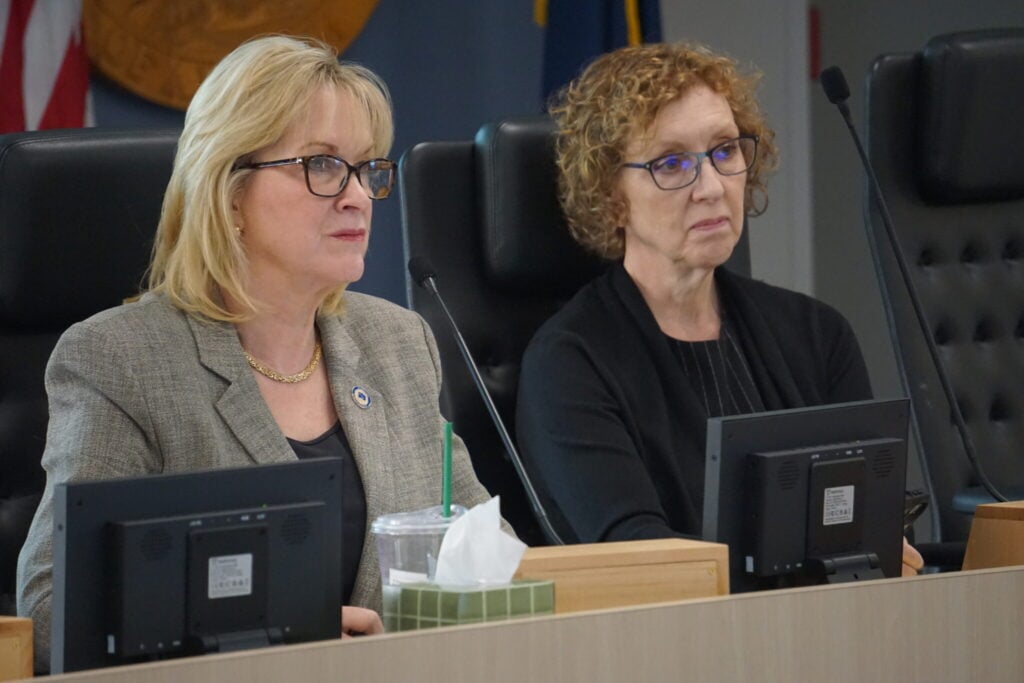
Officials with the Alaska Division of Elections held the first of two public hearings to gather input on the ballot measures Monday, as required by law. Campaign supporters, opponents and Alaskans called in from around the state to the Anchorage Legislative Information Office to share their views at an event chaired by Lt. Gov. Nancy Dahlstrom. A second day of public hearings for public testimony will be held on Aug. 5.
A similar ballot measure to repeal ranked choice voting was voted down in 2024 by 737 votes out of 320,985 cast. Supporters quickly restarted the campaign in 2025 and collected over 34,000 signatures, required to place the issue before Alaska voters again in 2026. The measure’s primary sponsors are Republican gubernatorial candidate Bernadette Wilson, along with Judy Eledge of Anchorage and Ken McCarty of Eagle River.
If approved, Ballot Measure 2 would repeal changes established by a 2020 ballot measure. It would repeal the nonpartisan, open primary system and ranked choice general election.
Currently, Alaska voters of any party affiliation can vote for any candidate in the primary election. If approved, the measure would revert the state’s elections to the closed primary system, where only one candidate from each party advances to the general election, and parties choose who may participate in that party’s vote.
The measure would also repeal some campaign finance disclosure rules. It would repeal limits enacted by the ballot measure passed in 2020 so that individuals and entities who contribute more than $2,000 to candidates or campaigns must disclose the true source, as defined by law. According to the ballot summary from the Division of Elections, the measure would remove spending limits and disclosure rules, including for digital ads, out-of-state donations, undisclosed donations and true source donations. It would also change the definition of “campaign expenditure” and remove some fines for violations.
If passed, the changes would cost the state an estimated $2.6 million to implement, according to the Alaska Public Offices Commission.
Supporters of the ballot measure, called the “Repeal Now” campaign, argue that ranked choice voting is confusing and burdensome to voters, and advocated for returning to the pre-2020 system.
Bethany Marcum, treasurer for Repeal Now, testified at the hearing on Monday, advocating for each voter to have a single vote for a candidate or measure. “Our campaign is about one person, one vote. That’s been the bedrock of the American Republic for the last 250 years,” she said.
Marcum argued ranking choices for candidates is complicated and voters complain about making mistakes. She objected to the tabulation system of counting up to four ranked choices.
If voters do not fill out second, third or fourth candidates, or all their candidates have been eliminated, their ballot is set aside, which Marcum objected to, falsely claiming “ballots were trashed.” But voters’ top choice candidates are counted.
She also blamed ranked choice voting for delaying election results. She said campaign disclosure rules set in 2020 hadn’t prevented “dark money,” or money whose source is secret, from flowing to Alaska, and she said the campaign finance reporting requirements are burdensome to smaller campaigns.
“So, in our opinion, the money overwhelms the disclaimer, and Alaskans recognize this. Smaller campaigns have to spend up to a third more of their money and their ad space on these disclaimers that do nothing to inform the public,” Marcum said.
Opponents of Ballot Measure 2 argue the ranked choice voting system gives voters more choices at the ballot box, and deters extreme partisans while encouraging candidates to appeal to a wider variety of voters. They argued against repealing campaign disclosure rules they say will welcome more Outside, undisclosed “dark money” into Alaska elections.

Scott Kendall testified on behalf of the No on 2 campaign, registered as a group called Protect Alaska’s Elections. He argued the system is not too complicated for voters, and Alaska has implemented ranked choice voting well. He countered that delays in election results are caused by unavoidable delays in the U.S. Postal Service, as nearly a quarter of the state’s precincts must vote by mail.
“The mail system in Alaska is what it is,” he said. “We have to wait for ballots to be brought in from across the state before we can tabulate. Again, that has nothing to do with ranked choice voting, because as those of us who have participated know, the actual tabulation process takes mere seconds. It’s nearly instantaneous.”
Kendall argued repealing campaign disclosure rules would have a larger negative impact on Alaska than repealing open primaries and ranked choice voting.
“Ballot Measure 2 is a bit of a Trojan horse … repealing RCV, that is only a fraction of what the measure does,” he said. “No longer will there be a ban on dark money. In fact, any outside billionaire will be able to give money to another organization, and launder their contributions to that organization. And finally, it lowers or actually removes fines for certain campaign finance misbehavior.”
Kendall also argued returning to closed primaries would give political parties the authority to determine who can vote in their primary elections.
“In a state like Alaska, where two-thirds of all voters do not register with either party, the thought of taking publicly funded elections and allowing the political parties to choke off who can participate in them should be abhorrent,” he said.
Alaskans who called in or testified in person at the hearing on Monday were split, arguing vehemently in support and against the ballot measure.
Several testifiers in support of the measure said ranked choice voting is too complicated.
“We don’t need confusion,” said Mark Spohn, calling in from Willow to testify. “Anytime you have confusion, your elections aren’t as accurate and honest. It’s completely ridiculous. Let’s get rid of the insanity and go back to one person, one vote.”
Testifiers opposing the measure objected to repealing campaign finance disclosures.
Bryan Schroder, a 24-year veteran of the U.S. Coast Guard and former U.S. Attorney in Alaska, urged keeping the current disclosure requirements and ranked choice system to encourage bipartisanship.
“Now, when our candidates campaign, they have to appeal to a majority of voters, not just the hardcore wing of any political party,” he said. “We have a Legislature where more members are willing to work together to do what is best for Alaskans, actively choosing against the do-nothing tribal politics that frustrates so many of us, and as a colleague of mine put it, ‘the workhorses are coming to the front, not the show horses.’”
Several testifiers objected to returning to the closed party system, where voters could have to register with a particular party to vote for their candidate, including Michelle Vasquez of Soldotna. She said that forced her to vote only a Republican ballot, and restricted her from voting for other candidates.
“And that drove me crazy,” she said. “So I was very happy when I changed my party affiliation to unaffiliated like five years ago, so that I could vote however I wished without any confusion or misunderstandings or having to change my voter registration.”
Both the yes and no campaigns criticize each others’ out-of-state funders
Supporters and opponents of the ballot measure criticized each other at the hearing for taking Outside funding from big donors.
Both campaigns have raised large sums of money since 2025, with contributions from out-of-state political action committees, according to public filings with the Alaska Public Offices Commission and Federal Elections Commission.
The “Repeal Now” campaign supporting the measure has raised $1.1 million to date.
The majority of funds, $846,000, have been donated by the Aurora Action Network, a Super PAC based in Wisconsin whose major donors include finance billionaire Jeff Yass of Pennsylvania.
Other Alaska-affiliated contributors to the Aurora Action Network include Jeff Hildebrand, CEO of Hilcorp; John Binkley, trustee of the Alaska Permanent Fund Corp.; Treg Taylor, Republican gubernatorial candidate and former attorney general, and Deena Bishop, state education commissioner, according to FEC filings.
The opposing No on 2 campaign has raised $5.75 million to date.
The campaign’s largest donor is Unite America PAC, Inc — contributing $4 million to date — a Colorado-based venture fund founded by a professor and advocate Charles Whelan, focused on funding elections reforms, in particular creating open, all-candidate primaries. Its biggest donors include Jason Carroll, a New York financier; Kent Thiry, a Colorado philanthropist who co-chairs Unite America; and David Randolph Peeler, an executive with the private equity firm Berkshire Partners.
The campaign has also received $1.5 million from Voters from the American Center, Inc., a Washington D.C. political nonprofit that supports lobbying “to advance democratic participation and strengthen democracy’s core systems,” according to a philanthropic trade outlet, philanthropy.org.