By: Grace Dumas, News of the North
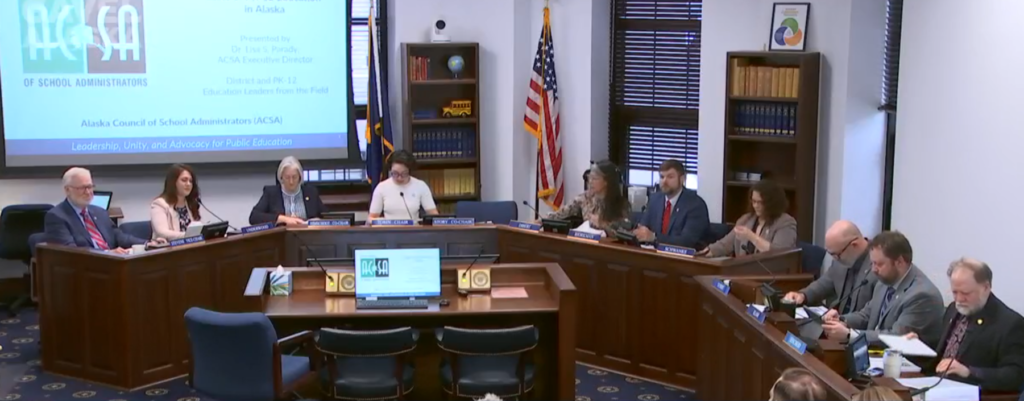
Alaska education leaders told lawmakers Monday, that the state’s public schools are in a “crisis” due to rising vacancies, high teacher and principle turnover and growing student needs, all while enrollment declines.
Testifying before the joint education committee, meaning both the House and the Senate, superintendents, principals, special education directors and recruitment experts described the education system as strained by flat funding.
They stressed housing and visa barriers for teachers, and a growing share of students needing intensive support.
Jennifer Schmitz, director of the Alaska Educator Retention and Recruitment Center, said Alaska’s annual turnover has reached about 30% for teachers and 35% for principals.
“We are in a crisis time right now with teacher turnover and principal turnover,” Schmitz said.
Districts are also depending on hundreds of international teachers and emergency teaching certificates to staff classrooms.
In many districts, she said, international teachers have become deeply rooted in communities and students rely on them for stability.
But new federal visa costs and restrictions, including a potential $100,000 price tag for some H‑1B visas, threaten those positions, especially for rural schools.
“We are in an educational crisis, and we are doing harm to the children of Alaska. An urgent response is needed to address the dire vacancy rates and the need for in person educators and support personnel across Alaskan schools.” Said David Nogg, principle of Goldenview Middle school.
In a separate Senate Labor and Commerce Committee hearing, lawmakers heard similar testimony when discussing Senate Joint Resolution 28, warning that steep federal fee hikes and new placement limits on visa programs are not only worsening worker shortages in schools but tourism and other key industries across the state as well.
“Visa workers are vital to filling Alaska’s diverse workforce. Foreign worker visa programs are extremely useful for highly seasonal industries such as tourism. Alaska has the largest seasonal employment swing in the country, this is not a marginal fluctuation, it is a structural feature of our economy.” Said Mike Mason, legislative assistant to Senator Löki Tobin.
Education leaders also pointed the Base Student Allocation (BSA), saying, even after last year’s increase, inflation has eroded its value.
“All boats rise and fall on the same tide, and for Alaska school districts, that tide is the BSA,” Randy Trani, Superintendent of the Mat-Su district said, calling for “timely, reliable, predictable” funding so districts can plan and focus on academics instead of annual cuts.
School finance officials also stressed that most dollars already go directly to students and there are funding needs beyond the classroom that districts are struggling to meet.
Anchorage budget director and Alaska Association of School Business Officials president Katie Parrott said about 75% of districts’ operating spending in FY2025 went to instruction, while only 2% went to district-level administration and 5% to administrative support like payroll and HR.
“There are a lot of competing priorities eating into these slices of the pie.” She said, “It’s truly imperative that the state does increase and inflation proof funding for pupil transportation as one of the key strategies to address chronic absenteeism, make sure kids are getting to school that they have equitable access.”
Throughout the hearing, educators said they remain committed to students and to Alaska, but warned that constant uncertainty is pushing many out of the profession or out of the state, saying, “when you starve a system, you see the impacts of that.”