By: James Brooks, Alaska Beacon
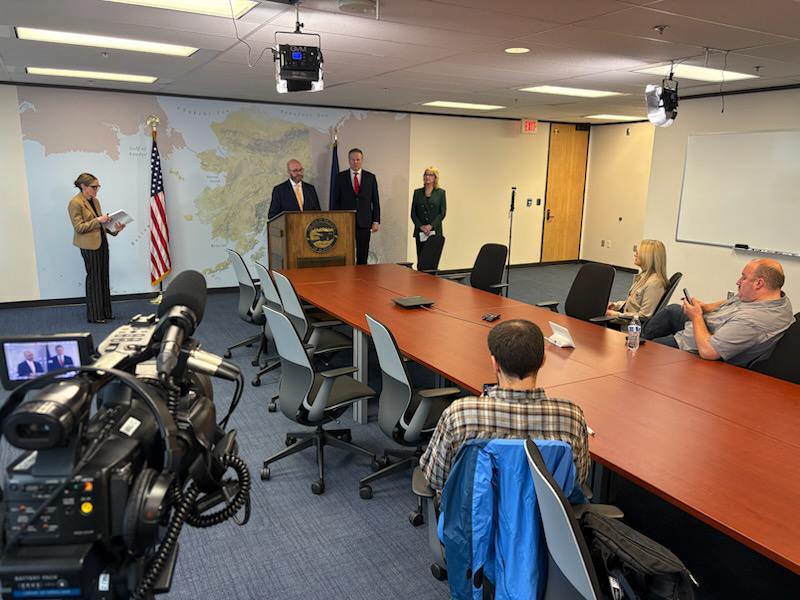
A decision that reversed Alaska Republican governor candidate Treg Taylor’s disqualification was motivated in part by a review that found 91 possible disclosure problems among 121 state-office candidates, Lt. Gov. Nancy Dahlstrom said Monday.
“My decision, I believe, was necessary for the integrity and the orderly administration of the election, and I believe this decision serves the public,” she told reporters during a news conference in Anchorage.
“There’s going to be a lot of people that think there were nefarious things going on. We don’t think so,” said Gov. Mike Dunleavy.
It wasn’t immediately clear whether any of the disclosure problems put candidates at risk of violating state law or if the state would require candidates to fix those problems.
Dahlstrom disqualified Treg Taylor and an Anchorage state House candidate on Aug. 31, following the recommendations of the Alaska Public Offices Commission, which cited flaws in their Public Official Financial Disclosure forms.
APOC is a regulatory agency of the Alaska Department of Administration that oversees campaigns and public officials’ financial disclosures, as well as lobbying activities.
Elected officials, members of state boards and commissions, and the governor’s cabinet, are required to use the POFD to disclose all business dealings worth more than $1,000 in order to discourage corruption.
Taylor, Dunleavy’s former attorney general, and Republican state House candidate Jose Tagle failed to file complete forms within 30 days after they registered as candidates, causing APOC to recommend that they be disqualified from advancing past the August primary.
Dahlstrom followed that recommendation but then reversed herself four days later, restoring Taylor and Tagle to the ballot on Sept. 4.
Rachel Witty, the top civil attorney for the Alaska Department of Law, said during Monday’s news conference that the department had conducted a “limited and expedited” review of other candidates’ POFDs after Taylor’s disqualification in order to judge whether Dahlstrom’s action was legally defensible.
“This was done over the course of a day and a half. So I can’t emphasize enough that this is a preliminary review. We didn’t have time to contact candidates,” she said.
The resulting review found dozens of potential problems, including some with every other finalist candidate for governor — Democratic candidate Jonathan Kreiss-Tomkins, Republican Bernadette Wilson and Republican Dave Bronson.
Wilson and Kreiss-Tomkins’ lieutenant governor candidate, Zac Johnson, were the subject of APOC complaints on Friday about their disclosures, according to the Anchorage Daily News.
APOC had not published the complaints as of Monday evening.
Dahlstrom said she was not aware of those complaints before making the decision to restore Taylor’s candidacy.
Candidates appeared to be surprised by Monday’s disclosure. None of the four candidates for governor responded to questions on Monday afternoon and evening about the issues raised by the Department of Law.
“And just because there are potential discrepancies, that doesn’t mean that those candidates violated the law,” said Stephen Cox, attorney to Gov. Dunleavy.
Cox was appointed as attorney general following Taylor’s departure, but was rejected by the Alaska State Legislature in May.
Cox said he worked with Witty and the Department of Law on the review; the extent of his involvement wasn’t immediately clear.
The Department of Law’s investigation is unusual, if not unprecedented. APOC typically operates on a complaint-based system, with most actions taken when a member of the public alerts the commission to a potential problem.
The agency is chronically underfunded and understaffed. Ten years ago, it had 13 staff; today it has nine, and APOC has struggled at times to fill those positions.
Until last year, Taylor served as attorney general, head of the Department of Law. He’s now running as a Republican for governor, and the decision to both disqualify him and restore him came from a Republican elected official.
Witty said that “unequivocally,” the review “was completely an initiative of the Department of Law as we assess litigation risk.”
When asked whether candidates will be fined or required to correct the potential discrepancies before the general election, Witty said that’s within the jurisdiction of APOC to investigate.
“We don’t know what APOC is going to do,” she said. “If they find there’s reason to believe there is a violation, they can refer that to the APOC commission to take action on, and at that point, we’re talking about different fines and in the form of penalties.”
Moving forward, Dunleavy said, he intends to recommend that the next governor and next Legislature review APOC laws and regulations with a group of former elected officials.
“That’s something that I’ve been thinking about quite honestly for some time, and this just kind of hits home that it’s long overdue,” he said.